Artigo
3 minutos de leitura
What 'internship' actually means around the world

Author
Lauren Thomas
Published
April 14, 2026


Internship season will soon be upon us. As someone with three degrees from three countries, I’ve seen firsthand that the term ‘intern’ is far from universal. In some places, it’s a short-term summer trial; in others, it’s six months to a year of intensive work designed to transition students directly into full-time roles.
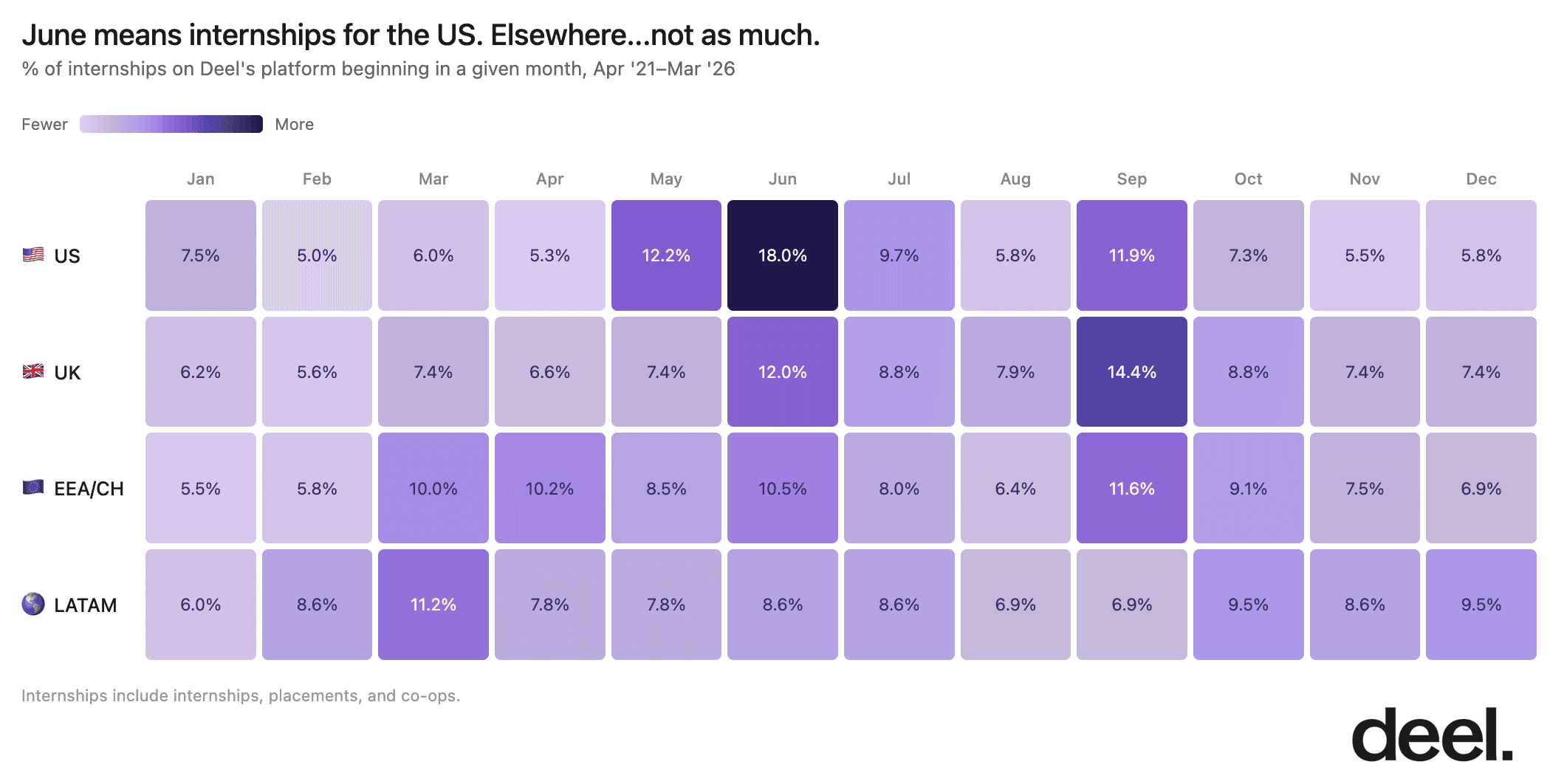
Our data underscores the diversity of internships across the world. First up…when do they start? June is by far the most common month for interns in the U.S. to begin, with May and September next. This shows that internships in the U.S. are heavily tethered to the summer term in the university academic calendar.
Outside the U.S., this summer-centric pattern is less common. In the U.K., the most common month to start an internship is actually September – a month when many interns begin their year-long placement, which substitutes for an academic year, rather than complementing it during the summer. Summer internships also exist in the U.K., but British universities tend to finish their academic years later than American ones, meaning June, not May, is the second most common month for an internship to begin.
European internship cycles are intrinsically linked to the university calendar, with start dates concentrated in September, March, April, and May. In Latin America, internships most commonly begin in March, which is the start of autumn in the Southern Hemisphere and often the beginning of the academic year for universities.
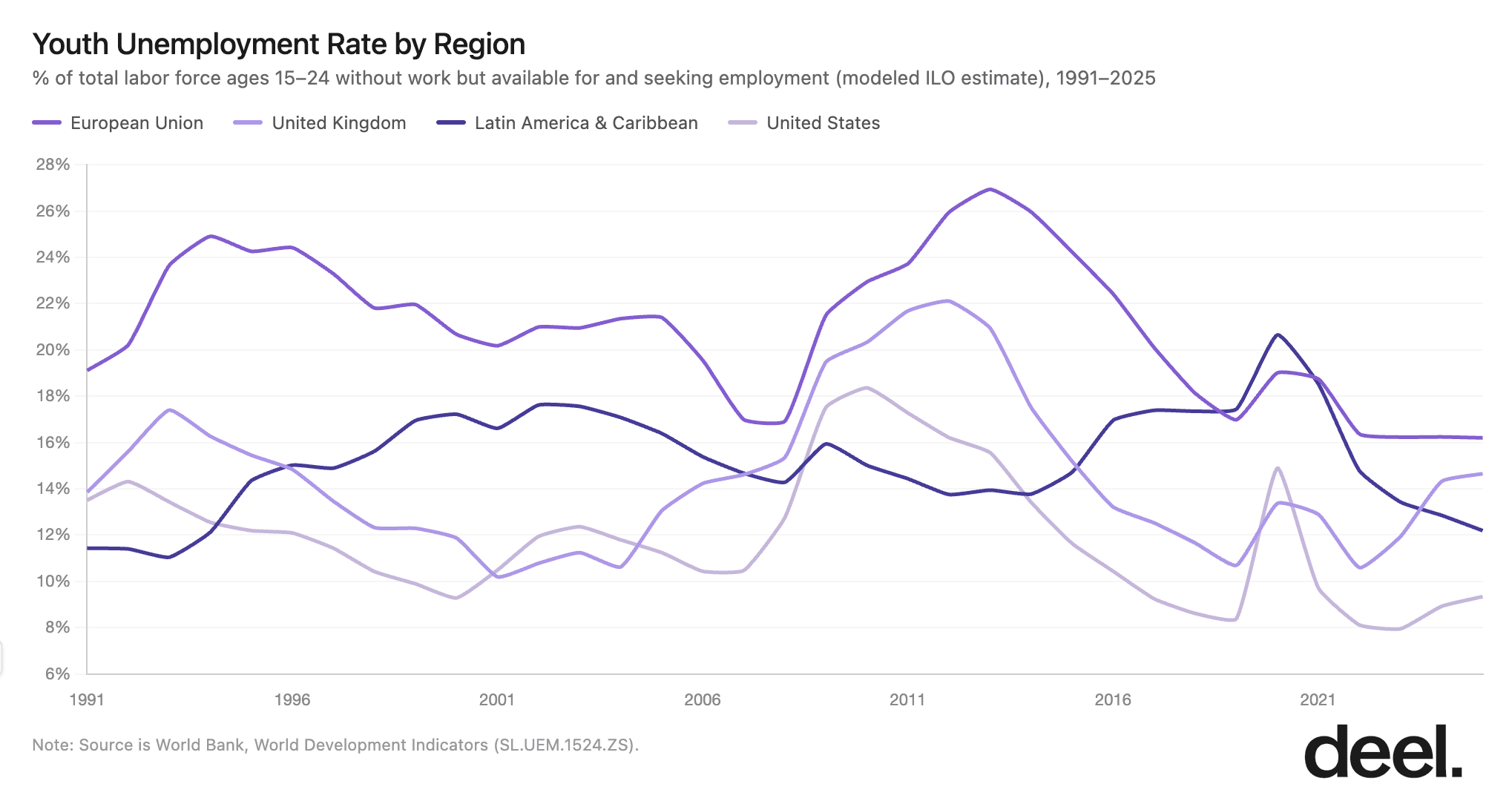
The U.S. conception of internships as a short-term summer taster isn’t universal. In places with higher youth unemployment, like Latin America and the EU, internships function less as a short-term workplace taster and more as a direct transition to a full-time, longer-term role.
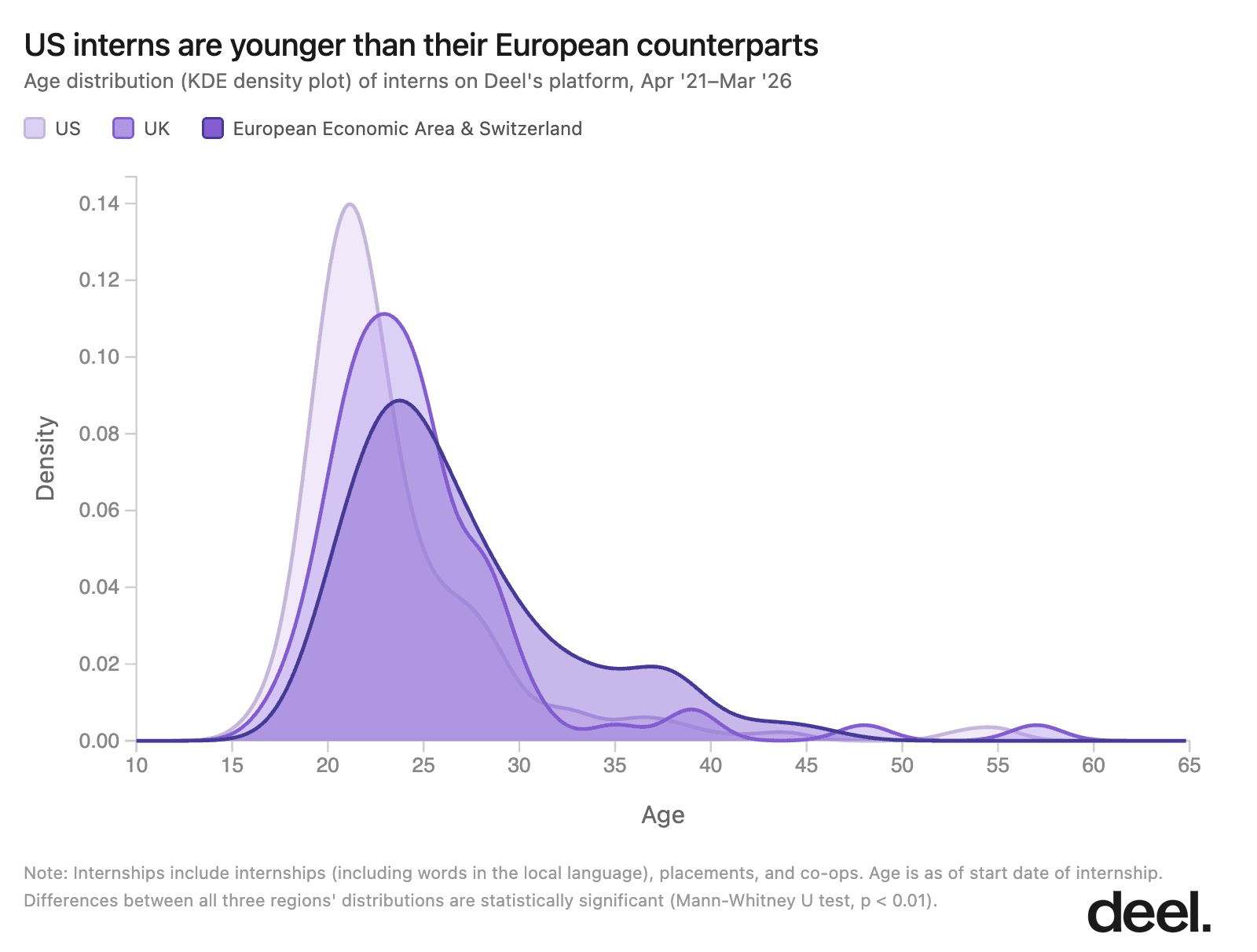
We can see this pattern reflected in both our age and internship length data. U.S. interns, with a median age of 22, are younger than their counterparts in the U.K. and Europe, who are often completing internships later in university. Interns in the U.K. have a median age of 24, versus 25 in Latin America and 26 in the European Economic Area and Switzerland – a statistically significant difference from the U.S.1
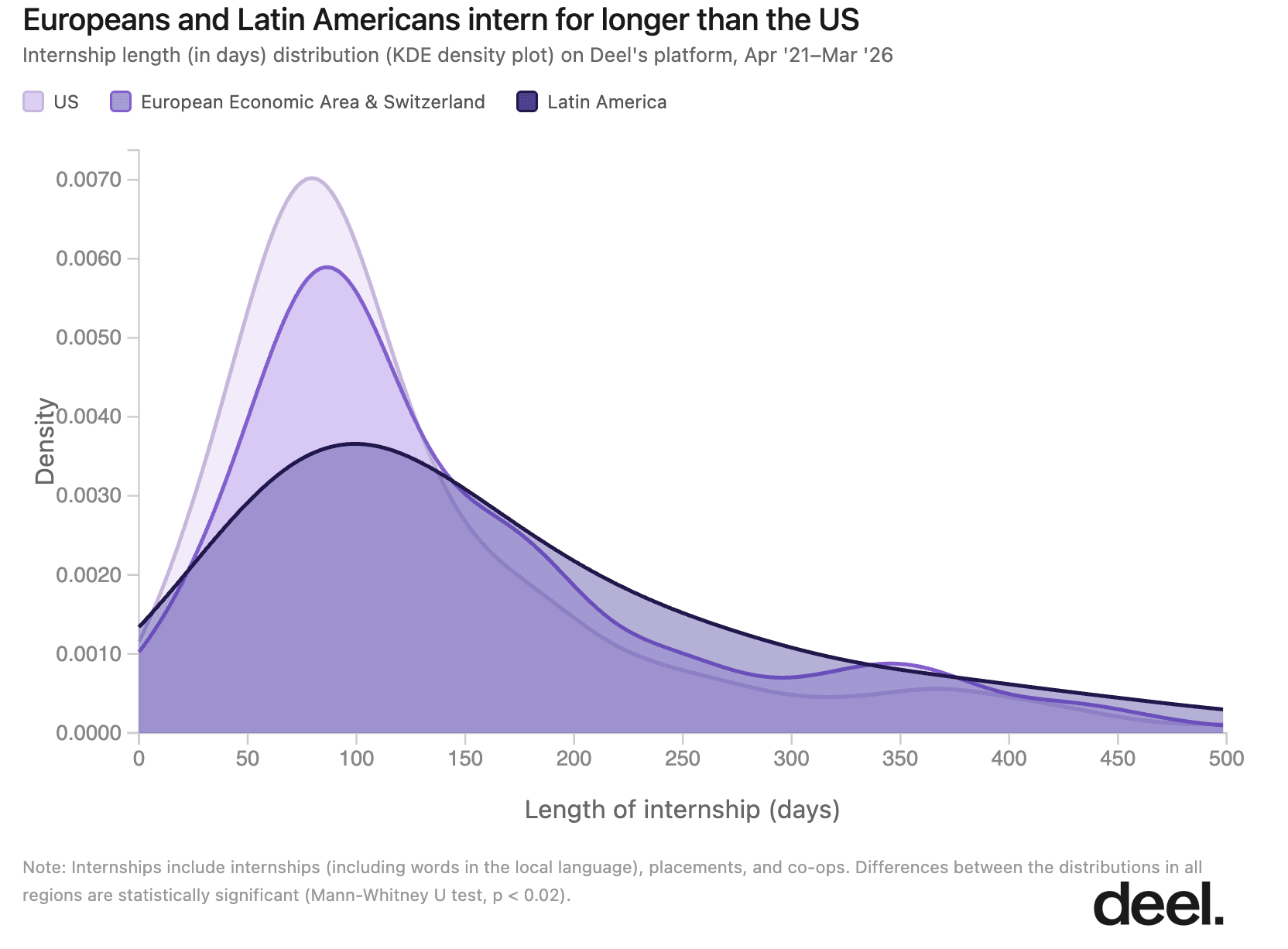
In the U.K., internships are often year-long “placements,” and European internships are more likely to be six months than six weeks. We can see this in our own data: the number of days between an intern’s start and finish date is shorter in the U.S. than in the EEA or Latin America. American internships have a median of 93 days, significantly shorter than the 106-day median in the EEA, 120-day median in the U.K., and 145-day median in Latin America.
Footnotes
-
A Mann-Whitney U test was used to test differences in distributions in both internship age and internship length across all regions. In all cases shown in the charts, differences in distribution were statistically significant (p < 0.01 for the age chart and p < 0.02 for the length of internship chart). ↩
Lauren Thomas is Deel's founding Economist, where she’s helping to bring Deel’s mission of breaking down geographic barriers to opportunity to life through data — a mission that resonates personally, as she's worked and studied in six cities across three countries!
Before joining Deel, Lauren worked in economic research and data storytelling at the Federal Reserve Bank of New York, Glassdoor, and Stripe. She has degrees in economics and data science from Oxford, Université Lumière Lyon 2, and Northwestern University.
Outside of work, she enjoys reading, playing volleyball, climbing, sewing her own clothes, and using Oxford commas. She does not enjoy long flights but takes a lot of them anyway!