
Guide
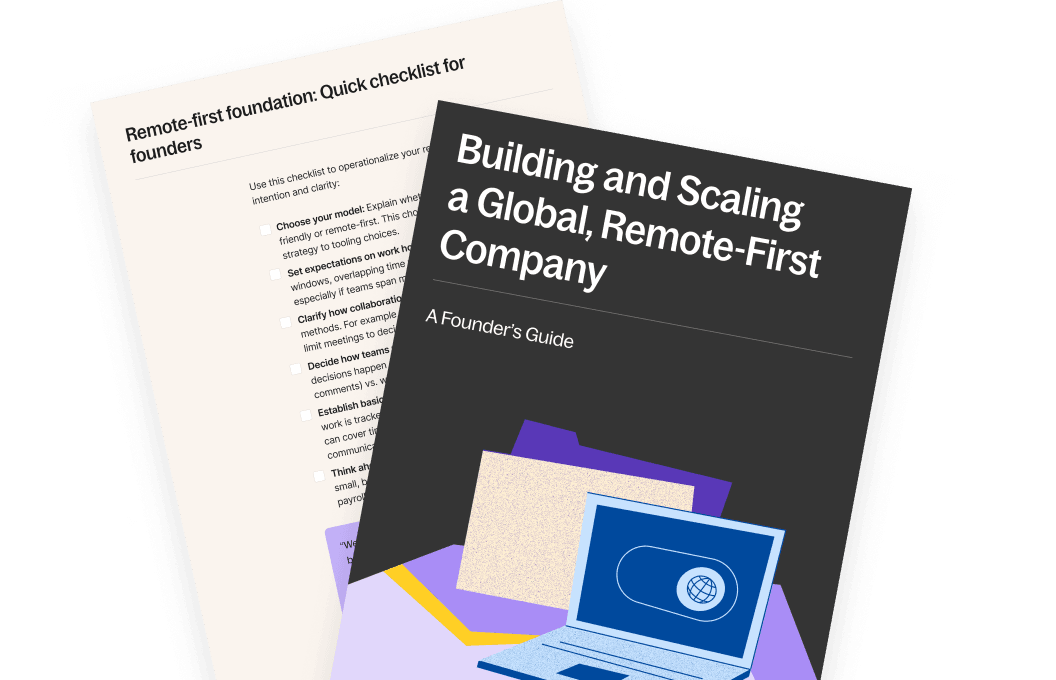
A Founder’s Guide to Building and Scaling a Global, Remote-First Company
Global expansion
Global HR
Get the resource for free
Founders today have more opportunity and more complexity than ever before. With the right infrastructure, you can hire, pay, and manage workers anywhere in the world. However, questions around compliance, compensation, equity, and culture can make scaling globally feel overwhelming.
This guide walks founders through the end-to-end journey of building a remote-first company. From choosing where to hire to managing payroll and cultivating culture, it’s a roadmap to growing a global team with confidence.
Guide overview
This guide gives founders a step-by-step playbook for building and scaling a remote-first company with confidence, from hiring their first global employee to managing a thriving international team.
The guide covers the following themes:
- Global hiring made simple: How to decide where to hire, which roles to prioritize, and the structures (subsidiary, EOR, contractor, etc.) that fit your stage
- Compliance without the chaos: What every founder needs to know about labor laws, payroll, and tax considerations when scaling internationally
- Compensation and equity done right: Strategies for setting fair global salaries, granting stock options, and rewarding your team consistently
- Making offers that win talent: How to compete for the best candidates worldwide while staying compliant and cost-efficient
- Paying your team (and yourself): The nuts and bolts of running international payroll, benefits, and founder compensation with confidence
- Your HR tech foundation: Tools and systems that keep remote-first operations lean, scalable, and future-ready
- Culture and communication: Proven practices for building trust, alignment, and engagement across time zones.
Key challenges founders face when scaling globally
Scaling a company across borders comes with endless questions and challenges:
- Where to hire: Which markets offer the right talent while keeping costs manageable?
- Compliance risk: How do you stay ahead of tax laws, labor rules, and misclassification penalties?
- Compensation and equity: How do you set fair, competitive packages that scale globally?
- Team building and culture: How do you keep a distributed workforce engaged, aligned, and productive?
- Paying teams: What’s the most efficient, compliant way to pay people—and yourself—as the company grows?
This guide helps you navigate these challenges step by step, with practical insights and resources that founders can put into practice immediately.
Who is this guide for
This guide is designed for:
- Early-stage founders ready to expand beyond their first market
- Startup leaders who want to hire international top talent but aren’t sure where to start
- Scaling CEOs balancing growth with compliance, payroll, and culture
- Founders of remote-first companies who want to sustain productivity and cohesion across borders
Unlock practical strategies to expand internationally and lead a thriving remote-first company. Download the guide now.
FAQs
What is global scaling?
Global scaling means expanding a company’s operations—sales, hiring, support, and delivery—into international markets without replicating its headquarters everywhere. Smart scaling leverages tech and partners to avoid entity overload.
What is the aim of scaling an organization globally?
Scaling an organization globally aims to unlock new revenue, talent pools, and operational leverage, without bloating headcount or overhead. It’s about compounding growth, not just adding headcount.
What were the biggest keys to being a successful remote company?
The biggest keys to being a successful remote company:
- Intentional hiring (bias toward autonomy and written communication)
- Over-communication of vision and decisions to align remote workers
- Solid ops—reliable payroll, compliance, and IT from day one
- Leadership visibility—founders show up consistently, even async
What are the hidden costs or scaling bottlenecks with remote-first operations?
Some of the hidden costs or scaling bottlenecks with remote-first operations include:
- Tax exposure from misclassified contractors or “permanent establishment” risk
- HR fragmentation (different HR tools per region)
- Delays from slow onboarding processes
- Time zone friction and cultural misalignment
- Leadership debt from unclear decision ownership
How can global teams develop good teamwork when working remotely?
To develop good teamwork when working remotely, build default systems for clarity and connection: shared OKRs, async updates, recurring 1:1s, and rituals that reinforce team identity. Good teamwork is structured, not spontaneous, in remote-first environments.
What is the key to keeping virtual team members working effectively together?
Cadence and context are key to keeping virtual teams working effectively together. Weekly async standups and structured check-ins prevent drift. Document everything: decisions, expectations, ownership, so no one’s blocked by distance or time zones.
How can founders maintain culture and performance with distributed teams across time zones?
To maintain culture and performance, codify your company culture in writing and reinforce it through rituals that connect people beyond geography. Pair that with a performance system built on clear OKRs, transparent dashboards, and fast feedback loops. The balance is simple: culture builds trust, performance systems enforce accountability. Together, they keep remote teams engaged and executing.
What should founders avoid when managing global teams?
Some of the most important things to avoid when managing globally distributed teams are:
- Don’t rely on culture alone. Camaraderie without clear goals leads to friendly but underperforming teams
- Don’t micromanage performance. Forcing constant check-ins kills trust and burns out global teams
- Don’t chase synchronous work. Expecting everyone online at the same time ignores time zone realities and slows delivery
How do you collaborate effectively with remote employees?
To collaborate effectively with remote employees, use a bias-for-action culture and tools that reduce friction, such as Slack, Notion, Loom, and Figma. Prioritize written clarity and short video walkthroughs over chaotic meetings.
How can founders balance speed of hiring with legal and tax compliance across borders?
To balance speed of hiring with legal and tax compliance across borders, use EOR (Employer of Record) platforms in the early stages. Once headcount stabilizes in a market, consider entity setup.
Don’t DIY compliance; delegate it to partners who’ve scaled this before. This solution is perfect for founders looking to scale a remote-first company without worrying about international labor laws.
What’s the simplest tech stack for a lean remote-first operation?
The simplest tech stack for a lean, fully remote operation contains:
- Slack for comms
- Notion for docs + wiki
- Gmail/GSuite as the core infrastructure
- Deel for global hiring, payroll, and ensuring compliance
- Loom for video async updates
- Linear or Asana for task/project tracking
- 1Password + Okta for security + access control
Lean ops means fewer tools, better integrations, and clear documentation.
More resources
- A Founder’s Guide to Building and Scaling a Global, Remote-First Company
- Scaling with Deel: A Founder’s Guide to Building a Global Team, Stage by Stage
- What CEOs Get Wrong About HR, and How It Costs Them Growth
- Winning in the AI Era: 5 Shifts for Leading Founders
- The Complete Guide to Using Deel for Your Startup
- When Should Founders Invest in HR? A Framework for Scaling People Operations (webinar)
- Surprising Work From Home Productivity Facts