Article
9 min read
Labor market roundup: January 2026

Author
Lauren Thomas
Published
January 20, 2026


I’m starting something new: reviewing the U.S. and U.K. labor market data that gets released each month and pairing with a monthly roundup of recent labor economics/economics of AI posts that I found interesting. The U.S. usually releases its Job Openings & Labor Turnover and Employment Situation results in the first week, and the U.K. its labor market overview in the third week of each month, so posts will likely come out the third week of each month.
It’s remarkable how similar the situations are across the Atlantic. Both countries are seeing a low-hire, low-fire market. This means life is difficult for new grads, the already unemployed, or those seeking new jobs, but we’re seeing nowhere near the heights of unemployment that marked the Great Financial Crisis of the early 2010s or the Covid crisis in 2020. The ‘vibe-cession’ isn’t going away anytime soon.
U.S.
The U.S. released its first JOLTs and Employment Situation reports in the first full week of January.
The U.S. is in an ahistoric labor market: unemployment has been creeping up steadily since April 2023, but it hasn’t entered a recession. That is completely unprecedented: such a long period of rising unemployment has always been accompanied by a recession (at least in the past seven decades since we began collecting this data!).
If you're looking for a new job right now, it's not a great time: the new-hire rate (3.2%) is as bad as it was in 2010. But the number of layoffs (1.69 million in November, down from 1.85 million in October) looks more like 2015, when the job market was consistently getting better. Job openings declined to 7,146,000 in November, a fall from 7,449,000 in October.
Unemployment in December has held steady at 4.4%, relieving some worries that it would continue to creep upwards. Job gains (up by 50,000 in December) were driven by food services, health care, and social assistance, whereas retail trade has lost jobs. Expect to see healthcare and social assistance continuing to drive what job gains the U.S. sees in 2026: it’s one of the few bright spots in the economy right now.
U.K.
The first U.K. job market report of the year, which came out today, has set the scene for 2026. Unfortunately, there’s not much good news in it. All signs point to a steadily deteriorating job market. While the labor market remained relatively flat between December and January, the year-over-year decline is unmistakable.
In a spot of good news, quarter-on-quarter vacancies increased slightly, up 10,000 in 2025Q4 from the previous quarter. But they’re flat on the year, and growth in inflation-adjusted regular pay is hovering just above zero, thanks to persistently high inflation. Even though nominal earnings are growing at a much faster rate than they were pre-Covid, relatively high inflation means that workers aren’t feeling the benefit of these increases.
Unemployment rates have risen (up to 5.1% from 4.4% from a year ago) on the back of higher involuntary redundancies, up to 4.9 per thousand employees (from 3.8 per 1000 employees a year ago). The latter is worth keeping an eye on; though involuntary redundancies dropped from last month’s report and remain below their heights in the Great Recession, they’ve been steadily increasing for the past few years.
While economic inactivity on the whole is trending back down towards pre-pandemic levels, those sidelined by long-term illnesses remain on the rise. The 6.5% of working age adults who are economically inactive due to these conditions may be below the record 6.7% reported in Spring 2024, but it remains above the 5.1% seen before Covid.
Interestingly, the longer-term rise in economic inactivity due to illness is being masked by a fall in those out of the labor force due to looking after their family or home. In the early 2010s, this was as high as 2.3 million people; it dropped to 1.80 million in Jan-March 2022 and has dropped further to 1.56 million in the latest release. It’s hard to say what’s causing this without further investigation, though a few possibilities come to mind: the longer-term effect could be a result of low growth in real-term wages or a change in generational norms, while the short-term effect could be linked to the sudden increase in cost of living over the past three years.
Data deep dive
As part of this new series, I’ll be sharing a data deep dive. This month’s data comes from Deel’s platform, where I pulled our new hires data and ran it through a seasonal decomposition to isolate the seasonal trend of start dates.
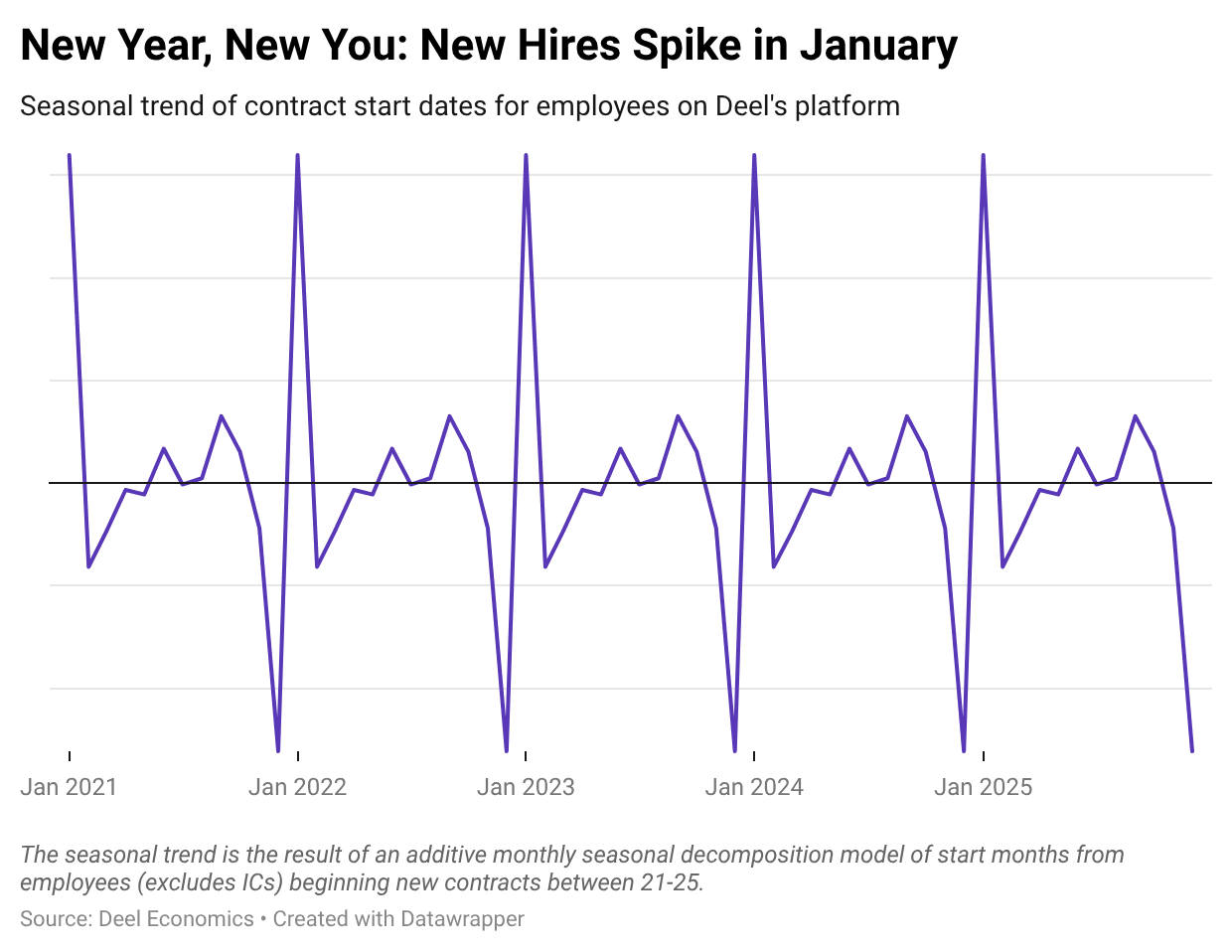
January sees a huge spike in start dates. The post-January lull is followed by a slow and steady rise through to September and then a big drop-off in Q4. So you are looking for a change - now is the time to do it!
I also analyzed the most common days of the week to start and end jobs. Unsurprisingly, start dates were most common on Mondays, followed by the rest of the week in decreasing order.
The more fun data came from end dates -- although Fridays were the most common, Wednesdays were a surprising second. Perhaps people are trying to take a long weekend before starting their next job?
Recent labor economics & economics of AI roundup
Below are a sampling of interesting papers and posts on the labor market that I’ve read recently.
Looking for the Ladder, Zanna Iscenko (AI & Economy Lead, Google) and Fabien Curto Millet (Chief Economist, Google)
Summary: Is AI really displacing young workers? Popular opinion and a high-profile study (Canaries in the Coal Mine) have suggested that AI has already negatively impacted employment prospects amongst the young (22-25) in “AI-exposed” jobs. Zanna and Fabien argue that most of the downturn in employment prospects are a natural consequence of the low-hire, low-fire economy brought on by the high inflation and base rate increases in 2022, pointing out that the decline in employment prospects started in Spring 2022, six months before ChatGPT existed.
Note: Personally, I agree with Zanna and Fabien, having been an extremely early adopter (earliest 0.1% of users according to my 2025 ChatGPT Wrapped). Though AI has seen unprecedented adoption amongst the public, it’s hard to believe that within six months of ChatGPT’s release, enterprises had successfully integrated AI enough to replace entry-level workers.
I’d love to see more research on this topic covering 1. How AI spending directly affects employment in ‘AI-exposed’ jobs; and 2. rather than looking at employment by age, how this picture changes when you look at employment by seniority of job role. The natural consequences of the low-hire, high-interest economy might show up as a seemingly disproportionate employment impact on the young in interest-rate-exposed jobs, but the promotions impact should be similar across age cohorts if promotions have slowed down and the interest-rate hypothesis is accurate.
There Are No New Ideas in AI…only New Datasets, Jack Morris (Cornell)
Summary: Most of the recent breakthroughs in AI have come off the back of four major developments: deep neural networks, transformers & LLMs, reinforcement learning from human feedback (human in the loop), and “reasoning.” Most of these underlying mechanisms existed 30 years ago, but each of them allowed us to learn from a new data source that unlocked massive new capabilities. What could be the next set of data that will lead to a major breakthrough?
Anthropic Economic Index report: economics primitives, Anthropic Economics Team
Summary: The Anthropic Economics team regularly analyzes Claude data to see how AI usage is spreading across the world. In this report, they find that Claude usage continues to be globally uneven and concentrated on certain tasks (coding) and introduce economic primitives: measures that show how Claude is used by both consumers and firms. Interestingly, Claude’s usage diversifies with higher adoption and income and is less successful on more complex tasks, meaning that ‘AI exposure’ varies for jobs once you factor success rate in. That is, while some jobs might be very easily moved out of the physical world into the virtual one, Claude isn’t very good at automating the day-to-day work in that job.
How Adaptable are American Workers to AI-Induced Job Displacement, Sam J Manning and Tomas Aguirre (Centre for the Governance of AI)
Abstract: We construct an occupation-level adaptive capacity index that measures a set of worker characteristics relevant for navigating job transitions if displaced, covering 356 occupations that represent 95.9% of the U.S. workforce. We find that AI exposure and adaptive capacity are positively correlated: many occupations highly exposed to AI contain workers with relatively strong means to manage a job transition. Of the 37.1 million workers in the top quartile of AI exposure, 26.5 million are in occupations that also have above-median adaptive capacity, leaving them comparatively well-equipped to handle job transitions if displacement occurs. At the same time, 6.1 million workers (4.2% of the workforce in our sample) work in occupations that are both highly exposed and where workers have low expected adaptive capacity. These workers are concentrated in clerical and administrative roles. Importantly, AI exposure reflects potential changes to work tasks, not inevitable displacement; only some of the changes brought on by AI will result in job loss. By distinguishing between highly exposed workers with relatively strong means to adjust and those with limited adaptive capacity, our analysis shows that exposure measures alone can obscure both areas of resilience to technological change and concentrated pockets of elevated vulnerability if displacement were to occur.
Unwilling to Reskill? Experimental Evidence from Real-World Jobseekers, Alexia Delfino et al
Abstract: We study barriers preventing jobseekers from pursuing reskilling in high-demand occupations. Using a discrete choice experiment, we quantify the demand for reskilling among Italian jobseekers in two white-collar high-demand occupations—information technology assistant and construction technician—and identify its main determinants. Willingness to pay estimates show that participants are willing to pay to reskill into IT, but would require compensation to reskill into construction. Beliefs about monetary returns and social status help explain differences in reskilling demand, but perceived identity fit in the target occupation emerges as the most important individual-level factor shaping reskilling decisions. A light-touch randomized information intervention providing data on occupational returns significantly increases both stated interest in reskilling and actual engagement in real-world training.
Technological Advance and Labor Demand: Evidence from Two Centuries, Huben Liu et al
Abstract: We use recent advances in natural language processing and large language models to construct novel measures of technology exposure for workers that span almost two centuries. Combining our measures with Census data on occupation employment, we show that technological progress over the 20th century has led to economically meaningful shifts in labor demand across occupations: it has consistently increased demand for occupations with higher education requirements, occupations that pay higher wages, and occupations with a greater fraction of female workers. Using these insights and a calibrated model, we then explore different scenarios for how advances in artificial intelligence (AI) are likely to impact employment trends in the medium run. The model predicts a reversal of past trends, with AI favoring occupations that are lower-educated, lower-paid, and more male-dominated.
Lauren Thomas is Deel's founding Economist, where she’s helping to bring Deel’s mission of breaking down geographic barriers to opportunity to life through data — a mission that resonates personally, as she's worked and studied in six cities across three countries!
Before joining Deel, Lauren worked in economic research and data storytelling at the Federal Reserve Bank of New York, Glassdoor, and Stripe. She has degrees in economics and data science from Oxford, Université Lumière Lyon 2, and Northwestern University.
Outside of work, she enjoys reading, playing volleyball, climbing, sewing her own clothes, and using Oxford commas. She does not enjoy long flights but takes a lot of them anyway!