Artikel
4 min read
Labo(u)r market roundup: April 2026

Author
Lauren Thomas
Published
April 24, 2026


U.S.
The BLS JOLTS and the Employment Situation, released earlier this month, showed little change from the previous month.
The number of job openings in February was little changed at 6.9 million. While they haven’t changed very much for the past year, the fact that they haven't dropped after rapid year-on-year declines between 2022 and 2025 is probably good news.
On the positive side, layoffs and involuntary separations have not increased – the number stayed steady at 1.7 million and 1.1%. But both hires and quits in February have declined from January (to 3.1 percent and 1.9 percent, respectively) – no surprise, as the two are closely related. The 3.1% hires rate is the lowest since April of 2020, and lower than it was during most of the 2010s post-Great Financial Crisis recovery. Even in the weak job market of 2011, the hires rate typically exceeded 3.2%.
Similarly, March’s unemployment (at 4.3%) and labor force participation rate (at 61.9%) were broadly unchanged over the month and the year. 178,000 jobs were added, with healthcare (unsurprisingly) driving most of the gains – but 20% came from physicians returning after a strike, not new positions. Construction, transportation/warehousing, and social assistance made up the rest of the gains, with finance & insurance and federal government employment accounting for most of the losses.
Many of these industry results reflect medium-term trends: healthcare and social assistance will continue to grow, driven by an ageing population and by the dynamic whereby rising productivity elsewhere in the economy causes labour-intensive sectors like healthcare to absorb an ever-larger share of employment and spending. On the other hand, government employment is unlikely to return to its pre-election norms anytime soon.
U.K.
The U.K. ONS released its monthly labour market overview earlier this week. Vacancies have dropped for the first time in nearly a year. I’d previously identified the flatness of vacancies as a potential sign of hope for the U.K. job market. A single quarter doesn’t make a trend, but hopefully this won’t be the start of one. Job vacancies are a leading indicator, particularly for new or re-entrants into the low-hire, low-fire labour market in which we now find ourselves. They began dropping in mid-2022, before unemployment began rising.
Overall unemployment, which comes from the Labour Force Survey (LFS), is down on the quarter - a pattern repeated in every age group. However, similarly to vacancies, we’ll have to wait and see if this pattern continues, as unemployment is still up from last year at this time and the number of payrolled employees in HMRC data - a very high-accuracy signal - has continued to fall. The seeming discrepancy could have occurred for several reasons: payrolled employee data only contains employees, so it doesn’t measure the number of self-employed or those who dropped out of the labour force; it’s monthly, whereas the LFS data is quarterly; and as administrative data, it’s a more real-time, high-accuracy signal than the survey-based LFS data is.
Unemployment amongst those aged 16-17 is the highest of any age group, at 28.8% in the most recent ONS survey, an increase of 20% from two years. But even though 18-24-year-olds have lower unemployment rates (14.3%), their unemployment growth has been higher, with 29% growth in unemployment rates from two years ago, which is the highest growth rate of any age group.
The share of those aged 16-17 in full-time education with a part-time job has fallen precipitously over the last few years, from a high of 28.9% in early 2023 to about 19.1%. This is likely because the job market had been extremely tight in 2022, which allowed young people more opportunities to find work that they wouldn't have previously been able to.
The share of those aged 18-24 who are in full-time education and are employed part-time has actually increased in the past few years. The increase in overall unemployment in this group is driven entirely by those who are not in full-time education.
One side note: buried midway down the page was an exciting update (or at least, exciting to me): the ONS, which has faced a lot of questions in recent years around the accuracy and reliability of its LFS data, is finally reporting household response levels similar to its pre-pandemic norms. However, significant challenges remain. If you’re interested in this topic, I’ve written a deep dive on the LFS data quality here.
Data deep dive
This month’s data is an update of a chart I shared in February’s Labo(u)r Market Roundup. I updated our job-hopping – voluntarily leaving a job for another job – data for employees in the US by age bracket through Q1 of 2026. This is reflective of, but not identical to, the quit rate. Most people leave their job for another job, but that's not always true. We’re also able to zoom in on certain age groups.
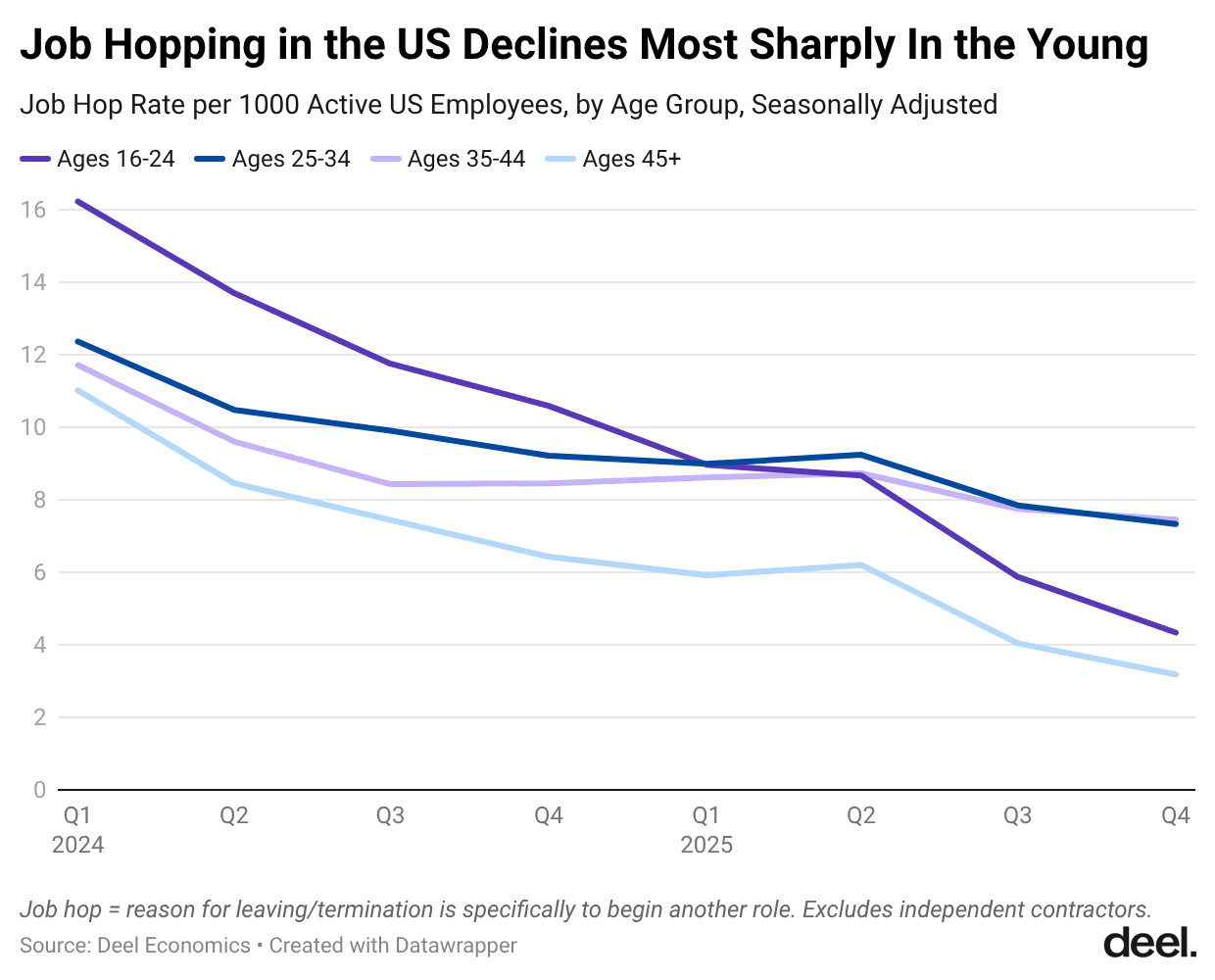
Job hopping is either steady or has declined slightly, depending on the age: for the youngest in our sample, job hopping has continued to fall. For 25-44, it has stayed steady. For those over 45, it has declined slightly.
This is important: we know the youngest usually fare particularly poorly in a low-hire, low-fire labor market -- since they're just entering the labor market, they don't have a job to hold onto, unlike older workers. But this data suggests that even those under 24s on Deel's platform with a job are finding it a lot harder to get a new one.
Lauren Thomas is Deel's founding Economist, where she’s helping to bring Deel’s mission of breaking down geographic barriers to opportunity to life through data — a mission that resonates personally, as she's worked and studied in six cities across three countries!
Before joining Deel, Lauren worked in economic research and data storytelling at the Federal Reserve Bank of New York, Glassdoor, and Stripe. She has degrees in economics and data science from Oxford, Université Lumière Lyon 2, and Northwestern University.
Outside of work, she enjoys reading, playing volleyball, climbing, sewing her own clothes, and using Oxford commas. She does not enjoy long flights but takes a lot of them anyway!