Article
8 min read
Boomerang hires are becoming one of the fastest-growing hiring categories

Author
Kim Cunningham
Published
July 22, 2026


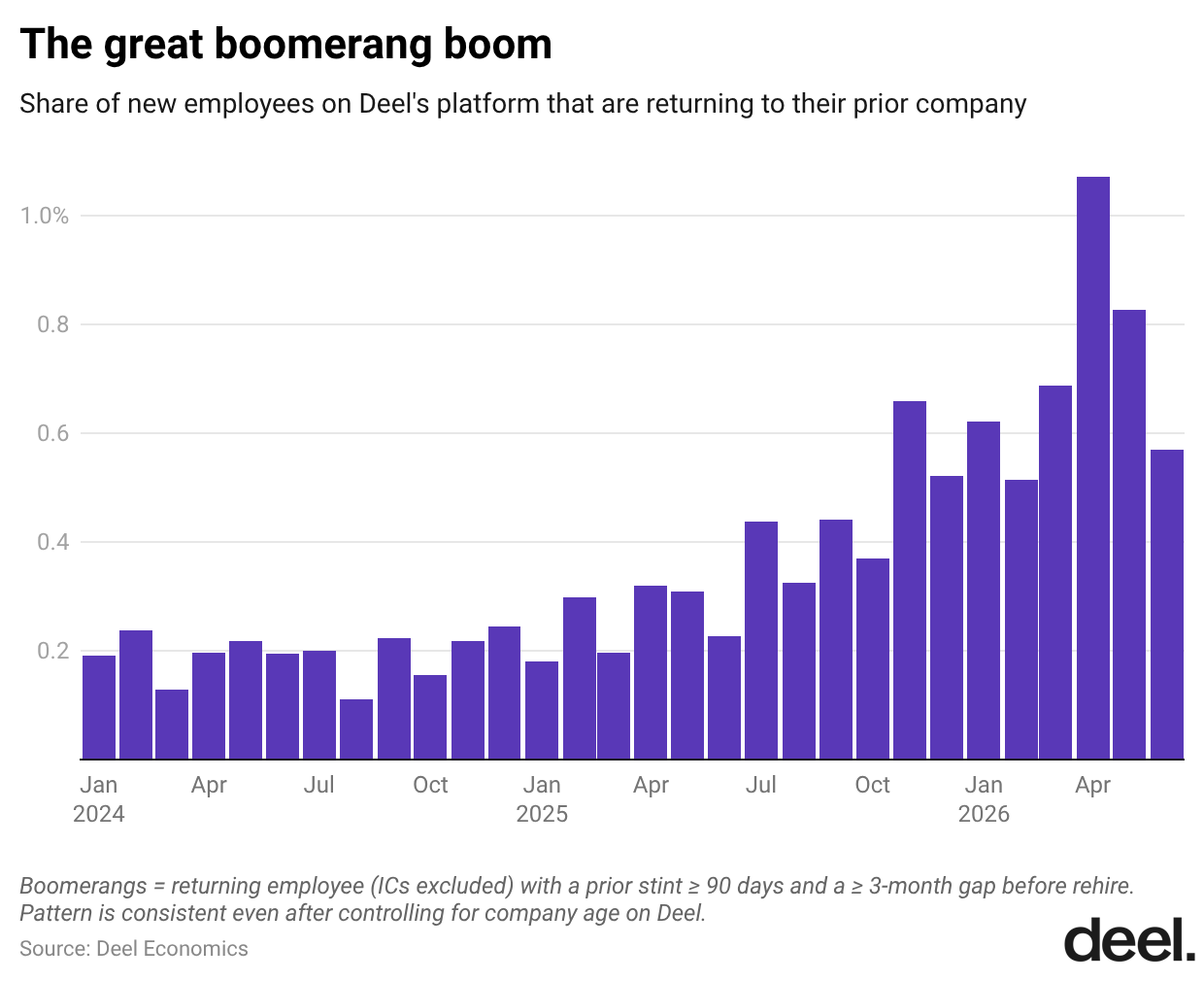
Boomerang employees, workers rehired by former employers, have become one of the fastest-growing categories of new hires in the current labor market. The share of new starters at global employers who returned to a prior employer has climbed from between 0.1 and 0.3% two years ago to between 0.6 and 1.1% today, according to an analysis of Deel platform data by chief economist Lauren Thomas. At Deel itself, boomerang rehires more than doubled year-over-year between 2024 and 2026 and now represent 1.1% of all hires in the last twelve months, with payroll and sales roles dominating the returning population.
The absolute numbers are small, but the direction is unmistakable. In a labor market where external hiring has stalled and internal promotion has slowed, boomerangs are one of the few hiring categories that keep growing. Career and executive coach Dr. Kyle Elliott has coached tech leaders through boomerang returns since before the trend had a name; he describes a clear shift in the past two years. "Back in 2020 through 2022, the boomerang returns I saw fell into two groups," Elliott says. "Workers coming back after a stint at a competitor, and workers who were laid off and later rehired by the same employer once business picked back up. Today, hiring is slower and internal promotions are stalled. As a result, more of my clients now put former employers at the top of their target list when starting a search."
Boomerangs are up because the labor market's other advancement channels have started to close off.
Why workers are boomeranging
The exit reasons Deel sees among its returning employees skew heavily voluntary. Career advancement and personal reasons top the list of why boomerangs originally left, matching what employer-side HR leaders describe as the distinction between "regrettable" and "non-regrettable" attrition.
"At larger organizations, it's common to distinguish between regrettable and non-regrettable attrition," says Jackie Shaw, Head of People at OneSkin, a fully remote biotechnology company. "If someone was a high performer who left for reasons like career growth, compensation, or a unique opportunity we couldn't offer at the time, they're often viewed very differently from someone who left because of performance or cultural concerns."
Among many, three Deel employees left for career-growth reasons and returned within eighteen months, matching the regrettable-attrition profile. Their reasons for coming back varied. Colin Jordan spent three months at a new company before realizing he wanted to come back. "I wanted to be surrounded by people with the same mentality," Jordan says. "Winners, who want to always beat expectations. The leadership vision is shared across the entire org, and they're steadfast in that, whereas at the other places I worked between Deel and coming back, [the] C-suite were indecisive, couldn't commit, and marketing couldn't tell the story or sell the vision."
Ahmed Mousa left after five years scaling Deel's immigration product from one country to more than seventy. He had moved into leadership and missed customer-facing work, took a role at another hyper-growth startup, stayed two months, then spent a month talking to companies and doing contract work. "It didn't take long for me to figure out the offer was too good to be true," Mousa says. "Outside of the frontier AI labs, almost everything I was seeing in the headlines was either a problem Deel could solve better, or a company that AI was going to eat."
Daniel Lancioni spent more than a year and a half in a leadership role at another company running an EMEA team. What he missed was the operating rhythm. "The main challenge I faced was speed. Speed to decision-making, speed to execution, and speed to market," Lancioni says. "For me, this was the main characteristic that I missed about working at Deel, where decisions don't need to pass through large decision-making committees and big meeting groups."
Different roles, different exit stories, different pull factors. What they share is that leaving gave each of them a point of comparison they didn't have before.
When it works: something material changed
The boomerang returns that succeed share a common trait, Elliott says. Something material about the situation has to be different from what pushed the person out in the first place. "The rehires that work share a common trait: something material changed during their time away," he shares. "A new manager, a restructured team, an elevated role, or additional compensation. The ones that fall apart tend to involve someone returning to the exact conditions that pushed them out in the first place."
In the Deel returners' cases, what changed most was the company. Between the point each person left and returned, Deel added thousands of employees, launched new products, and rolled out AI tooling internally at speed. "Deel itself had changed a lot too, which is crazy to think about since I was only gone for three months," Mousa says. "The company had leaned hard into AI, and that meant the already fast pace picked up even more, and the bar for what looks 'good' is noticeably higher now. Stepping back, it's wild how much moved in such a short window."
For Lancioni, whose function had scaled dramatically in his absence, the change showed up in operational infrastructure. "When I left Deel around two years ago, there were around 4,000 people," he says. "Now there's 7,000. For my specific role and function, that means we now have dedicated product, solutions engineering, leadership, account management, support, and technical expertise that just weren't available last time I was working on the White Label side of the business."
"Something material changed" can also mean the returner's own frame of reference has shifted, not just the company's. Mousa says leaving gave him "a real lived comparison instead of a hypothetical one." Elliott calls what returners like him are describing a "paid executive externship," a period at another employer that builds experience and impact the returner couldn't have accumulated by staying put.
When it doesn't: what LinkedIn won't show you
The success stories are the ones that get told, but boomerang returns that don't work usually don't get posted about. "You'll rarely see that second type of story on LinkedIn," Elliott says. "While people regularly announce their triumphant returns, they don't tend to announce coming back at the same level after a few years away."
Elliott points to a recent client for the failure pattern. The client had left for a competitor, taking a role that came with a technically higher title but significantly reduced scope. When they tried to come back to their previous employer, the hiring manager and skip-level [manager] realized the person had been leading a smaller team and budget than they had before leaving. The returner came back at the same level with a cost-of-living increase.
That pattern maps to Shaw’s evaluation framework, where she looks at what a returner has actually done during their time away, not just what their titles claim. "A boomerang hire shouldn't be based on familiarity," Shaw says. "It should be based on growth. The best returning employees bring back new skills, broader perspectives, and renewed commitment, not just institutional knowledge."
The questions she asks a potential returner reveal the frame. What motivated the return now? What have they learned since leaving? Why is this role a better fit today than it was before? What would they want to do differently this time?
Not every former employee clears those questions, and Shaw is direct about that. "At OneSkin, we've more commonly seen former full-time employees return as contractors or consultants," she says. "They can contribute quickly on specific initiatives while bringing valuable context about the business. For smaller companies, this can often be a more practical way to re-engage former talent than immediately rehiring into a full-time role."
The compensation reality is more variable than the trend suggests
Boomerangs sometimes come back at significantly higher compensation, but Elliott's coaching data shows the range is wide. "There's no standardized boomerang premium," he says. "The pattern I see is pretty consistent, with returning employees typically landing well above where they would have been had they never left. The size of that gap depends on what they accomplished while away, which is why the ranges vary so widely."
At the high end, Elliott says, some clients have more than doubled their total compensation on returning to a company. At the low end, others come back at the same level with just a cost-of-living increase. The variance depends on what the returner did during their time away, how long they were gone, and what level they're returning at.
Elliott also flags a compensation risk that most returners underestimate: time away often resets tenure-based benefits. "A higher salary doesn't always mean everything resets in your favor," he says. "Depending on the company, your tenure date, vesting schedule, benefits accrual, and other tenure-based perks may start over as if you were a brand-new hire. You'll want to ask about these terms directly before accepting an offer."
The base and equity gains can more than offset the tenure reset for employees returning at a higher level, though not for those returning at parity.
The hard part of coming back
Each of the three Deel shared specific adjustments that took real work. Mousa's was the biggest professional shift. He returned to Deel's core sales team as an individual contributor rather than a leader in the immigration group, selling into a larger customer segment through a more strategic sales process and covering a much broader product surface. "In my old role, I knew the product, the buyer, and the motion cold. I was probably overly confident," Mousa says. "Now I'm tracking so many products and juggling so many external and internal stakeholders that it feels less like sales and more like project management. Going from being the most comfortable I'd ever been in a role to feeling like a fish out of water has been a real mental and professional reset."
Jordan's adjustment was social. His first stint at Deel began when the company was under 200 people, and he had grown internal relationships across teams that let him get answers quickly. Coming back to a seven-thousand-person company meant those informal channels no longer worked the same way. "There are now so many more people, in different roles, it can feel like a needle in a haystack knowing where to go," he says.
Lancioni's adjustment was structural. His previous role required three days a week in an office. Coming back to Deel's fully distributed model meant re-learning how to work without daily in-person contact. "I much prefer the autonomy and control that fully-remote life brings," he says, "but it also means you're having fewer face-to-face interactions with colleagues." He compensates by attending Deel events and meeting up with colleagues visiting London.
What the trend actually reveals
Boomerangs at 1.1% of all hires is not a large share, but the doubling in two years across Deel's customer base shows a labor market where careers are less linear than they used to be and where the relationship between a worker and a former employer is no longer treated as a closed door.
"The best boomerang hires aren't simply returning to a company," Shaw says. "They're returning to a better fit than the one they left." That framing captures both sides of the trend: workers are more willing to leave and return because they've learned that leaving doesn't foreclose the relationship, while employers are more willing to rehire because the operational risk of a returning employee is often lower than the risk of a first-time hire in a stalled market.
The trend reflects a labor market where the alternatives to returning have gotten worse, not one where boomerangs have suddenly become a smarter strategy.
Kim Cunningham leads the Deel Works news desk, where she’s helping bring data and people together to tell future of work stories you’ll actually want to read.
Before joining Deel, Kim worked across HR Tech and corporate communications, developing editorial programs that connect research and storytelling. With experience in the US, Ireland, and France, she brings valuable international insights and perspectives to Deel Works. She is also an avid user and defender of the Oxford comma.
Connect with her on LinkedIn.