Article
3 min read
The economics of wedding leave worldwide

Author
Lauren Thomas
Published
February 24, 2026


Inspired by Valentine’s Day, I decided to dig into Deel’s data last week to see if we could say anything about love. Turns out we can!
Many employees on Deel’s platform take time off under policies specifically designed for time away for weddings and marriages, in addition to their normal paid time off. Some countries mandate this extra leave – for example, French employees receive four days for their own civil unions or marriages1, Croatian employees receive up to seven days for “significant personal events” including marriage, and Portuguese employees are entitled to 15 consecutive days of leave from the wedding (including weekends).
In other countries, employers voluntarily give their employees extra days for significant events like weddings. Those employees not lucky enough to have such leave, including many in countries like the US or UK, have to rely on their normal paid time off for a wedding.
Eastern Europe tops wedding leave likelihood list
I first pulled the probability that a leave-taking employee in a given country has taken any time off through Deel’s platform under policies specifically designed for marriage and wedding leave. Time off dates range between January 1, 2021 and December 31, 2026 (as employees often pre-book leave).
Because the likelihood of marriage is strongly influenced by one’s age, I limited the sample only to employees aged 18 to 40 to ensure the results weren’t reflecting a country’s overall age profile, and excluded countries with fewer than 10 wedding leave requests.
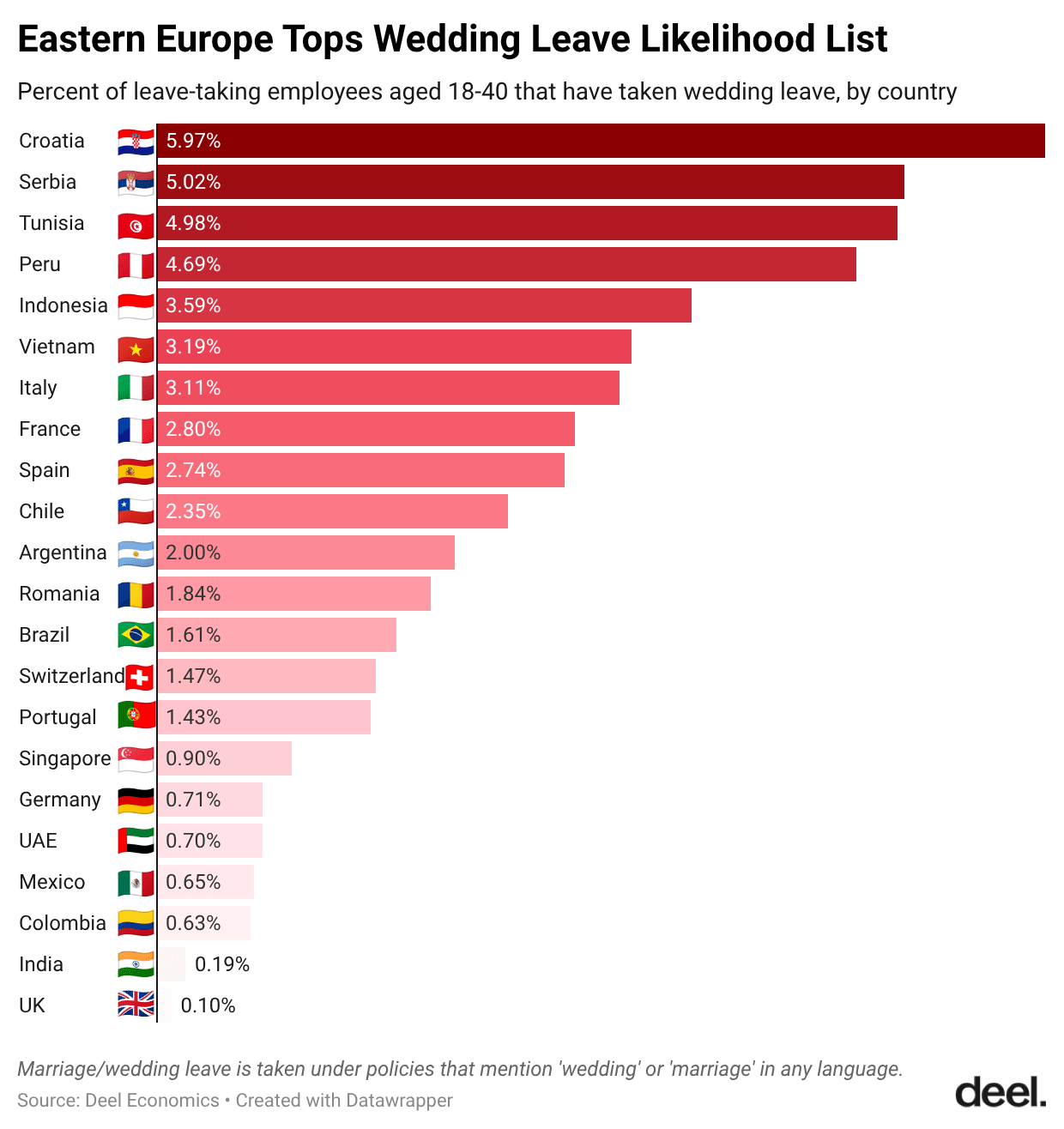
I also checked these results for slightly different age samples (25-40 and 18-35) to ensure robustness, with extremely similar results.
Unsurprisingly, we see large differences by country! The countries that top the list seem to be driven by a combination of high marriage rates and government policies, with all but one of the top ten countries legally mandating leave.
Unlike some other benefits, this doesn’t seem to be one that employers regularly give out voluntarily – neither the UK nor India, our bottom two countries on the list, have legally mandated wedding leave, while Colombia only introduced it in December 2024.
Southern Europe leads the way in wedding leave length
I next pulled the average number of days taken under a single marriage/wedding leave request.
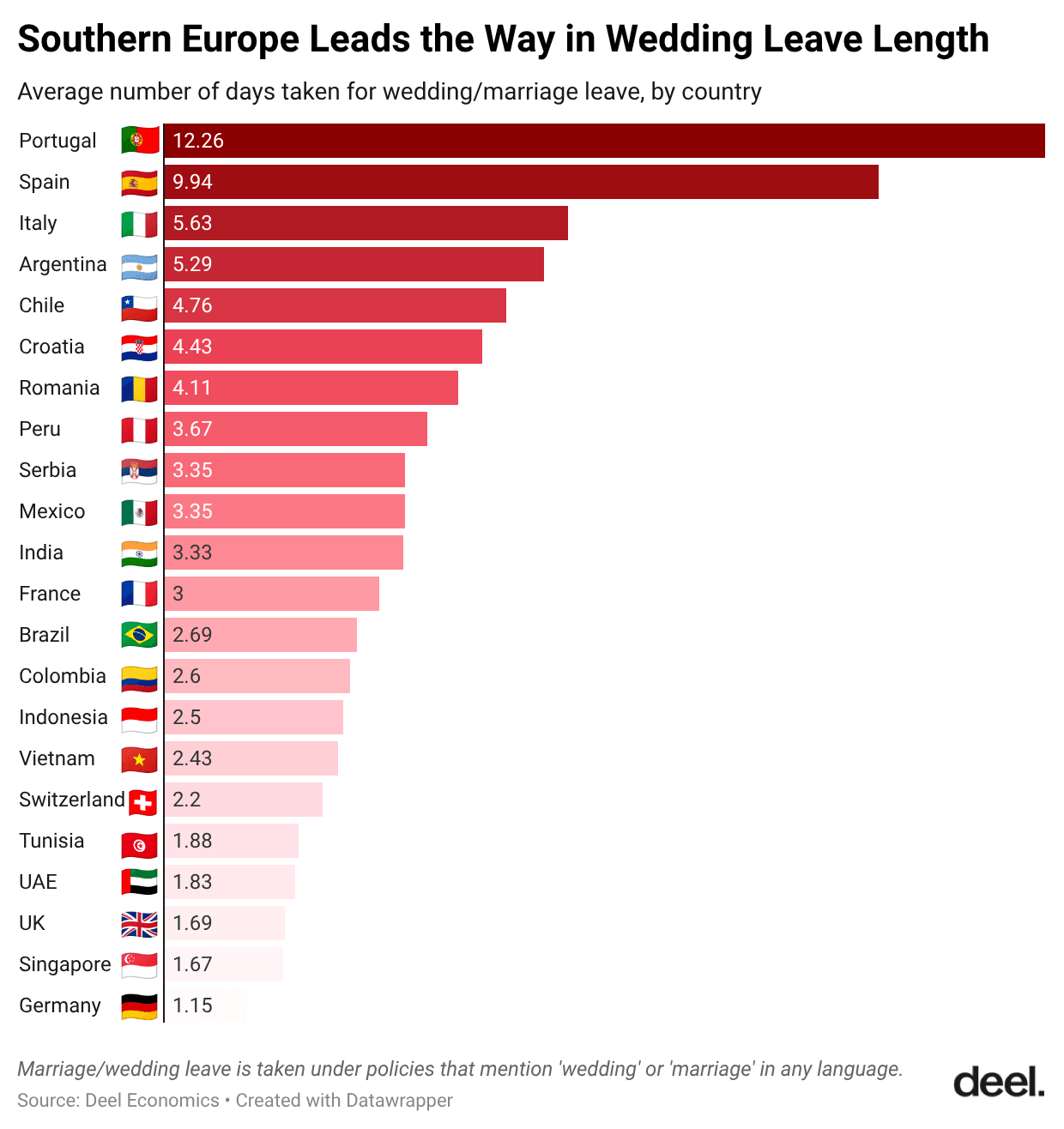
Portugal leads with more than 12 days of wedding leave on average, followed by Spain, Italy, Argentina, and Chile. Germany sits just above 1 day. We can see that the average number of days off is very closely related to a country’s legal policies – Portugal, Spain, and Italy all mandate 15 calendar days (around 11 business days) of leave.
Countries that combine legal mandates for wedding leave with other types of personal leaves like Croatia, Serbia, and Romania, tend to take less time off as a proportion of their total entitlement.
September: The best time for honeymoons?
Finally, I looked at the proportion of wedding leaves by month, globally.
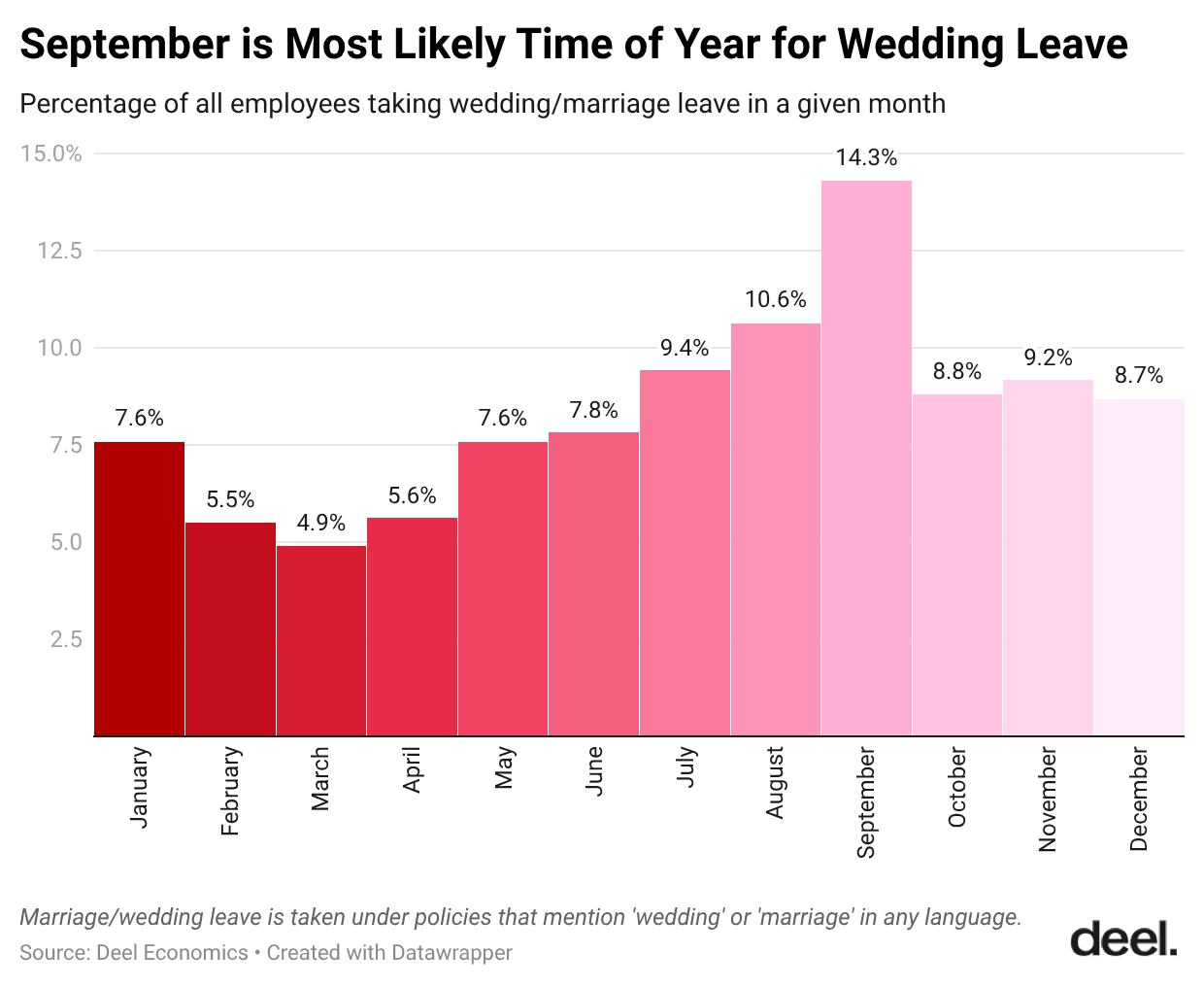
Surprisingly, September (when my parents got married!), not August, is the peak month for wedding leave, with 14% of all wedding time off happening then.
January is the most common month in Q1 (New Year's Day weddings, anyone?). March is the least popular month of the year. Sadly, and slightly to my surprise, it doesn’t seem like there are many Valentine’s Day weddings happening. Looks like the winter blues are stronger than the allure of romance.
What's cool about this data is that it shows how differently countries value time off for major life events. For companies building global teams, this is the reality: benefits aren't universal. What's standard in one market is generous in another or nonexistent in a third. And timing matters too. While Valentine’s Day marketing positions February as the month of love, employees worldwide vote with their leave requests for September. Turns out romance follows seasons and practicality more than greeting cards.
Footnotes
Lauren Thomas is Deel's founding Economist, where she’s helping to bring Deel’s mission of breaking down geographic barriers to opportunity to life through data — a mission that resonates personally, as she's worked and studied in six cities across three countries!
Before joining Deel, Lauren worked in economic research and data storytelling at the Federal Reserve Bank of New York, Glassdoor, and Stripe. She has degrees in economics and data science from Oxford, Université Lumière Lyon 2, and Northwestern University.
Outside of work, she enjoys reading, playing volleyball, climbing, sewing her own clothes, and using Oxford commas. She does not enjoy long flights but takes a lot of them anyway!