Article
6 min read
How executives at Deel actually use AI day-to-day

Author
Kim Cunningham
Published
May 18, 2026


The job of Deel's compliance team fundamentally changed when AI started doing the research. What used to be gathering information became judging AI-generated analysis. Non-developers started pushing code to production. An HR director built an entire operating system for his team in weeks with no engineering hours required. These shifts raise a question more interesting than whether AI is useful: what happens to organizational structure when shifts like these compound?
Deel is a global employment platform serving 40,000 customers across payroll, compliance, and HR infrastructure. After over a year of AI experimentation, we spoke with executives in the four functions where adoption has been most transformative: operations, engineering, HR, and product. They shared how they're using AI daily, what they've stopped doing, and where the technology still falls short.
What emerges is more granular than most coverage suggests. AI is reshaping specific workflows in concrete ways, but the results vary dramatically by function, and the failures are as instructive as the wins. While Deloitte's 2026 enterprise survey found 66% of organizations report efficiency gains from AI, Federal Reserve research shows only 18% of U.S. firms currently use AI in any business function.
At Deel, executives are pushing the “we use AI” narrative several steps further by building it into how work gets structured.
Operations: Redesigning compliance work
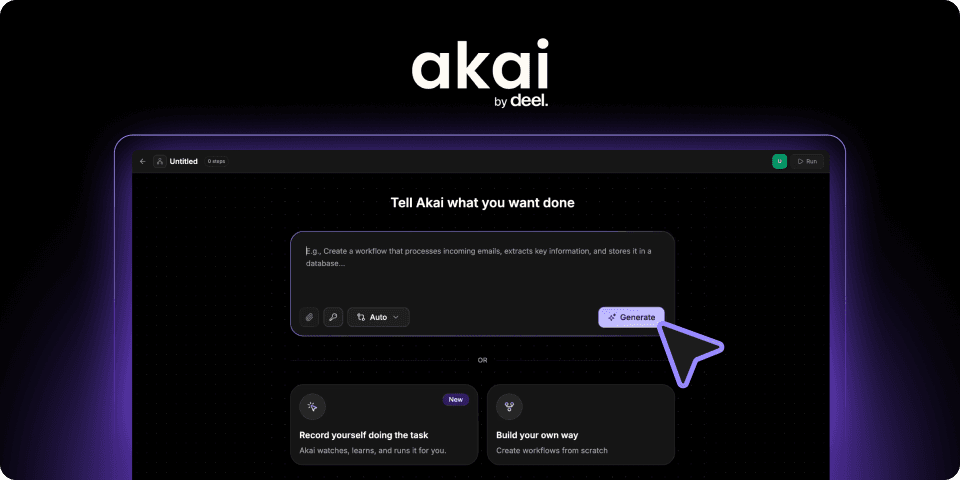
Dan Westgarth, Deel's Chief Operating Officer, points to payroll compliance as the clearest transformation. Previously, teams of researchers spent significant time manually analyzing tax tables, government guidance, and regulatory updates across countries. Now, AI handles that aggregation and interpretation while the compliance team focuses on validating, refining, and improving the outputs. Teams that once gathered information now adjudicate AI-generated analysis. Much of that automation runs on Akai, an agentic workflow platform Deel built internally because nothing off the shelf could handle its operational scale. It now processes more than 100,000 cases automatically each month, saving the ops team upwards of 91,000 hours.
Westgarth's personal AI stack includes ChatGPT for text-heavy tasks, Claude for spreadsheet analysis and connecting across tools like Jira and Google Drive, and Claude Code for direct code changes that he pushes to GitHub. For operations at scale, that stack sits on top of Akai, which is Deel-built, and now the platform that his entire ops org runs on.
But Westgarth also tried something far more ambitious that failed. Deel experimented with an OpenClaw-style agent deployed on a VM with tightly controlled system access, aiming to train it as a fully autonomous Customer Success Manager – responding to client emails, handling internal DMs, operating without human oversight. “Ultimately, it didn't work,” Westgarth says. “The compute wasn't fast enough, the model wasn't capable enough, and the volume of context required to perform effectively couldn't be retrieved and processed quickly enough. We shut the project down.”
Engineering: Timeline compression and new builders
Yaron Lavi, Deel's CTO, makes the boldest claim: “For the first time, non-developers are able to produce code changes, and to a good degree.” Since the beginning of the year, non-developers have pushed over 10 million lines of code. Those changes are reviewed and approved by an engineer before they ship, but the drafting step no longer requires one. The software development lifecycle has shortened dramatically, he says, letting teams ship much more, faster. The result is that build becomes the default choice over buy. “Since practically anyone can now build their dream, either as an internal tool or into the product, the build is the default choice for everything and everyone.”
Whether “practically anyone” can ship production code depends heavily on existing engineering expertise, code review processes, and maintenance capacity. What works at a company with Deel's technical density may not generalize, but Lavi's timeline compression description is concrete: “Products and features estimated in months are sometimes reduced to weeks, if not days. Many internal tools and needs that we [didn't have] resources/lower priority for are now done by non-developers.”
He's also specific about where AI underperforms. Trying to refactor a big codebase as a whole still proves challenging and often wrong, and backend code produced with AI lags in quality compared to frontend. The technology works better for certain tasks – frontend code, discrete features – than others. Understanding those boundaries prevents overextension.
HR: Workflow redesign and deployment shape
Mohamed Tantawy, Deel's Director of HR Experience, describes how document review has changed. Previously, every employee document, from training certificates and ID verification to country-specific compliance forms, was manually reviewed against checklists. “It was the single biggest queue, eating our team's time,” he says. Now, AI reviews documents against the exact instructions given to employees, flags discrepancies, and only escalates genuine edge cases. The team judges what AI is unsure about instead of reviewing everything from scratch. Tantawy emphasizes the work changed from doing to directing.
More striking is what Tantawy built himself. “I built the operating tool for our HR team myself, in Claude Code, in a few weeks. Zero engineering hours.” The tool pulls work across multiple systems into a single queue, with AI summaries on every ticket, auto-translation, and knowledge base integration. Whether this generalizes depends on the operator's baseline technical literacy and system complexity. He also identifies where real-time intelligence shifted decision-making. The old loop was retrospective, looking at month-end SLA reports, quarterly NPS, and annual surveys. Now the system predicts SLA breaches before they happen and flags reopened tickets as dissatisfaction signals. “I reshape capacity weekly instead of quarterly because the system tells me where we'll break next.”
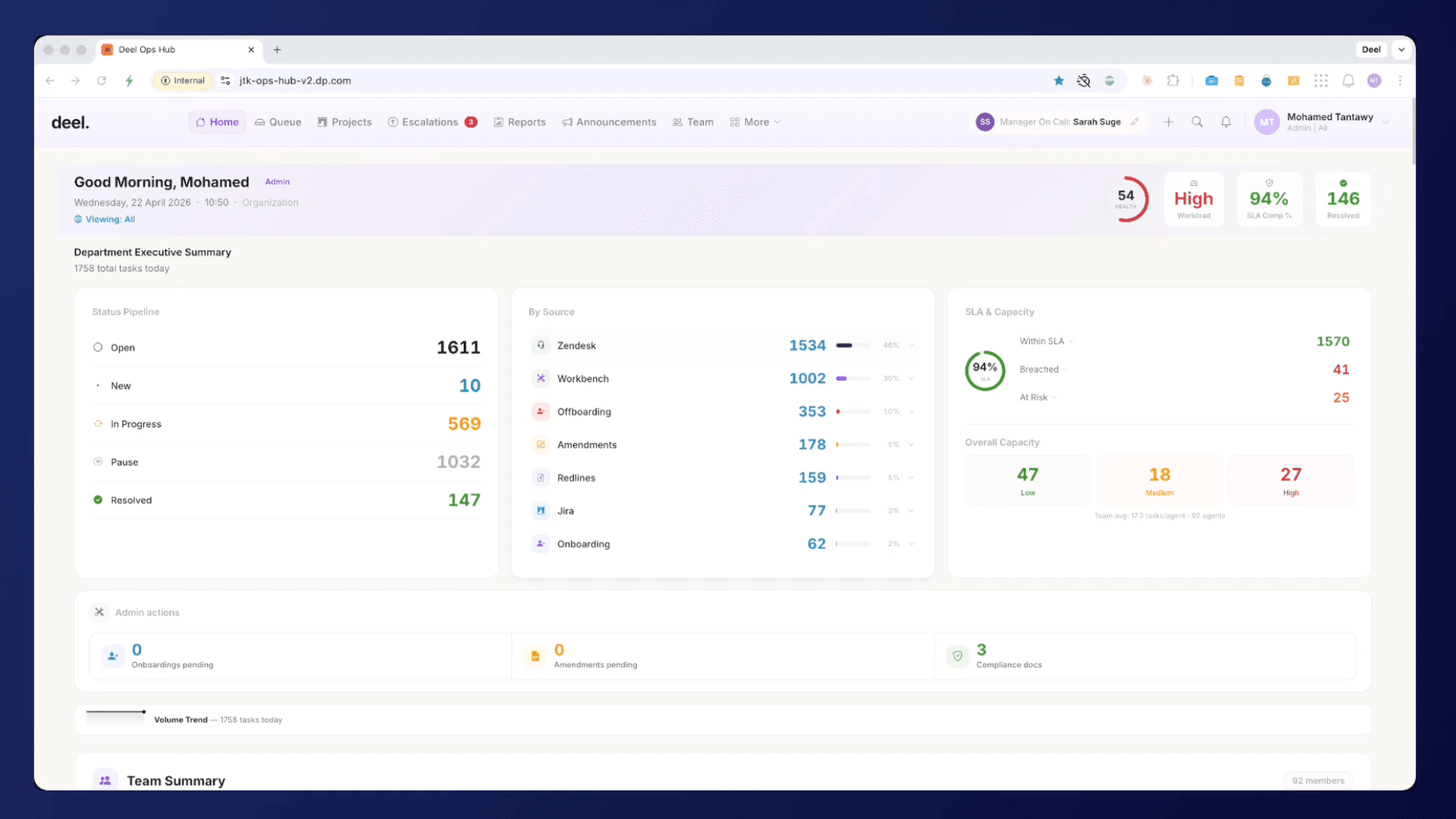
Where Tantawy tried autonomous AI responses to employee tickets, it failed in testing. “We saw enough drift to know it could send a confidently wrong policy answer to a real employee. We didn't ship it.” Instead, the agent drafts responses internally, watches what humans actually send, and learns from the difference. Same agent, but a completely different deployment shape. His lesson is this: “The right question isn't 'is the model good enough to send replies?' It's 'what's the smallest unit of autonomy where being wrong is still cheap?' Every AI rollout we've shut down or restructured failed at the workflow design layer, not the model layer.”
Product and growth: Prospecting at scale, deprecating tools
Kobi Eldar, Deel's Head of Product and Growth, describes how ‘book of business’ management changed. Previously, teams manually identified signals and made recommendations for next-best products. Now, AI analyzes and directs that work for both prospects and existing customers, helping account managers cover more accounts. The system assists with quarterly business review preparation, raises churn risk signals, and identifies cross-sell opportunities based on user behavior.
The operational impact also extends to software licensing. “We have enabled our internal teams across all departments to act as builders. Everyone has Claude access and can build apps,” Eldar says. Because of this, “we need much fewer single-use-case tools, which usually suffer from low adoption and poor ROI. We have already been able to deprecate and remove several software licenses and save significantly on costs.” In fact, since January, Deel has cut more than ten of these tools, eliminating over seven figures in annual licensing costs in the process. If internal teams can build what they need, external point solutions become redundant.
Eldar also identifies a concrete failure: value-based bidding on ad platforms. The concept was to dynamically adjust bids based on specific audiences and projected lifetime value, but it didn't deliver meaningful impact. “In the B2B space, where you have relatively low volumes compared to B2C, combined with more complicated deals and longer sales cycles, [this] significantly reduces the ability of value-based bidding to create impact,” Eldar shares. The same technique that works in high-volume B2C contexts fails in B2B environments. What's now feasible, according to Eldar, includes prospecting at a large scale, automatic localization in multiple languages, and deep personalization of messaging and ad assets.
What this reveals about AI adoption
The clearest takeaway across all four interviews isn't about AI at all. It's about where judgment still lives. The compliance team didn't disappear when AI took over document aggregation; they moved to validating what AI produced. The HR team stopped reviewing every document and started adjudicating the ones the system flagged. Account managers didn't get replaced by AI-generated QBR prep; they got more of it, faster. In each case, the human role shifted toward wherever the cost of being wrong was highest.
What didn't work follows the same logic in reverse. Westgarth's autonomous CS agent failed because the error cost of a wrong customer reply is high, and the technical requirements to avoid it – fast compute, capable model, efficient context retrieval – weren't there. Tantawy's autonomous ticket response failed for a similar reason with a different diagnosis: the model could have written the replies, but the workflow design made any drift unacceptable. Two projects in the same category, with different failure modes. Neither was purely a model problem. Both were judgment problems – specifically, where to put the boundary on what AI decides alone.
None of these executives claimed total transformation. They talked about specific processes that changed, roles that shifted, and experiments that failed. That's more useful – and honest – than declaring “AI is changing everything.”
Kim Cunningham leads the Deel Works news desk, where she’s helping bring data and people together to tell future of work stories you’ll actually want to read.
Before joining Deel, Kim worked across HR Tech and corporate communications, developing editorial programs that connect research and storytelling. With experience in the US, Ireland, and France, she brings valuable international insights and perspectives to Deel Works. She is also an avid user and defender of the Oxford comma.
Connect with her on LinkedIn.