Article
9 min read
The unlimited vacation paradox: Why it works in Europe but not in North America

Author
Lauren Thomas
Published
December 15, 2025


Key takeaways
- Unlimited leave is a perk in Europe but a wash in North America: Europeans with flexible leave take four more days off than their counterparts with fixed leave.
- North America is the “no vacation” region: Workers in the U.S. and Canada take far less leave than their European counterparts. Counterintuitively, it’s the Canadians in our sample who take the least time off, not the Americans.
- The Swedish and French lead the way in time off: While Sweden tops the list for actual time off taken, it’s actually the French who have the highest number of days given to them by their employers.
With the end of the year approaching and holiday plans filling up calendars, the Deel Works team wanted to zero in on the ultimate question of the season: what is really going on with vacation? Is “unlimited” leave really a perk (answer: it depends)? Do Americans really take less sick leave (yes)? And who’s working around the holidays?
Unlimited vacation: A perk in Europe, a wash in North America?
Popular opinion holds that unlimited vacation is often an illusion—one that actually encourages workers to take less time off. The perception comes from a 2018 study by HR platform Namely that found U.S. workers with unlimited time off took less time than those with fixed days. But is this really true? A repeat of the same study in 2022 found that there was no longer any difference between the amount of vacation taken by workers with unlimited and fixed time off. What story does our data tell?
To answer this question, I looked at 159,000+ approved and used time off requests from over 17,500 employees for thousands of companies across the European Economic Area1, Switzerland, the U.K., the U.S., Canada, and Mexico in 2025. This includes December time off requests already approved.
The headline finding: whether unlimited time off is a boon or a bust depends on where you are. Even though access to unlimited leave is much more common for the U.S. and Canadian employees (20 percentage points more likely) on our platform, European workers are much more likely to use unlimited time off to its full advantage.
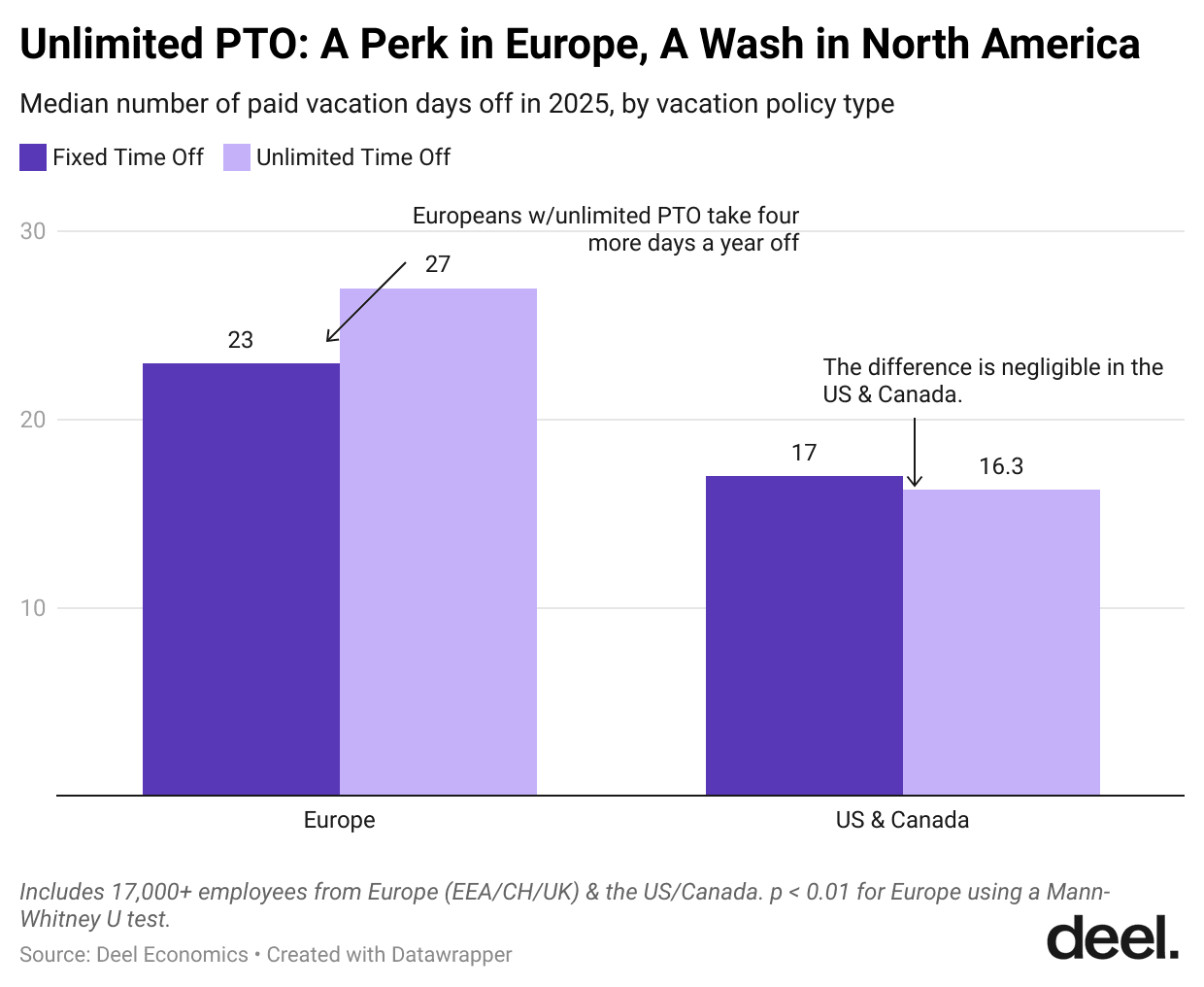
U.S. and Canadian employees with fixed time off took a median of 17 days off, compared to 16.3 days for those with flexible vacation, but the difference was not statistically significant. On the other hand, European employees took an extra four days off under an unlimited time off policy.
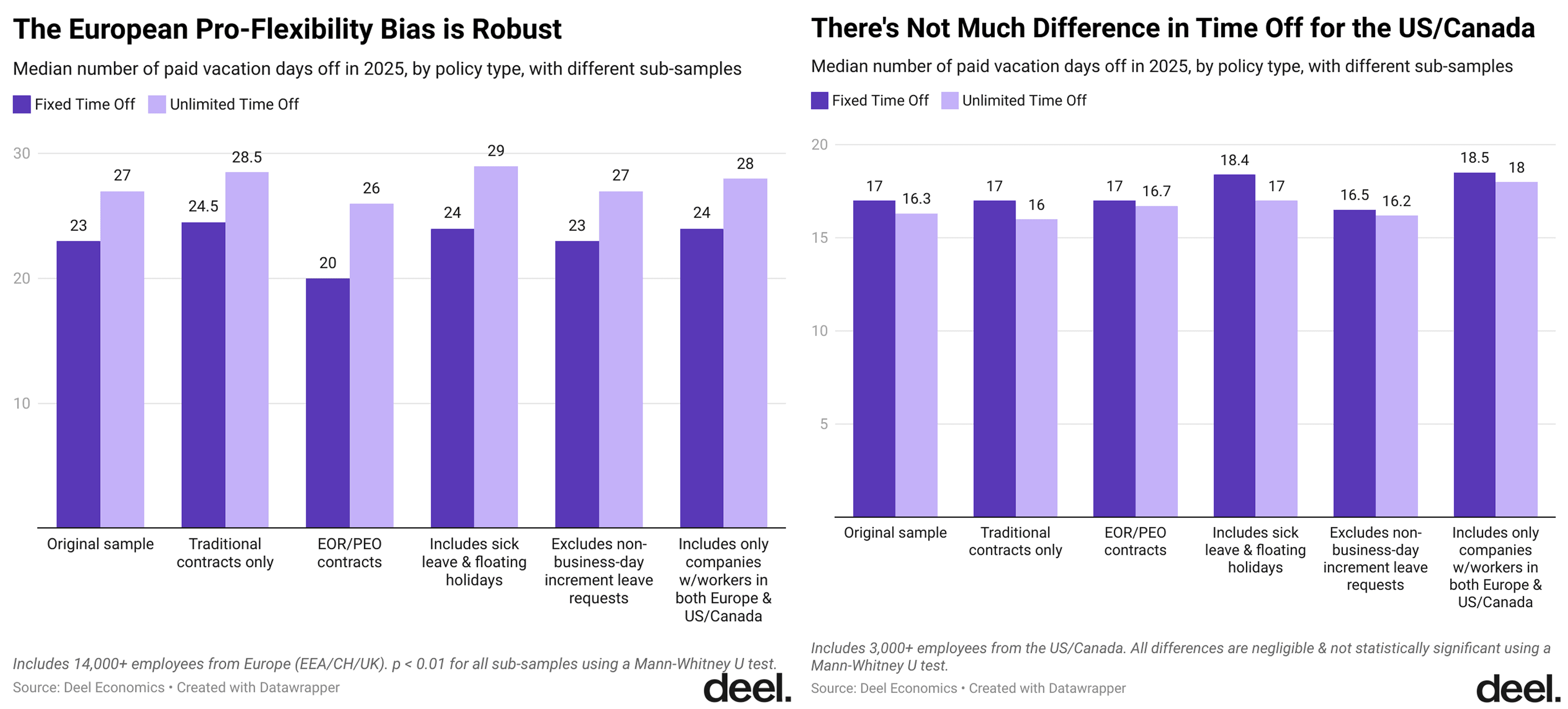
This pro-flexibility trend held true across all European employees, regardless of their specific contract structure (Employer of Record/Professional Employer Organization versus traditional contracts) or whether the analysis excluded workers requesting time off in hourly rather than business day increments. It also held true regardless of whether I analyzed vacation/annual leave alone or whether I included sick time and floating holidays in the analysis (as sometimes those with flexible leave don’t have a separate sick leave policy).
Are these results skewed by some business sectors or company types dominating in one region but not in another? To check, I re-ran the analysis, but only with companies that had at least one worker in Canada/the U.S. and one in Europe. This should eliminate any impact of differing company compositions in the two regions. Again, the same pattern emerged!
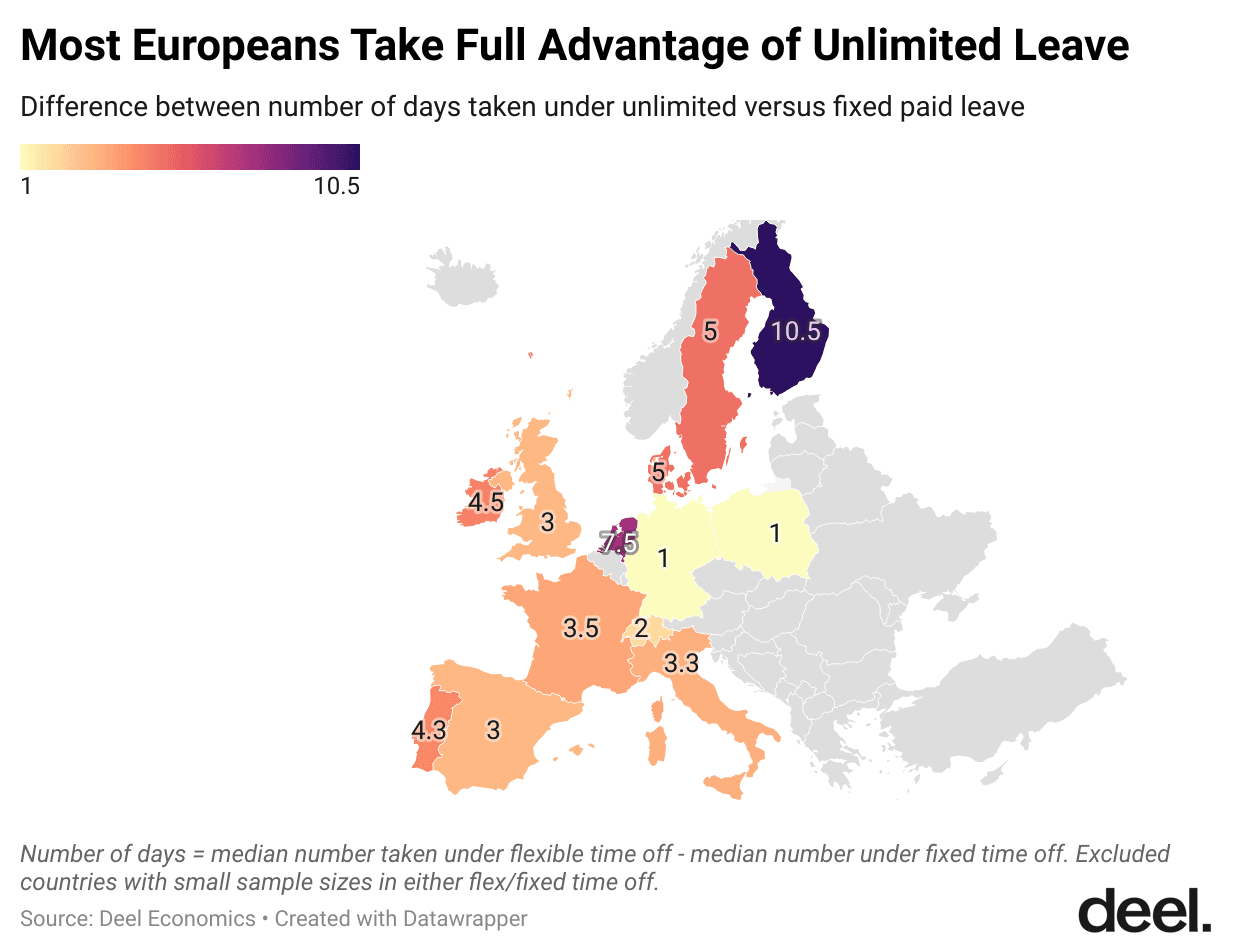
Breaking down the results by country showed that nearly every European country had a statistically significant increase in time off under flexible leave—a sharp contrast to the U.S. and Canada, where the difference was negligible and not statistically significant.
What does this mean? Perhaps in cultures where people are used to taking their time off seriously, they’re more likely to take full advantage of an “unlimited” time off policy.
Who is the worst at taking time off? Canadians
Let’s forget about the flexible and fixed distinction. How much time off are people taking off overall? And does it differ by country?
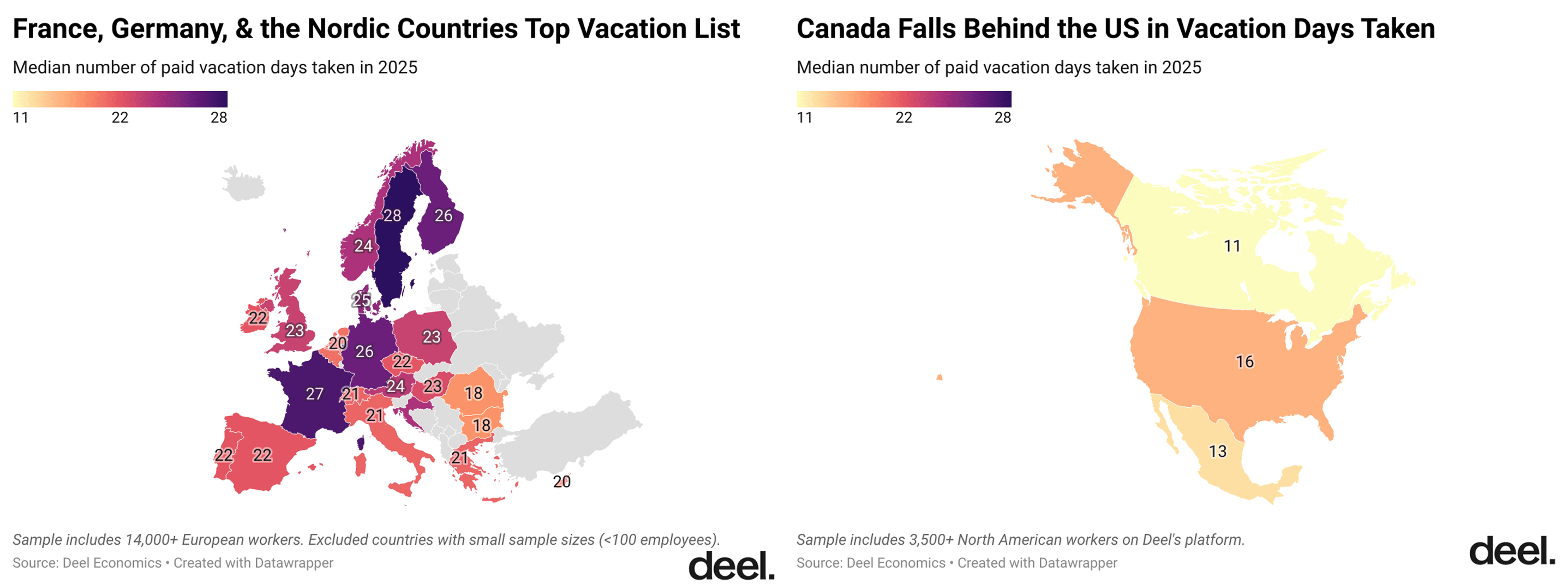
Absolutely. Unsurprisingly, North Americans take the least time off, but the country at the bottom of the list probably isn’t who you think it is. Though the U.S. (the only country on our list that does not mandate paid vacation leave) falls near the bottom, it’s actually Canada whose employees are taking the least amount of leave.
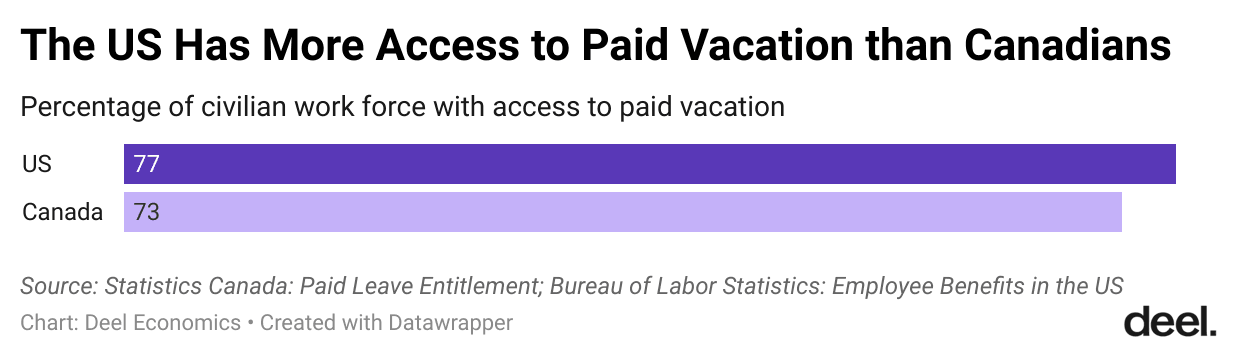
The Canadian/U.S. divide doesn’t arise from a biased sample. Not only does it hold true even for companies with employees in both countries and after controlling for job-specific characteristics, research from the U.S. Bureau of Labor Statistics and Statistics Canada shows that a higher percentage of U.S. workers (77%) have access to paid vacation than Canadians do (73%). Though the Canadian federal government and most provinces mandate a minimum of ten paid vacation days, this policy doesn’t apply to all employees.
Maybe the transatlantic difference occurs because companies with more generous leave policies are more likely to hire European employees? Nope! When I compared the amount of leave taken only for intercontinental companies (ICCs) with at least one worker in Europe and the U.S. or Canada, the relationship persisted, suggesting that even the same companies offer European workers more time off than their employees in the U.S.
Overall, European ICC workers took a median of 25 days off (versus 23.5 for all European workers), and U.S./Canada ICC workers took 15 days off (versus 14 for all U.S./Canadian workers). Interestingly, those at companies with employees spanning the Atlantic took more time off, implying that global companies are better for vacation time than local ones. So if you’re a North American looking for more time off, look for a company that also employs Europeans.
The “work hard, play hard” cities
If you want a lot of vacation, move to Berlin and avoid Munich. If you want very little, try Toronto. I broke down the median annual leave days by city. The differences within countries are almost as interesting as the differences between them.
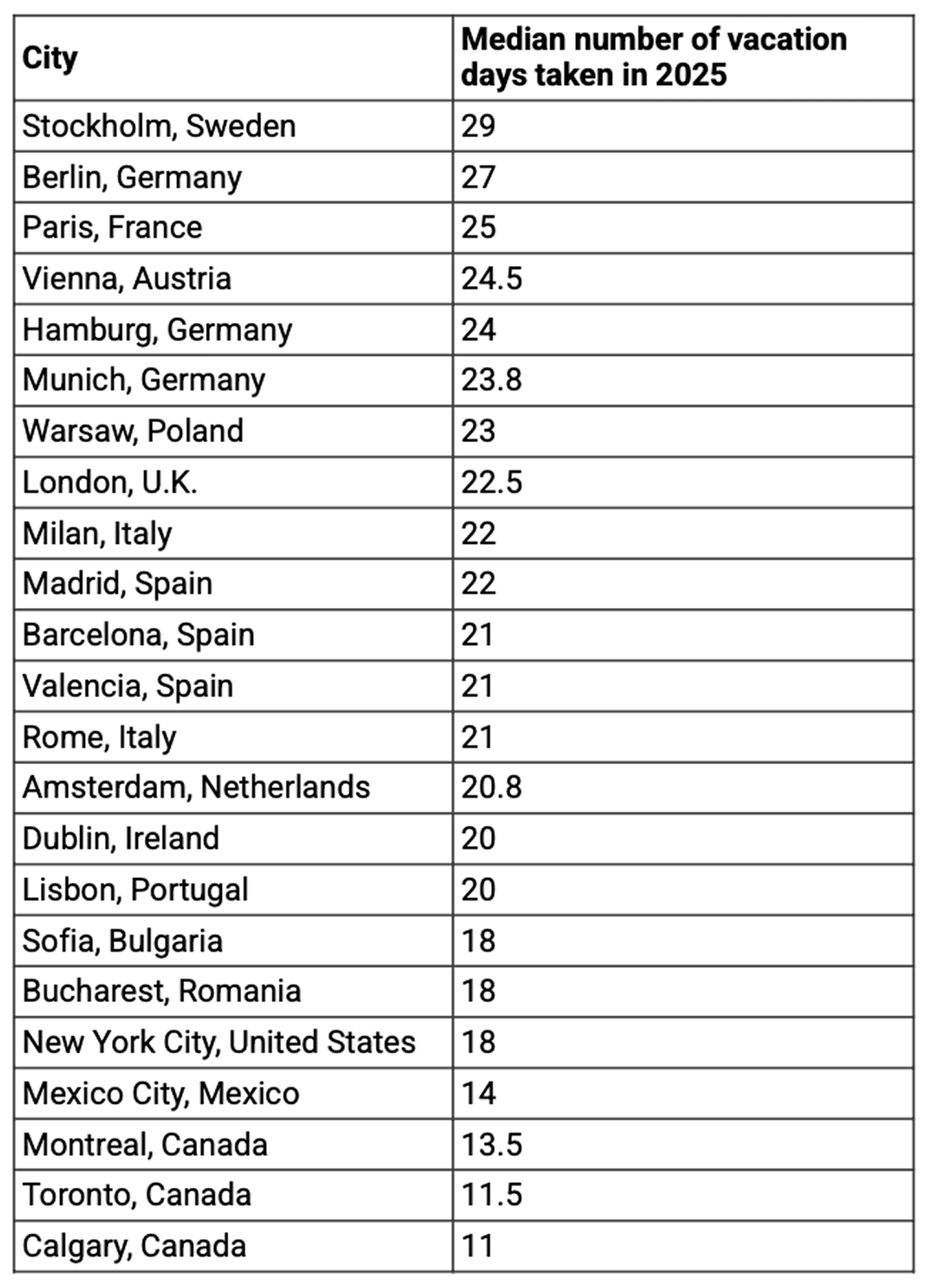
Among the major tech capitals of Europe, Londoners take more time off (22.5 days) than their counterparts in Dublin (20) or Amsterdam (20.8). Munich, one of the economic powerhouses of Germany, takes less time off than its famously more relaxed counterparts in Berlin.
Which European country gives employees the most time off?
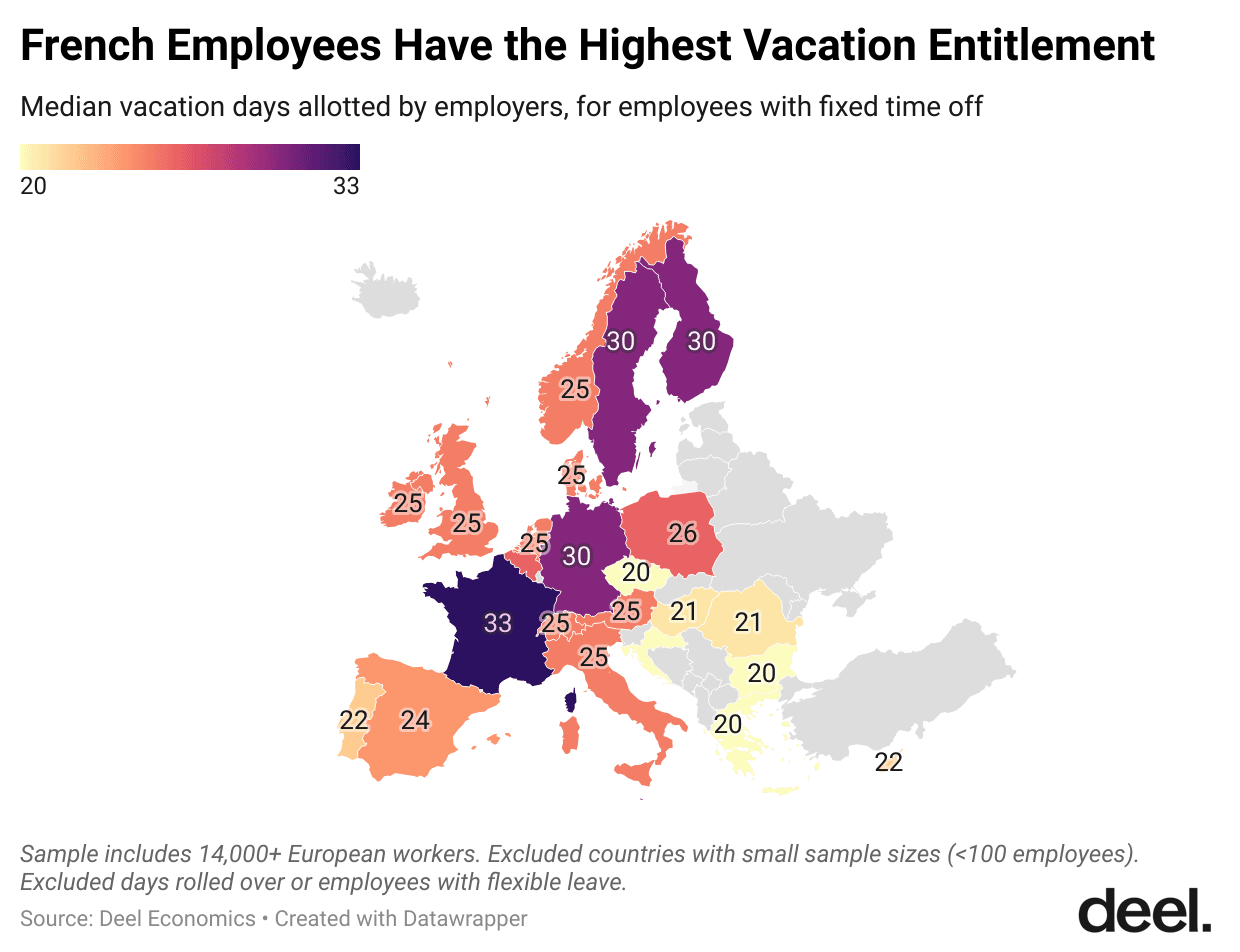
We can also look at how much time employees in Europe with fixed leave are given by their employer, excluding time off rolled over from the previous period. Though the number of days given and the number taken are strongly related, the Netherlands stands out for taking a relatively small proportion of the overall leave granted to it.
And while Sweden tops the list for actual time off taken, it’s actually the French who have the highest amount of time off. French law guarantees extra compensatory time off (RTT) in lieu of overtime pay for full-time employees who work more than the legal maximum of 35 hours per week, and French employees on Deel’s platform are big beneficiaries of this policy.
For more on how cultural patterns shape leave-taking behavior, from Christmas traditions to sick leave, read our companion piece here.
Methodological details
I analyzed 160,000+ approved and used time off requests for vacation and sick leave from over 18,000 employees for thousands of companies across the European Economic Area, Switzerland, the U.K., the U.S., Canada, and Mexico in 2025 (leave is grouped into a year based on the first day of the leave). All data is current as of December 4, 2025. Leave that has already been approved for December is also included. Only workers who have been present on Deel’s time off platform for the entirety of 2025 were included. Workers are assigned to countries based on the country of their contract.
Vacation leave includes paid leave policies such as annual leave, RTT days, vacation days, paid time off, marriage/wedding leave, moving leave, and personal leave. Sick leave is paid and includes disability leave, critical illness leave, paid sick days, blood donation leave, and doctor’s appointment leave. All home-working, remote work, working abroad, TOIL, unpaid leave, and overtime requests were excluded from the analysis (as they don’t represent paid time away from work). Note that employees could take days that they had rolled over, or could take less time than they were entitled to in order to roll over vacation days.
Leave could be taken in increments of hours, weeks, months, calendar days, or business days. The majority of leave was taken in business days, but all other leave was converted to business days according to the following formula:
- Weeks: multiplied by 5 (number of business days in a week)
- Years: multiplied by 261 (there are between 260 and 262 working days in a year, but it’s usually 261)
- Months: multiplied by 21.75 (261 working days/12 months)
- Hours: multiplied by between 7 and 8.4, depending on the standard for the country (e.g. French working days are 7 hours, but U.S. working days are 8)
- Calendar days: multiplied by 1 (most calendar day requests appeared to taken in a manner that was similar to business days, apart from in Estonia)
I excluded all known part-time employees and independent contractors from the analysis. Sometimes days were taken in increments (e.g., a half day or a part day for sick leave); these were added to full-day increments. Most calculations were median days off: this was calculated by summing 2025 leave by policy type (vacation or sick leave) and worker, then taking the median. Statistical significance for medians was calculated using a Mann-Whitney U test and a t-test of proportions for frequency differences.
Flexible leave was defined as having access to an unlimited number of days off on Deel’s platform. Fixed leave had both an accrued number of days and the ability to take only a fixed number of days beyond that in a given month (since time off often accrues each month, some employers gave their employees the ability to take a certain number of days off beyond their accrued amount). Measures of entitled time off don’t include days rolled over.
When comparing U.S. and Canadian leave, I ran a panel regression of U.S. & Canadian workers with company-level fixed effects. I set the number of days taken off as the dependent variable and a U.S. worker dummy, broad job group dummies, a dummy for non-EOR/PEO contracts, and “normalized” salary as the independent variables. I defined normalized salary as individual salary in USD divided by the 2024 median salary for full-time employees in the country (found here for Canada as $65,520 CAD or $47,401 USD and here for the U.S. as $61,620 USD), converted to USD. The use of this normalized metric was necessary to account for baseline differences in compensation between the two countries. The resulting coefficient for the U.S. dummy variable was strongly positive and statistically significant (p < 0.001), indicating that U.S. employees take significantly more time off, even after controlling for organizational factors, contract type, job function, and relative compensation level.
Footnotes
-
Austria, Belgium, Bulgaria, Croatia, Cyprus, Czech Republic (Czechia), Denmark, Estonia, Finland, France, Germany, Greece, Hungary, Iceland, Ireland, Italy, Latvia, Liechtenstein, Lithuania, Luxembourg, Malta, Netherlands, Norway, Poland, Portugal, Romania, Slovakia, Slovenia, Spain, and Sweden. ↩
Lauren Thomas is Deel's founding Economist, where she’s helping to bring Deel’s mission of breaking down geographic barriers to opportunity to life through data — a mission that resonates personally, as she's worked and studied in six cities across three countries!
Before joining Deel, Lauren worked in economic research and data storytelling at the Federal Reserve Bank of New York, Glassdoor, and Stripe. She has degrees in economics and data science from Oxford, Université Lumière Lyon 2, and Northwestern University.
Outside of work, she enjoys reading, playing volleyball, climbing, sewing her own clothes, and using Oxford commas. She does not enjoy long flights but takes a lot of them anyway!