Article
6 min read
Labo(u)r market roundup: August 2026

Author
Lauren Thomas
Published
August 20, 2026


Job openings barely move in the US, youth unemployment keeps rising in the UK, and do the French really disappear in August? (Yes.)
After a brief summer hiatus, these posts are back! This month: US payrolls disappointed even as unemployment ticked down, UK vacancies hit an 11-year low, and youth unemployment in the two countries is heading in opposite directions.
One note: August’s UK labor market data should be taken with a grain of salt, as the Office of National Statistics said the month before last that an operational error in May and June had led to reduced response rates and thus reduced data quality. This isn’t a new problem for the ONS – but it means this month's headline figures deserve more scepticism than usual.
Meanwhile, in the US, payrolled employee and unemployment rate figures seemingly diverged. Both countries are reminding us that even government data has its limits. Administrative data — like pay and payrolled employee counts from HMRC, or unemployment insurance claims from US states — is accurate for the universe of workers it covers, but plenty of people fall outside that universe.
Survey data is meant to represent the population as a whole, but it's far more exposed to methodological problems. That's why it's best to take a bird's-eye view of the data rather than fixate on month-to-month changes — unless they're drastic, like what happened at the start of the coronavirus pandemic.
That's where private-sector data can help. It's obviously biased and imperfect, but then again, so is government data, and it can offer a more granular look at specific industries. It's complementary, not a substitute, for the ONS and BLS — and that's what I hope we can do here at Deel.
On to each country’s analysis!
US
Job openings and hires hold steady, quits tick down slightly
The BLS JOLTS and the Employment Situation, released earlier this month, once again showed little change from the previous month. The number of job openings, at 7.4 million, was little changed from last month. Similarly, hires and quits haven’t changed much - the hires rate was 3.4%, identical to last June’s rate, and the quits rate was 2.0%, down by 0.1 pp from last June.
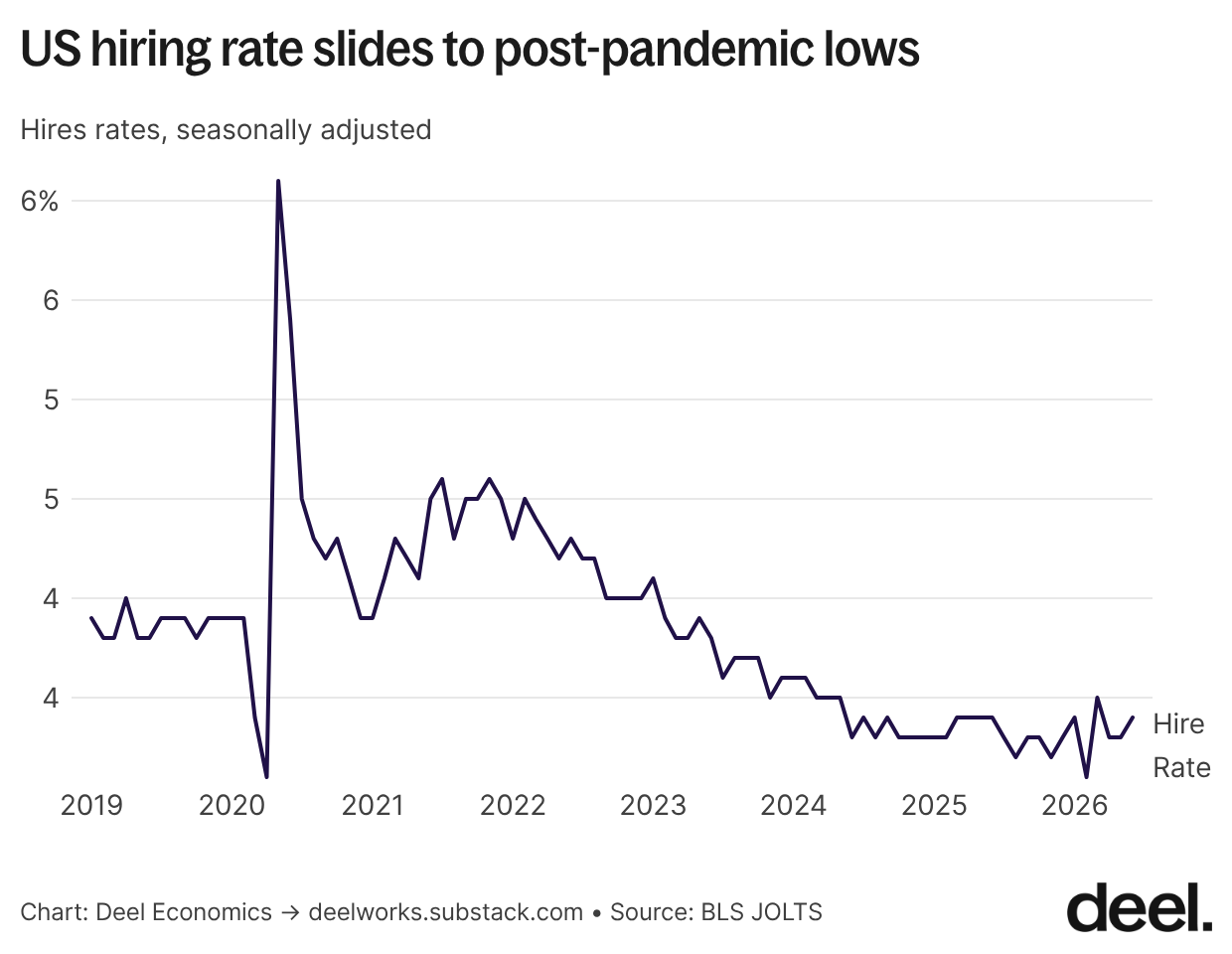
It feels like a lot of the post-pandemic slide in hiring may have worked itself out now that inflation has calmed down, interest rates are falling, and the US restored immediate expensing of the R&D tax credit — albeit only for domestic hires, not international ones — meaning engineering salaries can once again be deducted in full in the year they're paid, rather than amortized over five years. That meaningfully lowers the after-tax cost of hiring engineers in-house, and could tilt the calculus back toward domestic hiring specifically.
Non-farm payrolls fall short of expectations while unemployment ticks down
Meanwhile, non-farm payroll jobs fell by 23k in July when economists had expected them to increase by 83k, and May and June were revised down by 103,000 combined. Neither of those are a great sign.
But at the same time, unemployment also fell from 4.2% in June to 4.1% in July. Normally, we’d expect it to go up when payrolled jobs fall like they did - but this is a good reminder that the two numbers come from different sources (payrolled jobs are from a survey of businesses and unemployment is from a survey of individuals).
And, as my friend and fellow economist Malcom Splitter pointed out, this has to be put in the context of an aging population and estimated negative net migration, with 2025 marking the first time in half a century that more people have left the US than entered it. In such an environment, lower payrolled numbers may be the new normal, even if unemployment rates fall.
Youth unemployment continues to decline after a rocky 2025
One bright spot: youth unemployment (ages 16-24) has continued in its downwards trend. It's at 8.5%, down 1.5 percentage points from last July, after nearly a year of steady increases throughout 2025 and worries that such increases heralded an AI jobs apocalypse (this doesn't rule out its impact on particular fields, of course).
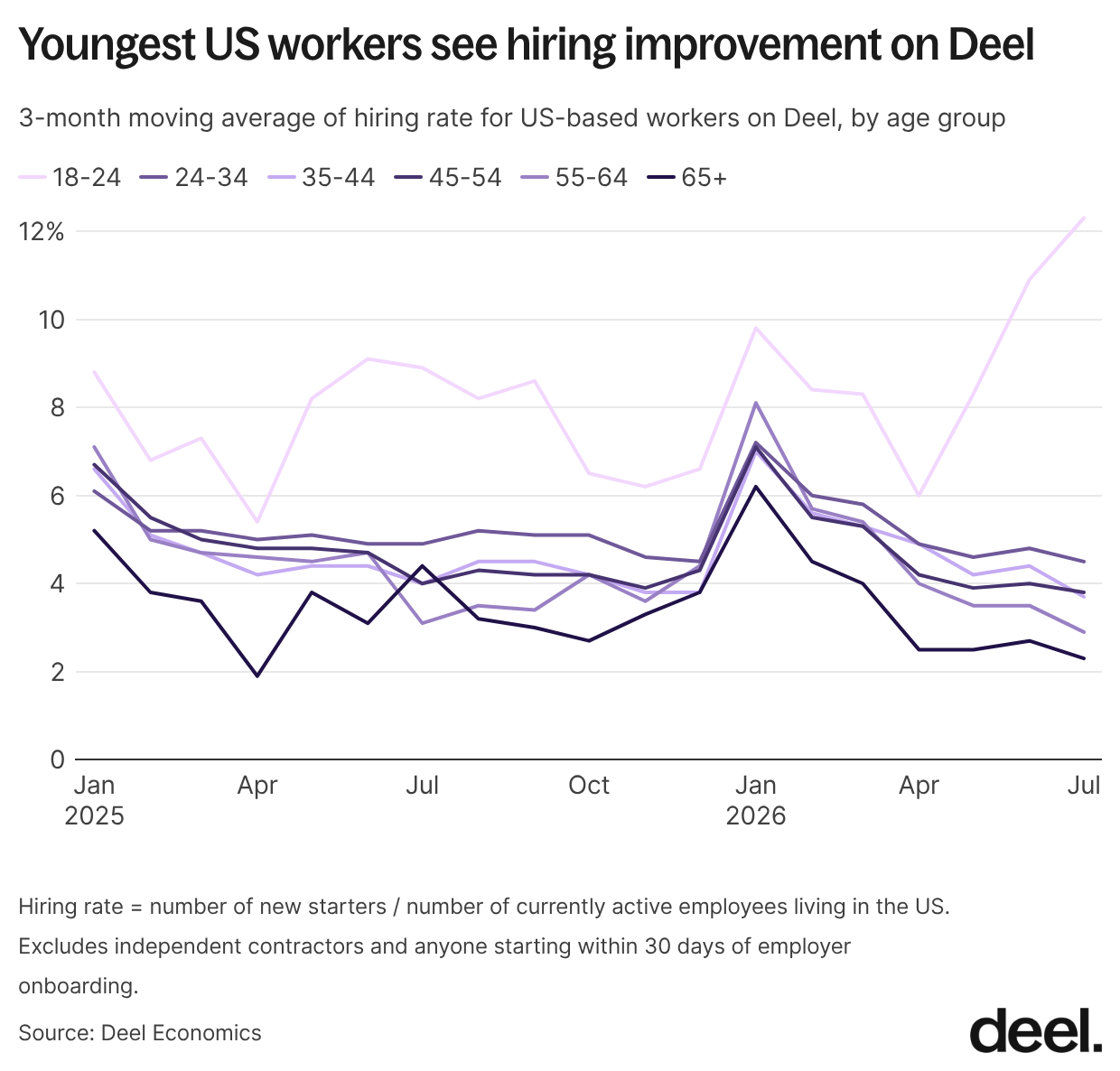
This shows up in Deel's data too, even before any industry or seasonal adjustment: hiring rates for the youngest US-based workers on our platform are up meaningfully versus 2025, while hiring rates for everyone else are roughly flat year over year.
Elsewhere in the report: health and social assistance jobs grew by 22,000; local government education shed 50,000 jobs; retail lost 19,000; and temporary layoffs jumped by 153,000 to 921,000. Wages grew 3.2% over the year, which is low considering June's inflation rate of 3.5%.
UK
Job vacancies fall to an 11-year low and real pay barely budges
The UK ONS released its monthly labour market overview on Tuesday, and two stories stood out.
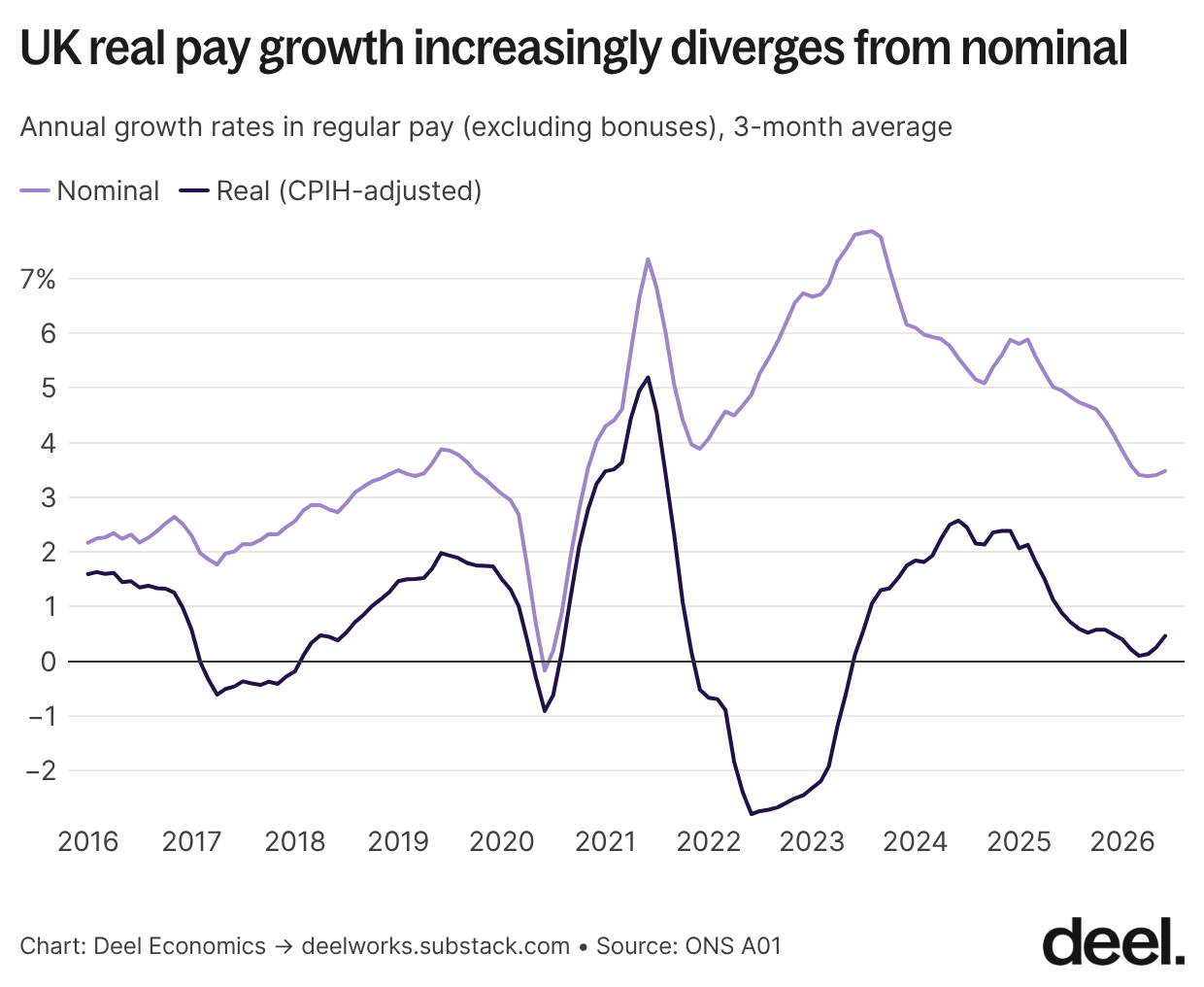
First, real pay growth remains stubbornly low — it’s barely been above zero for months, despite high nominal growth, thanks to inflation that’s stayed above 3%.
And secondly, job vacancies, which have hit their lowest level outside the pandemic since 2014, despite a 7% increase in the population since then.
Some of that is demographic: there’s also been a 14% increase in over-65s, and an aging population may mean a permanently lower number of vacancies going forward — unless retirees are replaced by migrants. But net migration has been falling precipitously for a few years now, so that’s unlikely to make most of a difference in the vacancy numbers.
But some of it is a sign that the UK labour market (much like many countries, including the US) has yet to see a robust jobs market. We remain in a low-hire market, and I expect that to be the case for a while to come.
Overall unemployment holds roughly steady, but youth unemployment keeps climbing
I want to zoom in on something else, though: what's going on with unemployment?
The headline figures look reasonably good. Unemployment, at 4.9%, is up only slightly from 4.7% a year ago, and has fallen from January's peak of 5.2%.
But the picture changes once you zoom in on the young. The rise is fully concentrated among 18–24-year-olds, where unemployment has climbed 2 percentage points to 14.6%, up from 12.1% a year ago. That's not being driven by more people staying in school — the pattern holds whether you look at people in or out of full-time education.
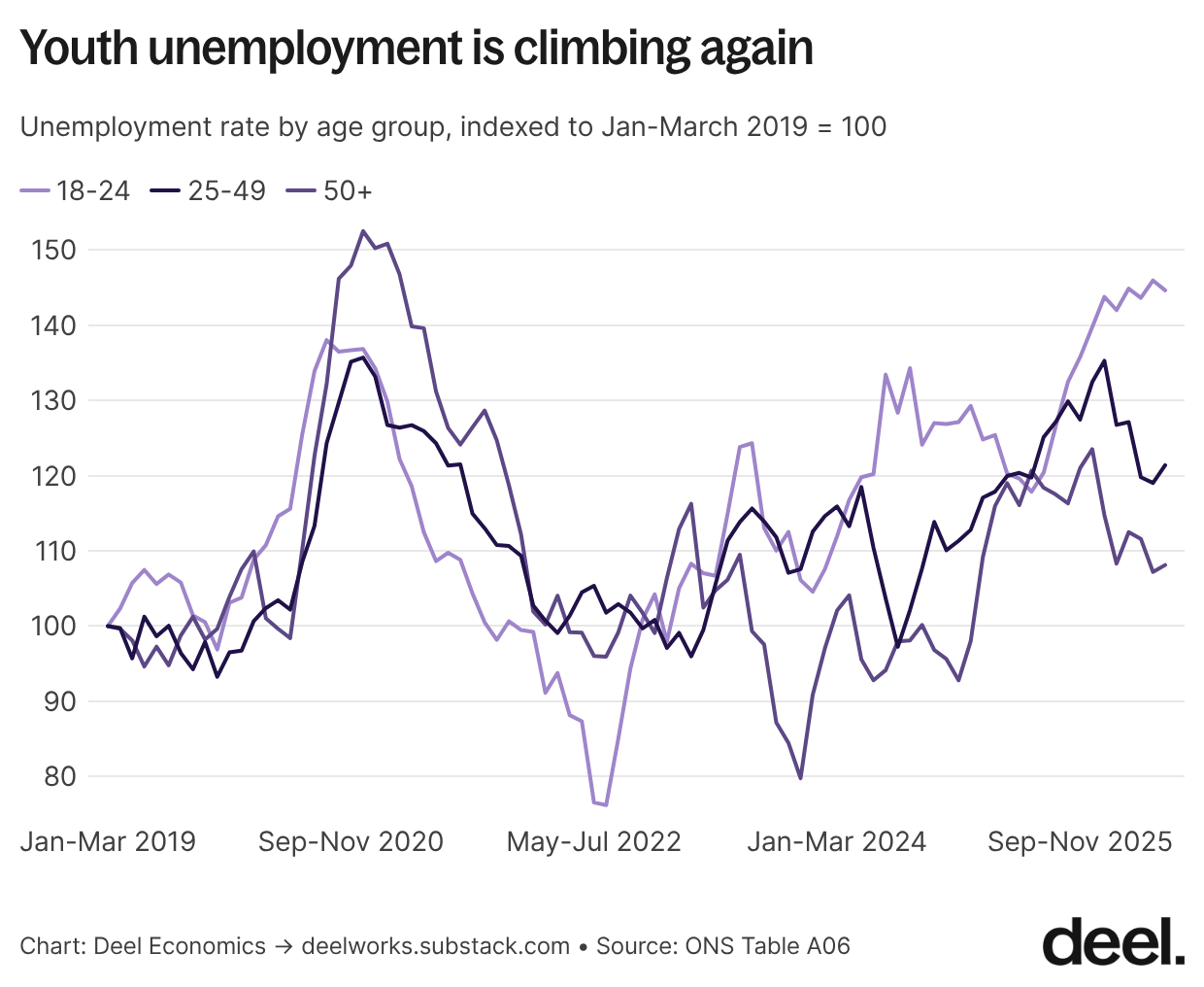
This is probably a result of falling vacancies. In a low-hire, low-fire market like the one we have now, the people just entering the job market face the highest unemployment rates — and no one is newer to the job market than young people.
Compare that to the US data above: youth unemployment there has fallen, after a rise in 2025 that made everyone nervous. Deel's data shows the same divergence — softer hiring among young workers in the UK over the past few months, versus faster hiring among young workers in the US. That's without any reweighting, so take it with a grain of salt, but the gap between the two countries is striking.
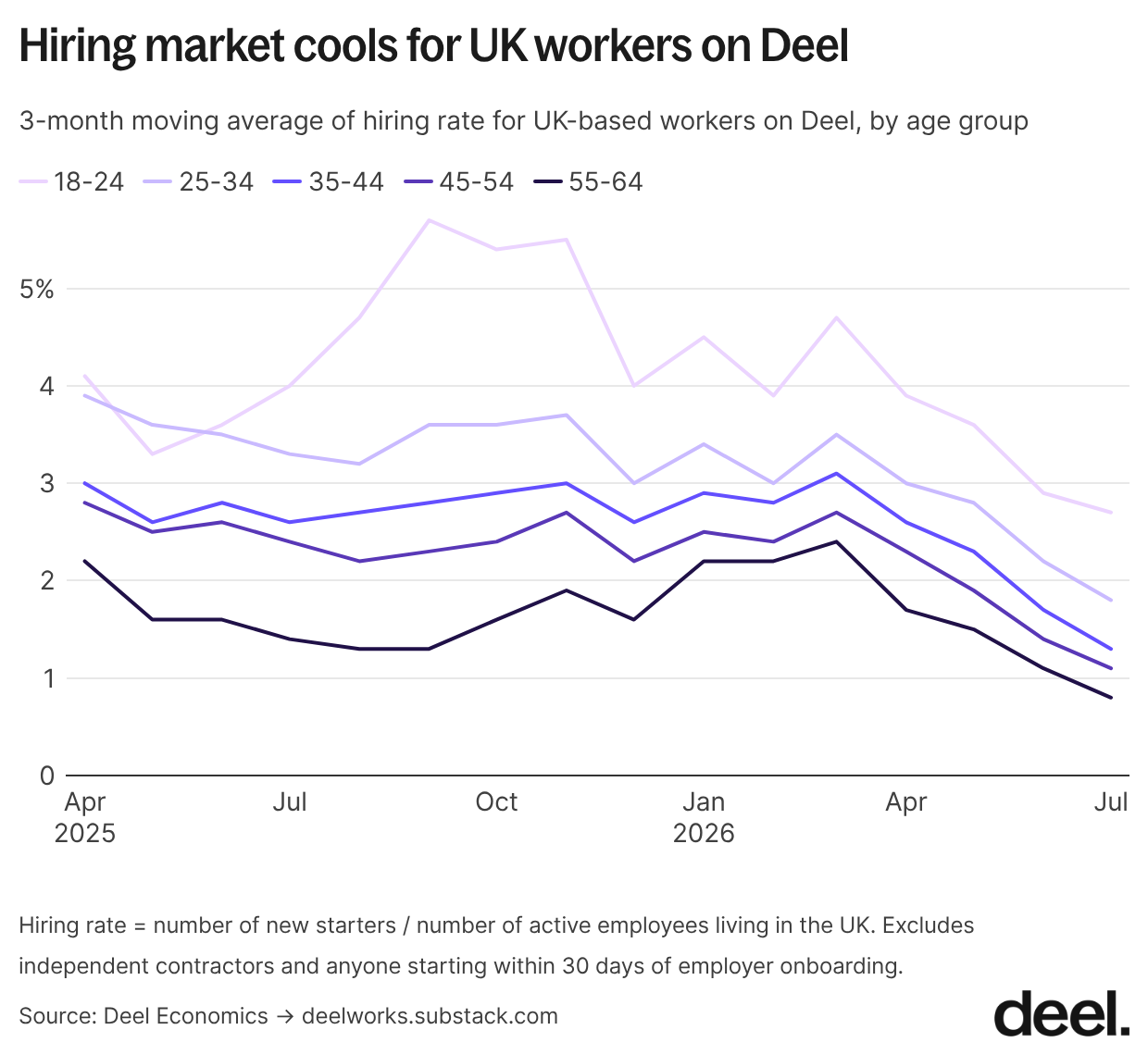
So what's driving it? The rise in National Insurance and the minimum wage? AI? Some combination of the two? I haven't dug in enough to say for sure — but I think it's one of the most important questions the UK will have to answer for the rest of 2026.
Data deep dive
This month's data deep dive comes from our PTO data, covering nearly 100,000 workers across 135 countries in 2025.
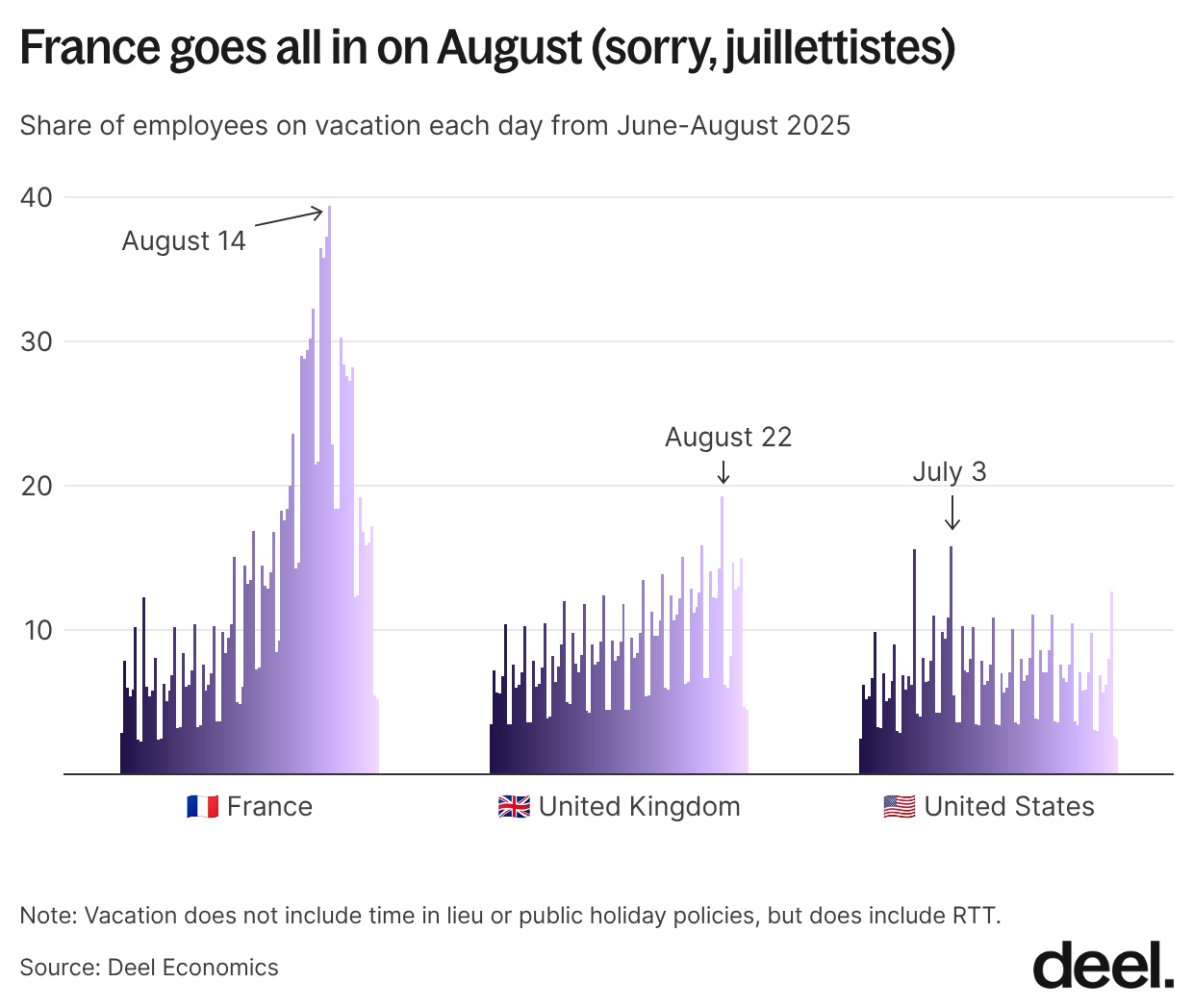
40% (!!) of French employees on Deel's platform took August 14 off in 2025. In honor of that anniversary, I charted what summer vacation looks like in each of the three countries I've lived in: the US, UK, and France.
The French don't actually have that much more vacation days than the UK. But the way that they take vacation is very different. Up to 40% of French employees in white-collar jobs like the sort on Deel's platform are taking the same day off at once, and August is their peak. There's a fun divide between the "juillettistes" (those who vacation in July) and the "aoûtiens" (those who vacation in August) in France - but it's clear one is winning out.
The UK also peaks in August, although at a much smaller number (just under 20%).
Americans prefer July, closer to the fourth, and they don't like being out all at once. This may partially be because American school summer holidays (10-12 weeks) are much longer than British (six weeks) or French (eight weeks) ones: the latter two countries tend to let out in mid-July, versus early June in the US.
What about other European countries? Germany and the Netherlands look more like the UK (peaking around 20% in August), while Spain, Italy and Sweden all peak at or above 40%, much like France.
Summer is the second-most popular time of year to take a holiday — but Christmas is the real winner. Nearly every country peaks sometime between Christmas Eve and New Year's Eve, often far outstripping the summer peak. (So if you're wondering when to send that email, avoid December too).
That’s it for this month’s roundup – see you next time.
Lauren Thomas is Deel's founding Economist, where she’s helping to bring Deel’s mission of breaking down geographic barriers to opportunity to life through data — a mission that resonates personally, as she's worked and studied in six cities across three countries!
Before joining Deel, Lauren worked in economic research and data storytelling at the Federal Reserve Bank of New York, Glassdoor, and Stripe. She has degrees in economics and data science from Oxford, Université Lumière Lyon 2, and Northwestern University.
Outside of work, she enjoys reading, playing volleyball, climbing, sewing her own clothes, and using Oxford commas. She does not enjoy long flights but takes a lot of them anyway!