
Article
6 min read
Top Identity Management Tools for 2026 That Enable Instant Rollouts
IT & device management

Author
Anna Grigoryan
Last Update
December 19, 2025

Table of Contents
Why instant rollout matters for global businesses
Deel IT
Okta
Scalefusion OneIdP
SailPoint
Ping Identity
ForgeRock
IBM Verify
CyerArk
Onfido
Jumio
How to choose the right identity management tool for fast implementation
Key features that enable instant rollouts
Challenges of scaling identity management quickly
Key takeaways
- Identity management is the foundation of secure access. Identity and access management (IAM) systems control who can access which systems, apps, and data—and ensure the right level of access at every stage of the employee lifecycle.
- For scaling companies, speed matters as much as security. When headcount, products, or regions grow quickly, IAM must roll out in days—not months—to avoid bottlenecks and risk.
- Modern IAM is built for rapid deployment. Cloud-native platforms with pre-built integrations, automated onboarding, and lifecycle management enable fast, low-friction implementation.
- The right IAM depends on your growth model. Selecting a solution means balancing rollout speed, IT complexity, and compliance needs—not just comparing feature lists.
Identity management has shifted from monolithic, on-premise projects to cloud-first, API-driven platforms that prioritize rapid deployment and security-by-default. Today’s scalable IAM spans SSO, MFA, IGA, PAM, CIAM, device trust, and risk-based policies—often delivered as modular services that plug into your stack in hours. Analyst and buyer guides consistently highlight vendors that combine breadth with speed, aided by large integration catalogs and automation for access lifecycle tasks and compliance reporting .
Why instant rollout matters for global businesses
- Better security posture: automated provisioning/deprovisioning reduces manual gaps and privilege creep
- Compliance at scale: embedded governance, certifications, and reporting keep audits on track across regions
- Better UX: SSO and device trust reduce login friction for employees, contractors, and customers.
Deel IT
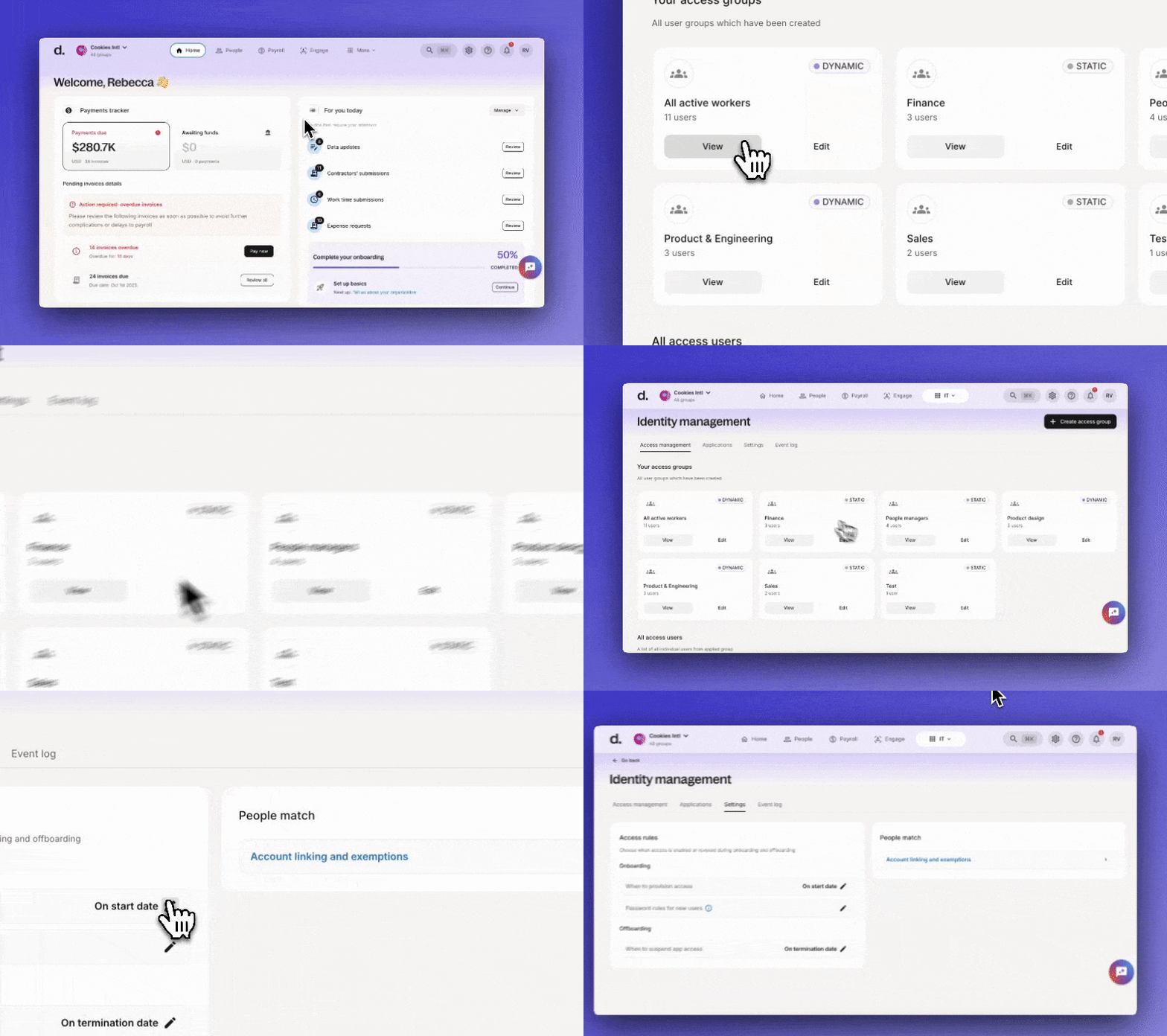
Deel IT is designed for teams that hire and scale globally, blending HR-driven identity lifecycle with instant, secure access. It connects people data (roles, locations, employment type) to automated provisioning and deprovisioning, ensuring the right access is granted from day one and revoked the moment someone leaves.
Pre-built connectors, templated role profiles, and approval workflows let IT, HR, and compliance move in lockstep—streamlining onboarding for employees and contractors alike. For distributed organizations, Deel IT’s emphasis on automation, audit trails, and device/app assignment helps standardize security across countries while preserving a great user experience.
It’s an ideal control plane when your HR system is the source of truth and you need to manage identity changes to propagate instantly across your toolchain.
Key benefits
- Faster global rollouts: Identity-triggered workflows ensure access, apps, and devices are ready before day one—no regional delays or manual setup.
- Lower security risk: Automated offboarding, enforced policies, and continuous audit logs reduce human error and lingering access.
- Less operational overhead: Centralized identity, access, and device management cuts down IT tickets and cross-team handoffs.
- Built for scale: Supports employees and contractors across countries with consistent controls, even as teams grow and change rapidly.
Identity Access Management
Okta
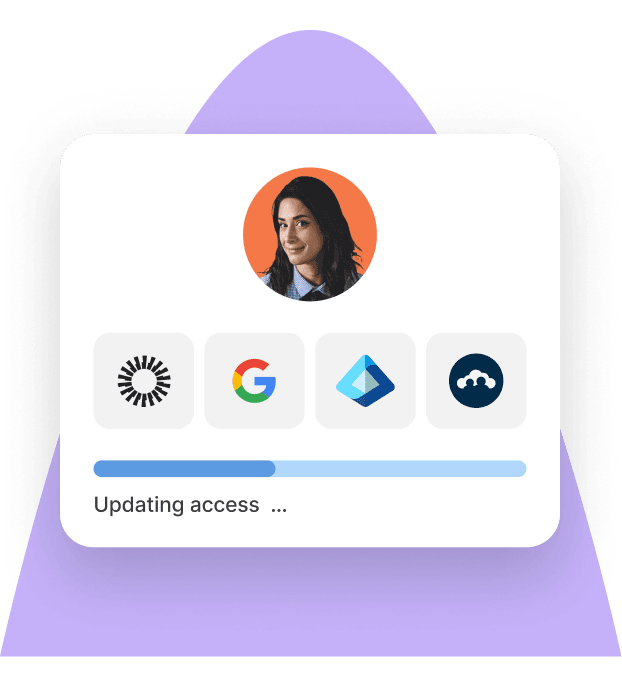
Okta is often the fastest path to enterprise-grade IAM because of its mature SSO, massive integration catalog, and cloud-native delivery. Single Sign-On (SSO) is “a centralized authentication process that allows users to access multiple applications with one set of credentials.”
Okta’s SSO plus its extensive Okta Integration Network enable quick wins: Okta provides enterprise single sign-on with over 8,000 pre-built app integrations, a core enabler of instant deployment. Its cloud-native architecture minimizes infrastructure overhead, while adaptive MFA, lifecycle management, and policy enforcement help standardize access across business units and regions.
For organizations that need both speed and reliability, Okta’s depth of integrations and mature admin experience make it a default short list option.
| Pros | Cons |
|---|---|
| Massive pre-built integration network for rapid rollouts | Licensing costs can add up at scale and across modules |
| Mature admin UX and policies streamline operations | Advanced features often require higher-tier plans |
| Cloud-native delivery reduces infrastructure overhead | Complex orgs may need professional services for optimal design |
| Strong adaptive MFA and lifecycle tooling | Vendor lock-in risk if deeply embedded across app estate |
Scalefusion OneIdP
Scalefusion OneIdP appeals to device-heavy, security-conscious organizations that want identity and endpoint controls under one roof. Scalefusion OneIdP integrates Unified Endpoint Management to ensure access only from verified users on trusted devices, reducing risk at login and beyond. Its unified endpoint management helps enforce device posture checks, while AI-driven IAM features (such as real-time risk analytics) adjust access policy dynamically.
Because user and device onboarding can be orchestrated in a single platform, IT teams see fewer moving parts and faster rollouts—ideal for frontline, retail, or field-service fleets where device security and identity must work together. or optimal design.
| Pros | Cons |
|---|---|
| Unified IAM + UEM simplifies device-first rollouts | Smaller third-party app catalog compared to IAM market leaders |
| Device posture and trust baked into access flows | Best suited for device-centric use cases, not all SSO needs |
| Reduced moving parts for frontline and fleet scenarios | May require learning curve for UEM policies and compliance |
| AI-driven risk analytics for adaptive access | Complex federation scenarios may need additional tooling |
SailPoint
SailPoint is synonymous with identity governance at scale. Identity Governance and Administration (IGA) refers to “the policies and technologies used to control access and compliance across an organization’s digital identities.”
SailPoint automates access reviews and certifications across thousands of apps, reducing manual IAM tasks—capabilities that materially cut time-to-compliance for large enterprises. While an experienced setup team is recommended, the payoff is significant: automated policy enforcement, out-of-the-box connectors, and strong audit trails that help regulated organizations scale securely without drowning in manual recertifications.
| Pros | Cons |
|---|---|
| Best-in-class governance, certifications, and access reviews | Longer implementations; requires skilled administrators |
| Robust connectors and audit-ready reporting | Less focused on SSO/CIAM experiences out of the box |
| Strong policy automation for regulated industries | Higher total cost of ownership for smaller teams |
| Scales to complex, multi-app environments | Change management needed to operationalize governance |
Ping Identity
Ping Identity is a strong fit for hybrid environments that need protocol breadth and rapid integration across cloud and on-prem. Ping Identity supports OAuth, OpenID Connect, and SAML for secure, seamless access across cloud and on-premises apps, helping enterprises meet complex federation needs quickly.
PingAccess enables fine-grained access control for apps and APIs hosted on-premises or cloud, which is useful when teams need to secure legacy applications and modern APIs under a single policy fabric. If your environment spans multiple identity providers, directories, and data centers, Ping’s flexible deployment patterns accelerate rollout without forcing re-platforms.
| Pros | Cons |
|---|---|
| Broad standards support for hybrid and legacy environments | Configuration can be complex for distributed enterprises |
| Fine-grained access to apps and APIs (PingAccess) | Smaller pre-built app catalog than Okta/Entra |
| Flexible deployment patterns across cloud and on-prem | May require multiple Ping components to cover all use cases |
| Strong federation capabilities for multi-IdP setups | Licensing and architecture can increase costs |
ForgeRock
ForgeRock is built for global enterprises that want scalable, standards-based IAM with deep extensibility. ForgeRock offers open standards-based IAM with scalability ideal for global organizations. “Open standards-based IAM” means the platform adheres to widely adopted specs (e.g., OAuth, OIDC, SAML), reducing lock-in and simplifying custom integrations over time.
While ForgeRock often requires technical expertise to implement, its developer tooling, SDKs, and orchestration capabilities pay off in complex environments with bespoke workflows and high availability requirements.
| Pros | Cons |
|---|---|
| Open-standards foundation reduces lock-in | Requires significant technical expertise to implement |
| Highly extensible with robust SDKs and orchestration | Longer time-to-value for complex builds |
| Scales for global, mission-critical deployments | Higher TCO compared to turnkey SaaS options |
| Suited for bespoke, complex workflows | Ongoing maintenance overhead for customizations |
IBM Verify
For customer identity at massive scale, IBM Verify combines CIAM, risk-based authentication, and fraud controls. Customer Identity and Access Management (CIAM) is “the tools and strategies that secure and manage customer identities for digital businesses.” IBM Verify uses AI-powered fraud detection and risk assessment for managing millions of consumer identities, supporting personalized user flows without sacrificing security. It’s a strong fit for ecommerce, fintech, and media platforms that need to balance conversion and protection, with orchestration features for passwordless and progressive profiling.
| Pros | Cons |
|---|---|
| CIAM at scale with risk-based authentication and fraud controls | Enterprise-grade complexity may require expert implementation |
| AI-driven risk and fraud detection | Licensing can be complex for varied CIAM use cases |
| Orchestration for passwordless and progressive profiling | Not primarily focused on workforce IAM needs |
| Personalization without sacrificing security | Integration effort for multi-channel customer experiences |
CyerArk
CyberArk leads in Privileged Access Management (PAM)—“the process and technology for securing, controlling, and auditing privileged (high-risk) accounts across IT systems.” Its vaulting, session monitoring, just-in-time access, and least-privilege controls help large organizations lock down admin, service, and machine identities across hybrid cloud.
For cloud-forward teams, CyberArk’s centralized policy management and API-driven integrations accelerate standardized rollouts while improving endpoint and server hardening. Enterprises choose it to reduce breach blast radius and meet stringent audit requirements for critical infrastructure.
| Pros | Cons |
|---|---|
| Market leader for PAM with deep controls (vaulting, JIT, session monitoring) | Focused on privileged accounts; not a full IAM suite |
| Strong compliance and audit alignment | Can be complex and time-consuming to deploy broadly |
| Centralized policy and API integrations | Costly for large privilege footprints |
| Reduces breach impact and lateral movement | Potential admin friction without careful UX design |
Onfido
Onfido accelerates compliant, cross-border onboarding with document and biometric verification powered by Atlas AI. Onfido’s Atlas AI platform supports global compliance in over 195 countries with no-code orchestration—useful when hiring or onboarding customers across regions with varying KYC rules. Global compliance means “meeting regulatory and security standards across multiple jurisdictions, especially crucial for international hiring.”
While there can be trade-offs between speed and thoroughness depending on verification level, Onfido’s breadth and orchestration tools enable rapid scale.
| Pros | Cons |
|---|---|
| Global document and biometric coverage with Atlas AI | Per-transaction costs can increase with volume |
| No-code orchestration accelerates onboarding flows | Verification levels can introduce UX friction |
| Strong KYC/AML alignment for cross-border needs | False positive/negative trade-offs require tuning |
| Fast time-to-value with pre-built workflows | Performance may vary by region and document type |
Jumio
Jumio is a leader in fast identity verification for high-velocity use cases. Identity verification is “the digital process of confirming a user’s claimed identity, typically using documents, biometrics, or databases.”
Fintechs and ecommerce platforms use Jumio to support near-instant onboarding while layering fraud detection and AML screening. Combined with CIAM platforms, it delivers a smooth first-mile experience that reduces drop-off without compromising compliance.
| Pros | Cons |
|---|---|
| High-throughput, fast verification for fintech/ecommerce | Pricing tied to verification volume |
| Broad document and biometric support | Integration and tuning effort for optimal pass rates |
| Built-in fraud detection and AML screening | Data residency and privacy considerations by region |
| Works smoothly with CIAM to reduce drop-off | UX can vary based on verification rigor and device |
How to choose the right identity management tool for fast implementation
Use this quick evaluation path to align business goals with the right platform:
- Define requirements: workforce vs. customer identities, geographies, device mix, risk tolerance.
- Map environment: cloud/hybrid, Microsoft vs. multi-vendor, legacy apps that require federation.
- Compliance scope: industry standards, data residency, audit cadence, certification needs.
- Integration needs: HRIS/ITSM/MDM tools, app catalogs, APIs, and developer workflows. User experience: SSO reach, passwordless, device trust, self-service access requests.
Involve IT, HR, security, and compliance stakeholders early to validate requirements and reduce rework during rollout.
Key features that enable instant rollouts
Features that consistently shorten time-to-value:
- Pre-built integrations and connectors
- Automated provisioning/deprovisioning and role templates
- Cloud-native architecture and managed services
- Intuitive onboarding and no-code orchestration
- Self-service access requests and delegated administration
- Unified endpoint management and device trust
- Lifecycle automation and audit-ready reporting
Challenges of scaling identity management quickly
- Legacy integration complexity: Older apps may need federation gateways or custom connectors; plan for phased cutovers and protocol mediation.
- User adoption and change fatigue: Provide clear SSO benefits and support; use progressive MFA and passwordless to reduce friction.
- Compliance drift at scale: Automate certifications, access reviews, and logging; standardize policies across regions.
- Incomplete deprovisioning: Tie HRIS events to automated offboarding and privilege revocation to prevent orphaned access.
- Compatibility gaps: Validate critical apps against your chosen platform’s connector library; use open standards to future-proof.
- Resource constraints: Platforms that require heavy customization need trained admins; consider managed services or out-of-the-box templates for faster time-to-value.
FAQs
What features make an identity management tool fast to deploy?
The fastest tools offer cloud-based architecture, pre-built integrations, automated provisioning, and simple onboarding workflows that drastically reduce rollout time.
How do identity management tools support compliance during rapid rollouts?
Modern IAM platforms provide automated compliance reporting, access certifications, and policy enforcement, helping companies meet regulatory needs even when scaling quickly.
Which solutions integrate best with existing HR and IT systems?
Leading IAM platforms offer thousands of ready-made app integrations and open APIs, making it easy to connect with HR, ITSM, MDM, and collaboration suites for a seamless user experience.
How do IAM platforms handle onboarding and offboarding efficiently?
They use automated workflows to provision and deprovision access in real time, ensuring secure day-one access and instant revocation for departures or role changes.
What role does automation play in accelerating identity management deployments?
Automation enables instant onboarding, continuous access updates, and streamlined compliance processes—vital for companies scaling their workforce at speed.
Anna Grigoryan is an SEO and Content Manager with 6+ years of experience in digital marketing and content strategy. She specializes in optimizing & creating high-impact, search-driven content in the tech and HR space, with a focus on global work, people operations, and the evolving world of employment. When she’s not optimizing content for growth, she’s exploring new trends in marketing and technology. Connect with her on Linkedin.


