2025 IN REVIEW
State of Global Hiring Report
Our full-year report covers the key roles startups are hiring, the explosive rise of AI trainers, the ways contractors are getting paid to combat economic shortcomings, and more.
Take a peek at some of our findings and then download our 2025 State of Global Hiring Report to get the full analysis.
Explore the report
We analyzed over one million worker contracts spanning 37,000+ companies in 150+ countries from venture-backed startups to global enterprises. Years of data on global hiring wins and shortcomings are transforming cross-border hiring. Here are the four patterns that stood out from our findings:
Top-funded startups choose talent over cost-saving
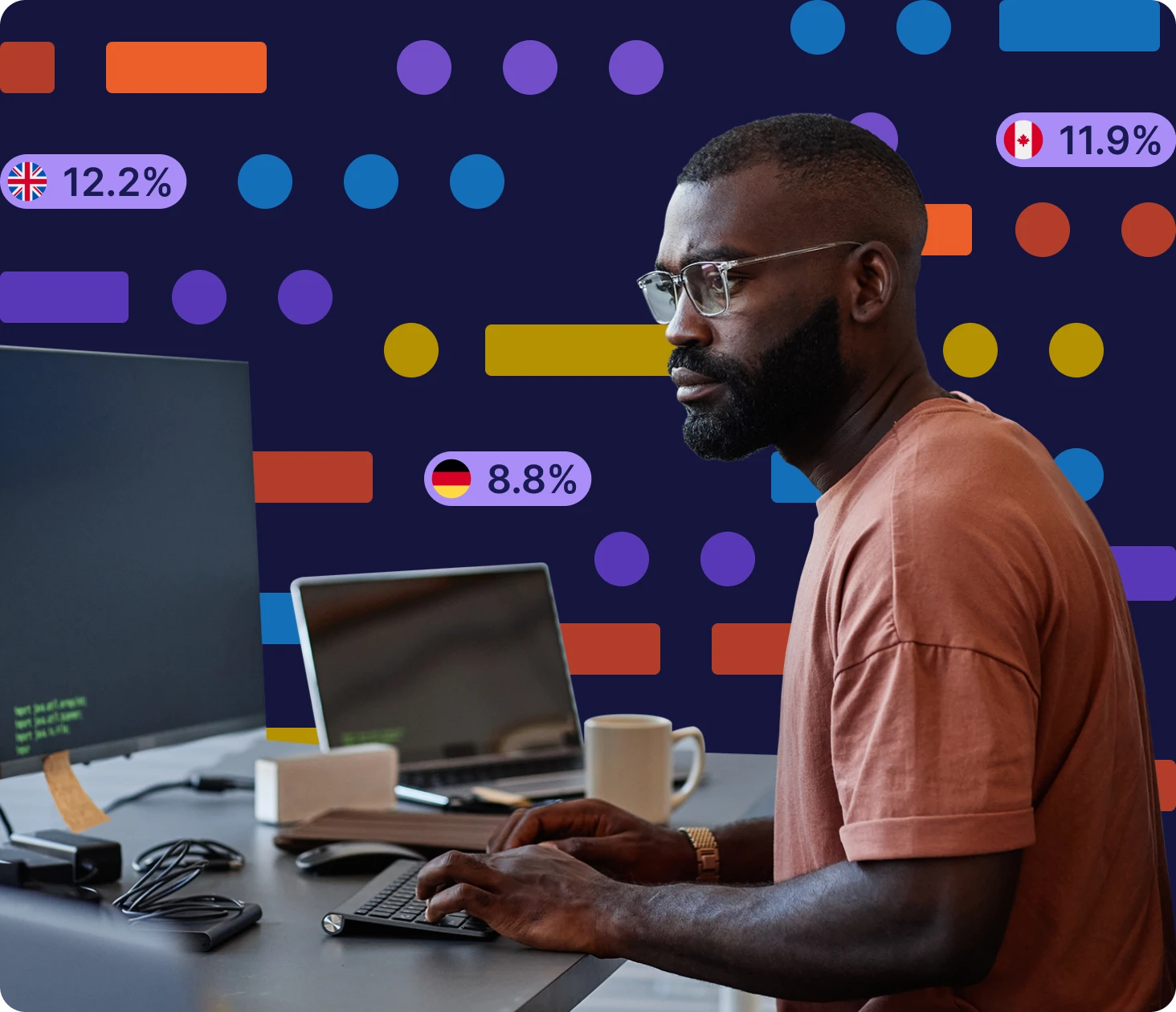
Among startups that raised $100M+, cross-border hiring concentrates in wealthy countries like the UK, Canada, and Germany. Roles requiring more expertise like software developers and AI engineers dominate their hires.
Ops roles in emerging markets see major salary growth
Latin American positions saw extremely fast salary growth, US project managers saw 24.5% increases. Less mature markets reward foundational business functions, while established markets reward leadership and specialization.
AI trainers emerge as a distinct profession
General AI trainer roles grew 283% cross-border in 2025. The occupation now spans 70,000+ workers across 600+ organizations, from basic annotators to subject matter experts in medicine and economics.
Workers adapt protective payment strategies
Contractors in high-inflation markets frequently choose USD or stablecoins over local currencies. When Croatia and Bulgaria adopted the euro, workers didn't switch entirely, and many maintained USD as a hedge.
How will these trends hold up in 2026? We’re keeping a close eye and will report back. All the while, we’ll continue standing in the forefront as the Global People Platform for HR, payroll, IT, and more. Now let’s dive into the report.
State of the market
What’s really driving global hiring decisions
Global hiring is evolving fast. Top-funded startups are expanding internationally earlier, using cross-border hiring to reach critical skills and new markets instead of the common belief of cost-cutting. Priorities have shifted to specialized roles that directly support product development, revenue growth, and long-term scale.
Enterprises use these same corridors but prioritize compliance, data analysis, and regulatory roles as they navigate complex global operations.
Across the broader market, global hiring follows clear patterns. Companies tend to hire along familiar corridors shaped by language, proximity, and regulatory alignment, while even remote workers are drifting back toward major cities. The result is a global workforce that’s flexible, but still anchored in strategic hubs.
28
%
of cross-border hires at top-funded startups are software developers.
1,400
+
cross-border employees hired in 2025 by startups with $100M+ in funding.
Hiring priorities are shifting, so how does it affect workers’ compensation, especially amongst role types? Read on to find out.
Changes in Distance (km) From Major Cities for EOR Employees Since 2022
Source: Deel Economics
Top cross-border roles for EOR
#1
Software developer
#2
Sales manager
#3
Business developer
#4
Sales account manager
#5
Customer service representative
#6
ICT account manager (tech sales)
#7
Marketing manager
#8
Client relations manager
#9
Product manager
#10
Commercial sales representative
Compensation trends
Compensation is growing, but who’s receiving it?
As US companies scale and manage more complex operations, executives and high-impact leadership roles are bringing home a disproportionate share of compensation growth compared to most roles in their organization. Following behind are technical, operational, and customer-facing roles.
Regional markets are telling a different story. C-suite positions gained nearly everywhere (excluding LATAM), but technical and operational roles diverged. Project managers in the UK saw zero change and EU help desk agents plummeted. Meanwhile, LATAM is seeing a compensation uptick in operational roles.
195
%
spike in compensation for financial analysts in LATAM.
-11.6
%
drop in compensation for help desk agents in the EU.
Mature markets reward established leadership and specialized technical talent, while emerging markets reflect currency fluctuations, rapid organizational growth in specific sectors, and shifting demand for roles. AI trainers are among the emerging roles reshaping the workforce.
US Top 5 Roles by Compensation Growth
Percentage growth in median compensation, 2024-2025
Source: Deel Economics
AI trainers
New job opportunities, rising trends, and familiar patterns
AI needs human touch and the job market has clearly responded. There are now 70,000+ AI trainers developing and refining systems in areas like economics, medicine, and translation. Tapping into the global talent pool brings in native speakers and subject matter experts. Depending on the skill-level and overall needs of the AI, trainers are making anywhere from $15-75 per hour.
Despite the advancements in technology, many familiar patterns remain within workplace gender disparities. In the US, male trainers are typically making $20 more than their female counterparts. Interestingly, certain fields like psychology are largely lead by women, yet they are still making less.
58.2
%
of AI trainers are based in the US—the largest global concentration.
600
+
organizations are employing AI trainers, with many placing within AI labs.
As workers continue to make a case for compensation improvements—even in growing, high-demand markets—workers in more volatile economic situations are utilizing new advancements to protect their earnings.
Median Hourly Compensation (USD) of AI Trainers in the US, by Occupation and Gender
Source: Deel Economics
Top countries hiring AI trainers

#1
The United States

#2
India

#3
The Philippines

#4
Canada

#5
Kenya

#6
Nigeria
Currency hopping
Uncertain economies bring on stable payment methods
Many contractors are choosing to be paid in USD or stablecoins instead of local currencies because of economic instability and general behaviors in their global roles. By referencing contractors who use Deel, we see workers in high-inflation markets are more likely to protect their purchasing power with these methods.
Stablecoin adoption is also gaining traction as an alternative to both local currencies and traditional USD payments. Stablecoins serve as a cheaper alternative to traditional remittances in markets with volatile or restricted currencies, where cross-border payment costs are typically high.
5 of 10
USD appeared in five of the ten most common country-currency combinations globally in 2025.
84.6%
of Argentinian workers chose to be paid in USD vs their local currency.
These trends signal a structural shift in how global contractors manage compensation risk. They also impact how companies structure cross-border compensation, manage foreign exchange exposure, and support distributed teams in economically unstable regions.
Percentage of Contractors Withdrawing in a Given Currency, by Contractor Country
Source: Deel Economics
Countries with highest stablecoin adoption among contractors

#1
Argentina

#2
Cameroon

#3
South Korea

#4
Türkiye

#5
Vietnam

#6
Tajikistan
Conclusion
This is just a peek at how things are becoming equal parts exciting and uncertain. Companies are investing in top talent and these specialists—and executives—are seeing the most return in their bank accounts. New jobs have secured themselves in markets, while workers continue to push for secure payments.
Download the full State of Global Hiring Report to explore the insights in depth and get ahead on where global work is headed next.
Deel’s Data & Methodology
All contracts that were active on Deel’s platform (i.e., paid or managed through the platform) in 2025 were considered in the analysis. Year-over-year comparisons from 2023 or 2024 included all contracts active in those years. Each contract is associated with a compensation in a given currency. These compensation rates were converted to USD (or a local currency if relevant) using the average 2025 foreign exchange rate.
Any analysis that specifies “employee” only includes jobs managed through Deel’s Global Payroll, Employer of Record (EOR), Professional Employer Organization (PEO), and Deel HR products. Some analyses also included independent contractors managed or paid through Deel’s contractor management software.
Download the full report for free to explore the complete, in-depth analysis of our data and methodology.

Download the Global Hiring Report 2025
Share a few details to get the full scope of today’s global landscape.