
Guide
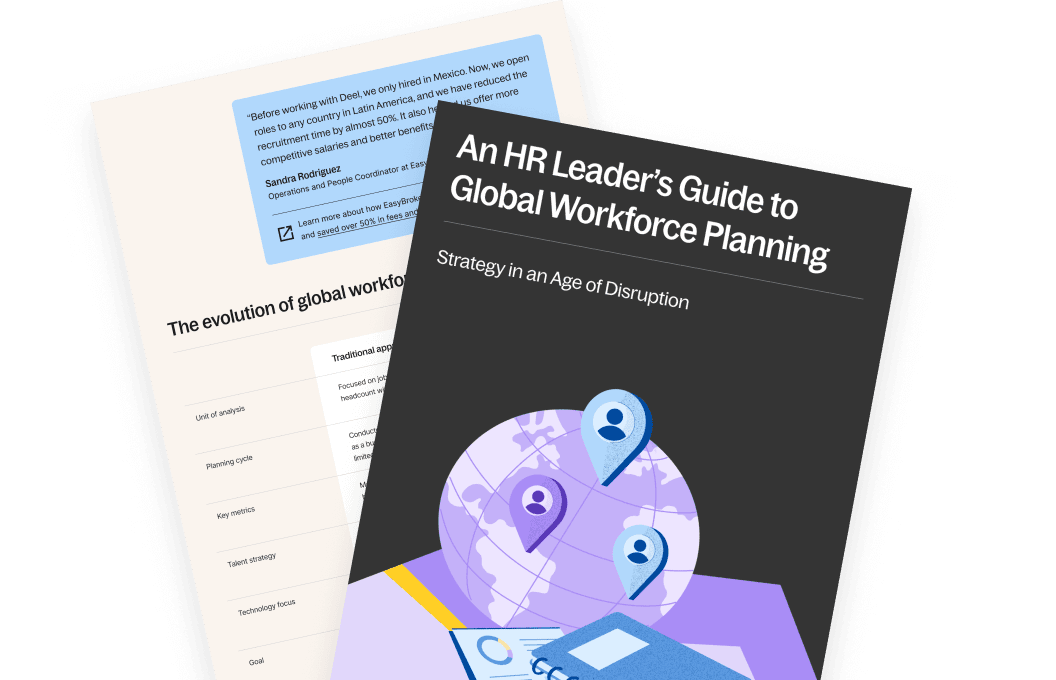
An HR Leader’s Guide to Global Workforce Planning
Global HR
Get the resource for free
Workforce planning used to be a predictable, cyclical exercise. Not anymore. Today, HR leaders are operating in a world defined by talent shortages, rapid AI adoption, demographic shifts, geopolitical unpredictability, and widening skills gaps. These pressures are hitting every organization, everywhere, all at once.
As a result, traditional planning models fall apart, short-term fixes can’t keep pace, and leaders are left asking the same question: “Do we have the right skills, in the right places, at the right time?”
This guide helps you build a resilient, future-ready workforce strategy that adapts to disruption rather than reacts to it—using data, foresight, and globally aligned processes.
Guide to global workforce planning: Content overview
This guide breaks down the complexity of global workforce planning into clear, actionable frameworks. You’ll learn how to:
- Understand the foundations of modern workforce planning, including the forces reshaping talent supply, demand, and mobility across global markets.
- Identify the biggest challenges affecting global organizations today, from skills shortages to geopolitical risk to rapid AI acceleration.
- Apply a proven planning framework that helps HR leaders anticipate future needs, align talent with business strategy, and make data-driven decisions.
- Operationalize workforce planning at scale, with best practices for cross-functional collaboration, scenario modeling, and global governance.
- Prepare for the future of work, including trends in AI adoption, demographic shifts, flexible work models, and the expanding global talent pool.
Together, these insights help you strengthen resilience, improve talent allocation, and build a workforce strategy designed for long-term success.
Key challenges HR leaders face when planning globally
Global workforce planning is essential, but increasingly difficult. Leaders today must navigate:
- Conflicting global trends like talent scarcity, automation, demographic shifts, and financial pressure
- Fragmented local labor markets with varying costs, regulations, and cultural norms
- The need for real-time workforce intelligence in environments where conditions change rapidly
- Skills gaps and shifting roles created by AI and digital transformation
- Competing priorities between short-term firefighting and long-term strategic planning
- Pressure to reduce costs while increasing capability, often with limited headcount or resources.
This guide shows you how to reconcile these tensions and build a workforce plan that’s resilient, scalable, and future-ready.
Who is this guide for
This guide supports any leader responsible for designing or operationalizing a global workforce strategy:
- HR and people leaders will learn how to build a structured planning process that keeps pace with disruption, ensures talent readiness, and supports business-wide decision-making.
- Workforce planning, Ops & Analytics teams will gain a scalable, data-oriented framework for forecasting talent needs, modeling scenarios, and aligning resources to future priorities.
- Executives and business leaders can use this guide to better understand the risks and opportunities shaping your global workforce, and to drive more strategic, forward-looking decisions.
- Global talent and mobility leaders will learn how to Identify where, when, and how to deploy talent across borders with greater confidence and compliance.
Get the guide and learn how to move from reactive decisions to strategic workforce planning powered by data, insight, and global readiness.
FAQs
How can HR leaders align a workforce strategy with global business goals?
To align a workforce strategy with global business goals, HR leaders can begin by mapping business objectives (e.g., expanding into new markets, launching X product) to workforce imperatives (skills needed, regional footprint, cost structure). Then, they build a people plan that supports those imperatives: which roles to hire, where, and what competencies to develop. Crucially, they need to stay connected to business leaders, ensuring workforce decisions are not isolated but act as enablers of growth, not just cost centres.
How can HR teams forecast talent needs across multiple regions?
To forecast talent needs across multiple regions, start with demand signals: business expansion plans by region, product launches, market entry, or regulatory changes. Then layer supply data: current headcount by region, attrition rates, contractor usage, and internal mobility. Use scenario modelling: “if market A grows by 20%”, “if attrition rises by 5 pp in region B”. From there, produce a regional talent‑gap view: roles, skills, and timing. Maintaining an up‑to‑date regional talent inventory is key.
What data do HR teams need to make informed headcount planning decisions?
To make informed headcount planning decisions, HR teams need:
- Core data: current headcount by region/function, roles by level, attrition history, internal mobility rates.
- Then add cost data: total cost of employment (salary, benefits, taxes) by geography.
- Also include market data: benchmarks for salary, demand for skills.
- On the demand side: business‑driven hiring plans, project pipelines, budget allocations.
- Finally: performance and productivity metrics to link headcount to output. With this combination, you can decide “how many people, where, for what cost.”
How can HR teams plan for headcount during periods of economic uncertainty or inflation?
HR teams should plan for headcount during periods of economic uncertainty or inflation by adopting a scenario-based approach. This means building flexible workforce plans that account for best-, moderate-, and worst-case economic conditions. They need to prioritize critical roles, identify which positions can shift to contract or part-time models, and align closely with Finance to track real-time cost fluctuations. Leveraging workforce planning tools that include salary inflation forecasts and market data also helps maintain agility without compromising long-term workforce goals.
How can HR teams build flexibility into workforce plans to account for growth or contraction?
To ensure flexibility when creating workforce plans, HR teams can incorporate:
- Buffer roles (contractors or contingent workers) that can scale up or down quickly
- Cross‑trained internal talent to shift across functions or geographies
- Scenario modelling built into the plan (best case/normal/worst case) with trigger points (e.g., market growth hits, budget cut hits).
Use rolling reviews rather than fixed annual plans and revisit every quarter to adjust. This keeps your workforce plan dynamic, not fixed.
How can HR teams ensure workforce planning is agile enough to adapt to sudden change?
HR teams can ensure workforce planning is agile enough to adapt to sudden change by implementing rolling planning cycles instead of fixed annual plans. They should build flexibility into talent strategies by maintaining a blend of employee and contingent workers, developing internal mobility frameworks, and investing in cross-skilling.
Using real-time data dashboards and scenario modeling tools enables HR to respond quickly to shifts, whether economic, organizational, or market-driven, without having to rebuild plans from scratch.
What are the key considerations when handling workforce planning for different worker types?
The most important considerations when handling different worker types (employees, contractors, freelancers) are:
- Legal and compliance implications: contractor classification, tax exposure across jurisdictions
- Cost structure differences: contractors may cost more hourly but have fewer obligations
- Skill availability and mobility: contractor pools may give access to rare skills faster
- Visibility and data capture: employees are often managed in an HRIS, while contractors may not
- Integration within the workforce strategy: contractors cannot be “afterthoughts,” you need to define when to use each type, and how succession or internal mobility links with them.
By recognizing these differences upfront, you avoid workforce planning blind spots.
What’s the best way to involve Finance and Business teams in workforce planning decisions?
To involve Finance and Business teams in workforce planning decisions, you need to:
- Involve them early: make workforce planning a shared exercise, not just HR’s process
- Use shared language: headcount = cost, roles = strategic assets, time‑to‑hire = revenue impact
- Provide business leaders with dashboards that show headcount by region, cost, and projected value
- Hold joint planning sessions: HR, Finance, and Business get together to discuss workforce scenarios alongside budget, product roadmap, and strategic milestones.
What tools or systems can help HR teams centralize and automate global workforce planning?
To centralize and automate global workforce planning, look for platforms that offer:
- A global HRIS like Deel with multi‑country support (currencies, legal entities, contractor/employee tracking)
- A workforce‑planning module like Deel Workforce Planning with headcount modelling, scenario simulation, and budget overlays
- Real‑time dashboards and analytics (talent supply/demand, attrition, cost)
- Workflow automation for approvals, requisitions, transfers
- Integration with other tools, like payroll, project management, and finance systems.
These tools reduce manual spreadsheet dependencies, speed up planning cycles, and give HR the visibility they need to act globally.
How do geopolitical risks or regulatory shifts impact workforce location strategies?
Geopolitical risks or regulatory shifts impact workforce location strategies by introducing uncertainty around labor laws, tax structures, data residency, and employee safety. HR teams must continuously monitor global compliance requirements and assess location risk profiles.
When planning where to hire or relocate talent, they need to balance cost advantages with legal and operational stability. In volatile regions, it’s essential to build contingency plans, such as remote-first policies or the ability to quickly engage contractors.
What metrics should HR teams track to detect early signs of burnout, attrition, or talent risk?
HR teams should track the following metrics to detect early signs of burnout, attrition, or talent risk:
- Unplanned absenteeism rates
- Employee engagement survey scores (especially in areas like workload, support, and wellbeing)
- Voluntary turnover and flight risk scores
- Manager-to-direct report ratios
- Overtime and after-hours work trends
- PTO usage and carryover
These signals, especially when viewed in combination, can reveal hidden stress points before they turn into costly exits or productivity losses.
More resources
- A Guide to Global Expansion
- How to Build a Talent Mobility Strategy to Drive Team Engagement and Development
- A Guide to Building a Compensation Strategy for Global Teams
- Strategic Planning Guide for Global Recruitment and Hiring
- AI in Talent Acquisition: A Guide for Global Teams
- Mastering Global Employment Laws with Deel: Startups Guide