
Guide
A Guide to Device Lifecycle Management for Global Healthcare Companies
IT & device management
Get the resource for free
Healthcare is changing fast.
Teams now work across countries and time zones, and many employees operate remotely. Virtual care is part of daily operations, while cloud systems store patient records and support communication.
As organizations grow, managing employee devices becomes more complex. HR hires in new regions. IT secures devices and manages access. Procurement coordinates vendors across a global supply chain, and compliance teams oversee regulatory requirements.
Every device must arrive on time and be secure from the first login. It must be tracked throughout daily use and recovered safely at the end of its life.
When these steps are not clearly defined, problems follow.
When these steps are not clearly defined, the impact is immediate. New hires are delayed because equipment is not ready. Devices fall behind on updates. Access remains active after employees leave. Costs rise and risk increases. In healthcare, these breakdowns disrupt operations and can put patient safety at risk.
This is why lifecycle device management for the global healthcare industry matters.
Why lifecycle device management is critical in healthcare
Healthcare organizations operate under strict regulatory requirements. Devices often access sensitive patient data, connect to clinical systems, and support daily operations that cannot afford downtime.
In this environment, security controls must remain consistent, access must be tightly managed, and documentation must stay clear and audit-ready. When processes are unclear or inconsistent, real risks follow:
- Delayed equipment can slow care delivery
- Missed updates can increase security risk
- Weak offboarding can leave systems exposed
- Poor documentation can create audit pressure
Strong lifecycle device management reduces these risks. It improves oversight. It supports compliance. It keeps daily work running smoothly across regions.
What lifecycle device management means in healthcare
Lifecycle device management covers the full life of employee devices — from planning and procurement to recovery and retirement. In healthcare, these devices are more than everyday tools. Laptops and tablets give staff access to patient records, connect to clinical systems, and support daily care delivery.
In the global healthcare industry, lifecycle device management is more complex. Devices are shipped across borders. Teams work remotely. Data privacy laws differ by country. Each of these factors makes coordination harder.
When processes are unclear, problems follow. HR may not know when devices will arrive. IT may not have accurate records of where equipment is located. Procurement may face supply chain delays that slow onboarding and daily operations.
A clear lifecycle device management approach defines each stage of the device journey:
- Plan device needs by role and region
- Purchase equipment from approved vendors
- Deploy secure, ready-to-use devices
- Maintain devices with regular updates
- Recover assets during offboarding
- Retire devices with proper data removal
When these steps are clear and repeatable, teams work more efficiently. Errors decrease. Compliance becomes easier to manage.
Why HR and IT must work together
Lifecycle device management is not only an IT task. It directly affects hiring, onboarding, and compliance.
Each team plays a role:
- HR manages hiring timelines and offboarding
- IT secures devices and controls system access
- Procurement manages vendors and budgets
- Compliance monitors regulatory requirements
When these teams work separately, gaps appear.
A new employee may start without equipment. IT may not be informed about a departure. Access may remain active longer than it should. Devices may not be recovered on time.
Clear alignment connects these workflows. Hiring should trigger device setup. Offboarding should trigger asset return and access removal. Device data should be visible across teams.
When HR and IT work together, onboarding improves. Compliance becomes stronger. Risk decreases.
The hidden costs of weak lifecycle management
Poor lifecycle management creates hidden costs.
Manual asset tracking leads to mistakes. Spreadsheets become outdated. Devices are misplaced. Shipments are delayed due to supply chain issues.
These problems affect the whole organization:
- Onboarding slows
- Productivity drops
- Budgets become harder to manage
- Audit preparation becomes stressful
Security risks also increase. Healthcare organizations are common targets for cyberattacks. If a device is lost or retired without proper data removal, sensitive information may be exposed.
Weak processes also limit improvement. Without clear asset data, leaders cannot measure performance or make informed decisions.
A consistent lifecycle approach improves visibility. It reduces waste. It supports better decision-making across teams.
What’s inside this guide
This guide provides a practical framework for lifecycle device management in the global healthcare industry.
Inside, you’ll learn how to:
- Build a scalable lifecycle framework across regions
- Clarify ownership at every stage of the device journey
- Align HR and IT around shared processes
- Improve asset visibility and accountability
- Reduce compliance and security risks
- Strengthen documentation for audits
- Support global expansion without adding operational complexity
Whether you are expanding internationally or modernizing remote operations, this guide helps you design a lifecycle system that supports both compliance and growth.
What strong lifecycle device management looks like
In healthcare, lifecycle device management cannot rely on informal processes. It requires consistency from planning through retirement.
Organizations need clear device standards by role. They need reliable vendors. They need secure deployment and ongoing monitoring.
Offboarding must trigger fast recovery and access removal. Retirement must follow defined compliance policies.
When these practices stay consistent, healthcare organizations gain:
- Better asset visibility
- Stronger regulatory confidence
- Lower operational risk
- More predictable hardware costs
- Fewer disruptions to care delivery
Simplify lifecycle device management with Deel IT
Managing lifecycle device management for the global healthcare industry across 130+ countries is complex. It requires coordination across HR, IT, procurement, and compliance teams—all while protecting patient data and meeting strict regulatory requirements.
Deel IT brings provisioning, asset tracking, recovery, and workflow automation into one global platform built for distributed healthcare teams.
With Deel IT, organizations can:
- Procure and manage devices in one centralized dashboard
- Deploy and track equipment globally from a single platform
- Ship pre-configured devices that meet healthcare security standards
- Automate onboarding and offboarding workflows
- Improve asset visibility across regions
- Access 24/7 global support
Instead of managing multiple vendors, spreadsheets, and disconnected workflows, your team operates within one connected system designed to support compliance and stable operations at scale.
If your organization is expanding internationally, now is the time to strengthen lifecycle device management for the global healthcare industry.
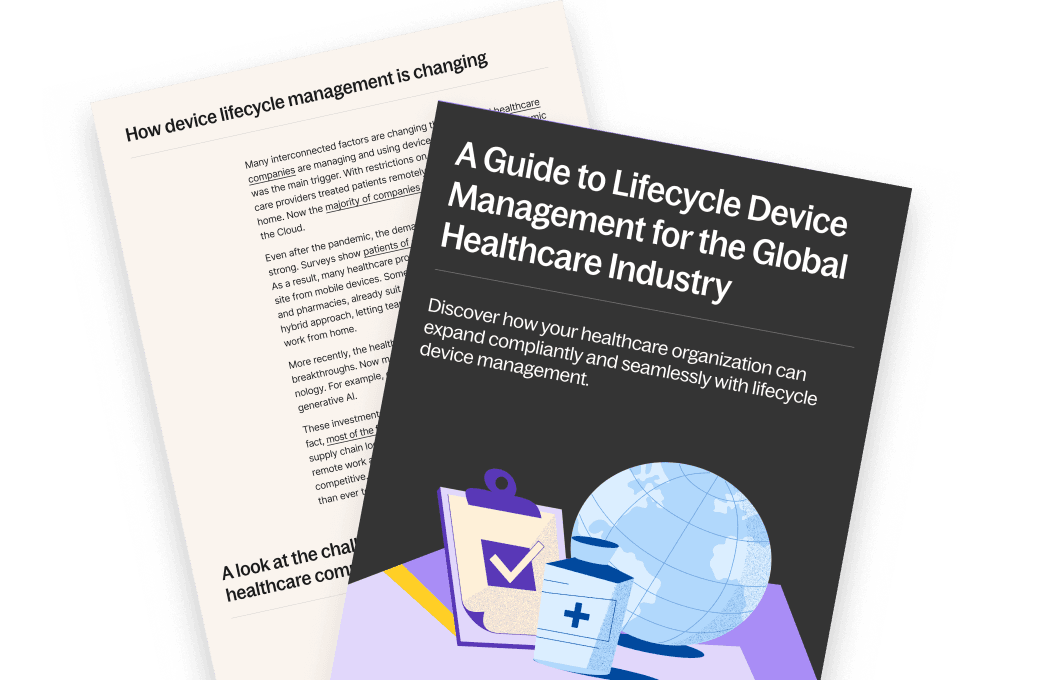
Download A Guide to Lifecycle Device Management for the Global Healthcare Industry to build a clearer, more consistent approach.
And when you’re ready to see how this works in practice, schedule a demo to explore how Deel IT can support your healthcare operations worldwide.
More resources
FAQs
What is device lifecycle management?
Device lifecycle management is your company’s strategy for handling all your equipment. It outlines how you give employees access to tools and ensure devices meet ongoing needs. HR, IT, and procurement teams are usually responsible for overseeing the process.
Managing devices for a large, dispersed workforce can be challenging. That’s why many healthcare companies choose to outsource processes to IT asset management solutions like Deel. Instead of dealing with inventory and updates, your team is free to focus on patient care, employee support, and overall strategy.
What are the benefits of device lifecycle management to healthcare companies?
An effective device lifecycle strategy makes it easier for healthcare companies to scale their processes and expand abroad. You can guarantee employees always have the right tools to perform their jobs well, no matter where they hire. As a result, you can ensure the same quality of patient care across all your operations.
In an industry struggling with rising costs and talent shortages, device lifecycle management also makes companies more resilient. The extra oversight allows you to make more informed decisions about IT budgets and resource allocation. As you can hire overseas more easily, you can tap into foreign hiring pools and source niche talent. Promising candidates will be more likely to join your team when you can offer the latest technology and a seamless onboarding experience.