
Guide
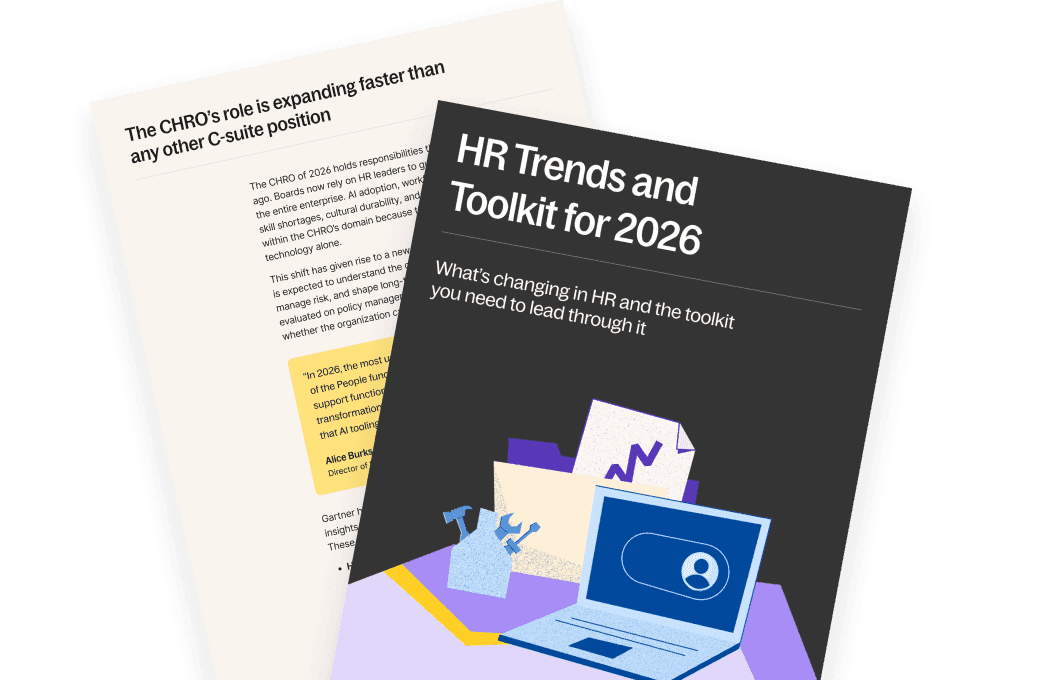
HR Trends and Toolkit for 2026: Navigating AI, Global Complexity, and Change Management
Global HR
Get the resource for free
The world of HR is shifting faster than most organizations can keep up. In the last two years alone, HR leaders have had to respond to an explosion of AI capabilities, rising cost pressures, tightening labor markets, global compliance complexity, and unprecedented rates of organizational change.
The result? HR is being asked to operate with more efficiency, clarity, and strategic influence, all while the HR environment continues to shift.
We’ve built this practical guide with strategies and tools to help you successfully navigate key HR trends for 2026 and maintain operational resilience.
What’s inside the 2026 HR trends report and toolkit
This guide highlights the five macro trends redefining HR in 2026 and shows you exactly how to prepare for each of them. Powered by insights from Deel’s People team, this report provides strategic insights and hands-on tools for each trend:
The rise of autonomous AI and the new human–machine enterprise: How AI is reshaping HR workflows, decision-making, skills, and org design, plus what HR must do now to adopt it safely and strategically.
HR’s expanding strategic mandate: Why HR is now accountable for workforce strategy, decision intelligence, organizational health, and leadership capability, and how to evolve your function for 2026.
Operational resilience: The shift from reactive problem-solving to building data-driven systems, processes, and teams that can absorb volatility and scale.
Global talent, demographic pressure, and compliance complexity: What changing labor markets, aging populations, and cross-border hiring mean for your talent strategy, and how to operate globally without operational risk.
HR as the engine of change management: Organizations are changing faster than people can absorb it. HR professionals need to own the systems, communication, and capability needed to support employees and keep workforces aligned and energized.
Each trend progresses from insight to action, providing your HR team with clear next steps. For each trend, we included practical tools, templates, checklists, and frameworks, such as:
AI readiness checklist
Global HR readiness checklist
Change readiness assessment
Vendor evaluation guide for AI-powered HR tools
Who is this guide for?
This guide is for executive and senior-level HR leaders responsible for large-scale transformation across global organizations.
Chief Human Resources Officers (CHROs) shaping enterprise workforce strategy amid economic, technological, and regulatory change
Global Heads of HR / People Operations responsible for consistency, governance, and execution across regions
VPs and Directors of HR leading function-wide transformation, including AI adoption, org design, and restructuring
Workforce Planning and Talent Strategy Leaders driving skills-based planning, mobility, and capability development
FAQs
How is AI impacting HR in 2026?
AI in 2026 is expected to keep progressing toward agentic capabilities, meaning systems that can take multi-step actions, surface insights, and make recommendations in real time. This shift transforms how HR operates: talent acquisition and hiring become faster and more predictive, performance management becomes data-rich, and workforce planning becomes continuous instead of annual.
But this shift also introduces new responsibilities: ensuring transparency, maintaining human-in-the-loop oversight, and complying with emerging global regulations (including high-risk classifications under acts like the EU AI Act). HR must now architect the “human–machine enterprise” and build the governance, skills, and policies to use AI responsibly.
Why is skills-based workforce planning becoming more important?
Roles are changing faster than org charts can keep up. With AI shifting tasks, emerging skill gaps, and new career pathways forming, traditional job-based planning no longer gives HR the visibility needed to allocate talent effectively. A skills-based approach helps organizations:
Understand what capabilities truly drive business outcomes
Redeploy talent faster during change
Build more accurate career pathways and mobility programs
Prepare teams for AI-driven shifts in work
In 2026, skills become the stable currency as roles, structures, and expectations rapidly evolve.
How should HR tech stacks evolve for 2026?
In 2026, HR tech stacks need to become connected, data-rich, and AI-ready. This means moving away from fragmented point solutions and toward platforms that integrate hiring, workforce data, performance, learning, and global operations in a single place.
A 2026-ready HR stack should include:
Native AI capabilities that enhance—not replace—human judgment
Global compliance automation as cross-border hiring expands
Strong data governance, auditability, and explainability
Tools that support mobility, skills tracking, and workforce planning
How can HR build a toolkit for the future?
A future-ready HR toolkit blends strategy, technology, and repeatable processes. At a minimum, HR needs:
Clear frameworks for AI adoption and ethical oversight
Skills and capability maps aligned to business objectives
Global hiring, onboarding, and compliance playbooks
Change management templates and leader enablement guides
Workforce planning models that integrate talent, cost, and capability data
Our guide’s appendices provide HR teams with ready-to-use templates, enabling them to start building their custom toolkit immediately.
What steps should HR teams take now to prepare for 2026?
To prepare for 2026, HR teams can accelerate readiness by focusing on five priorities:
Assess AI maturity: Skills, governance, data quality, and adoption readiness.
Strengthen global foundations: Worker classification, payroll compliance, documentation, and visibility.
Build resilience capacity: Leadership, culture, and systems that can absorb ongoing change.
Evolve the HR function’s scope: From operational partner to strategic architect.
Prioritize skills over roles: Build capability maps and embed skills into hiring, mobility, and development.
More than predicting disruption, preparation is all about building the muscle to adapt to it.
What global HR challenges are coming and how to prepare?
In 2026, global HR teams face rising complexity:
More companies hiring across borders
Diverging laws around payroll, benefits, AI, and data privacy
Inflation and currency volatility are impacting compensation models
Growing pressure to deliver consistent global experiences with local nuance
Preparation for these challenges requires:
Accurate visibility into all worker types and locations
Global processes that adhere to local laws
Partners and platforms that automate compliance and reduce operational risk
Standardized documentation, data governance, and mobility processes
What drives employee engagement and retention in 2026?
Engagement and retention hinge on three factors: meaningful work, strong manager relationships, and a sense of stability during change. With AI reshaping roles and ongoing volatility in markets and geopolitics, employees are looking for clarity more than ever. HR plays a central role by creating predictable processes, supporting managers with communication and coaching, and ensuring employees understand how they fit into the future of the business.
How can HR maintain culture and connection in a distributed, fast-changing world?
As remote and hybrid teams become the norm, culture depends less on physical spaces and more on consistent communication, leadership behaviors, and shared norms. HR must:
Equip managers to foster connection intentionally
Ensure employees feel seen and supported across locations
Reinforce culture through rituals, recognition, and transparent decision-making, especially during periods of rapid change or transformation.