Article
8 min read
AI Summit: A Front-Row Seat to the Future of Work
AI

Author
Ellie Merryweather
Last Update
December 15, 2025
Table of Contents
Introduction by Nick Catino, Global Head of Policy at Deel
Keynote: The AI Workforce Has Arrived by Aaron Goldsmid, GM, Head of Product at Deel
Panel: AI in Hiring & HR: What Works, What’s Next
AMA: Applied AI for Business Leaders, with Anne-Marie Clifton, Director of Product, AI & Agents at Zapier
AI in action: Deel AI and Deel AI Workforce
Book your Deel demo
The AI Summit brought together experts to talk about AI and its impact on the future of work. We focused on cutting through the noise and offering practical advice for the next steps of AI adoption in HR, payroll, and much more.
- Introduction with Nick Catino, Global Head of Policy at Deel
- Keynote: The AI Workforce Has Arrived with Aaron Goldsmid, GM, Head of Product at Deel
- Panel: AI in Hiring & HR: What Works, What’s Next with Alan Price, Director of Talent Acquisition at Deel, Siadhal Magos, CEO of MetaView.AI, and Vijay Mani, CEO of Covey
- AMA: Applied AI for Business Leaders with Anne-Marie Clifton, Director of Product, AI & Agents at Zapier
- AI in Action: Deel AI and Deel AI Workforce with Jase Assor, Senior Product Marketing Manager at Deel
- Lightning round: Expert takes in 5 minutes
Here you’ll find some highlights from the summit, but to not miss a single insight, catch up on the full recording right here.
Introduction by Nick Catino, Global Head of Policy at Deel
Deel’s AI Summit gives you a front-row seat to how AI is actually reshaping work - not just in theory, but what's really happening in the workplace and what's coming next. Nick kicked us off by setting the scene and sharing a few global trends from our AI research and Deel's platform.
There's a ton of AI hype right now. New models are being released, AI salaries are skyrocketing, and billion-dollar AI companies are emerging overnight. The news is fascinating, and everyone is captivated by AI developments. But the questions we hear from our customers are much more grounded. They want to know how AI can improve their businesses. How can it deliver ROI? How will it impact headcount and budgets for 2026? And what trends are emerging to ensure businesses keep up with their competitors?
At Deel, we released two major pieces of research in 2025. One is a policy report, AI and the Future of the Workforce, which examines global AI regulatory and labor market trends and offers a view of what's to come, especially given the dramatic changes in global politics around AI in 2025.
We also released an InfoBrief with IDC, The Role of AI in the Global Workforce, surveying 5,500 business and IT leaders across 22 countries. A few trends stood out:
-
70% of organizations have moved beyond pilot AI projects. AI is no longer just experimental; it’s being actively deployed.
-
Two in three companies expect slow entry-level hiring, an early warning if you’re concerned about job changes.
-
91% of companies say roles have already changed or been displaced because of AI. Jobs are actively being redesigned around the changing labor market.
-
Two in three companies are investing in AI training to reskill their teams. Businesses aren’t waiting for government support—they’re taking action themselves.
“Everyone worries about AI-related job losses, but I’m optimistic. Even if old task-based jobs disappear, new roles will emerge—just as automation and trade historically reshaped the labor market. AI could do in ten years what trade did in fifty. It’s an exciting time; the labor market and global economy are evolving before our eyes.”
Keynote: The AI Workforce Has Arrived by Aaron Goldsmid, GM, Head of Product at Deel
“The next generation of global teams won't just include people. It will include AI teammates,” said Aaron, highlighting in the keynote how AI is becoming an integral part of the workforce. The world has evolved from local to remote to global, and now it’s entering a new era: one augmented by AI.
Deel sits at the intersection of AI and the global workforce, serving companies across 150 countries. Aaron emphasized that Deel’s mission remains unchanged: “Our mission has always been to help people work for the best companies in the world, no matter their location. AI doesn't change our mission. It accelerates it.”
AI as a workforce co-pilot
Traditional HR systems struggle to keep up with rule-checking, approvals, and operational complexity. Deel’s solution automates repetitive tasks, clarifies complex processes, and ensures humans stay in control. Aaron likened it to “onboarding a compliance expert who wakes up every morning already knowing every new labour law in 150 countries and quietly guiding you through the right action, step-by-step. That’s Deel AI Workforce.”
What makes Deel AI different is its foundation of trust, transparency, and compliance—not black-box automation. “Every action is traceable, reversible, and has clear human sign-off points. AI performs HR, payroll, and finance tasks securely with audit trails and escalation routes. For the first time, teams can grow their impact without growing their workload or their headcount.”
The future of work
Aaron concluded by extending Deel’s mission to human-AI collaboration. “AI isn't here to replace people. It's here to help people work smarter, faster, and more fairly, wherever they are in the world.”
Panel: AI in Hiring & HR: What Works, What’s Next
A panel of industry leaders—Alan Price, Director of Talent Acquisition at Deel, Siadhal Magos, CEO of MetaView.AI, and Vijay Mani, CEO of Covey—gathered to discuss the transformative role of AI in talent acquisition. The conversation explored the tangible ways AI is reshaping recruiting today, the future of recruiter roles, and how organizations can leverage technology to create fair, effective, and human-centered hiring processes.
Better matching through AI
One of AI’s most significant contributions is improving candidate-job matching. Traditional recruiting often relied on mental checklists, memory, or manually tracking thousands of potential candidates. Today, AI can analyze large datasets, interpret nuanced instructions, and surface profiles that might otherwise have been missed.
In practice, this means:
-
Top-of-funnel efficiency: Reviewing thousands or even millions of applications faster while maintaining accuracy and fairness.
-
Smarter sourcing: AI interprets job requirements flexibly, considering candidates who may narrowly miss a numerical cutoff but are an excellent overall fit.
-
Interview insights: Recording and analyzing candidate conversations can highlight missing information or uncover hidden strengths that a human interviewer may have overlooked.
These capabilities allow recruiters to act as strategists, guiding hiring managers with data-driven insights and making better decisions faster.
Evolving recruiter roles
With AI handling much of the heavy lifting, recruiter roles are evolving rapidly. The future recruiter is akin to a scout for a professional sports team: deeply knowledgeable about the market, the talent pool, and what success looks like.
Key changes include:
-
Greater specialization and domain expertise.
-
Increased agency and ability to influence multiple roles simultaneously.
-
More strategic engagement with hiring managers and candidates.
Smaller, leaner recruiting teams can now make a bigger impact. AI allows recruiters to scale their efforts while focusing on personalized touchpoints, high-frequency candidate interactions, and relationship-building that no algorithm can fully replicate.
Fairness, bias, and personalization
AI’s promise to reduce hiring bias is compelling, but it’s not automatic. To achieve fair outcomes, organizations need structured bias audits and impact assessments to monitor AI decision-making. Recruiters are at the center of the process, maintaining control over strategic decisions. Systems must be designed to avoid unsupervised AI “learning” that could inadvertently reinforce biases.
When implemented thoughtfully, AI can actually make hiring feel more human. By automating low-value tasks, recruiters can engage with candidates on a more personal level, delivering tailored experiences at scale.
Avoiding talent cloning
A critical concern in AI-driven hiring is “talent cloning”—favoring candidates who fit a narrowly defined mold. The panel emphasized that AI must be treated as a dynamic, active system rather than a one-and-done solution. Organizations need to continuously evaluate whether the AI is screening for the right characteristics, assessing values alignment, and surfacing candidates who bring diverse perspectives and experiences.
The human element remains central
Despite AI’s capabilities, the human dimension of hiring remains irreplaceable. Candidates still want to interact with people, understand the culture, and feel a connection with the teams they may join. AI amplifies the recruiter’s capacity to deliver these human experiences by handling volume, providing insights, and freeing time for meaningful engagement.
Recruitment is more than just matching candidates to verifiable skills. It’s about finding teammates who fit the team’s culture and values. “When we’re building our products, we’re mainly working for companies that are trying to hire teammates as opposed to just a bundle of verifiable skills.” Chemistry and team dynamics were highlighted as crucial, but sometimes hard to articulate. “If I have a feeling that, hey, I don’t know if I’ll work well with this person…some of those things are really hard to articulate,” Siadhal explained, noting that values alignment is often “the most human part of the whole process.”
Proactive AI: The next frontier
Looking ahead, the panel agreed that the next phase of AI in recruiting is proactive collaboration. AI will not only respond to instructions but also anticipate needs. “It should actually start to learn about what you’re likely to want before you even ask for it.” Practical examples include AI identifying candidates similar to high-performing hires, signaling to hiring managers about top prospects, and providing context for upcoming interviews.
The panelists also stressed that forward-thinking organizations will see the greatest benefit from AI. “The organizations that deeply commit to understanding where AI can be impactful…are going to meaningfully accelerate their growth and development versus organizations that don’t.” Products like Covey and Metaview are helping teams operationalize AI effectively, and over the next 12 to 18 months, this will likely become standard practice.
Panel discussion: Key takeaways
- Recruitment is about human chemistry and values alignment, not just skills.
- AI should serve as an enabling tool, operating transparently within clear guardrails.
- Micro-decisions can be automated to improve efficiency; humans retain the final judgment.
- Proactive AI will anticipate recruiter needs, providing richer insights and context.
- Organizations that understand and integrate AI will accelerate hiring success.
The panel concluded with a clear message: the future of recruiting is not AI versus humans. It’s AI with humans, creating smarter, more informed, and more humane hiring processes.
To hear Nick, Vijay, and Siadhal dive deeper into these topics, catch the full conversation here.
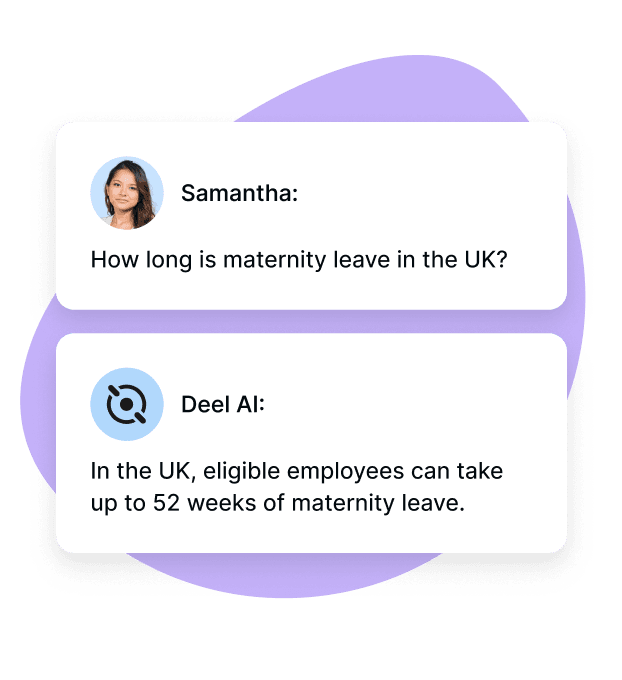
Deel AI
AMA: Applied AI for Business Leaders, with Anne-Marie Clifton, Director of Product, AI & Agents at Zapier
Next, Aaron sat down with Anne-Marie Clifton, Director of Product, AI & Agents at Zapier, for an exciting Ask Me Anything session.
Anne-Marie Clifton has been at the forefront of shaping how thousands of companies automate and scale with AI. During the AMA, she unpacked the practical, the technical, and the uncomfortable questions around automation, agents, and the future of work.
Q: What’s the most transformative AI shift you’ve seen in the last year? And what separates teams that get it right from those that don’t?
A: One of the biggest shifts is the move from viewing AI as a tool to seeing it as a mechanism for full organizational transformation.
The organizations doing this well aren’t just asking, “How do we make our current processes a bit faster with AI?” Instead, they’re stepping back and asking: “What outcomes are our teams driving, and how could we achieve those in entirely new ways?”
This means using AI not only to accelerate work, but to redesign how work flows through the organization—reducing handoffs, leveraging cross-domain expertise, and enabling people to operate more in their strengths because AI makes other expertise accessible.
This transformation starts with small tooling wins but quickly evolves into rethinking entire domains, letting domain experts redefine how value is created. When done well, it leads to better outcomes, better customer value, higher employee satisfaction, and dramatically less operational overhead.
Q: For teams still stuck in the “AI as a tool” mindset, what’s the unlock to move into true transformation?
A: We use a tool-agnostic AI Transformation Framework. It has four components:
-
Leadership: Executives must actively champion the importance of AI transformation. Without leadership alignment and reinforcement, nothing else sticks.
-
Talent & Culture: Hire and promote for AI fluency and adoption. Include it in performance reviews and incentives. Importantly, cultivate a culture comfortable with ambiguity—because people understandably fear how AI might change their jobs.
-
Tooling: Equip the people closest to the problems with AI tools—not just a centralized operations team. This democratizes rethinking workflows.
-
Governance: Don’t skip this. You need auditability, accountability, and responsible oversight as AI becomes more embedded in processes.
Together, these four elements create the foundation for real transformation.
Q: As we shift from generative AI to agentic AI, what actually makes a good agent?
A: Many people say “agent” when they just mean “AI.” A true agentic system has its own goals, the ability to decide when those goals are met, and the ability to operate in loops, calling tools as needed—whether to find, generate, transform, or move information.
Most organizations don’t truly need agentic systems for every problem. But agents are a great starting point when exploring possibilities, because they can fill the space between human intent and machine understanding more flexibly than deterministic workflows.
Once you figure out what works, you often bake it down into something more predictable and deterministic.
Agentic systems shine when you need flexibility or need to handle diverse inputs, but they require trade-offs: more flexibility means more variability in outputs. That’s why human-in-the-loop reviews or “draft” actions (rather than auto-send) are essential, such as generating offer letters for recruiters to review before sending.
Q: Any skills individuals should build as AI becomes more integrated into work?
A: Communication. AI forces us to make the implicit explicit. You must articulate assumptions, express intent clearly, and structure information in a way an LLM can understand—which often turns out to be the way humans should communicate, too.
AI is a forcing function for clearer documentation, more explicit reasoning, and more intentional interpersonal communication. It's fascinating how often designing things to work well with AI forces you to design them to be really, really lovely for humans.
To get more of Anne-Marie’s insights, catch up on the full AMA at the summit.
AI in action: Deel AI and Deel AI Workforce
Next, Jase Assor, Senior Product Marketing Manager at Deel, joined the summit to demonstrate how AI inside Deel can take real work off your plate, so you can focus on people, not paperwork.
Deel AI Workforce
Most HR and payroll teams today are lean. You're expected to support growth, keep everyone compliant across countries, and answer questions from every side of the business. The tools intended to help often just add more tabs and clicks.
That's why we built the Deel AI Workforce. Instead of another chatbot, you get agents. You hire them, give them a task, and they take action—completing steps, running checks, and helping you get work done inside and outside of your HR and payroll system.
Starting with hiring, which is hard to do across borders. You need to know where to hire, how much to pay, and more. You could spend hours in spreadsheets, reading salary guides, and researching countries, or you can hand all that research off to the Hiring Guru and go straight to decision-making.
Imagine you need three junior designers who speak English, in a European time zone, and we’ve got a budget of $130,000. The Hiring Guru looks across Deel's global data and online sources to suggest where to hire. You can see here we get a shortlist of locations, with estimated fully loaded cost, local hiring notes, and it even tells us how realistic our budget is. It's like a global scouting report generated instantly, without hours of manual research. Then you get a drafted job description to work from.
So you can go directly from the Hiring Guru to your ATS and post the position. Instead of wrestling with salary data and country guides, you move from “we should hire” to “ready to post” in minutes. And if you need help hiring, Talent puts you in touch with our network of trusted recruiting partners and companies.
To see these agents in action, catch up on the AI Summit recording. You’ll see where the agents live inside the Deel platform, and get a step-by-step demo of how to use the Hiring Guru, the Payroll Detective, and the Goodbye Genie.
Book your Deel demo
At the AI Summit, we dived into how AI is already helping inside Deel. It supports you when you hire, when you pay people, when you answer compliance questions, when you review expenses, and even when you create learning content.
AI is built into our platform. It's there in the agents you hire, the assistant you ask, and the checks that run in the background. If you'd like to see more, book a demo with us and we'll walk you through everything AI can do.
What you've seen is just the beginning of how we'll use AI at Deel, and we're really excited for what's coming next.
Further resources:
- Deel Policy Report: AI and the Future of the Workforce
- IDC InfoBrief, commissioned by Deel: The Role of AI in the Global Workforce
- Deel AI
- Deel AI Workforce
Live Demo
Get a live walkthrough of the Deel platform

Ellie Merryweather is a content marketing manager with a decade of experience in tech, leadership, startups, and the creative industries. A long-time remote worker, she's passionate about WFH productivity hacks and fostering company culture across globally distributed teams. She also writes and speaks on the ethical implementation of AI, advocating for transparency, fairness, and human oversight in emerging technologies to ensure innovation benefits both businesses and society.