
Article
11 min read
2026 Guide to Identity Platforms with MFA and Conditional Access
IT & device management

Author
Dr Kristine Lennie
Last Update
March 31, 2026

Identity is your first line of defense, and your biggest operational unlock.
Modern identity management platforms need to combine multi-factor authentication (MFA) with conditional access to stop credential-based threats without slowing teams down. MFA verifies users using two or more independent authentication factors. Conditional access adds context: evaluating location, device health, risk level, and role before granting access. Together, they ensure the right people access the right resources under the right conditions.
But in 2026, identity isn't just about secure logins: it's about managing access across the entire employee lifecycle.
As companies scale globally, access decisions can't live in silos. When someone joins your team in Berlin, transfers to a finance role in Austin, or leaves the company, their access should change instantly, not days later after someone files a ticket. Without automation connecting HR events to access policies, you're left with manual workflows, access drift, and compliance gaps across tools, devices, and regions.
The platforms below solve different parts of this challenge.
What to look for in an identity management platform in 2026
Modern identity platforms combine strong authentication with lifecycle automation, governance, and deep integration across HR and cloud systems. The strongest platforms typically share five core capabilities:
| Capability | What it means | Example in practice |
|---|---|---|
| Adaptive MFA & risk scoring | Adjusts authentication based on user, device, location, and behavior | Require hardware keys for high-risk logins |
| Conditional access policies | Defines who can access what, when, and how | Enforce MFA for sensitive finance tools |
| HR/cloud integration | Connects HRIS, IdPs, and SaaS tools | Provision users from HR to apps automatically |
| Governance automation | Automates access requests and reviews | Schedule entitlement reviews |
| Developer support & passwordless authentication | Supports passkeys and custom auth flows | Enable passwordless login for internal tools |
Below are the leading platforms in 2026 that handle authentication, access control, and workforce identity management — what they do well, and where they fit.
Deel IT
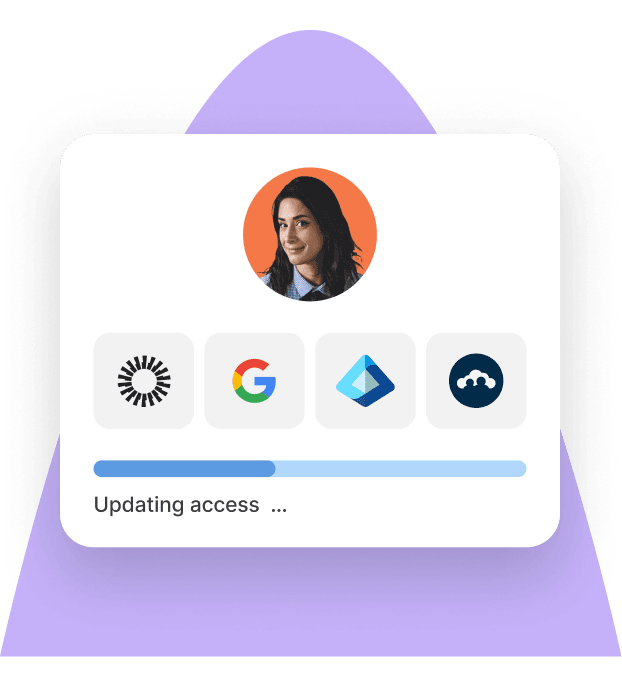
Deel IT approaches identity management differently by anchoring access decisions in workforce lifecycle data. Instead of treating identity as a standalone IT layer, Deel IT connects HR events directly to MFA, conditional access, and compliance workflows across global teams.
Key features:
- HR-driven identity orchestration: Syncs workforce lifecycle events (hires, role changes, transfers, departures) directly to identity workflows across regions and entities
- Automated provisioning and deprovisioning: Just-in-time (JIT) onboarding and offboarding using policy-based access tied to roles and country-specific requirements
- Region-aware compliance workflows: Maps job codes, entities, and locations to least-privilege roles to reduce exceptions and access drift
- IAM integrations: Works alongside leading identity providers (Okta, Microsoft Entra ID, Google Workspace) to enforce consistent MFA and conditional access policies
- Audit-ready evidence: Centralized access attestations, change history, and policy tracking for multinational compliance
- API-first architecture: Connects HRIS, directories, IdPs, ITSM, and ticketing tools for faster approvals and exception handling
- Operational efficiency: Reduces time-to-access for new hires and minimizes deprovisioning windows without increasing user friction
Best for: Global organizations that need to unify HR, IT, and security operations and automate access changes across multiple countries and entities.
Why Deel IT leads:
Traditional identity platforms treat HR data as an input to be manually synced. Deel IT makes HR events the trigger, so your access policies automatically stay aligned with who people are, what they do, and where they work.
Identity Access Management
Microsoft Entra ID
Microsoft Entra ID (formerly Azure AD) is Microsoft's enterprise identity platform, designed primarily for organizations embedded in the Microsoft ecosystem.
Key features:
- Conditional access policies: Granular controls for device health, location, and risk-based decisions across Free, Premium P1, and P2 tiers
- Microsoft ecosystem integration: Native support for M365, Azure, Intune, and Defender signals
- Continuous Access Evaluation: Real-time token and session controls
- Hybrid directory sync: Strong support for on-prem Active Directory
Best for: Enterprises that rely on Microsoft tools and hybrid Active Directory setups.
Limitations: Requires significant Microsoft licensing investment; limited flexibility outside the Microsoft ecosystem; HR event automation requires custom integrations or third-party middleware; multi-entity global deployments can be complex without additional orchestration layers.
Cisco Duo
Cisco Duo focuses on device trust and endpoint security as the foundation for access decisions.
Key features:
- Device health enforcement: Checks device posture before granting access
- Phishing-resistant authentication: FIDO2 security keys and verified push notifications
- Adaptive policies: Uses user, device, and location signals to adjust authentication
- Zero-trust alignment – Supports endpoint posture as part of zero-trust architecture
Best for: Security teams managing diverse device fleets with a focus on phishing resistance and endpoint security.
Limitations: Device-centric approach doesn't account for HR context (role changes, transfers, entity moves); lacks native HR integration for lifecycle management; limited support for complex conditional access beyond device posture; compliance evidence collection requires additional tools.
IT security and device management resources
Effective offboarding, remote device control, and provisioning workflows are key to keeping IT secure, compliant, and efficient.
- Set consistent security standards: Use our Free IT Policy Template to establish rules for encryption, updates, and remote wipe procedures.
- Prevent offboarding risks: Follow our Onboarding & Offboarding Guide for Distributed Teams to manage device returns, data removal, and remote access across multiple time zones.
- Prepare for growth: Align device recovery and data protection with company expansion using the IT Strategy Toolkit: 2026 Guide.
- Simplify remote device rollout: Use our Equipment Provisioning Policy Template to make onboarding and hardware distribution smoother for distributed teams.
Ping Identity
Ping Identity specializes in connecting legacy systems with cloud identity infrastructure.
Key Features:
- Connects old and new systems: Integrates internal servers and applications with cloud applications
- Precise access controls: Restricts who can see or use sensitive systems and data, such as financial records, patient information, or customer data
- Secure partner access: Gives external partners or other companies controlled access to specific systems without sharing passwords
- Directory and gateway connectors: Links internal applications to cloud identity systems
Best for: Companies with complex IT setups that include older systems, multiple domains, or strict compliance requirements.
Limitations: Steep learning curve and longer implementation timelines; expensive licensing model; lacks HR-native workflows and workforce lifecycle automation; manual configuration required for global, multi-entity compliance; not ideal for cloud-first organizations.
miniOrange
miniOrange offers flexible, cost-effective IAM with fast deployment.
Key Features:
- MFA options: Offers multiple ways to verify identity and apply risk-based policies
- Standard integrations: Supports common protocols like SAML, OIDC, and SCIM
- Adapters for legacy applications: Quick setup for older or niche applications
- Cloud-ready design: Built for cloud deployments
Best for: Budget-conscious teams seeking rapid time-to-value with customizable policies and cloud-first deployments.
Limitations: Limited enterprise-grade features for large, complex organizations; no HR lifecycle integration; minimal governance and compliance automation; smaller ecosystem compared to enterprise platforms; may require significant customization for multinational deployments.
SailPoint
SailPoint focuses on identity governance, compliance, and access certifications rather than real-time access provisioning.
Key Features:
- Automated access reviews: Role-based access, with periodic reviews that verify users’ access is appropriate for their role, removing outdated or unnecessary permissions
- Segregation-of-duties enforcement: Prevents users from having conflicting permissions
- Compliance management: Tracks access changes with reporting and audit trails
- Access request workflows: Structured approvals for granting access
Best for: Programs that prioritize compliance, governance, and audit readiness.
Limitations: Heavy, governance-focused platform not optimized for real-time provisioning; complex implementation requiring specialized expertise; focuses primarily on governance and certification rather than real-time HR-triggered provisioning; expensive licensing; slower time-to-access for end users compared to modern platforms.
Auth0 and Descope
Auth0 and Descope are developer-focused platforms for managing customer logins and authentication.
Key Features:
- Developer tools: Pre-built code libraries and APIs that let developers add custom login and authentication features to their applications
- Passwordless authentication: Supports passkeys, magic links, and device biometrics
- Custom login experiences: Branded and tailored login flows for customers or partners
- Low-code flow builders: Visual tools to set up authentication policies quickly
- Flexible rules and hooks: Customize behavior without changing backend systems
Best for: Developer-led teams building consumer-facing applications, partner portals, or customer identity (CIAM) solutions.
Limitations: Designed for external users, not workforce identity; no HR integration or employee lifecycle management; not built for internal enterprise access governance; lacks compliance features for multinational workforce management; requires separate systems for employee identity.
How Deel IT streamlines employee access and identity
Traditional identity platforms treat workforce data as something to import and sync. Deel IT makes the workforce lifecycle the foundation of identity management.
When you hire someone in Germany, promote a team member in Singapore, or offboard an employee in Brazil, Deel IT doesn't wait for a ticket or a manual sync—it triggers updates to MFA policies, conditional access rules, and compliance controls through integrated identity providers based on their new role, location, and entity.
Other platforms offer powerful features, but they all require you to bridge the gap between HR and IT manually. Deel IT eliminates that gap entirely, giving you a single platform that provides:
- Automatic access alignment: Employees get the right access based on their role, location, and entity in real time
- Built-in compliance: Supports global compliance requirements with policy templates and centralized reporting
- Faster provisioning: Employees can start working immediately with accounts, devices, and apps ready
- Centralized visibility: Track user access, devices, and entitlements from one dashboard
- Automated lifecycle updates: Onboarding, promotions, transfers, and offboarding trigger immediate access adjustments
- Secure offboarding: Instantly remove access, lock accounts, and securely retrieve company devices when employees leave, keeping systems and hardware protected without manual effort
- Lower operational overhead: Eliminates manual identity workflows and reduces administrative burden
If your workforce is global, your identity platform should be too. Deel IT is built from the ground up to connect HR and security operations across borders.
Book a demo to see how Deel IT connects HR, IT, and security to automate workforce identity at scale.
Deel IT

FAQs
When should organizations enforce mandatory MFA?
Organizations should enforce mandatory MFA as early as possible to reduce the risk of credential-based attacks. Start with high-risk groups like administrators and finance teams, then expand coverage across the organization in phased rollouts.
How do I create effective conditional access policies?
Build policies around context — combining user roles, device compliance, geolocation, and behavioral risk signals. Require stronger authentication for sensitive or privileged actions, and gradually expand enforcement to avoid operational disruption.
Which MFA methods provide the strongest security?
Phishing-resistant methods offer the highest level of protection. These include FIDO2/WebAuthn passkeys, hardware security keys, device biometrics, and verified app-based push authentication.
How can I test MFA and conditional access before a full rollout?
Start with pilot groups and enable policies in audit or report-only mode. Use built-in simulation and logging tools to validate decisions, measure user impact, and fine-tune rules before enforcing them organization-wide.
What are common challenges when deploying MFA with conditional access?
Common hurdles include integrating legacy systems, minimizing user friction, managing policy exceptions, and maintaining consistent compliance across regions and entities.
Dr Kristine Lennie holds a PhD in Mathematical Biology and loves learning, research and content creation. She had written academic, creative and industry-related content and enjoys exploring new topics and ideas. She is passionate about helping create a truly global workforce, where employers and employees are not limited by borders to achieve success.


