Article
10 min read
What Platforms Preserve Employee Benefits During M&A Transitions?
M&As

Author
Ellie Merryweather
Last Update
March 11, 2026
Table of Contents
How benefits continuity works in practice
How Deel preserves benefits from Day 1
Where traditional HRIS platforms fit — and where they fall short
Cross-border deals: where the stakes are highest
Deel's M&A benefits integration checklist
The hybrid approach: EOR now, HRIS for the long term
Ready to protect your people through your next deal?
Key takeaways
- Employee benefits continuity in M&As depends on two factors: legal-employer readiness and systems integration — both need to be resolved before close.
- Deel gives enterprise teams a single platform for global benefits administration, payroll, and an integrated EOR across 150+ countries, delivering compliant Day-1 coverage without waiting on entity setup.
- For most enterprise deals, the lowest-risk approach combines Deel EOR for immediate continuity and Deel HR for long-term administration.
Several platforms help companies preserve employee benefits during M&A transitions, but they differ significantly in how fast they can deliver coverage and how much cross-border complexity they can handle.
Deel is built for teams navigating this from Day 1. Its global HR platform combines benefits administration, payroll, and an integrated Employer of Record (EOR) option across 150+ countries — so acquired employees stay covered even when local entities don't exist yet. Traditional HRIS platforms offer deep benefits administration, but require existing legal entities and longer integration timelines to achieve the same outcome.
For enterprise teams with global workforces, the difference often comes down to two factors: legal-employer continuity and how quickly systems can be integrated post-close.
How benefits continuity works in practice
Two factors determine whether benefits survive an M&A transition intact: who holds legal-employer responsibility at close, and whether systems can migrate eligibility and enrollment data fast enough to avoid gaps.
Legal-employer continuity is the bigger risk. In domestic deals, a successor employer can often assume existing plans with minimal disruption. Cross-border deals are harder — local entity requirements, differing statutory benefits, and data portability constraints all add time and compliance exposure.
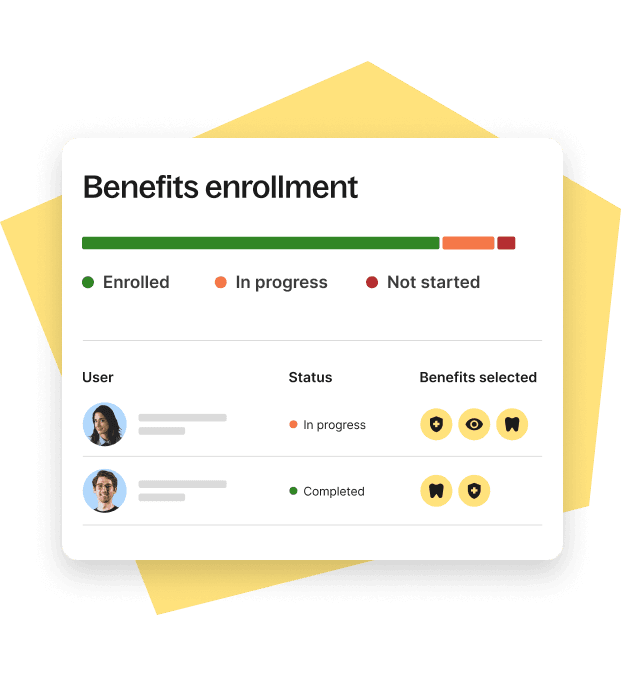
Benefits Administration
Domestic vs. cross-border M&A: where benefits break down
| Transition type | Typical steps | Key compliance needs | Primary failure points |
|---|---|---|---|
| Domestic (single-country) | Successor employer designation; plan sponsor updates; payroll/benefits system mapping; synchronized open enrollment | Continuity of coverage, nondiscrimination rules, COBRA/ERISA (US), timely carrier notifications | Late eligibility files; payroll deduction mismatches; plan sponsor changes not executed in time |
| Cross-border (multi-country) | Local employer designation or EOR onboarding; statutory benefits mapping; entity or EOR-based payroll setup; global data migration | Local labor and social security laws; statutory leave/holiday rules; currency/FX handling; country-specific enrollment windows | Missing local entity; misaligned statutory benefits; delays in data migration; noncompliant plan changes |
Complementary reading:
How Deel preserves benefits from Day 1
Deel gives M&A teams a single platform to onboard acquired employees, administer benefits, and run payroll across 150+ countries, without waiting for local entities to be established.
When an acquirer lacks a legal presence in a country, Deel's integrated EOR steps in as the legal employer within days, keeping statutory benefits and payroll running without interruption. Once entities are set up, teams can transition seamlessly to Deel HR for long-term administration and talent management.
For enterprise deals spanning multiple countries, this matters because the alternative — waiting on entity setup or manual data migration — is where coverage gaps happen. Deel automates localized enrollment, payroll deductions, and statutory compliance per country, reducing the handoffs that typically cause Day-1 failures.
For deeper context on payroll and benefits risk in deals, see Deel's guide to managing payroll during M&A.
Where traditional HRIS platforms fit — and where they fall short
Traditional HRIS platforms like Workday, SAP SuccessFactors, and Oracle HCM are built for benefits depth: complex plan architectures, carrier integrations, eligibility rules, and multi-plan governance at scale. For enterprise teams with established entities and mature benefits programs, they're the right long-term system.
The limitation in M&A is structural. An HRIS isn't a legal employer. It can't confer legal-employer status or sponsor statutory benefits in countries where the acquirer has no entity, which means cross-border Day-1 continuity depends entirely on how fast entity setup or a separate EOR arrangement can be completed. In fast-moving deals, that gap is where benefits break.
Deel vs. traditional HRIS: the two most strategic factors
| Factor | Deel (with integrated EOR) | Traditional HRIS |
|---|---|---|
| Legal-employer continuity | Immediate in 150+ countries via integrated EOR; transitions to Deel HR once entities exist | Requires existing local entities or a separate EOR arrangement |
| Systems integration | Centralized global onboarding; statutory benefits configured per country from Day 1 | Deep admin capabilities; integration timelines vary from weeks to months |
| Day-1 risk | Legal and systems coverage run in parallel, reducing eligibility gaps | Strong once employer and carriers are established; Day 1 depends on entity readiness |
Cross-border deals: where the stakes are highest
International M&As amplify every benefits risk. Teams face four recurring challenges: establishing legal-employer presence in new countries, meeting local labor and social security requirements, mapping statutory benefits alongside legacy plans, and maintaining data portability under local privacy laws.
Deel is built to support enterprise teams at every stage of that journey:
| Situation | How Deel helps |
|---|---|
| Lacking entities in acquired employees' countries | Integrated EOR provides immediate legal-employer coverage and statutory benefits, no entity setup required |
| Entity-ready markets with complex plan designs | Deel HR handles long-term benefits administration, carrier integrations, and multi-country payroll at scale |
| Mixed deal — some countries entity-ready, some not | EOR bridges gaps at close while Deel HR manages administration where entities already exist |
Deel's M&A benefits integration checklist
Use this framework to manage benefits continuity from pre-close through stabilization.
Phase 1: Pre-close assessment
-
Map legal-employer structures, plan sponsors, and statutory obligations by country
-
Identify which countries need EOR coverage vs. successor-employer transitions
-
Inventory benefits data sources, carrier connections, and enrollment calendars
-
Reconcile plan documents, eligibility classes, and waiting periods
-
Confirm carrier SLAs and flag blackout periods that could affect cutover timing
-
Validate works council and union consultation requirements
Phase 2: Day-1 bridge
-
Activate Deel EOR in countries where entities aren't ready — onboarding takes days, not months
-
Prepare successor-employer and plan-sponsor changes in entity-ready markets
-
Model entity vs. EOR scenarios side-by-side: readiness dates, compliance exposure, cost
-
Align labor notifications and transfer mechanics with local requirements
Deel Employer of Record

Phase 3: Systems integration and data migration
-
Cleanse HR and benefits data; align eligibility rules before migration
-
Map unique identifiers (employee IDs, national IDs) and validate plan eligibility rules
-
Use Deel's API and bulk import tools to reduce manual touchpoints
-
Run dry-run payroll and carrier file tests before cutover
-
Define a cutover freeze window and document transformation logic
Phase 4: Benefits rationalization
-
Align legacy plans with statutory baselines and your future-state portfolio
-
Compare coverage tiers, employer contributions, and waiting periods across entities
-
Identify protected terms under local law and carve out exceptions where required
Phase 5: Communication and change management
-
Publish country-specific FAQs, timelines, and cutover steps — confirm no coverage lapse
-
Set a communications cadence: pre-close, T-30, T-14, T-7, go-live, and +30 days
-
Stand up named support channels and manager toolkits for edge cases
Useful resource:
Phase 6: Post-go-live controls
-
Run parallel payroll and eligibility checks for one to two cycles
-
Monitor daily exception reports: missing deductions, rejected EDI records
-
Verify statutory filings and remittances post-cutover
-
Keep a hypercare triage channel open for 30–60 days
Phase 7: Governance and risk
-
Define a RACI across legal, HR, payroll, IT, and vendor partners
-
Set SLAs for enrollment corrections, deduction fixes, and carrier updates
-
Maintain a live risk register with mitigation owners and enforce change-freeze periods
Phase 8: Security and data privacy
-
Complete a data protection impact assessment before migration
-
Enforce role-based access, audit logs, and encryption across Deel and any legacy systems
-
Address country-specific data residency constraints during migration planning
Phase 9: Country-by-country playbooks
-
Build repeatable templates per country: statutory enrollments, social contributions, leave rules
-
Track enrollment windows and insurer notice periods by timezone
-
Pre-approve localized benefit summaries and plan documentation with legal
Phase 10: Metrics and continuous improvement
-
Define KPIs: enrollment completion rate, deduction accuracy, carrier acceptance rate, ticket resolution time, employee satisfaction
-
Schedule retrospectives at +30, +60, and +90 days
-
Track total cost of ownership vs. plan to time transitions from EOR to entity-based administration
Deel's Built-In HRIS

The hybrid approach: EOR now, HRIS for the long term
For most enterprise M&As, the lowest-risk path combines both tools. Use Deel EOR to secure immediate legal-employer continuity and statutory benefits at close, then transition to Deel HR for long-term administration once entities and plan sponsors are fully established.
When to lean on EOR
-
Entities don't exist in some acquired countries
-
Statutory benefits and local payroll need to be live within days of close
-
You need to reduce compliance exposure while entity setup proceeds
When to transition to long-term HRIS administration
-
Entities and plan sponsors are established
-
Complex plan designs (self-insured medical, defined benefit pensions) require advanced administration
-
You're ready to consolidate global HR data into a single system of record
Handoff best practices
-
Freeze scope and timelines before transition
-
Reconcile eligibility and contributions; run dual reporting for one cycle
-
Notify employees of any plan ID or carrier changes with confirmed effective dates
Ready to protect your people through your next deal?
Deel gives enterprise teams compliant Day-1 benefits coverage across 150+ countries — no entity setup required. Talk to our team to see how we handle the complexity, so you don't have to. Book your personalized 30-minute Deel demo.
Live Demo
Get a live walkthrough of the Deel platform

FAQs
What platforms preserve employee benefits during M&A transitions?
Deel is purpose-built for this. Its global HR platform combines benefits administration, payroll, and an integrated EOR across 150+ countries — giving enterprise teams a single system to maintain coverage from Day 1, whether or not local entities exist.
How does an Employer of Record support benefits continuity in M&As?
An EOR becomes the legal employer in countries where the acquirer has no entity, enabling immediate payroll and statutory benefits without waiting for local entity setup. Deel's integrated EOR can onboard acquired employees within days of close.
What are the most common risks to employee benefits during M&As?
Eligibility gaps, missed enrollments, and noncompliance with local labor laws — most often caused by delays in establishing legal-employer responsibility or migrating benefits data into a compliant system.
How can enterprise teams speed up benefits integration after an acquisition?
Activate EOR coverage immediately for countries without entities, use a platform with unified global HR and payroll to automate data migration, and run parallel payroll checks for the first one to two cycles post-close. Deel handles all three.
What should enterprise teams prioritize when evaluating benefits platforms for M&A?
Look for three things: the ability to act as or integrate with a legal employer in all relevant countries, a unified system for benefits data and payroll to minimize migration risk, and a proven track record in cross-border deals at enterprise scale.
How do cross-border deals affect benefits administration?
They add jurisdictional complexity at every level: statutory benefits mapping, local labor compliance, data portability, and country-specific enrollment windows. A platform with built-in global infrastructure — like Deel — reduces that complexity significantly compared to assembling local vendors country by country.
Ellie Merryweather is a content marketing manager with a decade of experience in tech, leadership, startups, and the creative industries. A long-time remote worker, she's passionate about WFH productivity hacks and fostering company culture across globally distributed teams. She also writes and speaks on the ethical implementation of AI, advocating for transparency, fairness, and human oversight in emerging technologies to ensure innovation benefits both businesses and society.