
Guide
Worker Classification Guide: How to Avoid Misclassification When Hiring Globally
Legal & compliance
Contractor management
Get the resource for free
The distinction between employees and independent contractors varies from country to country — and getting it wrong carries serious legal and financial consequences. Worker misclassification can result in back taxes, financial penalties, lawsuits from misclassified workers, and reputational damage that makes it harder to attract talent and maintain business partnerships.
The challenge is that classification criteria differ significantly across jurisdictions. A working arrangement that qualifies as an independent contractor agreement in one country may constitute full-time employment in another, based on local labor laws, the nature of the working relationship, and how much control the hiring company exercises. For global employers, a one-size-fits-all approach simply doesn't work.
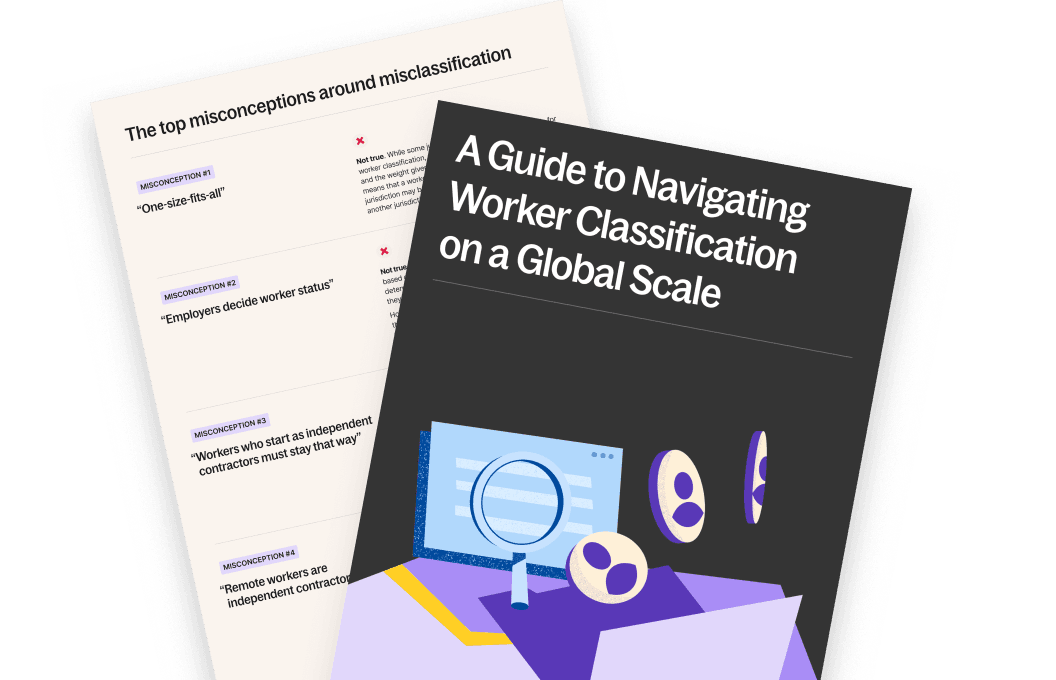
This guide — developed with Deel's in-house legal and compliance experts — shares practical methods, cutting-edge tools, and robust strategies to help you classify workers correctly across every country you hire from, and maintain a globally compliant workforce.
What this guide covers
- What worker misclassification is, how it happens, and why it affects both employees and independent contractors differently under global employment law
- The legal and financial consequences of misclassification — from Department of Labor investigations and back tax liabilities to class action lawsuits (including high-profile cases involving Uber and Nike)
- How to determine proper worker classification country by country, using local misclassification tests, regular audits, thorough work agreements, and AI-powered classification tools
- The four most common misclassification myths that trip up global employers
- How Deel's Worker Classifier, Workforce Insights, Compliance Monitor, and Contractor of Record service help you classify workers with over 90% accuracy and assume full liability if misclassification occurs
Who will benefit
- Small business owners, founders, and C-suite leaders seeking practical methods to classify workers worldwide and close compliance gaps with limited internal resources
- HR teams responsible for ensuring that employees typically classified as contractors are correctly assessed against local labor laws before onboarding
- Legal and compliance teams managing misclassification risk across multiple jurisdictions, especially where classification criteria change over time or vary by industry
- Finance leaders evaluating the legal and financial exposure of their current work arrangements with contractors globally
FAQs
What is worker misclassification and why does it matter?
Worker misclassification occurs when a company classifies a worker as an independent contractor when, under local employment laws, they should be treated as an employee. This matters because employees and independent contractors have different legal rights and protections — including entitlements to minimum wage, statutory benefits, overtime pay, and social security contributions.
When a misclassified employee is denied these rights, the hiring company becomes liable for back payments, penalties, and potential legal action, regardless of whether the misclassification was intentional.
How does worker classification differ from country to country?
Classification criteria vary significantly across jurisdictions. In the US, the Department of Labor and the IRS assess worker status based on behavioral control, financial control, and the nature of the working relationship. In the UK, HMRC uses the IR35 off-payroll working rules. In Canada, the integration test determines whether a worker's services are performed as an integral part of the business. In Brazil, a contractor can only work under a fixed-term independent contractor agreement for a maximum of two years before reclassification as an employee is required.
Because these laws also evolve over time, global employers must monitor regulatory changes continuously across every country they hire from.
What are the legal and financial consequences of misclassifying a worker?
Consequences depend on the jurisdiction and whether misclassification was intentional, but they typically include repayment of back wages, statutory benefits, and unpaid taxes — plus penalties and interest on the unpaid amounts.
In some jurisdictions, criminal charges are possible in severe cases. Beyond the financial impact, misclassification lawsuits attract significant media scrutiny, damaging a company's reputation with business partners, investors, and prospective talent. The 2023 Uber misclassification case resulted in a $290 million settlement, while a Nike class action settlement reached $8.25 million.
How can companies ensure proper worker classification across multiple countries?
The most reliable approaches are: staying informed of jurisdictional differences through official government and regulatory sources; using local misclassification tests as a framework for each new hire; conducting regular classification audits, especially when a working relationship has evolved over time; drafting thorough work agreements that accurately reflect the nature of the arrangement; and using a global hiring solution like Deel that classifies workers on your behalf and assumes full liability if misclassification occurs.
Deel's AI-based Worker Classifier uses award-winning research into localized employment court cases to classify workers with over 90% accuracy.
What is an Employer of Record (EOR) and how does it help with misclassification risk?
An Employer of Record (EOR) is an organization that legally employs workers on your behalf in countries where you don't have a local entity. By becoming the legal employer, the EOR takes full responsibility for ensuring that workers are correctly classified, compliant contracts are in place, and all local labor laws and tax obligations are met.
Deel's Contractor of Record service goes further — it hires and classifies contractors in 150+ countries on your behalf and assumes full legal liability in the event of a misclassification claim, removing the compliance burden from your team entirely.
Can a worker's classification change over time?
Yes — and this is one of the most common causes of unintentional misclassification. In some countries, what constitutes a contractor versus an employee can shift based on how long the working relationship has continued, how much of the worker's income comes from your company, or how central their role has become to your core business operations.
In Germany, for example, a worker may need to convert to employee status if their income is primarily or entirely derived from a single company. Regular classification audits — ideally twice a year — are essential to catch these shifts before they become a compliance risk.