
Guide
Global Mobility Strategy: An 8-Step Guide to Building a Resilient Programme
Immigration
Global expansion
Get the resource for free
Global mobility isn't what it used to be. What was once reserved for senior leadership is now a strategic tool that companies of all sizes use to open up a global talent pool, increase employee retention, support flexible work, and explore new markets before committing to full entity establishment.
But building a global mobility programme that actually delivers on these business goals requires more than ad hoc decisions. HR teams need a structured strategy that aligns with business objectives, ensures employees are well-supported throughout their relocation, and keeps the company compliant with the employment law, immigration requirements, tax social security obligations, and data privacy regulations of every country involved.
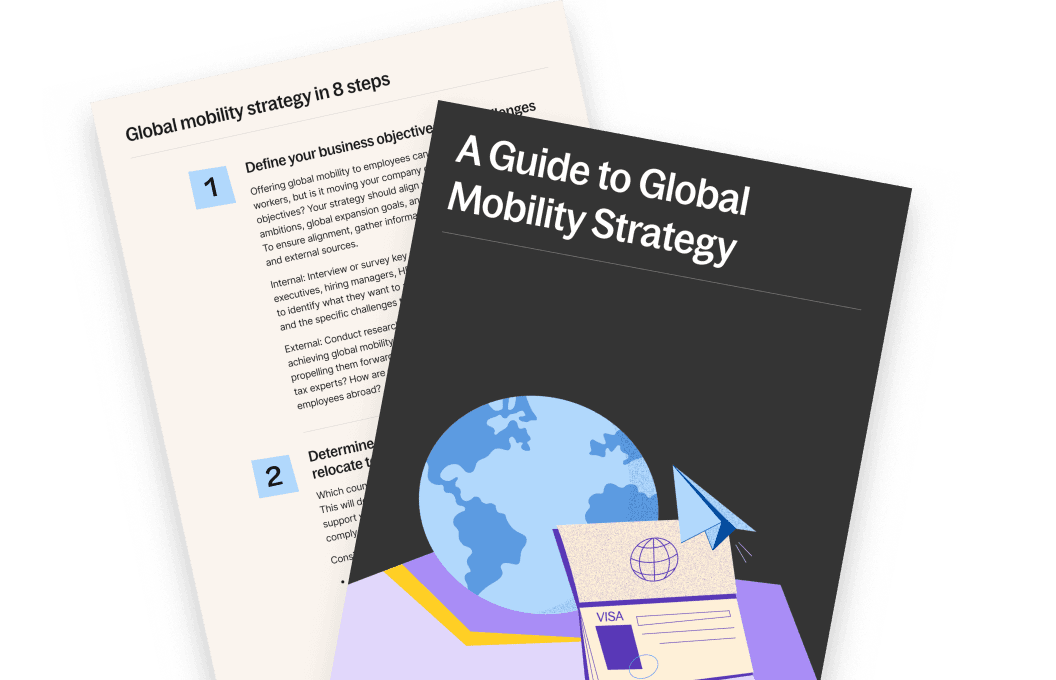
This guide — developed by Deel's global mobility experts — walks you through current trends, the key building blocks of a resilient strategy, and eight actionable steps for implementing a global mobility programme that scales with your business.
What this guide covers
- Global mobility trends — how shifting worker priorities around work-life balance, mental health support, flexible work, and DEI are reshaping how companies approach employee mobility
- Building a strategy that responds to current and future trends — how to define your primary business goals, audit your financial and workforce capabilities, and plan both entry and exit strategies for new markets
- The types of global mobility to offer — from short-term business travelers and project assignments to long-term relocations and digital nomad arrangements, including which visas and work permits apply
- Ensuring compliance across four risk areas — immigration, taxation (including permanent establishment risk), employment law, and data privacy requirements such as GDPR
- Supporting the employee experience — how to enhance employee experience throughout the relocation process, including dependent support, cost of living adjustments, and flexible work arrangements during transition
- The 8-step implementation framework — from defining business objectives and determining where employees can relocate, to formalising your global mobility programme with documented policies and management tools
- How Deel Mobility streamlines the process — managing and scaling global mobility programmes across 75+ countries, with options for self-managed, compliance-monitored, or fully managed immigration services
Who will benefit from this guide
- HR teams building or scaling a global mobility programme and looking for a structured, compliance-first framework to guide implementation
- People and talent leaders using global mobility to improve employee retention, attract global talent, and support long-term career development
- Finance and operations teams evaluating the costs of a global mobility programme — from immigration fees and relocation costs to employer of record (EOR) fees and payroll management tools
- Legal and compliance teams navigating the employment law, tax social security, and immigration obligations that arise when employees work across borders
FAQs
What is a global mobility strategy and why does a business need one?
A global mobility strategy is a comprehensive framework that outlines how an organisation moves talent across borders. Rather than handling relocations on a case-by-case basis, a strategy creates consistency, scalability, and alignment with the company's broader business objectives.
Without one, companies face reactive decision-making, inconsistent employee experiences, compliance gaps, and unnecessary costs. A well-designed strategy helps HR teams and leadership align on which types of mobility to offer, which countries to prioritise, and how to ensure employees are supported and the business remains compliant throughout.
What are the biggest compliance risks in a global mobility programme?
Ensuring compliance across a global mobility programme requires monitoring four key risk areas. Immigration compliance means securing the correct work permits and visas before any work begins. Tax compliance involves managing permanent establishment risks and ensuring income tax, social security, and payroll tax obligations are met in the right jurisdictions. Employment law compliance requires adhering to local standards including mandatory benefits, working hours, and termination laws. Data privacy compliance means ensuring employee data is transferred securely across borders in line with regulations such as GDPR.
Each country has its own rules, and short-term business travelers are increasingly subject to the same scrutiny as long-term assignees — making proactive compliance monitoring essential.
How does global mobility support employee retention and work-life balance?
Global mobility has evolved from a perk for executives to a mainstream tool for attracting and retaining global talent. Employees increasingly value the flexibility to work from different locations, the opportunity to experience new markets, and the chance for international career development.
When implemented well — with strong mental health support, clear policies, dependent visa assistance, and cost of living adjustments — a global mobility programme can significantly enhance employee experience and reduce attrition. When implemented poorly, it can have the opposite effect.
What types of global mobility should a company offer?
The right mix depends on your business goals, workforce, and the nature of the roles involved. Options include short-term assignments (typically three to twelve months), long-term assignments (one to three years), permanent relocations, business travel arrangements for business travelers, and digital nomad or remote work visa sponsorships. Each type carries different visa requirements, tax implications, and levels of company support — all of which should be defined in your global mobility programme documentation before employees are offered these options.
When should a company use an EOR instead of opening a local entity?
For companies relocating employees to countries where they have no legal entity, an employer of record (EOR) is typically the faster and more cost-effective solution. Opening a local entity can take three to twelve months and cost up to $100,000 per country in setup and management fees. An EOR like Deel allows companies to hire and employ workers in 150+ countries compliantly, without entity establishment — making it particularly valuable for market testing, short-term assignments, and post-acquisition talent integration.
How does Deel Mobility help HR teams manage global mobility?
Deel Mobility helps companies manage and scale global mobility programmes across 75+ countries. HR teams can choose to manage immigration cases independently through the platform, add proactive compliance oversight, or opt for fully managed immigration services delivered by Deel's in-house experts. The platform handles visa applications, work permit renewals, dependent visa processing, right-to-work checks, and compliance documentation — removing the administrative burden from HR teams and ensuring employees have a smoother relocation experience.