
Guide
How to Solve Labor Shortages with Global Hiring
Global hiring
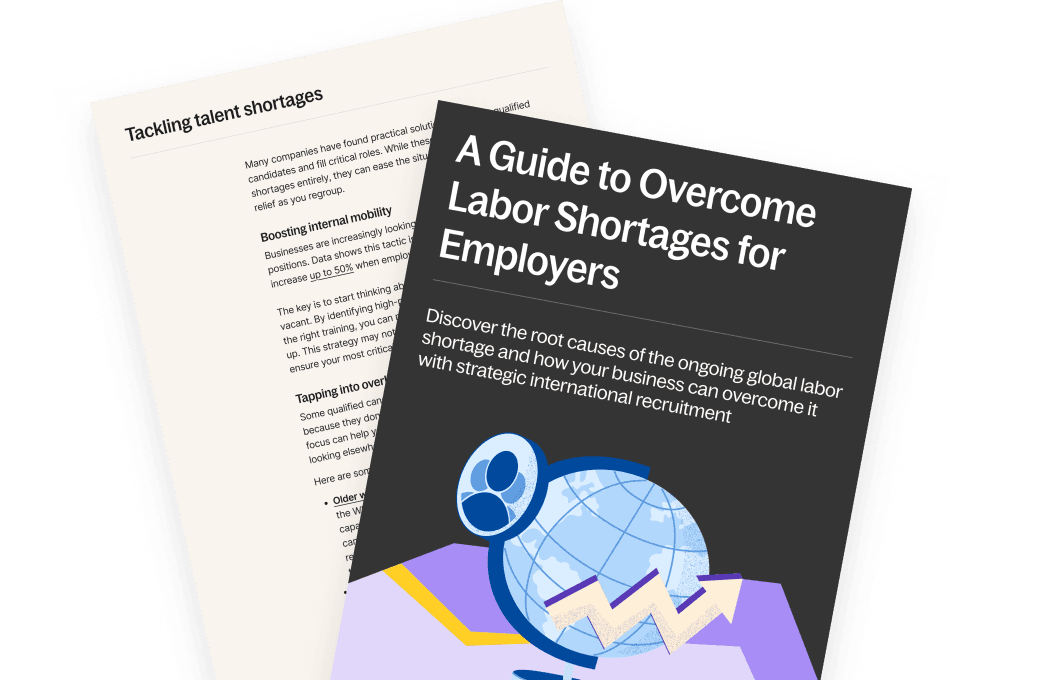
Get the resource for free
The competition for specialized talent has moved beyond local borders, leaving many businesses struggling with vacant roles and stalled growth. Relying on a limited local talent pool is no longer a viable long-term strategy when the skills you need are available globally.
This guide provides a professional shortcut for HR and operations leaders to move from hiring bottlenecks to a scalable international recruitment model. Learn how to navigate the shift in talent sourcing and gain the clarity needed to hire, pay, and manage a global team with confidence.
Who is this guide for?
- CHROs managing persistent hiring bottlenecks while supporting rapid growth
- COOs concerned with delivery risk and productivity loss due to understaffing
- VPs of Talent Acquisition navigating constrained local markets and rising skills gaps
- HR Business Partners addressing employee burnout driven by prolonged labor shortages
How to solve labor shortages with global hiring
Building a sustainable path forward requires a shift from traditional recruitment to a structured global model. Here is how to implement a global hiring strategy using this guide:
Preparation: Analyze your skills gap. Identify the specific technical or leadership roles that remain unfilled in your local market. Determine if these roles can be performed remotely or if you require a new regional hub.
Input: Map your global talent search. Use the guide to evaluate different workforce models, such as using an Employer of Record (EOR) to hire in countries where you don’t have a local entity.
Refinement: Streamline your international operations. Apply the guide’s insights to simplify global payroll and compliance. Instead of managing multiple vendors, consolidate your hiring and onboarding into one system to maintain speed and momentum.
Pro tip: When expanding your search, look at emerging tech hubs in regions like LatAm or APAC. Many companies find that "overlooked" markets offer high-quality talent with lower competition than traditional hubs.
Access the guide for free
From hiring hurdles to a borderless talent strategy.
More resources
FAQs
What are the main causes of the current labor shortage?
Labor shortages are driven by a combination of aging demographics, shifting worker expectations regarding flexibility, and a mismatch between available skills and evolving technical requirements.
As noted in our blog post on employing seniors as a solution to labor shortages, many organizations are now looking at non-traditional demographics and international markets to fill these gaps.
How does global hiring help solve labor shortages?
Global hiring allows businesses to bypass local talent scarcity by accessing a worldwide pool of candidates. By removing geographic constraints, you can find specialized skills more quickly and reduce the pressure of local compensation escalation.
Deel helps you manage this transition by handling the complex administrative and compliance requirements of international employment.
Is hiring internationally more expensive than hiring locally?
While there are costs associated with international compliance and payroll, global hiring often reduces overall expenses by allowing you to hire in markets with different cost-of-living standards.
Additionally, the cost of leaving a critical role vacant—in terms of lost productivity and team burnout—is often much higher than the investment in a global workforce strategy.
How can Deel help with global recruitment?
Deel provides the infrastructure to hire, onboard, and pay team members in over 150 countries without the need to set up local entities. This includes EOR services, contractor management, and global payroll solutions, ensuring your international expansion is both compliant and efficient.