
Report
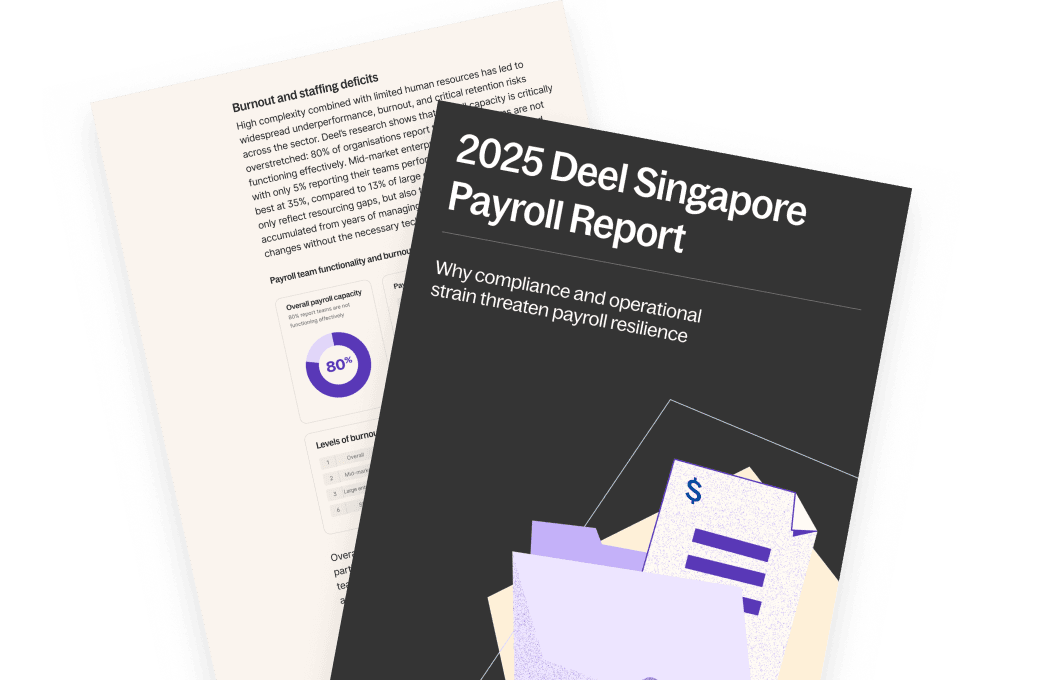
2025 Deel Singapore Payroll Report
Global payroll
Get the resource for free
Redefine payroll from a compliance burden to a strategic advantage
Singapore’s payroll landscape is undergoing a significant transformation. Rapid policy changes, increased employee expectations for flexible and transparent pay, and escalating compliance demands are pushing payroll to be more strategic than administrative.
In July 2025, Deel conducted two surveys involving payroll leaders and full-time employees to better understand the current challenges and opportunities affecting payroll in Singapore. The resulting report paints a wider picture of operational complexities, employee expectations, and the impact of technology and AI on payroll.
Who is this report for?
- HR and payroll leaders managing compliance challenges, technology upgrades, and employee retention
- C-suite leaders (CHROs, CFOs, COOs) who are strategizing how to increase operational efficiency, address organizational challenges, and meet employee demands
- Singapore employees facing financial pressures and seeking to understand overall trends in workforce demands
Key findings
- Payroll accuracy and employee satisfaction: 30% of employers identified payroll errors or delays as a major cause for employee dissatisfaction and operational concern
- AI’s impact on payroll: 47% of organizations in Singapore already use AI in payroll and report improved integration and reduced manual processes
- Rising demand for flexible pay: 74% of employees are open to on-demand pay that would allow earlier access to wages
- Integration as a top challenge: 56% of payroll teams cite lack of integration with HR and finance systems as a top challenge, revealing significant barriers to data and compliance accuracy
- Lean teams and complex operations: 80% of mid-market enterprises say their payroll teams have less than 10 staff managing global payroll, signaling an urgent need for payroll outsourcing and compliance assurance
Why download the full report?
The 2025 Singapore Payroll Report delivers deeper insights behind the trends reshaping payroll today. It breaks down survey findings from employers and employees, highlights key shifts in technology and expectations, and offers practical recommendations for improving accuracy, efficiency, and employee trust.
Download the report to:
- Benchmark your payroll performance against organizations in Singapore
- Understand real challenges payroll teams and employees face, from integration gaps to rising expectations
- Identify high-impact opportunities to automate workflows, reduce errors, and improve employee experience
- Track emerging trends like flexible pay and AI adoption that are influencing payroll strategy
How to leverage this data
Understanding what drives workforce dissatisfaction and which technologies are delivering the greatest ROI today helps HR, payroll, and C-suite leaders prioritize the right investments, introduce flexible pay models with confidence, and proactively modernize payroll with technology like AI to meet regulatory demands and evolving employee expectations.
FAQs
What are Central Provident Fund (CPF) contributions?
Central Provident Fund (CPF) contributions are mandatory savings funds that employees and employers in Singapore contribute to. These contributions are governed by Singapore’s CPF Act, and they are a major part of the social security system that helps people save and prepare for retirement.
Are Deel’s payroll services available in Singapore?
Yes, Deel Payroll can help businesses in Singapore simplify payroll through automated compliance updates, instant tax calculations, real-time payroll, country-specific monitoring, tailored workforce reports, and more. Our payroll services are available in 130+ countries and backed by 2,000 in-house experts in payroll, HR, and legal.
What are on-demand pay options for Singapore?
Deel offers on-demand pay through Anytime Pay, built directly into Deel’s EOR infrastructure. Unlike other similar solutions, it works across currencies, countries, and compliance frameworks without disrupting payroll or adding unnecessary fees.
On-demand pay offers financial flexibility, helps employees avoid overdraft fees or high-interest loans, and improves employee satisfaction by allowing workers to access their pay as they need it.