Article
15 min read
Agents vs. Chatbots vs. Copilots: How to Choose the Best AI Tool
AI

Author
Ellie Merryweather
Last Update
November 06, 2025

Table of Contents
Comparison: Chatbots vs. copilots vs. agents vs. generative AI
Comparison: Chatbots vs. copilots vs. agents vs. generative AI
What is a chatbot?
What is an AI copilot or assistant?
What is an AI agent?
What is generative AI?
Why human oversight still matters
Checklist: How to pick the right AI tool
Deel AI Workforce: Your next AI win
Key takeaways
- Leaders are overwhelmed by AI labels—chatbots, copilots, agents, and generative AI—making it hard to invest confidently without mapping tools to real problems.
- Apply a fit-for-purpose framework: chatbots for quick Q&A, copilots to augment workflows, agents for autonomous multi-step tasks, and generative AI for creation.
- Deel’s AI Workforce lets you deploy ready-made HR, payroll, and IT agents with compliance built in, so you automate at scale without sacrificing trust.
With ‘AI-powered’ tools flooding the market, knowing which one is best for the job at hand can be overwhelming. For business and HR leaders, this can make it difficult to know where to invest and how to tie AI tools to real business values. What’s hype, and what’s actually going to deliver?
While you don’t need to be an AI engineer, you do need to understand the pros and cons, practical applications, and common use cases of these technologies to make the right strategic decisions for your team. In this guide, we’ll show you how to choose AI tools that drive real impact, to help you cut through the noise and start leveraging AI the right way.
Comparison: Chatbots vs. copilots vs. agents vs. generative AI
| Tool type: | Chatbot | Copilot | Agent | Generative AI |
|---|---|---|---|---|
| Primary function | Conversations: Handles reactive, quick-fire Q&A and customer service requests. | Workflow Assistance: Works as a collaborative partner to augment human workflows within business applications. | Autonomy: Executes multi-step tasks and works proactively toward a goal with minimal human intervention. | Creation: Produces new and original content in various formats, including text, images, and code. |
| Key pros for business | Efficiency Cost-effective | Productivity boost Ease of use | Task automation Efficiency Scalability | Creativity and innovation Personalization at scale Problem-solving |
| Key cons for business | Limited scope Lack of empathy Maintenance | Dependence Potential for error Data security risks | High complexity Unpredictability Risk of errors | Risk of bias Intellectual property Lack of originality |
| Examples | Intercom, Zendesk | Microsoft Copilot, GitHub Copilot | Jira AI, Auto-GPT | ChatGPT, Midjourney, Canva AI |
Deel AI
With ‘AI-powered’ tools flooding the market, knowing which one is best for the job at hand can be overwhelming. For business and HR leaders, this can make it difficult to know where to invest and how to tie AI tools to real business values. What’s hype, and what’s actually going to deliver?
While you don’t need to be an AI engineer, you do need to understand the pros and cons, practical applications, and common use cases of these technologies to make the right strategic decisions for your team. In this guide, we’ll show you how to choose AI tools that drive real impact, to help you cut through the noise and start leveraging AI the right way.
Comparison: Chatbots vs. copilots vs. agents vs. generative AI
| Tool type: | Chatbot | Copilot | Agent | Generative AI |
|---|---|---|---|---|
| Primary function | Conversations: Handles reactive, quick-fire Q&A and customer service requests. | Workflow Assistance: Works as a collaborative partner to augment human workflows within business applications. | Autonomy: Executes multi-step tasks and works proactively toward a goal with minimal human intervention. | Creation: Produces new and original content in various formats, including text, images, and code. |
| Key pros for business | Efficiency Cost-effective | Productivity boost Ease of use | Task automation Efficiency Scalability | Creativity and innovation Personalization at scale Problem-solving |
| Key cons for business | Limited scope Lack of empathy Maintenance | Dependence Potential for error Data security risks | High complexity Unpredictability Risk of errors | Risk of bias Intellectual property Lack of originality |
| Examples | Intercom, Zendesk | Microsoft Copilot, GitHub Copilot | Jira AI, Auto-GPT | ChatGPT, Midjourney, Canva AI |
What is a chatbot?
Chatbots use a predefined script of a large language model (LLM) to deliver information in a conversational format. For example, customer service chatbots like Intercom and Zendesk sit on websites and serve as a first point of contact between businesses and potential customers.
Complementary reading
Discover 8 practical uses for ChatGPT for HR.
When to choose a chatbot
Designed to respond and not to act on its own, chatbots are a perfect choice for handling simple exchanges. They’re efficient, provide 24/7 support, are capable of handling multiple queries at once, and easily reduce the workload for human teams.
However, the technology has its limitations. Although user-friendly, it can struggle with complex, unique, or ambiguous queries. It also lacks empathy and cannot handle emotionally charged interactions, making it a poor substitute for a human interaction - a key concern for industries such as healthcare and childcare.
Chatbots are best for simple, repetitive tasks - providing quick customer support, answering frequently asked questions, and onboarding new employees with standard information.
Choose a chatbot when you’re in need of a reactive, conversational tool.
Once you understand their limitations, chatbots can still be implemented in useful ways. Chatbots are familiar to most consumers, and can be used internally to help employees quickly access information.
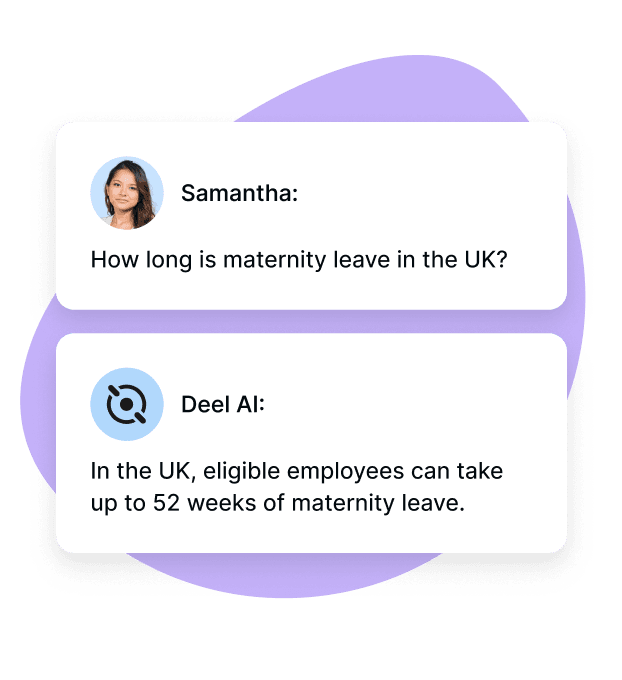
For HR teams, Deel AI is built and trained by HR and compliance experts from over 150 countries. It connects seamlessly with your people data to deliver accurate, tailored information around the clock. With expert oversight and a continually updated knowledge base, Deel AI overcomes the typical limitations of chatbots, ensuring every answer you receive is reliable and up to date.
What is an AI copilot or assistant?
An AI copilot or assistant works as a collaborative partner to augment human workflows within business applications. It works by integrating directly into an application, analyzing the user’s ongoing task, and providing context-aware suggestions. For example, a copilot might assist a lawyer in drafting a contract by suggesting clauses based on case details and legal precedents.
When to choose an AI copilot
Copilot tools like GitHub Copilot, Microsoft Copilot, and Notion AI are known for significantly speeding up tasks without replacing human expertise. They’re easy to use with a minimal learning curve, as they integrate directly into existing apps and processes.
However, there is a potential for error, as copilots rely on LLMs and can ‘hallucinate’ information. This is why copilots should augment human expertise, not replace it. For example, a seasoned HR expert can use a copilot to draft a high-quality Performance Improvement Plan (PIP) more efficiently, while an intern relying solely on an AI tool like Notion AI may produce an inaccurate or incomplete document. Human oversight and verification are essential to ensure accuracy and quality.
Choose an AI copilot or assistant when you need a collaborative partner to boost individual productivity within existing workflows, to augment human work rather than replace it.
What is an AI agent?
An AI agent is a “doer”, not just a responder. It receives a high-level objective, then uses an LLM to break it down into smaller tasks, execute them, and adapt its plan until the goal is achieved. By combining LLMs with APIs, memory, and tools to act toward a defined goal,
agents perform complex tasks at a scale and speed that humans can't match.
For example, an agent can be built into your onboarding workflows, automatically creating user accounts, sending welcome emails, scheduling first meetings, and ordering equipment without constant prompting. This saves hours for HR teams, especially those hiring at scale.
Complementary reading
Get to grips with the basics of Agentic AI, with our FAQ guides for startups and for enterprise.
When to choose an AI agent
The most significant benefit of AI agents is their autonomy, making them excellent at handling complex, multi-step business processes with minimal oversight. Agents can handle entire workflows, from screening job applicants to managing supply chains, empowering your team to focus on strategic initiatives.
However, most agents on the AI market are highly complex and difficult to set up. By contrast, Deel AI Workforce provides you with a selection of readymade agents which are ready to join your team, across HR, PTO, IT, and more. You might choose our IT agent to assign tech and tools to new hires based on role, cost, and availability, or our payroll agent to spot and fix payroll errors before they become a problem.
Deel AI Workforce also offers the ability to build your own custom agent, ready to integrate with Slack, Zapier, and your existing stack. This is a great option if you need to automate complex tasks across multiple platforms.
Choose an AI agent when you need an autonomous partner to lift more complex yet repetitive work from your team’s plates.
What is generative AI?
There is arguably the most hype online around generative AI, particularly on social media. From AI image generators to AI writing tools, generative AI is as controversial as it is exciting. It uses a neural network trained on vast amounts of data to identify patterns and generate novel outputs based on a given prompt. Popular tools using this technology include ChatGPT, Midjourney, Canva AI, and Jasper.
For example, HR professionals can generate personalized learning plans for every employee, translate key documents into multiple languages, and generate job descriptions.
When to choose generative AI
Despite the time saved on content creation, generative AI technology is far from perfect. If any bias is present in the training data, it’ll be reflected in the output. There are also legal and ethical questions around the ownership and copyright of generated content. The output can sometimes feel generic, as recognisable patterns are repeated across users. Information can be hallucinated or presented in an unintentionally misleading way.
To mitigate this, generative AI is best used in collaboration with in-house experts, and it’s important to invest in the right set-up for optimal results. For example, have your product and marketing teams create customized GPTs based on their knowledge of your brand and offering. This will allow anyone in the business to create quick copies, knowing that the brand voice and product information are aligned. Neither of those is a guarantee when using ChatGPT straight out of the box.
Choose generative AI tools when you need a collaborative tool, not a replacement for human creativity and oversight.
Why human oversight still matters
In global payroll and compliance, AI boosts efficiency but can’t replace human judgment. AI systems can mitigate risk and catch errors, but only when properly designed and maintained. This makes human oversight essential, no matter how small the task.
At Deel, we integrate AI for automation, anomaly detection, and faster service. But we ensure compliance with human review built in. For example, our Knowledge Hub is maintained by legal and compliance experts in multiple countries, with the assistance of AI. This helps us move at speed, without compromising the integrity of our information.
Combining the scale and speed of AI with human oversight is ultimately what will lead to trusted outcomes.
Complementary reading
Checklist: How to pick the right AI tool
Next time you’re shopping for an AI tool, keep this checklist to hand to help you filter through your options and make the right choice.
- Does the tool match the business problem?
- How much human oversight does it require?
- Does it integrate with your existing systems (Jira, Workday, Deel)?
- Is it cost-effective for your scale?
- Does it meet compliance and data security standards?
Red flags: Watch for these warning signs that your AI tool doesn’t fit the job:
- Repetitive errors: The tool generates outputs that constantly need correction (e.g., generative AI drafting payroll reports).
- User frustration: Employees or customers complain about unhelpful answers (e.g., chatbot used for complex troubleshooting).
- High costs, low ROI: You’re paying for advanced functionality but only using basic features.
- Compliance concerns: Sensitive data is processed without transparency or audit trails.
- Over-reliance on AI: Critical decisions are made without human review, raising risk of errors or bias.
Deel AI Workforce: Your next AI win
If you’re looking to put your new AI knowledge into practice, Deel AI Workforce is ready to supercharge your team. With a library of ready-made AI agents across HR, payroll, and IT—or the ability to build your own custom agents—you can automate repetitive work, reduce errors, and scale operations without adding headcount.
Every agent is built with compliance and human oversight at the core, so you get the speed and efficiency of AI without sacrificing trust. Sign up today, and be among the first to welcome Deel’s AI agents to your team!
Live Demo
Get a live walkthrough of the Deel platform

Ellie Merryweather is a content marketing manager with a decade of experience in tech, leadership, startups, and the creative industries. A long-time remote worker, she's passionate about WFH productivity hacks and fostering company culture across globally distributed teams. She also writes and speaks on the ethical implementation of AI, advocating for transparency, fairness, and human oversight in emerging technologies to ensure innovation benefits both businesses and society.