Article
14 min read
Applied AI 101 for Business Leaders
AI

Author
Ellie Merryweather
Last Update
November 06, 2025

Key takeaways
- Applied AI is the bridge from theory to practice. It's the practical application of AI technologies—like machine learning, natural language processing, and automation—to solve real business problems and deliver clear ROI.
- Applied AI drives efficiency and reduces risk. By automating repetitive tasks, AI helps teams in HR, payroll, and compliance work faster. It also automatically catches compliance risks and discrepancies, reducing the chance of human error.
- Deel uses applied AI to deliver real business impact. Our AI-powered tools, like Deel AI Workforce, are a suite of AI agents that proactively handle repetitive tasks. This frees up your teams to focus on what matters most.
AI’s rapid evolution continues to send shockwaves across the business world, making it tough for leaders to separate hype from real-world impact. To build sustainable and scalable AI systems that actually deliver a return on investment, it’s time to move from theoretical discussion to practical adoption. That’s where applied AI comes in.
Applied AI is the point where we move beyond headlines and think pieces to implementing AI to solve real business problems. At Deel, it’s what helps us deliver impactful features, such as 24/7 support with Deel AI and proactive agents with Deel AI Workforce.
In this guide, we’ll go through what applied AI is, how businesses (including Deel) leverage it in the real world, and give you some tips for getting started.
What is applied AI? (vs. general AI and generative AI)
Applied AI refers to artificial intelligence that is designed to solve a specific problem or meet a specific business need. It’s less hypothetical than general AI, and less broad in scope than generative AI.
| Dimension | Applied AI | Generative AI | General AI (AGI) |
|---|---|---|---|
| Definition | AI designed for a specific task or domain (e.g., fraud detection, customer support chatbots). | AI models that create new content (text, images, code, designs) based on training data. | Hypothetical AI with human-level intelligence across all domains, able to reason, learn, and adapt broadly. |
| Scope | Narrow and task-focused. | Medium — broader than applied AI but still within content generation. | Broad and universal (not yet realized in practice). |
| Examples | Recommendation engines, predictive maintenance, credit scoring. | ChatGPT, Midjourney, GitHub Copilot. | A system that could autonomously manage a company like a human CEO. |
| Maturity | Mature and widely deployed in business. | Emerging but fast-growing and commercially viable. | Still theoretical; no true AGI exists today. |
| Value to Business | Efficiency, cost savings, and accuracy in specific workflows. | Unlocks creativity, accelerates content production, personalization, and product innovation. | Future potential for full automation of knowledge work and strategic decision-making. |
| Risks | Bias in data, lack of adaptability beyond domain. | Hallucinations, copyright/IP issues, misinformation, workforce disruption. | Unknown ethical, economic, and existential risks. |
| Investment Horizon | Short-term ROI (today’s use cases). | Medium-term — early adoption already providing ROI. | Long-term, speculative. |
| Decision-Maker View | Reliable for process optimization and cost efficiency. | Experiment and scale in areas of marketing, design, customer interaction, and knowledge work. | Monitor but don’t over-invest; watch long-term implications. |
Deel AI
The key components of applied AI
For strategic leaders, applied AI involves utilizing machine learning, natural language processing, and automation to address specific business challenges, such as reducing costs, enhancing customer experience, and streamlining decision-making.
Machine learning
Machine Learning (ML) enables systems to identify patterns in data and improve performance over time without explicit programming. For business, this means smarter forecasting, personalization, and risk detection that continuously adapts as new data arrives.
Example: A retailer uses ML models to forecast seasonal demand, ensuring the right products are stocked in the right locations, reducing inventory costs while maximizing sales.
Natural language processing (NLP)
NLP allows AI to understand and respond to human language, turning text or speech into structured business insights. It powers applications like chatbots, sentiment analysis, and document automation, driving efficiency and better customer engagement.
Example: A bank deploys NLP to automatically review loan applications and extract key details from documents, speeding up approvals and improving compliance accuracy.
AI-powered automation
AI combined with automation tools streamlines repetitive and rule-based business processes. This reduces costs, scales operations, and frees employees to focus on higher-value strategic work.
Example: A global HR team uses AI-powered automation to process employee onboarding documents, set up payroll accounts, and trigger IT access requests, all without manual intervention.
Generative models
Generative AI creates new content such as reports, marketing copy, or scenario analyses based on existing data. It accelerates creativity, knowledge management, and decision support, giving leaders faster access to insights and ideas.
Example: A consulting firm leverages generative AI to summarize thousands of client survey responses into a concise report with actionable recommendations for executives.
Applied AI in action: Real-world business examples
The best way to understand technology without a computer science degree is to see how it is used in real business scenarios. Here are some examples, including how we use AI at Deel to streamline processes and provide AI-driven solutions for our partners.
Introducing AI into the workplace can make people anxious. But at Deel, what we saw was excitement. Teams that had been stuck doing repetitive tasks welcomed the change, because nobody enjoyed that work in the first place.
—Abhijit Mehta,
Senior Director of Product at Deel
Find out how Deel builds AI tools and workflows that win back hours and drive real business impact.
AI in Collaboration: Smarter communication across global teams
AI tools can do much more than finish writing emails. Used correctly, it can help communicate across borders and time zones, making global teams feel more connected and facilitating better collaboration. For instance:
- Natural language processing (NLP) is used to translate conversations in real-time across different languages.
- Generative AI and NLP are used to summarize long meetings and highlight key action items.
- Machine learning algorithms analyze communication patterns to improve team workflows and efficiency.
- Automation is used to schedule personalized messages, ensuring timely communication across time zones
- Machine learning is also used to intelligently organize shared documents and project files for easy access.
How Deel does it:
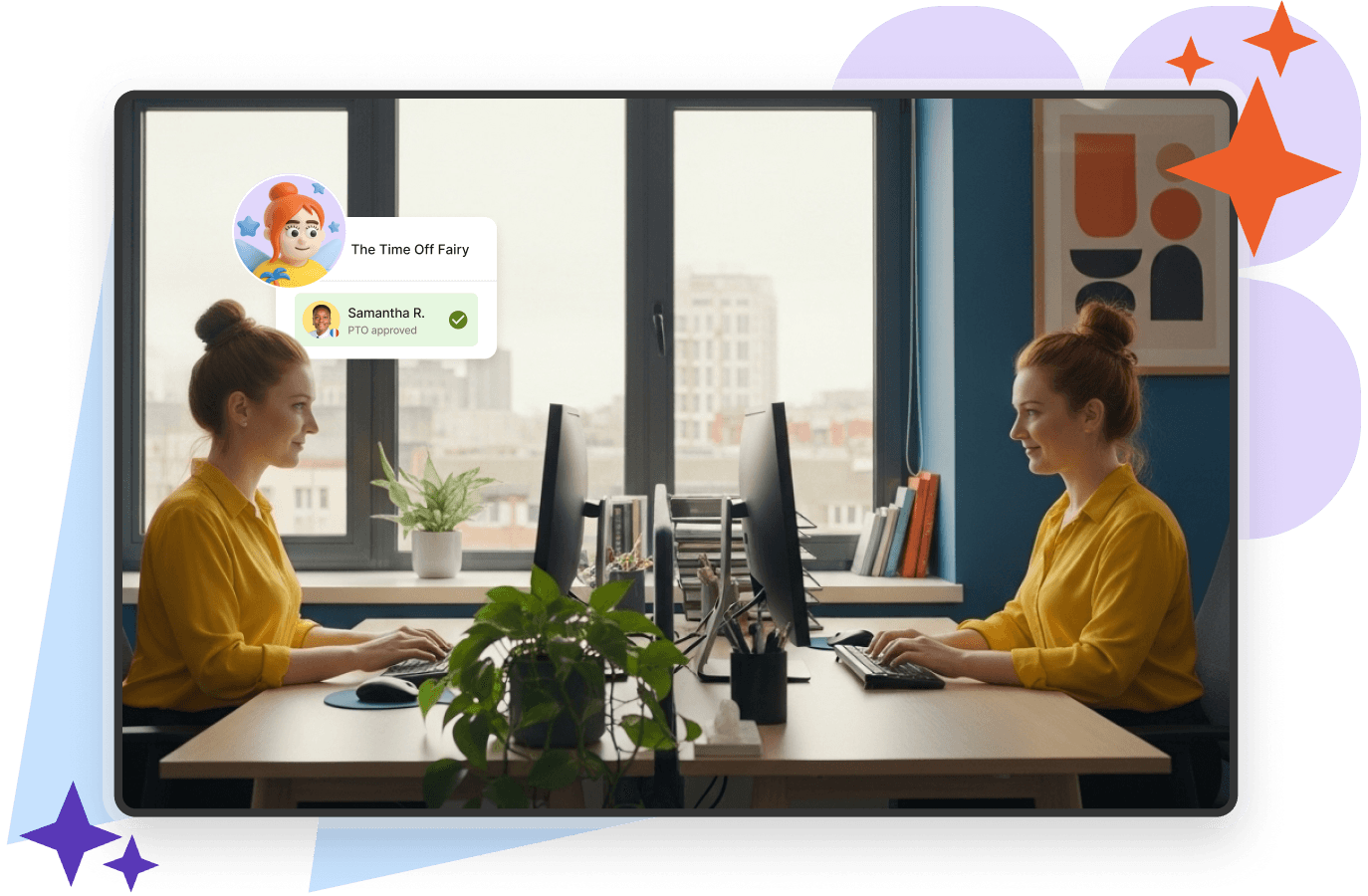
‘The Time Off Fairy’ is an AI Agent within Deel AI Workforce, which consolidates PTO requests from any channel, flags conflicts, and detects coverage gaps. This mitigates the risk of downtime, without taking hours to compare calendars and spreadsheets.
AI in HR: Smarter hiring, onboarding, and employee support
In HR, applied AI is most useful for automating repetitive tasks, with human intervention built in to mitigate bias and ensure that humans remain the primary decision-makers. For example:
- Machine learning is used to analyze resumes and candidate profiles to identify top talent.
- Automation is used to personalize onboarding experiences with AI-driven workflows and checklists.
- Natural language processing (NLP) and generative AI provide employees with 24/7 access to answers about HR policies, benefits, or payroll through chatbots.
- Machine learning is also used to analyze employee feedback and engagement data to improve retention.
How Deel does it:
Our AI-powered onboarding generates contracts in minutes, speeding up new hire setup and mitigating non-compliance risks.
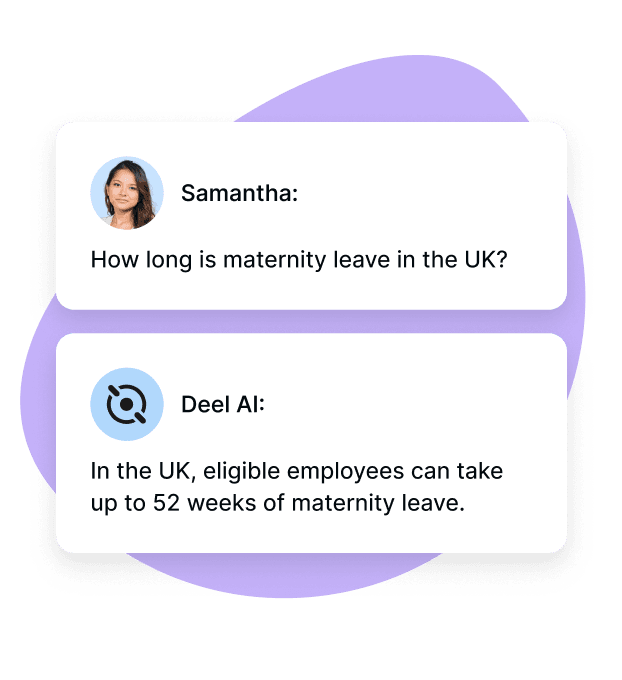
Deel AI, trained using a blend of our Knowledge Base and your own internal data, speeds up decision-making by offering insights directly within the Deel platform and through our Slack plug-in.
Deel AI saves me 8-15 minutes per task with instant answers.
—Harry W.,
AI in payroll: Automating global payroll for accuracy and speed
The margin for error in payroll is very low, and timeliness is everything. That’s why smart payroll teams turn to AI to reduce mistakes, streamline repetitive processes, and boost overall efficiency. Such as:
- Automation is used for salary, tax, and benefits calculations to reduce manual errors.
- Automation is also used to accelerate payroll processing cycles for faster payouts.
- Machine learning algorithms detect anomalies or discrepancies before payments are made.
- Generative AI is used to create and summarize payroll reports for financial planning and audits.
How Deel does it:
Deel Payroll leverages AI to automatically calculate real-time salaries, deductions, and taxes across 100+ countries. The AI ensures on-time, accurate payments while reducing the need for manual checks.
AI in compliance: Reducing risk with automated checks and monitoring
Keeping up with compliance manually is inefficient and leaves the door open for human error. Applied AI can mitigate the risk while performing tasks that can be tedious for human employees. For example:
- Natural language processing (NLP) is used for continuously monitoring regulatory updates to ensure policies are current.
- Machine learning algorithms scan contracts and legal documents to ensure they meet compliance standards.
- Machine learning and automation are used to detect fraudulent activities and suspicious patterns in real-time.
- Automation and generative AI are used to flag non-compliant transactions and communications as they happen, often providing a summary of the issue.
How Deel does it:
Our Compliance Monitor, built into the Deel platform, monitors regulations across 150+ countries, alerting teams of any changes. We apply machine learning to automate global background checks, verifying new hires within 15 minutes.
Thanks to our in-house knowledge hub (built and maintained by local legal experts), compliance is built into all of our AI processes. For example, any new contracts generated within the HRIS will automatically be compliant according to the latest labor laws.
Getting started: Applied AI for global teams
As with all things disruptive and exciting, there’s a lot of noise surrounding AI. By focusing on AI tools that solve specific problems, leaders can cut through the noise, make smarter investments, and deliver a tangible impact.
One of the best ways to get started is with Deel AI Workforce: a suite of AI Agents designed to proactively handle specific tasks as if they were human employees. With no coding required, you can simply plug in and play, or customize your own agent to fit a wide range of functions.
Try out the Payroll Detective, which spots and fixes payroll errors before they become a problem, or the Hiring Guru for sharpening your international hiring strategy.
Sign up today, and be among the first to welcome Deel’s AI agents to your team.
Ellie Merryweather is a content marketing manager with a decade of experience in tech, leadership, startups, and the creative industries. A long-time remote worker, she's passionate about WFH productivity hacks and fostering company culture across globally distributed teams. She also writes and speaks on the ethical implementation of AI, advocating for transparency, fairness, and human oversight in emerging technologies to ensure innovation benefits both businesses and society.