
Article
5 min read
7 Best Device Management Tools for Startups in 2026
IT & device management

Author
Dr Kristine Lennie
Last Update
March 31, 2026

As startups grow, hiring becomes more distributed and device management becomes harder to coordinate. Whether you’re onboarding remote employees or supporting teams in multiple locations, how devices are provisioned, secured, and recovered starts to affect more than IT.
The right device management tool in 2026 should help HR and IT work in sync: automating provisioning when someone joins, maintaining security policies as roles change, and triggering recovery workflows when employees leave.
Below are the leading device management tools for startups, starting with solutions designed to connect device operations directly to workforce changes.
1. Deel IT
Deel IT is a device management platform used by companies operating across regions—from growing startups to larger, distributed organizations. It connects device operations to workforce changes, helping HR and IT manage provisioning, repairs, refresh cycles, and recovery within one coordinated system.
As teams expand, device processes often become fragmented across procurement vendors, endpoint tools, and manual coordination. Deel IT brings these steps together so devices are provisioned, secured, repaired, refreshed, and recovered in a way that scales alongside your workforce.
Core capabilities:
- End-to-end device procurement and global delivery, including cross-border coordination and shipment tracking
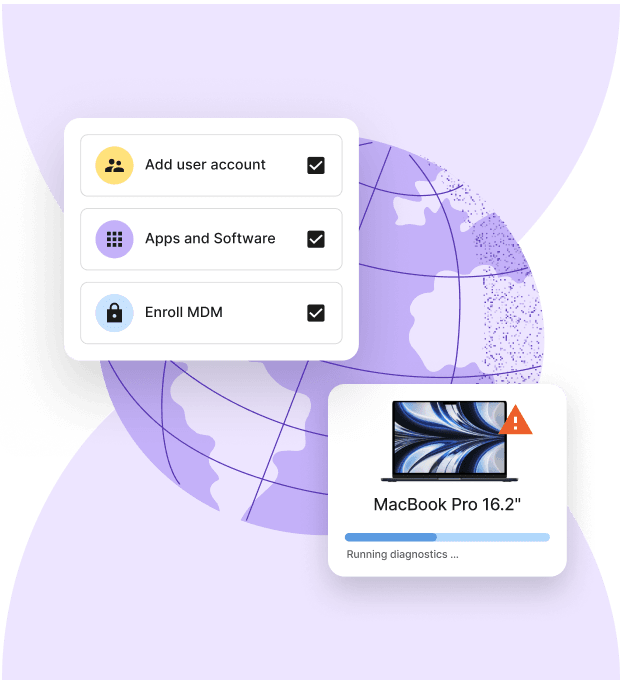
- Zero-touch deployment with pre-configured enrollment into your mobile device management (MDM), so security policies and required applications are applied automatically on first boot
- Coordinated repair and refresh workflows, supporting replacements and planned upgrade cycles without manual tracking
- HR-triggered onboarding and offboarding automation, initiating provisioning, access updates, and retrieval tasks automatically
- Structured device recovery with certified data erasure, reducing security risk during offboarding
- Centralized lifecycle visibility, giving HR and IT shared insight into inventory status, compliance posture, and recovery timelines
Best for: Organizations at any stage of growth — especially those hiring across locations — that want device management to scale alongside headcount without increasing manual coordination.
Limitations: Companies operating in a single office with limited hiring complexity may not require integrated global logistics and HR-linked automation early on.
See also: IT Security For Small Businesses: Built-in or Third-Party?
Device Lifecycle Management
2. Microsoft Intune
Microsoft Intune is a cross-platform endpoint management solution integrated with Microsoft 365 and Entra ID. For startups already using Microsoft 365, Intune allows IT teams to manage device policies, operating system updates, and access controls within the same environment as their identity and collaboration tools.
Core capabilities:
- Cross-platform device enrollment and configuration
- Operating system update and patch management
- Conditional access and device compliance enforcement
- Integration with Microsoft 365 and Entra ID
Best for: Startups standardized on Microsoft 365 that want identity-driven endpoint management within the same ecosystem.
Limitations: Intune focuses on endpoint policy enforcement. Hardware procurement, logistics, and recovery processes typically require separate tools or service providers.
3. Jamf Pro
Jamf Pro is an Apple-focused device management platform for macOS and iOS environments. It integrates with Apple Business Manager and supports zero-touch enrollment and centralized configuration management for Apple devices.
Core capabilities:
- Apple device enrollment through Apple Business Manager
- macOS and iOS configuration profiles
- Patch and update management for Apple operating systems
- Compliance and reporting controls
Best for: Apple-first startups that require deep macOS and iOS management.
Limitations: Designed specifically for Apple devices. Mixed operating system environments or global logistics needs require additional tools.
4. Cisco Meraki Systems Manager
Cisco Meraki Systems Manager is a cloud-based MDM supporting Windows, macOS, iOS/iPadOS, Android, and ChromeOS. It provides centralized policy management and remote device monitoring.
Core capabilities:
- Cross-platform device enrollment
- Remote troubleshooting and configuration
- Policy enforcement across multiple operating systems
- Integration with Cisco networking infrastructure
Best for: Mixed-device startups that already use Cisco networking solutions.
Limitations: Focused on endpoint management. Does not provide integrated procurement or global lifecycle logistics.
5. Scalefusion
Scalefusion is a unified endpoint management platform supporting Android, iOS/iPadOS, Windows, and macOS. It is commonly used in frontline, kiosk, and controlled device environments.
Core capabilities:
- Device lockdown and kiosk mode configuration
- Cross-platform enrollment and management
- Remote troubleshooting
- Geofencing and usage controls
Best for: Startups managing frontline or restricted-use devices.
Limitations: Primarily focused on endpoint control. Procurement, lifecycle logistics, and HR integration require separate tools.
6. Esper
Esper is an Android-focused device management platform built for dedicated device fleets such as kiosks and IoT deployments.
Core capabilities:
- Android device provisioning and control
- Application deployment management
- Remote monitoring and diagnostics
- Centralized fleet oversight
Best for: Startups operating managed Android hardware fleets.
Limitations: Android-specific platform. Cross-platform management and lifecycle logistics require additional systems.
7. GroWrk
GroWrk is a device logistics platform that supports global hardware procurement, shipping, and retrieval for distributed teams. It focuses on helping companies manage the operational side of device delivery and recovery across multiple countries.
Unlike endpoint management platforms, GroWrk concentrates on coordinating physical device movement rather than enforcing security policies.
Core capabilities:
- Multi-country hardware procurement and sourcing
- International shipping coordination and customs handling
- Device retrieval and redeployment workflows
- Logistics tracking and visibility dashboards
Best for: Remote-first startups expanding across borders that want outsourced support for device procurement and global shipping logistics.
Limitations: GroWrk focuses on logistics and hardware operations. Endpoint security policy enforcement, compliance controls, and HR-triggered automation require integration with external MDM and workforce systems.
How to choose the right device management approach
Not every startup needs the same setup. The right solution depends on your operating system mix, how distributed your team is, and how tightly you need device workflows connected to hiring and offboarding.
Start by assessing where your complexity lives:
Start by asking a few practical questions:
- Are most of your employees on the same device ecosystem? If so, a platform aligned with that ecosystem may be sufficient in the early stages.
- Are you hiring remotely or across multiple locations? The more distributed your team becomes, the more important provisioning, shipping, and recovery coordination become.
- Do HR and IT rely on manual handoffs during onboarding and offboarding? If device setup and retrieval depend on emails and spreadsheets, automation may quickly become a priority.
- Are you planning to grow headcount quickly? Tools that work for 20 employees may not scale smoothly to 200 without stronger lifecycle visibility and update management.
As startups grow, device management becomes less about configuring laptops and more about maintaining consistency across hiring, security, and compliance.
Looking to equip your employees with the right devices? See: 7 Best Laptops for Small Businesses in 2026
Simplify startup device management in 2026 with Deel IT
For startups evaluating device management tools in 2026, the challenge isn’t just endpoint control—it’s keeping repairs, upgrades, provisioning, and recovery coordinated as headcount grows.
Deel IT brings workforce changes and device operations into one connected system, helping HR and IT maintain visibility and control as the company scales.
With Deel IT, startups can:
- Standardize how devices are provisioned, repaired, refreshed, and recovered
- Unify procurement, MDM policy, shipping, and retrieval workflows in a single platform
- Keep onboarding and offboarding workflows connected to device actions
- Maintain visibility into inventory, compliance status, and recovery timelines
- Reduce manual coordination between HR, IT, and external logistics partners
- Support global hiring without adding operational complexity
As your startup grows, device management becomes less about configuring individual laptops and more about maintaining a structured system that supports hiring, security updates, and cost control.
Choosing the right platform in 2026 means choosing one that scales with your team — across roles, regions, and stages of growth.
Book a demo to see how Deel IT supports device management as your team expands.
Deel IT

FAQs
What is the most cost-effective device management system for fast-scaling startups?
The most cost-effective approach is to match your primary device ecosystem, choose predictable pricing, and prioritize automation to minimize IT overhead; many startups gain efficiency by unifying device lifecycle and identity controls.
How do device management tools support remote and global teams?
They enable secure onboarding, remote troubleshooting, and continuous endpoint compliance regardless of location, helping distributed teams stay productive while protecting company data.
Which device management features are essential for compliance?
Automated patching, policy enforcement, secure remote wipe, audit trails, and prebuilt compliance templates mapped to frameworks like SOC 2 and GDPR are essential.
When should startups layer IT asset management on top of MDM or UEM?
Add ITAM when you need to track the physical lifecycle—procurement, assignments, audits, and retrieval—beyond digital policy coverage.
What questions should startups ask vendors about pricing models?
Ask whether pricing is per device or per user, what features each tier includes, and how costs scale with headcount and device growth, including bundles you already buy (e.g., productivity suites).
Dr Kristine Lennie holds a PhD in Mathematical Biology and loves learning, research and content creation. She had written academic, creative and industry-related content and enjoys exploring new topics and ideas. She is passionate about helping create a truly global workforce, where employers and employees are not limited by borders to achieve success.


