Article
9 min read
The Future of Candidate Sourcing: 8 Trends You Can't Ignore
Global hiring

Author
Ellie Merryweather
Last Update
March 31, 2026

Table of Contents
What is changing in candidate sourcing in 2026?
Trend 1: AI-powered sourcing is the norm
Trend 2: ATS evolves into a strategic sourcing engine
Trend 3: Responsible AI and data governance become critical in sourcing
Trend 4: Precision sourcing replaces high-volume outreach
Trend 5: Skills-based sourcing overtakes credential screening
Trend 6: Global and remote sourcing expands competition
Trend 7: Candidate experience becomes a differentiator
Trend 8: Human recruiters become strategic talent advisors
How recruiting teams should prepare for the future
Make proactive global sourcing your competitive edge with Deel
Key takeaways
1. Candidate sourcing is moving from reactive hiring to a proactive strategy as global labor shortages continue and the competition for talent intensifies.
2. Modern ATS are also evolving into strategic systems that sync data across functions and unify HRIS, payroll, and workforce management.
3. The most successful companies in 2026 will complement human teams with technology to increase time-to-hire and get the best matches while providing a great candidate experience.
Candidate sourcing looks very different in 2026. Just a few years ago, it meant posting roles on a couple of job boards and manually searching on LinkedIn.
Today, automation and integrated tech stacks are changing the game. Industry leaders like Deel are building the next generation of Applicant Tracking Systems (ATS) to make hiring and workforce management more strategic and data-driven than ever before.
These technological shifts have been driven by necessity as much as innovation. Amid ongoing labor shortages, 70% of companies said they’re struggling to hire for full-time positions in a recent SHRM survey. There’s too much competition for talent, making it harder for recruiters to both source candidates and convince them to join their team.
Staying ahead of these developments can help global teams remain competitive. Let us explore the top eight candidate sourcing trends for 2026 to show you what’s changing and what you need to prioritize.
What is changing in candidate sourcing in 2026?
Gone are the days of waiting for positions to open before updating the careers page on the company website. The employment market is tighter than ever before. Recruiters must have potential candidates lined up the moment workers resign or skills gaps emerge in their company — if not before.
The average time to hire is 45 days, according to SHRM data. If businesses wait to fill positions, they could be looking at thousands in lost productivity and missed opportunities.
As such, candidate sourcing is moving from a reactive function to an ongoing discipline. Instead of starting from scratch as gaps open, teams are maintaining visibility over workforce needs all year round. More stakeholders, such as senior leadership and department heads, are also getting involved as the hiring process becomes more strategic.
Many recruitment teams are relying on technology to support this shift from reactive to continuous sourcing. In fact, 60% of employers predicted that advances like AI and robotics will have transformed their business by 2030 in a survey for the World Economic Forum.
Deel HR

Trend 1: AI-powered sourcing is the norm
AI-powered sourcing has become standard rather than experimental as companies integrate the technology throughout the hiring process. The investment is already paying off — two-thirds of adoptees say the technology has helped them become more strategic.
Here’s how AI features can support the different stages of hiring:
-
Workforce analysis: Syncs with HRIS and finds patterns in historical hiring data to support decisions
-
Role definition: Interprets job descriptions to pinpoint the core competencies needed for a position rather than superficial requirements
-
Sourcing: Identifies top candidates based on deep insights rather than keywords using contextual matching
-
Outreach: Drafts and refines hiring materials to help you target your ideal candidates more effectively
-
Candidate experience: Handles routine questions and guides candidates through the early hiring stages with conversational AI to maintain responsiveness
-
Interview scheduling: Automatically finds spots in your time table for meetings and coordinates with interviewees
Trend 2: ATS evolves into a strategic sourcing engine
The role of ATS is expanding. They’re no longer just a tool for tracking candidates after they apply but a centralized system where you can consolidate and analyze all your talent data.
When you layer AI into ATS workflows, you also get more insights into hiring processes. Source tracking helps you understand which channels are performing best and what methods are giving you results. Embedded AI can also reveal past applicants and runners-up for positions who’d be ideally suited for roles.
As they take on more strategic value, ATS are becoming more widely used. A recent survey found that 73% of businesses have adopted them, making them the most popular type of recruitment technology in 2026.
Check out Deel's ATS
Built for modern hiring teams, Deel’s native ATS brings the entire candidate-to-employee journey into one system for faster workflows and cleaner handoffs. AI assists with candidate sourcing, job postings, and screenings to reduce manual work and help teams stay agile.
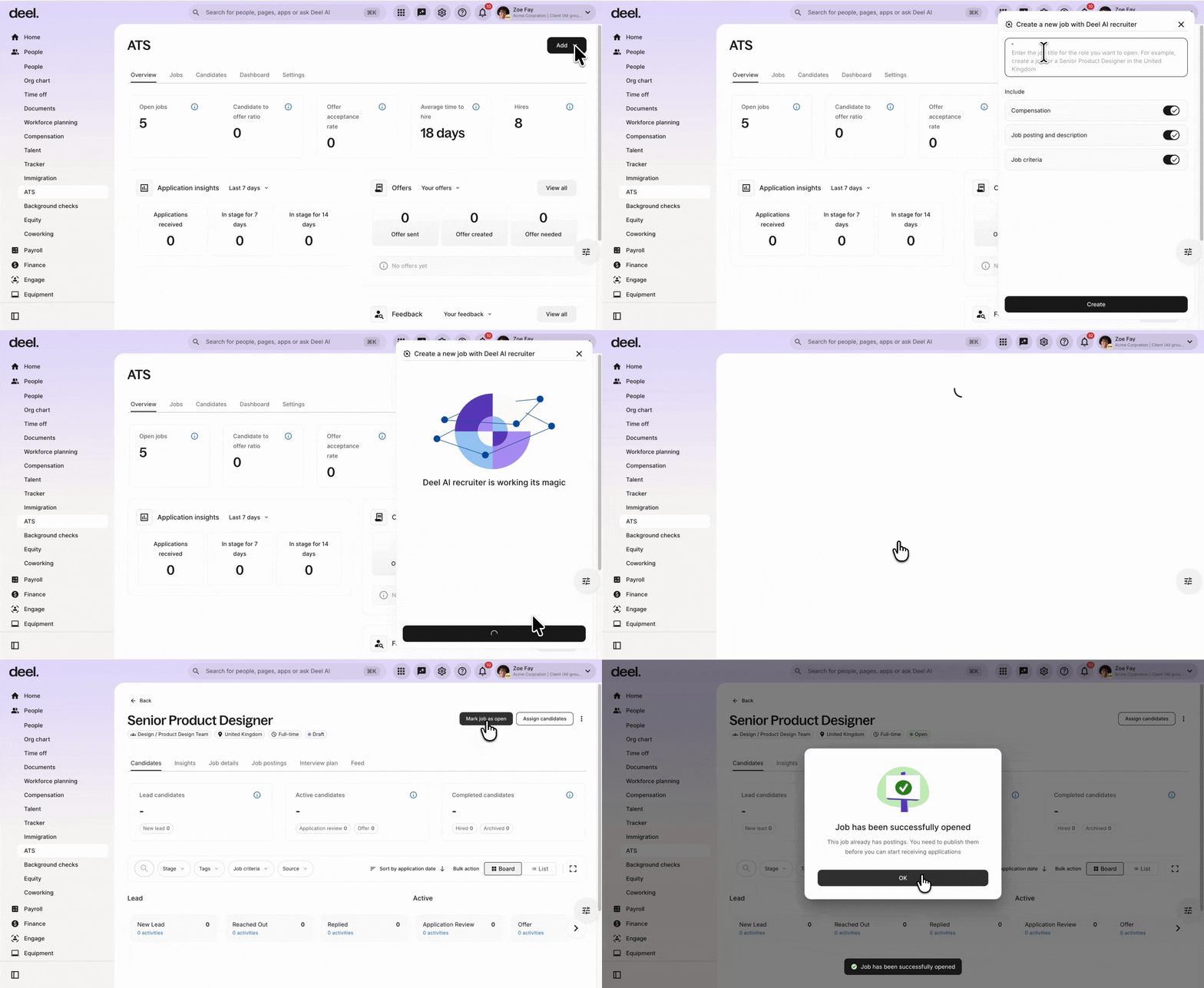
See Deel’s ATS for yourself, and book your 30-minute demo.
Trend 3: Responsible AI and data governance become critical in sourcing
AI is coming under more scrutiny from regulators as it plays a larger role in candidate sourcing. According to a LinkedIn survey, 37% say data privacy and security have become a barrier to using the technology.
Some key concerns include:
- Overreliance on AI scoring
- Algorithmic bias filtering out candidates
- Data privacy concerns when processing sensitive data
- Potential security issues with new tools
- Lack of transparency around decisions
Some jurisdictions have introduced laws restricting the use of automated decision-making. For example, the California Consumer Privacy Act (CCPA) was recently amended — as of 2027, businesses must notify candidates, manage consent, and conduct thorough risk assessments.
Compliance is typically the responsibility of both the employer and the software provider. As such, it’s important to ensure you only use tools with a strong track record in data privacy and protection and apply the appropriate safeguards to hiring processes. Getting regular compliance updates can help you stay on top of these changing laws.
Trend 4: Precision sourcing replaces high-volume outreach
Recruiters say the top challenge they’re facing going into 2026 is a lack of candidates with the right skills and expertise. They can no longer guarantee that a single batch of applicants will bring a good match.
Many industries are rethinking their approach to hiring to fill workforce needs. For example, a recent report by Experis shows that many US tech companies are prioritizing quality of hire over volume hiring. Around a quarter say they’re already tapping into new and underrepresented markets to source the specialists they need.
Trend 5: Skills-based sourcing overtakes credential screening
Companies are focusing less on credentials and job titles as they pay more attention to skills. In fact, around half have abandoned degree requirements altogether.
Skills-based hiring helps you make better matches. Instead of filtering applicants based on qualifications that may no longer be relevant to the role, you can use AI to identify candidates. The tools have become advanced enough to detect nuanced quality signals rather than relying on exact keyword matches.
When you stop requiring degrees, you also expand your potential hiring pool. You’re more likely to find top candidates who lack traditional credentials or career paths that are an otherwise great fit for your business.
Trend 6: Global and remote sourcing expands competition
Recruiters aren’t confined by geography anymore. Now that remote work has become commonplace, they can hire across regions and timezones, dramatically increasing their access to skills.
SHRM data shows that global hiring not only increases your access to talent but also helps you attract candidates. Employers who offer flexible working arrangements report less difficulty sourcing candidates.
Although international hiring solves many hiring challenges, it introduces more operational complexity. Remote-first companies must find ways to coordinate onboarding, payroll, and compliance across borders. Before you take this step, you must ensure you have a scalable, global solution like Deel in place to manage these key processes.
Useful resource:
Hiring globally? Take the headache out of global compliance with Deel. Check out our Hiring Guides to see how we can support your expansion in 150+ countries.
Trend 7: Candidate experience becomes a differentiator
Over the next two years, 44% of organizations say improving the candidate experience will be a top priority. A further 29% say they use this as a metric to gauge the success of their hiring processes.
Candidate engagement strategy has become so vital in 2026 because talent has their choice of roles. Simply offering the best compensation package is not enough to outdo the competition and secure top talent. You must demonstrate that your company is a good place to work for with a positive culture and potential for career advancement.
AI might not be a substitute for relationship-building, but it can help you achieve these ends. Tools can allow you to remain responsive to candidates as they send applications and arrange interviews, and personalize these follow-ups. As they also save time, you can focus more on providing a great experience to those on your shortlist.
Trend 8: Human recruiters become strategic talent advisors
Now that AI is taking on more of the administrative workload, the role of recruiters is becoming more strategic. You can focus on priorities like interpreting market dynamics, advising senior leadership, or developing long-term workforce plans.
AI also helps recruiters make more strategic decisions. Analytics tools in particular can enable you to quickly surface candidate data, forecast skills gaps, and assess potential hires on a deeper level. All this leads to more efficient hiring processes with better matches.
As with any technology, there are concerns that AI may replace recruiters. The reality is that AI still has some limitations when it comes to detecting nuance and applying judgment, and it works best when it supports people. In 2026, the most successful businesses will be the ones that blend technological efficiency with human insight.
How recruiting teams should prepare for the future
Adapting to these candidate sourcing trends requires more than just awareness. Recruitment teams must focus on three key areas to ensure their hiring process is proactive and future-ready.
Infrastructure
- Does your ATS integrate effectively with AI sourcing and engagement tools rather than forcing you to operate in silos?
- Can it give you broad oversight, including flagging potential bottlenecks and rediscovering past candidates?
- Are global teams able to access and collaborate on hiring workflows asynchronously to reach faster hiring decisions?
Expertise
- Do teams have the expertise to understand how AI tools can support the hiring process?
- Does your organization provide regular training and updates on the latest advances in candidate sourcing technology?
- Are all stakeholders in the hiring process aware of the compliance risks related to AI sourcing and international hiring?
Metrics
- Do the metrics you track give you insights into hiring outcomes and the candidate experience as well as pipeline velocity?
- Can you monitor your progress toward diversity benchmarks to ensure equitable opportunities and access to a wide talent pool?
- Are you able to track metrics on a granular level and get a broad idea of performance?
Make proactive global sourcing your competitive edge with Deel
Candidate sourcing in 2026 is becoming more proactive, tech-enabled, and built on data insights. Businesses that hop on these trends early will be far better positioned to compete for talent in the tight labor market.
Deel can provide the infrastructure to support this strategic shift. Our new ATS connects with our HRIS to give you control over the entire worker lifecycle in one place. We empower you to find, assess, and manage hires from anywhere with:
- Powerful AI screening and scoring features
- A single unified dashboard for quick collaboration
- Highly configurable filters and fields
- Customizable applications, feedback, and approval workflows
- Syndication with 4,000+ job boards
- Detailed reporting insights
- Access to the latest global benchmarking data
- Integrations with Google and Microsoft Teams
- Custom permissions by team and role
- Built-in compliance for local employment laws
Ready to move from reactive hiring to proactive sourcing? Book a call with Deel to see how our new ATS can support a smarter, more scalable hiring strategy.
Live Demo
Get a live walkthrough of the Deel platform

FAQs
How will AI change candidate sourcing in 2026?
AI will increasingly assist with identifying, assessing, and engaging talent. As these processes become more efficient, recruiters will be able to play a more strategic role and invest more time into the candidate experience.
Will AI replace recruiters in sourcing?
No, AI is unlikely to replace recruiters. Tools are designed to support teams, not replace them altogether, as humans remain essential for evaluating fit, supporting candidates, and building relationships.
What role will ATS play in future sourcing?
ATS is changing from a simple tracking tool into a sophisticated, centralized system. Leading solutions can connect with an organization’s HRIS, payroll, and workforce management functions to give them more oversight and control over the employee lifecycle.
Is skills-based hiring really replacing degree requirements?
Skills-based hiring is becoming more popular as requirements change more rapidly in the past. Many sectors are prioritizing candidates with proven capabilities over those with formal credentials, especially in industries like science and tech.
Ellie Merryweather is a content marketing manager with a decade of experience in tech, leadership, startups, and the creative industries. A long-time remote worker, she's passionate about WFH productivity hacks and fostering company culture across globally distributed teams. She also writes and speaks on the ethical implementation of AI, advocating for transparency, fairness, and human oversight in emerging technologies to ensure innovation benefits both businesses and society.