Article
7 min read
Human-Centric Hiring: How an ATS Ranks Real Talent in the Age of AI Bots
AI

Author
Alan Price
Last Update
April 06, 2026

About the author
Alan Price serves as the Director of Talent Acquisition at Deel, overseeing talent acquisition teams in the US, LATAM, EMEA, and APAC regions. Before joining Deel, Alan was a founding member of the micro-mobility company Dott, where he held the position of Vice President of People. Prior to his role at Dott, he held senior positions at Uber and Google.
Hiring teams are receiving more applications than ever before, as a natural byproduct of candidates under immense pressure to find their next role quickly. The Bureau of Labor Statistics reports that the share of workers who remain unemployed for six months or longer has grown consistently since 2023. Those out of work increasingly turn to AI to support their job search, casting the net wider than any manual approach to applications would allow.
For hiring teams, the result is a surge of applications, each more polished and generic than the last, with no real way to learn about the humans behind the “Submit” button. They, in turn, rely on AI tools to help them sift through the noise and find those hidden gem candidates that would bring the most value to the organization.
Is fighting fire with fire the best option? It certainly can be. But depending on AI to solve the problems caused by AI only works if humans remain central to the process. The technology is secondary, working hard to give the right candidates the attention they deserve.
The pipeline problem that’s nobody’s fault
66% of organizations consider it’s been harder to acquire quality talent over the past year, even though they have fewer roles to fill. Artificial intelligence stands out as one of the main reasons for the growing gap, with generative AI playing a key role.
The Economist reports that the average job candidate now sends 239% more applications than they did before ChatGPT existed. Candidate-in-the-loop isn’t even essential, as some paid services handle the legwork, auto-submitting applications on behalf of job seekers as they sleep. These services generate tailored CVs and cover letters, optimizing the output for the keywords mentioned in each individual job ad.
With 1.1 million layoff announcements last year, we can’t blame candidates for using every tool available to get back on their feet faster. But as application volumes rise, and 81% of people report they’ve either used or plan to use AI in their job search, it’s undeniably hard for recruiters to separate candidates who are a genuine fit, from those who’ve outsourced their first impression to an algorithm.
The challenge becomes even harder for small to medium-sized companies, who simply don't have the hands on deck to absorb the extra load. This is even more pronounced if your SMB is hiring globally, dealing with the complexities of managing compliance in multiple jurisdictions.
According to Deel’s State of Global Hiring Report, top-funded startups made 1,400 cross-border hires in 2025, and software developers were the most common role. In competitive, high-volume categories like this, screening quality directly affects hiring outcomes, so ideally you’d spend more time on each application.
But more applications actually results in less time per candidate. And less time per candidate means a higher risk of missing someone great, or accidentally progressing someone who interviewed better on paper than they'll perform in the role.
Deel HR
Speed without structure is noisy at scale
When the pressure to fill seats builds, the natural response is to move faster. And the easiest way to measure whether you're moving fast enough is to track time-to-hire. But this approach doesn’t consider quality of hire, a more important recruitment metric that reveals if your process is working.
Instead, when pipelines fill up, the response is to skim more CVs, shorten interview stages, and trust gut feel — exactly the type of unstructured behaviors that amplify recruitment bias rather than eliminate it. When the success of a candidate’s application is based on which hiring team member is reviewing their application or how burned out they feel that day, it’s no surprise that hiring decisions are riddled with bias.
How AI brings much-needed structure to your hiring
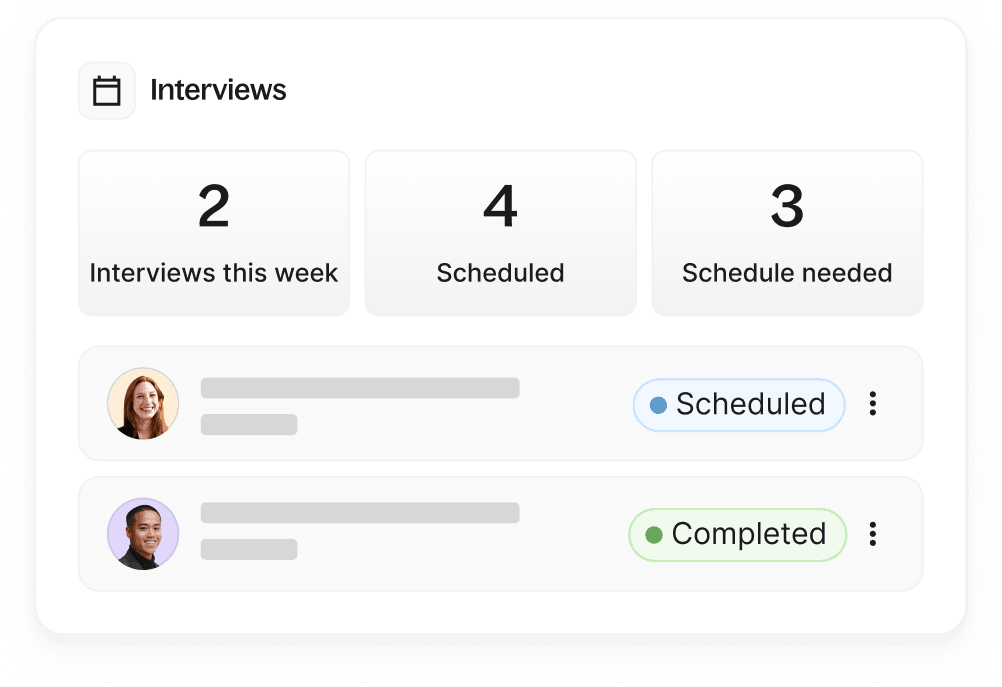
A structured hiring process is the only way to move fast and apply fair, consistent criteria to every person that applies for a job. This is where AI-assisted screening earns its place, helping recruiters locate those crucial hiring signals. Some of the following AI features in Deel’s ATS make this possible.
AI-assisted CV-to-job matching based on your criteria
Your team defines role criteria for each open vacancy and the AI matches applicants against it. Every application is evaluated against the same bar, and your team uses this consistent foundation to decide who moves forward
Knock-out questions at the application stage
Structured knock-out questions filter candidates based on genuine role requirements before anyone has spent time reviewing a CV. The result is a shortlist built on fit, not on how impressively someone has formatted their work history.
AI-generated transcript summaries in interviews
Candidates receive a notification before an interview recording takes place and can opt out. For those who consent, AI-generated transcript summaries help interviewers understand exactly what each candidate said. This gives everyone a fair chance, and helps hiring teams find the right person for the job, even if they weren’t directly involved in their interview.
Data-led screening prioritizes signal over speed
Analytics are another dependable building block that humans can use to hire other humans. When teams can see key recruitment metrics like candidate-to-offer ratio and source quality (which job boards, channels or markets deliver the best talent) alongside their average time to hire, they have a more complete picture of how their hiring efforts are paying off.
This delivers a strategic advantage — if you discover that top candidates consistently drop out at the same hiring stage, this highlights problems in your process. Doing the work and making the fix early saves you time in the long run.
This is particularly valuable in emerging role categories where there's no established playbook to fall back on. Deel's State of Global Hiring Report found that AI trainer roles grew 283% cross-border last year, which was the fastest-growing category. When you're hiring at speed for a role that barely existed two years ago, analytics are your only source of truth.
How to keep the human in human-centric hiring
With all the talk of numbers and metrics and algorithms, alongside the headlines of AI replacing people, the obvious question is: where do humans fit in all of this? And the short answer is: everywhere that matters.
Humans can and should feel supported by AI in hiring to cut through the noise and volume of applications they’re dealing with. But the point of AI tools is to put better information in front of the people making the decisions, never to make the decisions for them.
When hiring teams bring structure and automation to their workflows, they have more time and energy to spend building real, human relationships with their candidates. By communicating clearly at every stage and being available to answer queries, they create a candidate experience that reflects well on the organization. In a market where employer brand influences who says yes to an offer, the human moments in your hiring process are more important than ever. These only happen when your team isn't buried in spreadsheets and inbox management.
The teams winning at hiring right now aren't those moving fastest or being most cautious about AI. They're the teams who've built processes that free people up to do what only people can do.
Complementary reading:
Separate fact from fiction, and understand how an AI-powered ATS works in our guide: AI ATS: What It Is, Benefits, and How to Choose One
Find the humans behind the applications with Deel
The rise of AI-generated applications hasn’t suddenly broken hiring. Organizations without structured hiring processes have been playing fast and loose for a while, and the influx of AI has just exposed what was already broken.
What it's also done is accelerate a shift that was always coming: from hiring based on how well someone presents, toward hiring based on how well they match. That's a better outcome for candidates and for companies. But it only works if you've got the right process behind it.
Deel's ATS gives your team the foundation, offering criteria-based screening, analytics that tell you where your process is working and where it isn't, and a human-in-the-loop design that keeps your people in control of every decision. Book a demo to see how it works.
Live Demo
Get a live walkthrough of the Deel platform

Alan Price serves as the Director of Talent Acquisition at Deel, overseeing talent acquisition teams in the US, LATAM, EMEA, and APAC regions. Before joining Deel, Alan was a founding member of the micro-mobility company Dott, where he held the position of Vice President of People. Prior to his role at Dott, he held senior positions at Uber and Google.