
Article
5 min read
Top Device Lifecycle Management Platforms for Repairs and Upgrades in 2026
IT & device management

Author
Dr Kristine Lennie
Last Update
March 31, 2026

As hybrid and remote teams grow across countries, keeping devices repaired and up to date becomes harder to manage. What used to be occasional break-fix work now affects onboarding timelines, employee productivity, and long-term device costs.
Most organizations use mobile device management (MDM) tools to enforce security policies and push updates. But repairs and hardware refresh cycles involve more than digital controls—they also depend on procurement, shipping, warranty coordination, and device recovery.
When those layers aren’t coordinated, downtime increases, upgrade cycles slip, and visibility weakens. That’s why repairs and upgrades work best when they’re managed as part of a broader device lifecycle strategy.
Below, we compare leading device lifecycle management platforms based on how well they support repair coordination and upgrade planning at scale—especially for distributed teams operating across regions.
Why repairs and upgrades matter more than ever
As device fleets expand across regions, repairs and upgrades shift repairs and upgrades stop being isolated IT tasks and start shaping everyday operations. For HR leaders, device reliability directly affects onboarding timelines and employee experience. For IT leaders, slow repairs and inconsistent upgrade cycles increase security risk, reduce visibility into device status, and inflate the total cost of ownership.
If repairs and upgrades aren’t managed through a structured lifecycle model, turnaround times lengthen, upgrade planning becomes inconsistent, and long-term asset value is harder to control. At scale, that impact becomes harder to contain:
- Downtime affects not just one employee, but entire distributed teams
- Security exposure increases when upgrades lag across hundreds or thousands of devices
- Replacement costs rise when refresh cycles aren’t planned
- Asset value declines when devices aren’t recovered and redeployed systematically
- Audit preparation becomes more complex when repair and upgrade records are fragmented
Repairs and upgrades matter more than ever because they now influence productivity, security posture, financial forecasting, and compliance across the organization, not just IT operations.
See also: How to Create a Fair Laptop Fresh Policy
What modern device lifecycle management should include
To keep repairs fast and upgrades predictable across distributed teams, device lifecycle management must go beyond basic endpoint control. A modern platform should connect procurement, repairs, upgrades, recovery, and compliance into one coordinated system—so repair SLAs, replacement paths, and refresh cycles can be executed consistently from purchase through retirement.
At a minimum, that includes:
- Clear warranty tracking and repair coordination to reduce downtime and standardize service levels
- Global procurement and delivery so employees receive the right devices wherever they’re based
- Zero-touch deployment so devices automatically enroll and configure on first boot without manual setup
- Seamless mobile device management (MDM) or Unified Endpoint Management (UEM) integration to enforce security policies and maintain compliance visibility
- Planned upgrade and refresh cycles that prevent emergency replacements and extend asset value
- Secure recovery and certified data erasure before devices are redeployed or retired
- Cross-border shipping and logistics support for repairs, replacements, and retrievals
- Automation tied to onboarding and offboarding events so device workflows stay aligned with workforce changes
- Centralized reporting and audit-ready documentation for compliance and financial oversight
Some tools manage endpoint policy, others manage logistics, and others manage maintenance workflows. The platforms most effective for repairs and upgrades connect these layers so replacements, repairs, and refresh cycles don’t depend on manual coordination.
1. Deel IT
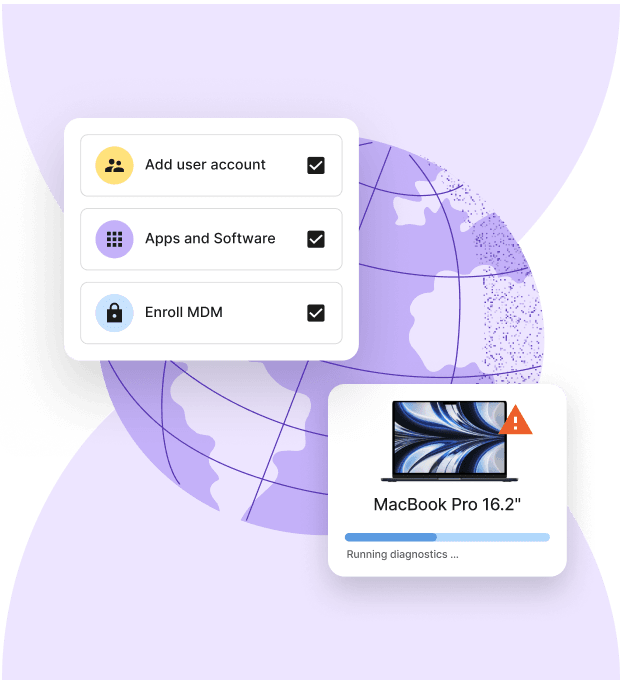
Deel IT is built for companies managing devices across countries, where repairs and upgrade cycles involve procurement, cross-border shipping, and device recovery. Rather than juggling separate tools and vendors, Deel IT centralizes repair, replacement, and refresh workflows in a single platform.
Because Deel also supports global hiring and workforce changes, device repairs and upgrades naturally follow the employee journey: from onboarding to role changes to offboarding. Instead of being handled reactively, repairs and refreshes are part of a consistent lifecycle that keeps teams productive and operations predictable.
Core capabilities:
- Global device procurement and delivery so teams receive the right hardware wherever they’re located
- Pre-configured deployment that works with your MDM so devices arrive ready, and policies are applied from day one
- Structured repair and warranty coordination that reduces downtime and standardizes SLAs across regions
- Planned upgrade and refresh cycles to avoid reactive replacements and extend asset value
- Automated offboarding and retrieval workflows triggered directly from HR events
- Certified data erasure and secure redeployment to protect sensitive information
- Centralized lifecycle reporting that gives HR and IT shared visibility into inventory, compliance, and recovery status
Best for: Organizations of any size (especially those operating across multiple countries) that want procurement, repairs, upgrades, and recovery managed in one unified lifecycle system aligned with workforce operations.
Limitations: Organizations operating in a single country with minimal repair or logistics complexity may not require the full breadth of lifecycle and workforce integration that Deel IT provides.
Device Lifecycle Management
2. Jamf
Jamf helps organizations manage Apple device updates and configurations centrally, supporting ongoing upgrade and patch management. It integrates with Apple Business Manager for zero-touch enrollment and ongoing policy management on macOS and iOS devices
Core capabilities:
- Apple device enrollment and provisioning
- Patch management and update controls for macOS and iOS
- Integration with Apple Business Manager
- Compliance and reporting controls
Best for: Organizations managing primarily macOS and iOS devices.
Limitations: Primarily focused on Apple device management. Organizations with mixed OS fleets or complex global repair logistics typically need additional tools or service partners.
3. Kandji
Kandji (Iru) is an Apple-focused endpoint management platform that supports upgrades through automated policy enforcement, patch management, and compliance controls.
Core capabilities:
- Apple device enrollment and provisioning
- Pre-configured compliance and security policies
- macOS and iOS patch management
- Configuration enforcement and reporting
Best for: Organizations managing primarily Apple devices that require automated policy and compliance management.
Limitations: Apple-centric scope. Organizations with mixed operating systems or those requiring integrated procurement, global repair logistics, or recovery workflows will need additional systems.
4. Microsoft Intune
Microsoft Intune is a cross-platform endpoint management solution integrated with Microsoft 365 and Entra ID that manages operating system updates and how upgrades roll out across devices. It enforces compliance and access requirements across Windows, macOS, iOS, and Android.
Core capabilities:
- Cross-platform device enrollment and management
- Conditional access and compliance policy enforcement
- Integration with Microsoft security and identity tools
- Update and patch management
Best for: Organizations standardized on Microsoft 365 and Entra ID for identity and endpoint management.
Limitations: Intune is focused on endpoint policy and compliance management. Procurement logistics, repair coordination, upgrade planning, and global device recovery workflows require separate systems or service providers.
5. GroWrk
GroWrk handles logistics for replacements and returns by managing procurement, shipping, and device retrieval for distributed teams.
Core capabilities:
- Multi-country device procurement
- Shipping and replacement coordination
- Retrieval and redeployment support
- Logistics visibility dashboards
Best for: Organizations seeking outsourced global hardware logistics.
Limitations: Primarily focused on procurement and logistics services. Endpoint policy management, security enforcement, and lifecycle automation require integration with external MDM or workforce systems.
6. IBM Maximo
IBM Maximo supports repair planning and preventive maintenance for industrial assets through enterprise asset management.
Core capabilities:
- Asset performance monitoring
- Predictive maintenance workflows
- Work order automation
- Enterprise asset analytics
Best for: Manufacturing, utilities, and infrastructure environments managing sensor-driven assets.
Limitations: Designed for industrial asset management rather than knowledge-worker device fleets.
7. MaintainX
MaintainX helps teams manage repairs through work orders, inspections, and maintenance records.
Core capabilities:
- Digital inspections and checklists
- Work order automation
- Inventory tracking
- Compliance documentation
Best for: Operations teams formalizing maintenance and audit workflows.
Limitations: Primarily a maintenance coordination tool; does not provide integrated endpoint management or global device lifecycle services.
Standardize device lifecycle management with Deel IT
As organizations expand across regions, managing repairs and upgrades requires more than individual tools—it requires a consistent operating model.
Deel IT enables organizations to standardize how devices are procured, maintained, refreshed, and recovered across countries, keeping HR and IT aligned through every workforce change.
With Deel IT, organizations gain:
- A consistent global framework for managing device repairs and upgrade cycles
- Lifecycle workflows that stay synchronized with onboarding and offboarding
- Clear ownership and visibility across procurement, maintenance, and recovery
- Structured refresh planning that improves cost predictability
- Audit-ready documentation across the entire device journey
The result is not just better device management — but a scalable, repeatable system that supports growth without adding operational complexity.
Book a demo to see how Deel IT supports global device lifecycle standardization.
Deel IT

FAQs
What features should I look for in a device lifecycle management platform for repairs and upgrades?
Look for automated asset tracking, remote repair and RMA workflows, secure data erasure, procurement and warranty integrations, and support for automated refresh or buyback programs.
How does device lifecycle management improve asset tracking and device recovery?
DLM centralizes real-time inventory and chain-of-custody, enabling streamlined recovery, redeployment, and verified data wipes during offboarding.
What pricing models are common for device lifecycle management platforms?
Most offer per-device or per-user pricing, with enterprise tiers and add-ons for logistics, data erasure, or warranties; some bundle DLM with HR or productivity suites.
How can integration with repair workflows and warranty tracking benefit my organization?
Integrated repairs and warranty claims reduce downtime, enforce SLAs automatically, and maintain complete audit trails for compliance.
What are the key steps to implement a device lifecycle management platform successfully?
Inventory your fleet, map compliance needs, select a platform aligned to your OS mix and regions, integrate data sources (HRIS, IdP, MDM/UEM), and train IT and operations on new workflows.
Dr Kristine Lennie holds a PhD in Mathematical Biology and loves learning, research and content creation. She had written academic, creative and industry-related content and enjoys exploring new topics and ideas. She is passionate about helping create a truly global workforce, where employers and employees are not limited by borders to achieve success.


