Article
9 min read
The UK’s Quiet Lead in HR & Payroll AI
AI

Author
Matt Monette
Last Update
January 22, 2026

2025 was a big year for AI in the UK. The government launched its AI Opportunities Action Plan, securing £14 billion in private investment commitments, aiming to boost adoption, growth, and innovation. A large-scale government trial revealed that over 20,000 civil servants saved two weeks per year using generative AI. In the private sector, British banks accelerated their use of agentic AI for financial decision automation, prompting wide-scale changes to autonomy and customer protection. And in offices across the country, conversations around the ‘skills of the future’ are centred firmly around AI.
Now, research shows that British HR and Payroll teams are driving this march forward. In the UK, 55% of companies invested in AI for HR in 2025, and 42% of companies are using AI in payroll. This outshines its European counterparts, where only 38% of companies are using AI for HR, and 30% for payroll.
While the majority of Europe debates AI readiness, teams in the UK are already experimenting and operationalising. But how long will this advantage last, and what can HR professionals in the UK do to maintain it long-term?
How HR and Payroll teams are using AI
HR and Payroll have overdue for an update for a long time, as high-volume, rules-based work that requires a great amount of human expertise and sensibilities. Payroll queries, validation, and employee lifecycle management are all ripe for automation, something teams in the UK are realising ahead of those in Europe.
Breaking down the research reveals where teams are implementing new technology.
- 31% Learning and development: Personalised training pathways
- 28% Recruitment: Automated CV screening and interview scheduling
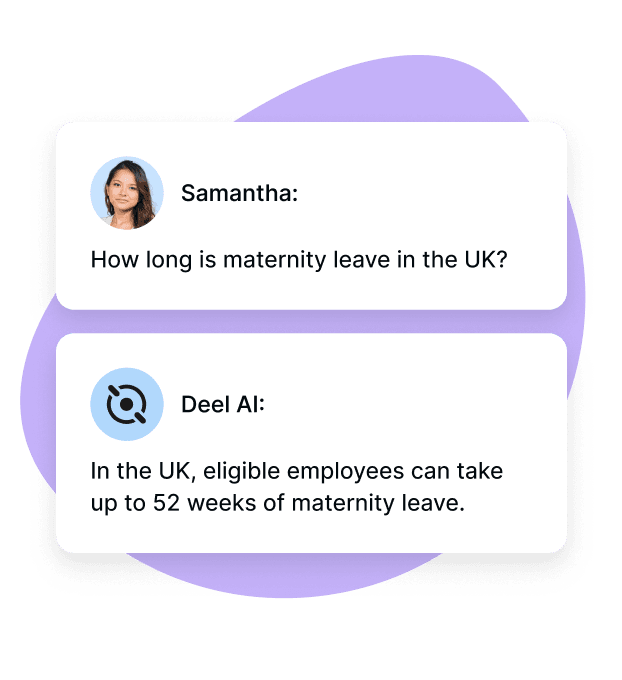
- 28% HR support: Chatbots answering simple employee questions
However, only 41.7% of respondents report seeing a significant return on investment. This could be because it’s easy to miscalculate or misunderstand the ROI of AI, or a mismatch between investment and execution. Either way, it suggests that many organisations are still in the early stages of adoption, and the UK still has a long way to go in its AI efforts. Now isn’t the time for complacency, but for strategically planning the next steps.
Deel AI
Why the UK is pulling ahead
Persistent skills shortages across sectors may have forced automation earlier, lifting repetitive work from teams who were stretched thin. Payroll complexity undoubtedly plays a role, as UK payroll is compliance-heavy but standardised, and ideal for AI augmentation.
Our own research revealed that the need for guidance and compliance frameworks was a major blocker for companies in their AI efforts, suggesting that government policy strongly shapes how businesses approach AI adoption. The UK government’s AI Opportunities Action Plan offers a lighter-touch, principles-based approach, perhaps enabling faster experimentation than the more prescriptive frameworks set in some EU markets.
For example, the EU AI Act’s risk-based model, AI systems used in areas like recruitment, performance management, or payroll are classified as high risk. This encourages leaders to pursue AI pilots in lower-risk verticals, or to approach AI in HR and payroll more cautiously. The UK’s attitude to AI provides more of a sandbox to play in than a checklist of strict rules.
Complementary reading
Where Europe differs (and how it’ll catch up)
The UK’s lead in HR and Payroll AI is not driven by superior technology or aptitude, but by faster decision-making and a culture of fast experimentation. But the gap is closing. To stay competitive, the UK can’t afford to underestimate its European neighbours. Signals from other countries suggest that Europe is primed to catch up fast.
Germany is planning major AI investment initiatives and infrastructure scaling aimed at boosting competitiveness and closing technology gaps. Their goal is to achieve significant economic impact from AI by 2030, indicating a shift from theory to action. We know from our own research that governance and frameworks boost AI adoption and encourage experimentation. Germany’s governance-first approach could see it overtaking the UK in the AI race when rollout starts in earnest.
The Netherlands, one of the most business-friendly AI environments in the EU, is another contender. Dutch businesses interpret EU AI regulation more pragmatically, rolling out AI in logistics, HR tech, and finance. Finland is focusing on AI skills and education (for example, the University of Helsinki offers free, government-backed online AI courses), equipping workers with AI literacy.
The list goes on.
The next phase: From adoption to advantage
The next wave of AI leadership, particularly in payroll and HR, will depend on responsible AI governance. Transparency, explainability, and bias mitigation will ensure smooth adoption, whilst also maintaining trust. Practically, this means building or adopting tools with audit-ready logs, regular human review, and clearly defined accountability for automated decisions across the employee lifecycle. Any AI workflows must be human-in-the-loop by design—augmentation over replacement. HR is an intrinsically human function, with numerous sensitive aspects that cannot be left to machines.
Cross-functional ownership, rather than each department implementing AI in siloes, will be the key differentiator. While AI can boost efficiency across HR, payroll, finance, and IT separately, the true game-changer lies in technology which improves alignment between them. For example, with Deel, the entire employee lifecycle is handled within a single platform. Automations create smooth collaboration between teams while creating a seamless employee experience.
The final puzzle piece for AI leadership is understanding ROI and properly measuring outcomes. If we focus solely on money and time saved, we miss that AI in payroll and HR leads to error reduction, enhanced compliance confidence, and an improved employee experience.
Complementary reading
Leading, but still learning
60% of HR professionals worldwide cite AI adoption as their top priority for the future. This indicates strategic, not experimental intent.
At Deel, we’re preparing for AI to be not just a tool used for speed and accuracy, but a foundational technology that delivers solutions for our partners and our teams. Here’s what I believe will be the keys to success:
-
Compliance as standard: Compliance is non-negotiable for trust, which is itself non-negotiable for AI leadership. Everything we do is aligned with emerging AI legislation and governance.
-
Measuring qualitative and quantitative results: We look beyond speed, efficiency, and accuracy and look to the human impact. When AI removes the rote work that stops people from loving their jobs, when it speeds up immigration documentation processing times to remove stress and uncertainty, and when it makes keeping up with compliance stress-free, that’s when we get excited.
-
Invest in change management, not just tools: Understanding how transformational AI really is allows us to treat it as more than just another tool. That means investing in change management, training, and ongoing feedback loops to ensure any new workflows are working with our teams and not against them.
-
Treat AI literacy as a leadership skill: Recognising AI literacy as a key leadership skill for all employees, not just those on the tech team, lets us factor it in more seamlessly in workforce planning and performance management. We’re able to recognise those who drive adoption, and properly reward those who drive results. This ensures that our AI strategies are never static and are always poised to advance when new technologies and tools emerge.
Complementary reading
For more on how we build AI tools for humans, catch our Senior Director of Product, Abhijit Mehta, talking about how his team combines AI and human insight for better work.
For the UK’s HR and payroll leaders, now is the time to get excited about AI. It offers new solutions to old problems previously thought unsolvable, removes the rote work thought of as ‘part of the job’, and smoothes out clunky processes teams have accepted as standard.
See what responsible, compliant, and exciting AI-driven HR and payroll look like. Book your 30-minute Deel demo today.
Matt Monette is the Director, Solutions Consulting, Global Payroll at Deel. He has worked at hyper growth SaaS companies most of his career. Most recently, leading Shopify's UK expansion in London to being the VP of Sales at a late stage startup.