Article
5 min read
UK Talent is in Global Demand — Here's What That Means for British Employers
Global hiring

Author
Matt Monette
Last Update
March 31, 2026

About the author
Matt Monette is the Director, Solutions Consulting, Global Payroll at Deel. He has worked at hyper growth SaaS companies most of his career. Most recently, leading Shopify's UK expansion in London to being the VP of Sales at a late stage startup.
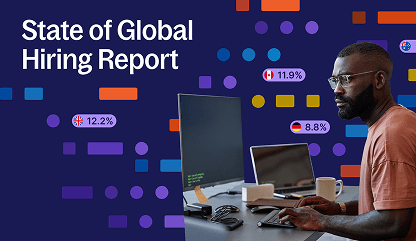
According to Deel's 2025 State of Global Hiring Report, the UK is the single most-hired country for the world's top-funded startups, accounting for 12.2% of all cross-border employee hires. That puts British workers ahead of Canada (11.9%), Germany (8.8%), Australia (5.8%), and Spain (5.2%).
While our first instinct might be pride, it carries a warning for British employers; the world’s best-funded startups want your people.
The companies doing this hiring aren't small operations hedging on cheap labour. They're startups founded between 2020 and 2025 that raised at least $100 million in funding. These are well-resourced, fast-moving businesses that know exactly what they're looking for — and they've decided the UK is where they'll find it.
This is a significant shift in how the talent competition works. It's no longer just domestic businesses competing for the same local hires. It's a globally distributed hiring market, and UK workers are among the most targeted in the world.
Language is the foundation, but it's not the whole story
Ask why international startups disproportionately hire in the UK, and language is the most obvious answer. English is the default operating language of global business, and the ability to communicate fluently across markets — with US headquarters, European partners, and Asia-Pacific customers — makes UK workers immediately valuable to companies operating across time zones.
The data backs this up. Our report consistently shows that cross-border hiring concentrates in familiar corridors shaped by language, proximity, and regulatory alignment. The US hires heavily into the UK (22% growth), and the UK returns the favour, with 44.1% of UK cross-border EOR hiring going into the US. These hiring patterns reflect trust, ease of communication, and cultural compatibility.
The UK also offers a mature talent pool in exactly the roles most in demand. Software developers make up 28% of cross-border hires among top-funded startups, followed by ICT account managers (6.2%), business developers (4%), and AI engineers (2%). These are roles where the UK has genuine depth, with the UK’s software development market becoming “increasingly senior-driven.” London ranks 20th globally for elite software engineering talent, second in Europe, with a talent pool placing it the 12th largest worldwide.
The new reality of cross-border hiring
One of the most important findings in Deel's report is what this hiring isn't. These companies aren't going cross-border to reduce costs, but to access rare, high-value skill sets that are harder to find at home, such as sales engineering, AI development, and technical product expertise.
That reframes the risk for UK employers. The people most likely to be approached by international competitors aren't replaceable or entry-level workers. They're your most capable ones, like senior engineers, technical sales leads, and AI talent. Essentially, the people who are hardest to backfill and most expensive to lose are the ones most likely to be poached.
There's another dimension worth noting. Deel's data shows that the US or UK appears in the top three worker countries for every major hiring market globally. That’s a reflection of the UK's unique position as a bridge between the US and Europe, with strong regulatory familiarity on both sides, a highly mobile professional workforce, and a long track record of producing globally recognised talent.
Global hiring infrastructure, including platforms like Deel, makes it easier than ever to hire compliantly across borders. Because of that, the friction that once protected UK employers from international competition has largely disappeared. A well-funded startup in San Francisco or Montreal can hire a software developer in Manchester or Edinburgh as easily as hiring someone across town.
Deel's HRIS

Next steps for UK employers
Understanding the competitive landscape is one thing. Responding to it is another. Here's what UK business leaders should focus on:
Know which roles are most exposed. Software developers, sales engineers, AI engineers, and technical account managers are the most actively targeted by international startups. If you employ people in these categories, treat their retention as a strategic priority — not an HR formality.
Revisit your compensation benchmarks. Our State of Global Hiring report also shows that pay growth in 2025 concentrated in senior leadership and specialised technical roles. Static salaries in high-demand categories are effectively pay cuts when global competitors are actively recruiting. Regular benchmarking against international as well as domestic rates is no longer optional.
Compete on what global startups can't easily replicate. Flexible working, genuine career development, strong team culture, and a sense of belonging are harder to offer remotely (though certainly not impossible). International employers can match or beat on salary, but they may struggle to match on day-to-day experience, local community, or long-term career investment. Build those advantages deliberately, particularly if you have an in-office or hybrid model.
Consider going global yourself. The same infrastructure that lets international startups hire your people lets you hire theirs. If you're a UK business constrained by local talent supply, expanding your hiring internationally — across Europe, Canada, or beyond — is now genuinely accessible. You don't need a global legal team or overseas entities to do it compliantly.
Move faster on hiring decisions. Startups operate quickly. If your hiring process takes three months while a competitor can extend an offer in three weeks, you'll lose candidates you didn't even know you were competing for. Speed is a competitive advantage that is easy to improve with the right tools.
Discover the solutions that level the playing field
The rise of global hiring platforms has created a more competitive market for UK talent. But it's created the same opportunity for UK employers. The solutions that let a US startup hire your best engineers are the same tools you can use to hire the best engineers anywhere.
The businesses that will be left behind are those clinging to antiquated tech stacks that don’t match the pace of the modern-day world of work. The businesses that will come out ahead are the ones that recognise the shift is already happening, take retention seriously, and start thinking about talent with the same global mindset their competitors have.
To learn more about the state of global hiring, download the full report.
To discover the tools that make global hiring faster, easier, and more scalable than ever, book your 30-minute Deel demo.
Live Demo
Get a live walkthrough of the Deel platform

Matt Monette is the Director, Solutions Consulting, Global Payroll at Deel. He has worked at hyper growth SaaS companies most of his career. Most recently, leading Shopify's UK expansion in London to being the VP of Sales at a late stage startup.