Article
15 min read
The Rise of Workslop: A Leader’s Guide to Smarter AI
AI

Author
Ellie Merryweather
Last Update
March 31, 2026
Table of Contents
What is workslop?
Why workslop is increasing
The hidden costs of workslop
The difference between AI productivity and workslop
How leaders can avoid workslop
HR’s role in preventing workslop
Signs your company has a workslop problem
The future of AI at work
Case study: How 360Player streamlined their HR system of record with Deel
See what efficient AI in HR and payroll looks like
Key takeaways
- More AI output doesn’t mean more productivity. Without intentional implementation, AI creates "workslop" — a flood of low-quality content that shifts employee time toward reviewing, editing, and fact-checking rather than meaningful work.
- Leaders set the tone. Avoiding workslop requires measuring outcomes over output, setting clear AI usage principles, and leading by example — including being transparent when AI creates more work than it saves.
- HR is a critical line of defense. Investing in ongoing AI literacy training, rewarding smart automation over sheer volume, and building a culture of lean AI output are the most effective ways to keep workslop in check.
Of the many benefits of AI, the time it saves is perhaps the most celebrated. By now, you’ll have heard some variation of the following dozens of times: “By automating rote work, teams can focus on doing what matters most.”
While this is true, it doesn’t mean that the existence of AI within an organization automatically leads to a productivity boost. Many teams are producing more, but achieving less, thanks to the amount of human oversight needed on increasing amounts of AI output. The promise of increased productivity turns into a phenomenon known as ‘workslop’, leading to more low-value work instead of less.
This is a problem, particularly for businesses that implement AI at scale. Increased output creates an illusion of increased productivity, but carries numerous hidden costs. Here, we’ll uncover the risks leaders run when workslop is left rampant. We’ll also give you Deel’s top tips on how to make AI work for your teams, and not the other way around.
What is workslop?
Workslop is the professional equivalent of "brainrot" for the office. It refers to low-quality, AI-generated content—emails, reports, code, or slide decks—that looks polished at a glance but is actually generic, inaccurate, or redundant.
Instead of saving time, workslop creates a "review tax," forcing colleagues to spend hours fact-checking, editing, and humanizing the output before it’s actually useful. Characteristics of AI slop include:
-
Excessive documentation
-
AI-generated reports nobody reads
-
Over-produced presentations
-
Long AI-written emails
-
Duplicate knowledge bases
-
Busywork disguised as innovation
In r/technology, one of the internet’s most active industry forums, users report various incidents of AI leading to more burnout and rote work. One anecdote involves a manager who assumed AI provided a 4x speedup and quadrupled the team's ticket load. The employees, however, found themselves "hacking together codebases" they didn't fully understand just to meet the new, unrealistic deadlines.
Another anecdote mentions that their organization has automated the parts of work that people enjoy, rather than the supposed rote work that leads to burnout. This leaves them with only the "high-stakes review" phase, which is mentally draining and offers less job satisfaction.
Why workslop is increasing
Workslop isn’t caused by AI. It’s caused by careless implementation, which doesn’t factor in its weaknesses or its impact on employees.
On the surface, AI removes friction. It writes faster, makes research easier, and can handle repetitive tasks at speeds humans could never hope to achieve. That means one thing: more output. However, most output requires human oversight.
This increased output also leads to productivity theater, where founders and leaders want visible productivity as proof of ROI on their AI initiatives. More reports, more dashboards, more updates. All this does is accelerate performative work, adding to employees' workloads without driving real business value.
Remote work can amplify the problem, as distributed teams sometimes have a tendency to document everything and overcommunicate. AI makes this exponential.
The hidden costs of workslop
While keeping teams happy in their roles is important, reducing workslop is about much more than satisfaction scores. There are several consequences of workslop which affect everything from a business’s internal knowledge banks to how leadership teams strategize.
- Decision fatigue: With an endless amount of reports, dashboards, and proposals, teams start to drown in information, leading to slower decision-making and numerous pivots.
- Lower real productivity: AI creates a different kind of rote work. The time teams have ‘saved’ by using AI gets spent on editing AI output, reviewing documents, formatting content, instead of solving problems or shipping products.
- Increased burnout: As AI increases workload, employees feel the pressure to produce more and respond faster.
- Scattered knowledge: More content, without careful organization, leads to harder search, conflicting information, and version chaos.
The difference between AI productivity and workslop
Not all AI work is workslop. Healthy AI usage does as intended, making teams more agile and solving problems with automation. When compared side-by-side, the differences between effective AI and workslop are obvious:
| Feature | Healthy AI Usage | Workslop |
|---|---|---|
| Decision Making | Faster decisions: AI surfaces key data points for human judgment. | Artificial complexity: AI generates "options" and "frameworks" that obscure the simple truth. |
| Documentation | Shorter documents: Meeting transcripts are distilled into 3-5 high-impact, actionable steps. | Longer documents: AI-generated "fluff" turns a 5-minute update into a 10-page "strategic whitepaper." |
| Administration | Automated admin: AI handles scheduling and basic data entry, freeing up "deep work" time. | Extra reporting: Management demands new, AI-generated "regular status insights" that no one actually reads. |
| Communication | Clear outputs: Direct, punchy emails that prioritize the recipient’s time. | More meetings: People schedule "alignment syncs" just to decode what an AI-written memo actually meant. |
| Agency | Employee-led: Staff choose tools that solve their specific bottlenecks. | Top-down "workload": AI is mandated for everything, forcing rote "prompting" onto creative tasks. |
| Mental Load | Creative flow: Humans spend more time on strategy, empathy, and problem-solving. | Burnout & Rote work: Employees become "human-in-the-loop" janitors, cleaning up AI errors all day. |
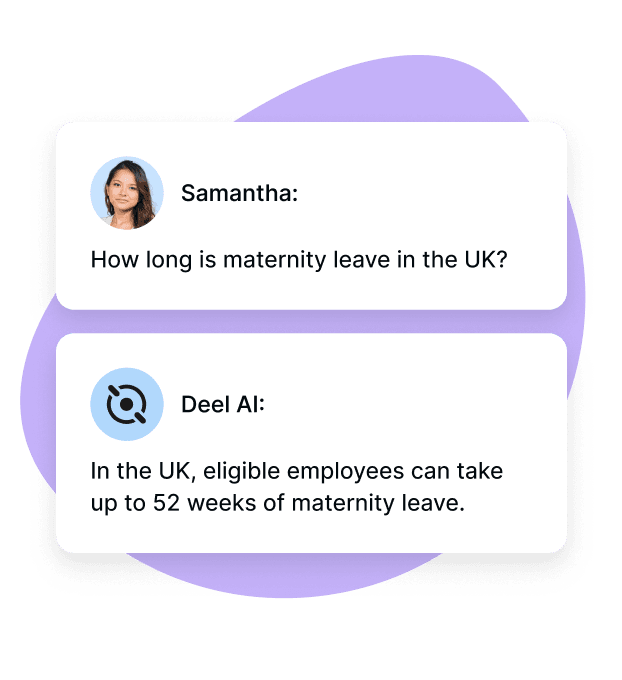
Deel AI
How leaders can avoid workslop
Since workslop isn’t inherent to AI, it can be easily avoided with a few key tactics:
Build a culture of lean AI output
Start by measuring outcomes, not output. This is a principle most leaders already understand, but one that can get lost in translation as AI enthusiasm spreads across teams. Your marketing team can generate ten times the amount of blog posts, but is all of that extra traffic converting to customers? Your product team may be able to launch new feature MVPs faster, but how much user impact will they deliver? The risk is that the teams closest to the tools default to AI because it's available rather than because it moves the needle.
Track:
- Delivery speed (including the time it takes to check or fix what AI generates)
- Customer impact
- Revenue metrics
This ‘less but better’ approach extends to admin and internal communication. Short memos, fewer meetings, and data reports that’ll actually influence decisions or answer questions.
Set AI usage principles
Putting up guardrails is not contradictory to building a culture of AI experimentation. In fact, our research shows that teams feel more comfortable experimenting with AI when guardrails are in place. Much of AI is still unknown, and usage slows when teams are wary of ‘breaking things’ or accidentally unethical use. Usage principles help define the sandbox, so not only are you keeping your organization safe, you’re creating an environment where adoption thrives.
Examples:
-
AI should reduce work
-
AI should shorten communication
-
AI should automate repetitive tasks
You can also set more physical constraints through IT management, such as blocking unapproved AI tools at the network level, requiring SSO for any sanctioned platforms, and auditing what data employees are feeding into them.
HR’s role in preventing workslop
HR plays a key role in AI adoption across organizations,
Train employees to use AI well
Workslop is usually a result of a lack of training. Teams take a haphazard ‘throw things at the wall and see what sticks’ approach, rather than the focus needed to achieve a true productivity boost. To discourage misuse, invest in AI skills training for all employees, not just the tech team.
It goes beyond training in the how-tos of particular LLMs or platforms. This ‘one and done’ approach to AI skills training gives teams a skillset with an expiration date. Training that keeps up with the rapid evolution of the AI landscape focuses on:
- AI literacy
- Data literacy
- Adaptability
- Critical thinking
- Collaboration
- Experimentation
- Prompt engineering
- Data analysis and visualization
- Process automation
- AI leadership
Helpful resource:
Reward smart automation
When creating schemes or friendly competitions to reward AI adoption, focus on recognizing employees who eliminate tasks, simplify workflows, or save time. Not those who produce the most content.
For example, celebrate the analyst who automated a weekly reporting process that used to take three hours, or the customer success manager who built a prompt that instantly summarizes long support threads. These are the wins worth spotlighting, rather than focusing solely on the salesperson who used AI to send twice as many cold emails, or the content team that tripled their publishing volume.
Lead by example
The best way to show an organization how AI can and should be implemented is to lead by example. For HR leaders, that means using AI to streamline the processes your teams already find tedious. Automating first-round interview scheduling, summarizing employee survey data, or drafting job descriptions that your team then refines and owns. Be transparent about where AI is helping and, just as importantly, where you've chosen not to use it. When HR visibly applies the same standards it asks of the rest of the organization, it builds credibility.
It also means being honest when AI disappoints. If a tool created more work than it saved, say so. If your team spent hours editing AI-generated onboarding content only to rewrite most of it anyway, share that lesson openly. Teams look to leadership to demonstrate the outcomes-focused thinking that separates thoughtful AI adoption from AI for AI's sake, thus eliminating workslop.
Useful resource:
Signs your company has a workslop problem
Workslop can be difficult to self-diagnose, especially once AI is embedded at many levels of your organization. While the exact manner of workslop depends on many factors, here’s a quick checklist of the most common workslop signals.
- Employee satisfaction scores are slipping — and exit interviews or pulse surveys point to frustration with busywork, not workload itself. Employees feel like they're spending more time editing and quality-checking AI outputs than doing meaningful work.
- AI fatigue is showing up in your engagement data — teams that were early AI adopters are now among the most burned out, caught in a cycle of generating, reviewing, and revising content that rarely feels finished.
- Leaders are overwhelmed by volume, not complexity — managers report spending more time reading and reconciling reports than making decisions. The information exists; the signal doesn't.
- Collaboration has gotten noisier, not clearer — Slack threads are longer, documentation has multiplied, and yet alignment is harder to reach. Multiple versions of the same deck or doc circulate without a clear owner.
- Nobody trusts the documentation — employees skip internal resources because they can't tell what's current, what was AI-generated, or whether anyone has actually reviewed it.
- Dashboards have proliferated, but decision-making hasn't improved — teams can measure everything but act on little. The abundance of data has created analysis paralysis rather than clarity.
The future of AI at work
The winners in the AI era will not be the companies that produce the most, but the ones that produce the most value. With the launch of user-friendly AI tools like ChatGPT, the focus was on AI adoption among teams. But widespread adoption and operational efficiency are very different things. AI maturity will mean less work, better decisions, leaner teams, and faster execution. That means rooting out workslop and eliminating it.
Case study: How 360Player streamlined their HR system of record with Deel
360Player, an all-in-one sports tech platform based in Stockholm, faced the classic "startup mess" as it expanded across five continents. Before Deel, employee data lived in a patchwork of Excel sheets and Google Drives. Start dates, contracts, and salary histories were scattered, making it impossible to provide fast answers to employees or accurate data to investors.
With staff doubling in size, the operations team realized that managing diverse employment models across Sweden, the UK, Spain, the US, and Australia via manual processes was no longer sustainable.
Before Deel, it was a mess. People didn't know if their time off was approved or if their expenses were mailed. Deel enabled us to take the next steps as a company.
—Isabella Sala,
Operations Specialist, 360player
Read the rest of the case study to see how Deel’s AI-powered HRIS reduced 2 week reduced reporting cycles to minutes
See what efficient AI in HR and payroll looks like
With Deel, AI isn’t a chatbot that sits next to your workflows. It’s the foundational layer of one connected people platform, handling everything from immigration and compliant global hiring to talent management and IT equipment.
With Deel, AI helps you by:
- Flagging payroll anomalies before payout, catching errors before they reach your people
- Recommending the best countries to source candidates based on role requirements and budget
- Automatically reviewing time-off requests, identifying coverage gaps, and routing approvals without the back-and-forth
- Keeping "work from anywhere" arrangements compliant by cross-referencing location data against local tax rules
- Surfacing workforce insights and recommendations so leaders can make faster, smarter decisions without digging through dashboards
- Automating onboarding, offboarding, and compliance workflows across 150+ countries, and removing the administrative burden of growing your team
- Provisioning and managing IT equipment globally, integrated directly with your HR data
Book your 30-minute Deel demo to see what responsible, compliant, and actually useful AI looks like across your entire world of work.
Live Demo
Get a live walkthrough of the Deel platform

Ellie Merryweather is a content marketing manager with a decade of experience in tech, leadership, startups, and the creative industries. A long-time remote worker, she's passionate about WFH productivity hacks and fostering company culture across globally distributed teams. She also writes and speaks on the ethical implementation of AI, advocating for transparency, fairness, and human oversight in emerging technologies to ensure innovation benefits both businesses and society.