
Guide
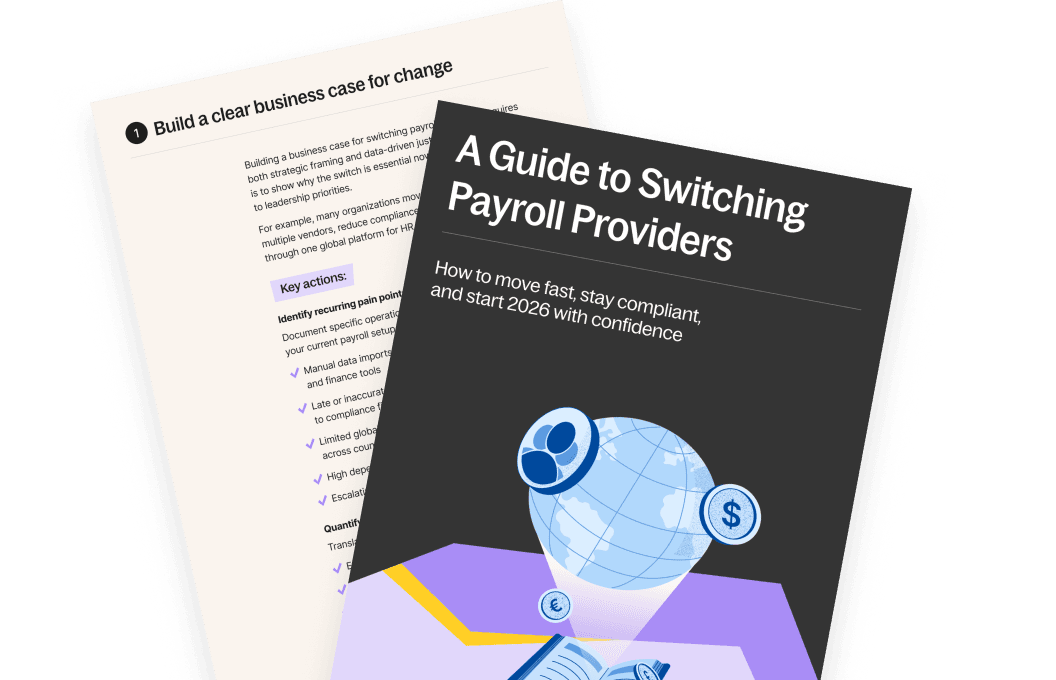
A Guide to Switching Payroll Providers for 2026
Global payroll
US payroll
Get the resource for free
Switching payroll providers is one of the highest-stakes transitions an organization can undertake. When you manage a workforce across multiple borders, every decision impacts your compliance posture, financial credibility, and the trust of your employees. Done poorly, a migration leads to missed pay runs, integration failures, and costly penalties. Done right, it becomes a strategic lever for efficiency and global scalability.
Whether you are consolidating legacy systems or moving away from fragmented local providers, this guide provides a framework for a successful migration.
Real results from payroll transformation with Deel
Companies that switched payroll providers with Deel achieved:
- 80% time saved on payroll vendor management
- 60% faster payroll processing
- 75% fewer employee payroll queries
- 50% less time spent on compliance reporting
Source: The Total Economic Impact™ of Deel Payroll, Forrester Consulting, 2025
Why global enterprises are switching payroll providers now
Payroll is too important to get wrong, yet many leaders still struggle with manual data transfers and a lack of real-time visibility. According to our Forrester Study on global payroll, 49% of enterprises plan to consolidate their payroll vendors within the next 12 months. The move toward centralization is not just a trend; it is a necessity for organizations looking to reduce the overhead of managing multiple, disparate systems.
This guide is designed to help you move from payroll chaos to a unified workforce infrastructure. By following our structured migration model, you can reduce the manual lift and ensure your data remains accurate.
Who is this guide for?
We designed this resource for leaders who oversee complex, multi-country operations and need a high-level strategy for change.
- Payroll Directors at global enterprises managing 1,000+ employees
- Chief Financial Officers looking to quantify the ROI of vendor consolidation and automation
- HR Operations Leaders struggling with manual data imports between HRIS and finance tools
- Procurement and Legal Teams tasked with vetting the security and compliance of new global partners
Inside the guide: A roadmap for transformation
This resource covers the six essential pillars of a successful payroll migration. Each section includes expert insights and practical steps to guide your team through the transition.
1. Building a clear business case
Learn how to translate operational pain points into measurable business impacts. We outline the key actions and metrics involved in building a clear business case for payroll transformation. A strong business case does not just highlight problems; it quantifies the ROI of automation and improved visibility.
2. Strategic timing and regional milestones
Timing can make or break your transformation. We provide a regional breakdown of the optimal windows to switch your payroll provider based on key payroll cycles and filings.
3. Mapping complex payroll workflows
Before you look at new software, you must understand your current state. The guide helps you document your full scope, including HRIS integrations, data sources, and varying pay frequencies.
4. Expert vendor selection and RFP strategy
A well-structured Request for Proposal (RFP) is vital for global companies. We outline best practices for what to include in your RFP in order to thoroughly evaluate payroll vendors.
5. Proactive employee communication
Keeping your people informed on the payroll transformation is as important as the transformation itself. We provide communication essentials to help you maintain employee trust throughout the process.
6. Post-migration success metrics
Implementation doesn’t end at go-live. Learn which KPIs to track both during migration and after launch to ensure your new system delivers long-term value.
Real-world impact: How Outreach reduced 90% of their workload
Outreach, a leading sales execution platform, faced global workforce management challenges through fragmented legal entities and multiple payroll vendors. By switching to Deel, they consolidated their processes into a unified platform, resulting in a 90% reduction in workload.
Large-scale transformations require a partner, not just a vendor. Like the team at Outreach, global companies partner with Deel to gain end-to-end visibility.
Download our Guide to Switching Payroll Providers to access our framework and begin your payroll transformation process.
Our biggest challenge was not having a unified system to manage and pay our global workforce. We needed a comprehensive solution for HR and payroll, and that’s where Deel came in.
—Stephen Epling,
Vice President of Global Rewards and Workplace, Outreach
FAQs
When is the best time to switch payroll providers?
The timing of your payroll switch can make or break its success. Organizations often face overlapping payroll cycles, bonus payouts, reconciliations, and local tax deadlines. Attempting a transition during these periods risks compliance gaps and employee trust. That’s why many companies plan go-live in Q1 of the new year, or before the start of the new tax year in their country.
How long does it take to switch payroll providers?
With expert-led implementation, enterprise payroll transitions can be completed in one to three months, even in complex environments. For small businesses, the process can take as little as 10 days.
What should I look for in a new payroll provider?
Modern payroll providers should offer:
- Consolidation potential with a single global vendor
- Scalability for growth or M&A
- Automation to reduce manual work
- Compliance expertise across jurisdictions
- Transparent implementation methods
- Native payroll engine capabilities (not just in-country outsourcing)
- Security, data privacy, and certifications
A payroll request for proposal (RFP) can help you gather vendor information and make a well-informed decision.
How do I build a business case for switching payroll providers?
Start by documenting current pain points such as payroll errors, late filings, compliance fines, limited global reach, or high costs. Then, define outcomes like vendor consolidation, automation, and improved employee experience. Secure executive alignment by tying payroll transformation to larger company goals and modeling before/after ROI.
How do I communicate payroll provider changes to employees?
Payroll impacts every employee each cycle, so communication and trust are central. Leaders should explain why the change is happening, highlight benefits like accuracy and better user experience, and clarify any changes to pay dates or processes. Providing FAQs, quick guides, and designated support contacts builds confidence and reduces uncertainty.
How do I measure success after switching payroll providers?
Success should be tracked both during and after migration. Key metrics include:
- Payroll accuracy and on-time delivery
- Reduction in payroll errors
- SLA adherence
- Time saved on processing and reporting
- Employee satisfaction with payroll experience
- Post-migration, a 90-day review helps identify quick wins and recalibrate processes.
Learn more about how to measure the ROI of your global payroll system.
Can large enterprises switch payroll providers without disruption?
Yes—when the transition is approached with structure. Enterprises should map payroll workflows, prepare a tailored RFP, involve cross-functional teams, and consider running parallel payrolls against historical data before going live. With a structured process, organizations can reduce risk and set up payroll operations for long-term scalability.
Speak with an expert to learn how Deel can help you switch payroll providers with minimal disruptions to your workforce.