
Report
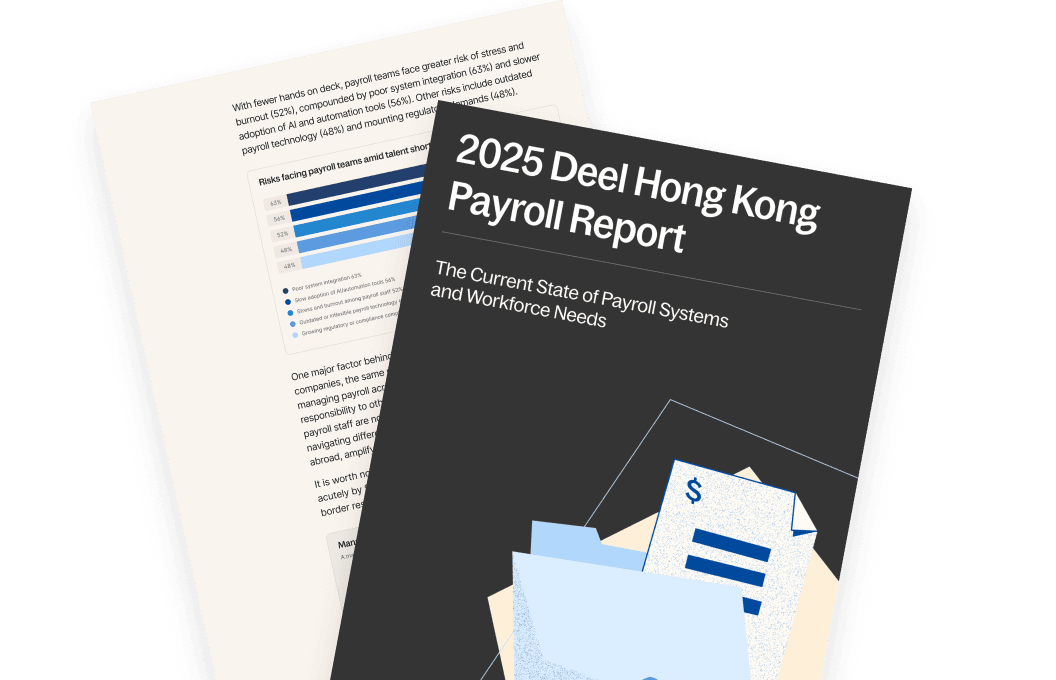
2025 Deel Hong Kong Payroll Report
Global payroll
Get the resource for free
Gain insight into the current state of payroll systems and workforce needs
As payroll teams face increasing operational complexity and employees feel the pressure of mounting living costs, it’s clear that businesses in Hong Kong must adapt their payroll systems to keep up with changing regulations and employee demands.
To better understand the current landscape and how to address these challenges, Deel conducted two complementary surveys in July 2025. One survey focused on Hong Kong employees from various industries, income brackets, and generations. The second survey focused on employers and the latest trends and risks affecting Hong Kong businesses.
Who is this report for?
- HR and payroll leaders who are navigating compliance challenges, integrating new technology, and looking for ways to improve workforce wellbeing
- C-suite leaders seeking better solutions to improve operational efficiency, mitigate risk, and create a stronger payroll strategy
Key findings
- Rising talent shortages: Nearly 80% of payroll teams in Hong Kong are facing talent shortages, and regulatory shifts like the Mandatory Provident Fund (MPF) offset abolition have increased workloads even more
- Increasing financial burden: 86% of younger workers in Hong Kong express that wages are not keeping up with inflation, leading to an increased interest in on-demand pay and non-traditional salary payments
- Integration challenges: While AI and automation offer opportunities for positive change, 63% of companies say poor system integration is the main barrier to realizing their full benefits
- Errors driven by manual processes: 40% of payroll leaders cite a high risk of errors caused by manual payroll processes, further reinforcing the need for properly integrated automations to ensure accuracy and efficiency
- Common payroll errors: The most common payroll error affecting employees is underpayment (28%), which is a reminder of how payroll is not only a business function, but it’s also a significant factor in employee satisfaction
Why download the full report?
By downloading the report, you will:
- Get detailed insights into how talent shortages, compliance changes, and increased workloads are affecting payroll teams
- Understand rising employee financial pressures and growing interest in on-demand pay and alternative salary formats
- See how companies are using AI and automation and what’s holding them back
- Benchmark your organization against findings from Hong Kong employers and employees
How to leverage this data
The insights in this report can guide HR, payroll, and finance leaders as they assess current processes and prepare for future workforce needs.
Use this data to adapt your pay strategies to better support employees dealing with rising living costs and changing financial expectations.
FAQs
What is the Mandatory Provident Fund offset abolition?
The Mandatory Provident Fund offset abolition prevents employers from using MPF contributions to offset severance payments or long service payments made to employees upon termination. Passed in June 2022, this legislation supports retirement security for employees while keeping employers more accountable in their financial responsibilities.
How do I outsource payroll in Hong Kong?
You can outsource payroll in Hong Kong by partnering with a trusted payroll provider like Deel. Deel Payroll helps business hire and pay employees and contractors in 130+ countries, ensuring that everyone gets paid faster and in full compliance.
Features like automated compliance updates, instant gross-to-net calculations, and certified integrations with Workday ensure that your business stays compliant without sacrificing operational efficiency.
Does Deel offer any on-demand pay options?
Yes, Deel offers Anytime Pay, which allows eligible EOR employees in supported countries to access a portion of their earned salary before payday. This feature offers financial flexibility, helps employees avoid overdraft fees or high-interest loans, and improves employee retention and satisfaction.