
Guide
How to Scale a Hybrid Workforce Across Countries (With an EOR)
Employer of record
Global expansion
Get the resource for free
International expansion is the ultimate growth lever, but managing a hybrid workforce across different countries is often where the momentum stalls. Between local tax laws, complex visa requirements, and cultural nuances, the operational red tape can quickly overshadow your strategic goals.
According to the World Economic Forum, 63% of employers see the skills gap as a massive barrier to business transformation. Without a strategy to access and leverage global talent to fill these gaps, businesses are left with operational inefficiency and decreased productivity.
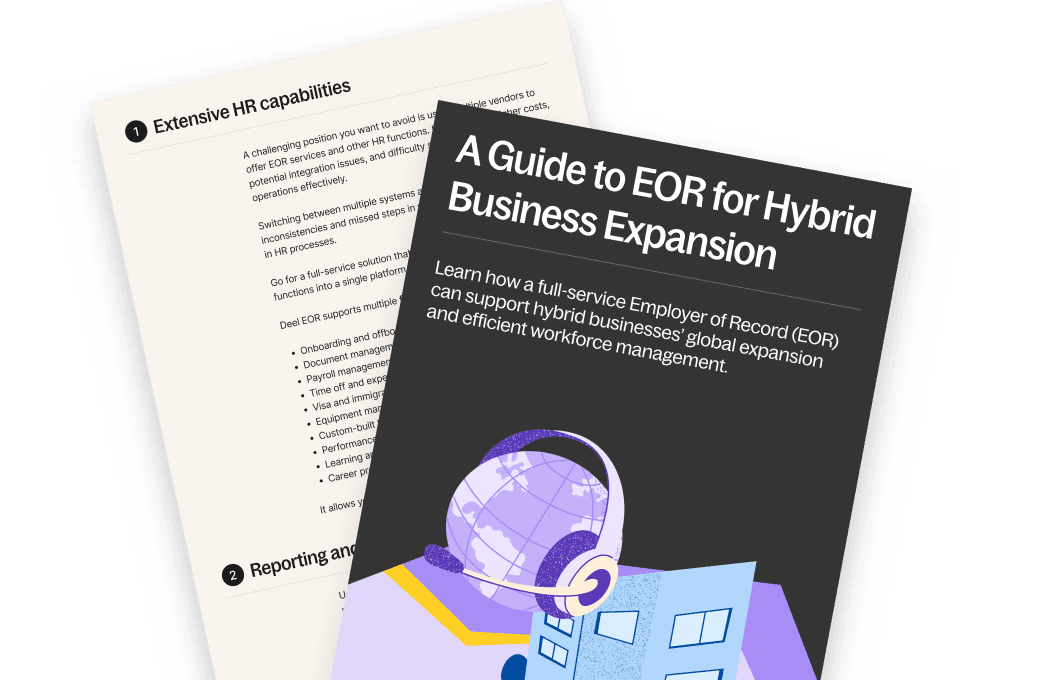
This guide provides a comprehensive look at the impact of an Employer of Record (EOR) on scaling a hybrid workforce. We’ve outlined key benefits, challenges, considerations, and enterprise case studies to show how an EOR enables you to hire, pay, and manage anyone, anywhere.
Global business expansion simplified
For a hybrid business, the stakes are higher. You aren't just managing people; you’re integrating different work cultures, time zones, and employment classifications into one cohesive unit. When data is scattered across multiple local providers, visibility into your total cost of ownership (TCO) disappears.
This guide explains how a full-service EOR acts as your global infrastructure, allowing you to establish a presence in new markets without the months of delay and high costs associated with opening local entities. You’ll learn how to standardize your operations so that an employee in Berlin has the same world-class experience as a team member in New York.
By the end of this guide, you’ll understand how to:
- Access and attract top talent in over 150 countries using data-driven salary insights
- Onboard international hires in as little as five minutes with localized, compliant contracts
- Automate the heavy lifting of multi-country payroll, taxes, and benefits administration
- Consolidate your tech stack by replacing fragmented local vendors with enterprise-grade workforce infrastructure
- Mitigate the risk of misclassification and ever-changing labor law updates
Who is this guide for?
We designed this resource for enterprise leaders who need to move fast without breaking compliance. It’s specifically tailored for:
- Finance Leaders looking to reduce the total cost of ownership (TCO) and gain better oversight of global labor spend
- Legal Counsel focused on mitigating risks of international hiring and ensuring continuous compliance with localized employment laws
- Global Expansion Managers tasked with entering new markets without the overhead of local entities
- Operations Leads struggling to manage the logistics of a distributed hybrid workforce
What’s inside: A roadmap for the hybrid era
Scaling a hybrid workforce requires a strategy that balances global reach with local expertise. This guide breaks down the essential pillars of international growth:
The strategic benefits of going global
Learn how global business expansion stimulates innovation through diverse perspectives and helps you escape saturated local markets. We cover how to use Deel’s Global Hiring Toolkit to analyze talent pools and compliance requirements before you hire.
Overcoming the hybrid gap
Address the specific challenges of managing a globally distributed workforce. We look at solving the problem of "invisible" remote workers and how to use talent management modules like Engage to build workplace relationships and track OKRs across time zones.
The EOR advantage
We’ll elaborate on the role of an EOR in hybrid business expansion. We explain the difference between a partner that owns their entities and those that outsource to third parties—and why that distinction is critical for your data security and employee experience.
Seven key considerations for choosing a partner
Not all EORs are built for enterprise demands. We provide a checklist of what to look for, such as 24/7 support in multiple languages, built-in reporting and analytics, flexibility in payroll processing, and more.
Real-world success stories
Read about companies like Eucalyptus, which successfully entered the German market in just three months. By switching from a costly BPO to Deel, they achieved 100% revenue growth in a single year and saved 15% on hiring costs.
How to use this expansion guide
Leverage this guide as a tool to help you build your internal business case for more efficient global operations.
- Audit your current setup: Refer to our section about hybrid workforce challenges to identify where your current processes are sinking time or money
- Gather your benchmarks: Use our Salary Insights and Employee Cost Calculator tools to prepare for your next round of international hiring
- Refine your vendor list: Apply our seven key considerations to your current HR tech stack to evaluate the effectiveness of your current vendors
Pro Tip: When expanding to a new country, always check the "mandatory vs. common" benefits. Offering only the legal minimum in a competitive market like Brazil or Germany can make it difficult to attract the specialized talent you need. Use Deel’s Benefits Tool to see what local competitors are offering.
Scale your hybrid workforce with Deel
Whether you are entering your first international market or consolidating a presence in twenty, the complexity of global compliance shouldn't be a barrier to hiring the world's best talent.
Download our guide to learn more about how Deel helps enterprise leaders navigate and overcome the challenges of managing a hybrid workforce.
FAQs
What is a hybrid workforce?
A hybrid workforce is a flexible employment model where a company’s team is composed of both in-office and remote employees. In a global context, this often means having central "hubs" or local entities in some countries while hiring remote talent through an EOR in others. Managing this model effectively requires a unified HRIS to ensure that all workers, regardless of their location or contract type, feel connected to the company culture and have access to the same resources.
How does an EOR support global business expansion?
An Employer of Record (EOR) acts as the legal employer for your international staff, handling all the complex administrative tasks like payroll, taxes, benefits, and compliance. This allows you to hire talent in a new country in days rather than months, as you don't need to go through the time-consuming process of setting up a local legal entity. You maintain the day-to-day management of the employee, while the EOR handles the back-end liability and compliance.
What are the biggest risks when scaling a hybrid workforce across countries?
The primary risks include misclassification of contractors, non-compliance with local labor laws, and fragmented data. If you hire someone as a contractor when they should be a full-time employee under local law, you could face significant fines. Additionally, using different payroll providers in every country leads to data silos, making it difficult for finance teams to maintain accurate visibility over global workforce spend.
How does Deel handle data security for enterprise teams?
Deel implements enterprise-level security with features like SOC2 compliance, ISO 27001 certification, and GDPR adherence. By consolidating your global HR and payroll data into an integrated platform, you reduce your attack surface, compared to sending sensitive employee information via email to multiple third-party local vendors.
EOR vs. local entity: Which should I choose?
Setting up a local entity is typically a better long-term fit if you plan to hire a very large volume of employees in one specific country (usually 50+). However, for testing new markets or managing a distributed hybrid workforce of 1–20 people per country, an EOR is significantly more cost-effective and flexible. Many companies use a hybrid approach, starting with an EOR and transitioning to their own entity as they scale, a process Deel can also manage for you.