Article
14 min read
5 Best Sales Tax Compliance Software for Global Businesses
Legal & compliance

Author
Jemima Owen-Jones
Last Update
March 31, 2026

Table of Contents
What is sales tax compliance software?
What do these platforms automate?
Who needs sales tax compliance software?
What are the main features to look for in the best sales tax compliance software?
Best sales tax compliance software
Other notable sales tax software solutions
How to choose the right sales tax compliance software
Sales tax compliance at scale starts with the right software
Key takeaways
- Sales tax compliance becomes complex fast: Growing businesses quickly face multi-state and global tax obligations that are difficult to manage manually.
- Compliance software automates tax from calculation to filing: Modern platforms handle tax rates, nexus tracking, reporting, and remittance automatically.
- Global coverage matters as companies expand: The best solutions manage US sales tax alongside international VAT and GST in one system.
Sales tax compliance grows more complicated by the year. Between new economic nexus rules, constantly changing tax rates across the US’s more than 14,000 taxing jurisdictions, and the rise of cross-border VAT and GST obligations, manual tax management simply doesn’t scale.
Even small sales tax mistakes can trigger audits, penalties, and compliance nightmares that eat into your bottom line.
The right sales tax compliance software automates tax calculations, tracks nexus obligations, and handles filing across every jurisdiction where you do business.
This guide compares the best platforms for SaaS companies, ecommerce businesses, and any company selling across state lines or internationally. We'll cover automation depth, integrations, global tax coverage, and pricing so you can choose the solution that fits your tax obligations.
What is sales tax compliance software?
Sales tax compliance software automates and streamlines the entire tax lifecycle from calculation through filing and remittance. These platforms connect to your billing systems, ecommerce stores, and ERPs to apply the correct tax rates, track nexus thresholds, prepare returns, and submit filings to tax authorities.
Modern tax compliance platforms eliminate manual work that used to require dedicated tax staff or expensive consultants. They update tax rates in real time, monitor when you cross economic nexus thresholds, and ensure you're charging the right amount of tax on every transaction.
What do these platforms automate?
End-to-end sales tax compliance software automates:
- Tax determination: Software analyzes every transaction to determine if it is taxable, each jurisdiction’s tax rules, and how much state, county, city and other local tax applies
- Real-time tax rules: Part of tax determination is keeping up with tax changes in real-time, including changes in tax laws, rates, or what items are taxable
- Sales tax reporting: Most jurisdictions require sales tax returns broken down by not just state but also county, city, and other special taxing districts. Software automates the reports that taxing authorities require.
- Sales tax filing & payment: Software connects automatically with state or international taxing authorities to file sales tax returns on time, avoiding penalties and interest. They also often pay sales tax directly from your accounts, avoiding extra steps.
Who needs sales tax compliance software?
Sales tax gets complicated quickly. Businesses with nexus in more than one state or who sell complicated products like software, which are taxed differently from state to state, will need automation from day one.
Subscription-based Saas companies
SaaS companies selling subscriptions across multiple states need automation because taxability rules for software vary dramatically by state. Some states tax SaaS as tangible property, others as a service, and some don't tax it at all. Tracking these rules manually across your entire customer base isn't realistic.
Ecommerce businesses and online marketplaces
Ecommerce businesses and marketplace sellers face the same complexity with physical products. Economic nexus rules mean you're required to collect tax in states where you've never had a physical presence. Once you hit $100,000 in sales or 200 transactions in most US states, you're on the hook for compliance.
General multi-state businesses
Multi-state businesses of any kind trigger compliance obligations fast. Even if you started in one state, growing your customer base means crossing nexus thresholds in new jurisdictions. Each new state brings its own registration requirements, filing schedules, and tax rules. This adds complexity fast.
For businesses, the cost of non-compliance is serious. States are aggressive about auditing businesses that should be collecting tax but aren't. Penalties typically include the uncollected tax amount, interest, and fines. For growing businesses, that back tax bill can run into six figures, a major business setback.
What are the main features to look for in the best sales tax compliance software?
Modern sales tax software should cover sales tax from registration on day one to filing when tax is due.
Automation and real-time accuracy
Seamless tax calculations
Sales tax automation should handle calculations without any manual input from your team. The software receives transaction data, applies the correct tax rates and rules, and returns accurate tax amounts in milliseconds so that your customers at checkout don’t even notice. This process needs to work for every sale, subscription renewal, or invoice you generate.
Why real-time accuracy matters
Real-time tax calculations matter because rates change constantly. A platform using outdated rate tables will cause you to over or undercharge customers. Over-collection creates refund headaches, while under-collection means you pay the difference out of pocket when filing tax returns.
Nexus tracking for growth
Nexus tracking is critical for growing businesses. The platform should monitor your sales activity in every state and alert you when you're approaching economic nexus thresholds. This gives you time to register before you're legally required to start collecting tax.
Integrations and ERP connectivity
Direct ERP and accounting integrations
Your tax solution needs to integrate directly with ERP systems like NetSuite, SAP, or accounting systems like QuickBooks in order to automate tax. It should automatically calculate tax within your normal billing workflow without manual exports or imports. From there, tax data flows directly into your financial reporting.
Native ecommerce and payment connections
Ecommerce platforms and payment providers also require native connections. Whether you use Shopify, WooCommerce, Stripe, or Square, the tax platform should pull transaction data automatically. This ensures every sale gets the correct tax treatment without your team touching it.
Robust API for custom workflows
APIs enable custom workflows for companies with unique billing setups. If you've built proprietary systems or use less common platforms, API access lets your developers integrate tax calculations directly into your product. This is especially important for SaaS companies that bill programmatically. If you customize your stack, your tax solution should have a robust API.
Filing, remittance, and reporting
Tax filing automation
Tax filing automation removes the manual burden of preparing and submitting returns. The platform generates accurate returns for every jurisdiction where you're registered, breaking down collections by state, county, city, and special district. It submits these returns on time according to each state's schedule.
Remittance handling
Remittance handling means the platform sends the tax dollars you collected to the appropriate tax authorities. This typically happens through ACH transfers directly from your bank account. Automated remittance eliminates the need to log into dozens of state tax portals every month.
Tax reporting
Tax reporting gives you visibility into your compliance status. You should be able to see what you collected, what you filed, and what you remitted across all jurisdictions. Detailed reports also help during audits by providing a clear paper trail.
Exemption certificate management
Exemption certificate management is essential for B2B sellers. Many business customers are exempt from sales tax if they provide valid resale certificates. The platform should collect, validate, and store these certificates while automatically applying exemptions to qualifying transactions.
Global and indirect tax coverage
VAT and GST compliance extends beyond US sales tax for companies selling internationally. The best platforms handle value-added tax in the EU, goods and services tax in Australia and Canada, and other indirect taxes worldwide. This prevents you from needing separate systems for US and international compliance.
Cross-border selling triggers tax obligations in countries where you have customers. Indirect tax obligations work differently in each country, but the principle is the same: reach a certain threshold and you're required to register and collect tax. Global platforms track these thresholds across all countries where you operate.
Global tax rules vary significantly from US sales tax. Different countries have different taxability rules, exemption criteria, and filing requirements. A truly global platform understands these nuances and applies the correct treatment automatically.
Best sales tax compliance software
These platforms represent the strongest options for businesses managing sales tax, VAT, GST, and other indirect taxes. Each has different strengths depending on your business model, transaction volume, and geographic footprint.
1. Sphere
Best for
Global SaaS companies, ecommerce businesses, and digital product sellers managing both US sales tax and international VAT/GST obligations face the most complex compliance challenges. Sphere handles this entire scope in a single platform.
Teams managing indirect tax across multiple countries benefit from Sphere's unified approach. Instead of cobbling together separate US and international solutions, you get one platform that understands tax rules everywhere you sell.
Why Sphere leads the market
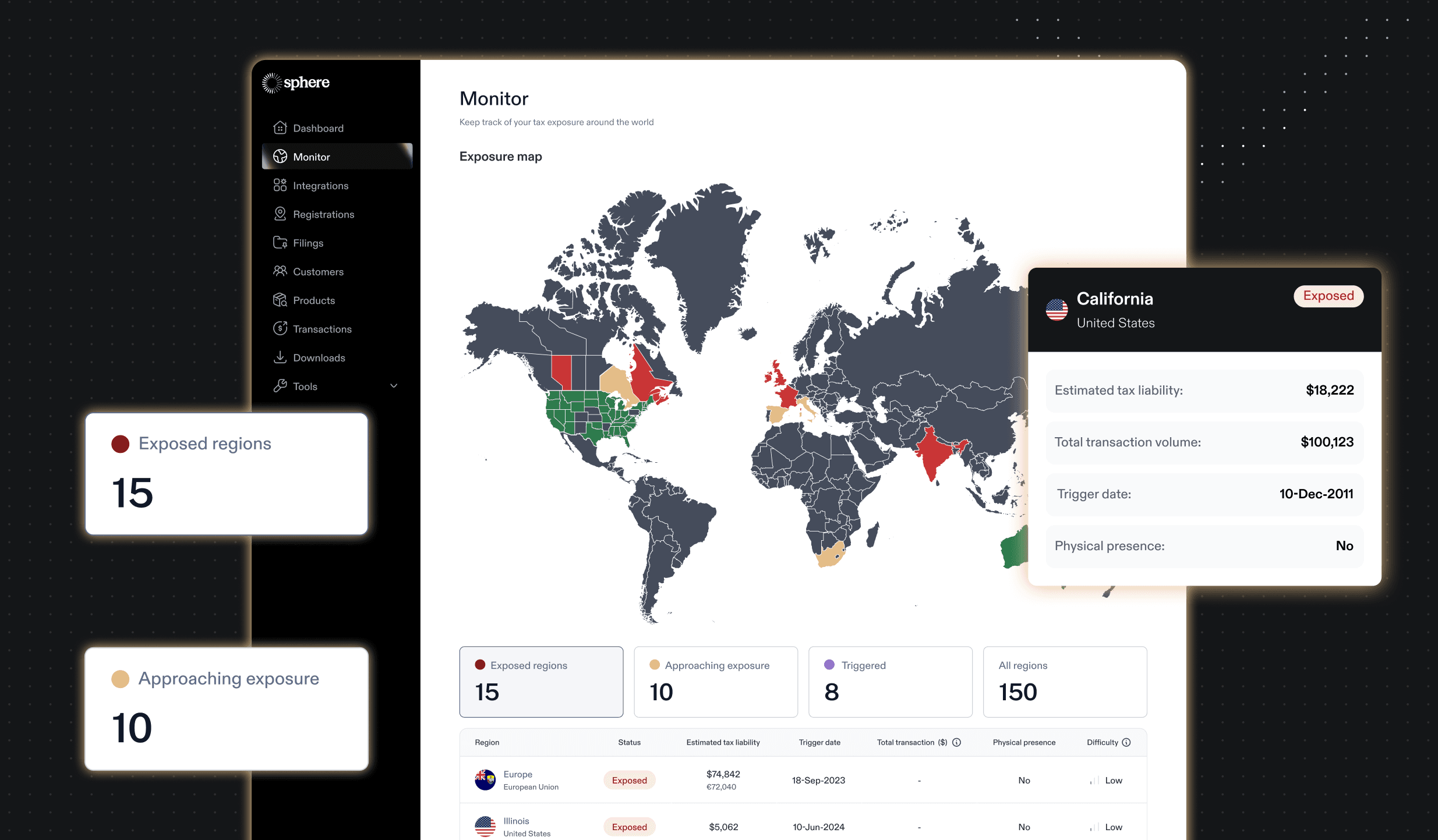
Sphere is the first AI-powered tax compliance platform built from the ground up for global businesses. The platform's Tax Review and Assessment Model (TRAM) uses a specialized language model trained on tax law to automatically determine taxability across jurisdictions worldwide.
End-to-end automation covers the entire compliance lifecycle. From tax determination to nexus monitoring to filing and remittance, Sphere eliminates manual workflows that bog down finance teams. The platform updates in real time as tax laws change, ensuring continuous accuracy.
True global coverage sets Sphere apart from legacy solutions. While other platforms patched together international support through third-party partnerships, Sphere offers native integrations into 100+ tax authorities worldwide. You get direct filing, remittance, and reporting across US sales tax, VAT, GST, and all other indirect taxes.
Key features
- Sphere automatically calculates sales tax on every transaction. TRAM analyzes your products, customer locations, and applicable tax rules to determine the correct tax treatment. This works across all US states, Canadian provinces, EU countries, and other jurisdictions. (See a full list of Sphere’s coverage here)
- Economic nexus monitoring tracks your sales activity in real time. The platform alerts you when you're approaching nexus thresholds in new jurisdictions (including internationally), giving you time to register and get compliant before you're legally required to collect tax
- ERP and ecommerce integrations connect directly to your existing systems. Sphere works with NetSuite, QuickBooks, Stripe, Shopify, and other platforms through native integrations and APIs. Tax calculations happen automatically within your normal billing workflow
- API-first workflows give developers full control over tax determination. If you've built custom billing systems or need programmatic tax calculations, Sphere's API enables seamless integration into your product
- Exemption certificate management automates the collection and validation of resale certificates and other tax exemptions. The platform stores certificates, validates their authenticity, and automatically applies exemptions to qualifying transactions
- Tax reporting and return filing cover every jurisdiction where you're registered. Sphere prepares accurate returns, submits them on time, and handles remittance directly to tax authorities. You get complete visibility into what you collected, filed, and paid
Pricing and scalability
Sphere’s pricing is a flat rate of $100 per month per jurisdiction. This transparent pricing model eliminates usage fees, overage charges, and hidden costs that plague legacy platforms. You know exactly what you'll pay as you expand into new markets.
The platform scales effortlessly from startups to enterprises. Whether you're processing 100 transactions or 1 million per month, the pricing and performance remain consistent. There’s no need to renegotiate contracts or worry about usage limits as you grow.
Support and tax expertise
Sphere's support team includes tax experts who understand both the technology and the underlying tax law. You get help with complex taxability questions, registration guidance, and audit support precisely when needed.
Response times beat industry standards, with most inquiries answered within hours instead of the 8-24 hour (or more) waits common with legacy providers. The team helps you navigate tax requirements across all jurisdictions where you operate.
2. Avalara
Best for
Large enterprises with complex, high-volume tax management needs across many jurisdictions often choose Avalara for its extensive feature set. The platform has been around for decades and offers deep functionality.
Companies already invested in legacy systems may prefer Avalara's broad integration library. The platform connects to hundreds of ERP systems, ecommerce platforms, and business applications.
Strengths and limitations
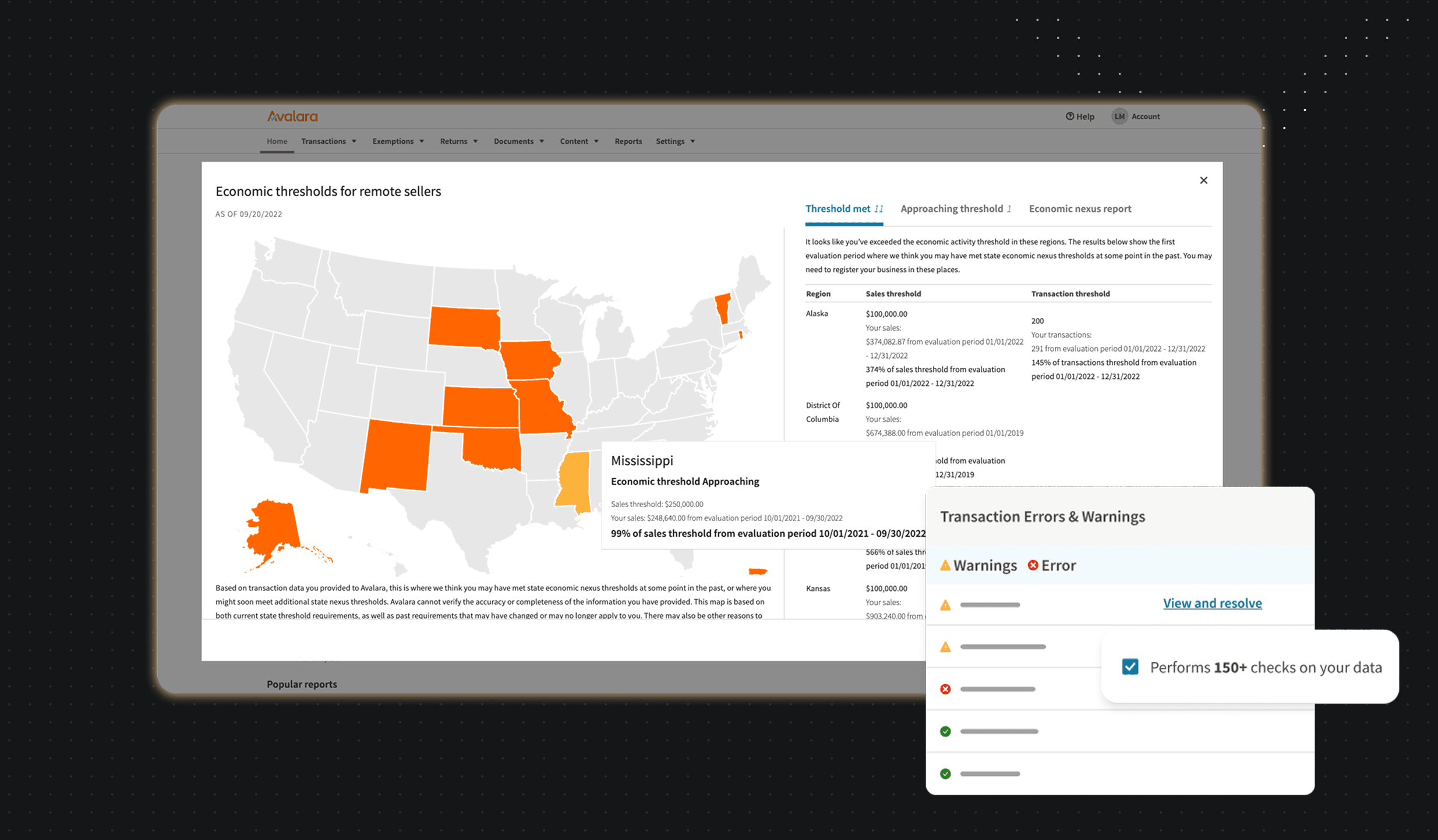
- Broad integrations are Avalara's main strength. The platform connects to virtually every major business system, making it relatively easy to get started if your tech stack includes commonly used tools
- Compliance depth covers US sales tax thoroughly. Avalara handles calculations, exemption certificates, filing, and remittance for all US jurisdictions. The platform also offers international modules for VAT and GST at an additional cost
- Pricing complexity is a significant limitation. Avalara's pricing model includes usage fees, transaction limits, and various add-on costs that make budgeting difficult. Many customers report surprise bills for overages or features they assumed were included
- Setup overhead can take months. The implementation process often requires dedicated developer resources and extensive configuration. This makes Avalara better suited for large companies with IT teams than fast-moving startups.
3. TaxJar
Best for
Ecommerce sellers and marketplace businesses selling primarily in the US often choose TaxJar for its straightforward approach. The platform focuses on making sales tax simple for online retailers.
Small to mid-sized businesses appreciate TaxJar's user-friendly interface and quick setup. You can be up and running in days instead of months.
Strengths and limitations
- Ecommerce automation works well for retailers using platforms like Shopify, WooCommerce, or Amazon. TaxJar's integrations with these platforms are mature and reliable
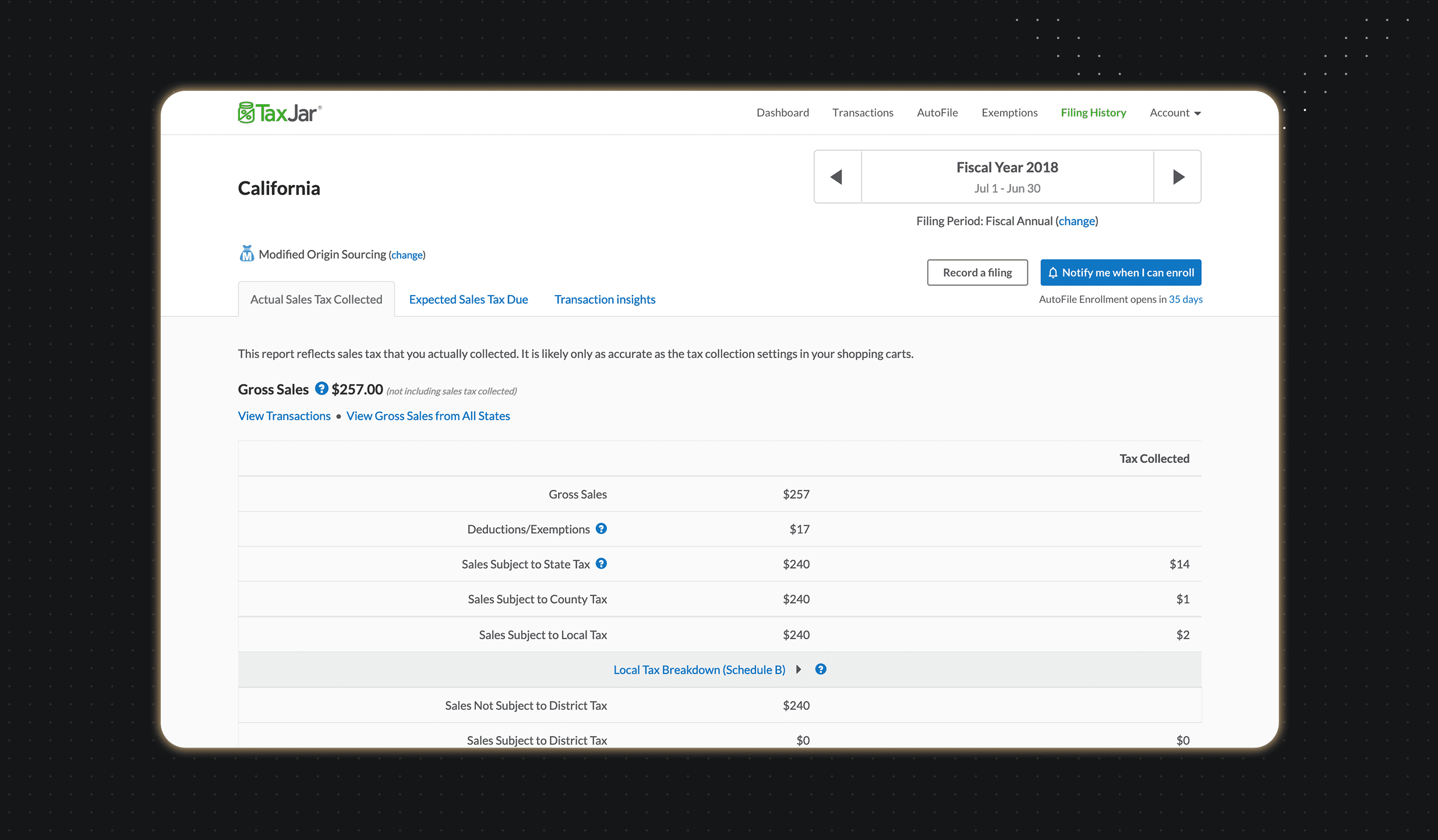
- AutoFile handles filing and remittance automatically for US states. The platform prepares your returns, submits them on time, and sends payment to tax authorities without manual intervention
- Limited global tax depth means TaxJar isn't suited for businesses selling outside the US. There is minimal support for VAT, GST, or other non-US indirect taxes
- Product-focused taxability can be limiting. While TaxJar handles physical products well, companies selling SaaS, digital products, or services may find the platform's taxability logic less robust.
4. Anrok
Best for
SaaS and technology companies selling software subscriptions benefit from Anrok's focus on this specific business model. The platform understands how to handle recurring revenue and subscription billing.
API-first companies building tax directly into their products appreciate Anrok's developer-friendly approach. The platform emphasizes clean APIs and automated tax determination.
Strengths and limitations
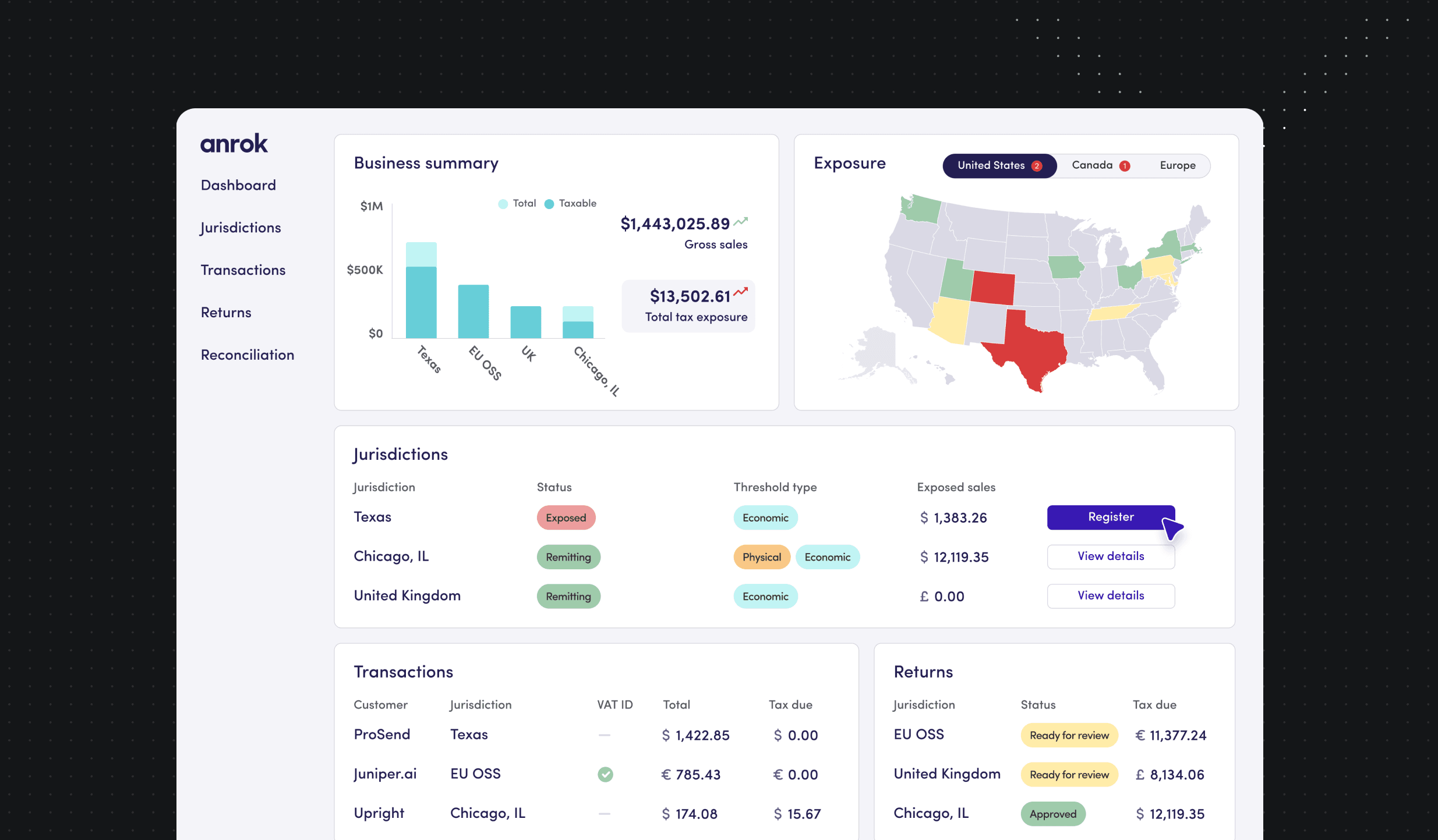
- SaaS-focused taxability logic handles the nuances of software taxation well. Anrok understands which states tax SaaS, how to handle subscription renewals, and when to apply different tax treatments
- Modern integrations with billing platforms like Stripe and Chargebee make implementation straightforward for tech companies using these tools
- Narrower ecommerce coverage means Anrok isn't the best fit for companies selling physical products. The platform focuses heavily on sales tax for digital goods and services
- Geographic coverage focuses primarily on US sales tax. While Anrok has added some international support, it's not as comprehensive as platforms built for global compliance from the start.
5. Zamp
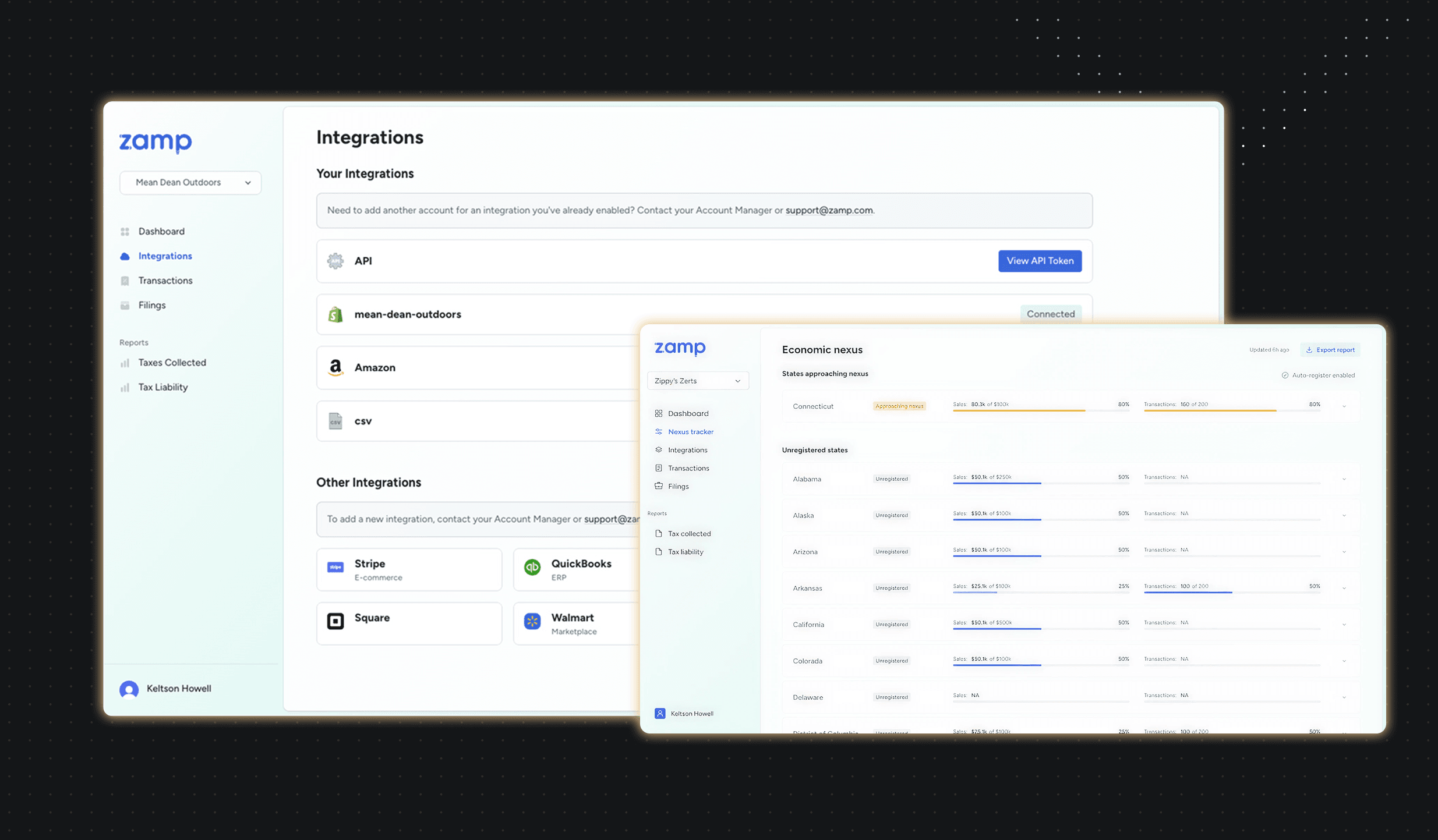
Best For
Teams seeking a managed compliance approach rather than DIY software choose Zamp for its hands-off model. The company combines technology with human tax professionals who handle filing on your behalf.
Businesses that want to completely outsource sales tax appreciate Zamp's white-glove service. You get a dedicated tax manager instead of just software.
Strengths and limitations
- Hands-off filing removes the burden from your team. Zamp's tax professionals prepare and file your returns, handle correspondence with tax authorities, and manage the entire compliance process
- Personalized support means you have a real person to call with questions. This can be valuable for companies navigating complex taxability issues or unusual business models
- Reduced control and visibility can be frustrating. Since humans handle much of the process, you may have less real-time insight into your compliance status compared to fully automated platforms
- Higher costs reflect the managed service model. You're paying for both technology and human expertise, which typically costs more than pure software solutions.
Other notable sales tax software solutions
Other market players work well for some use cases.
Vertex
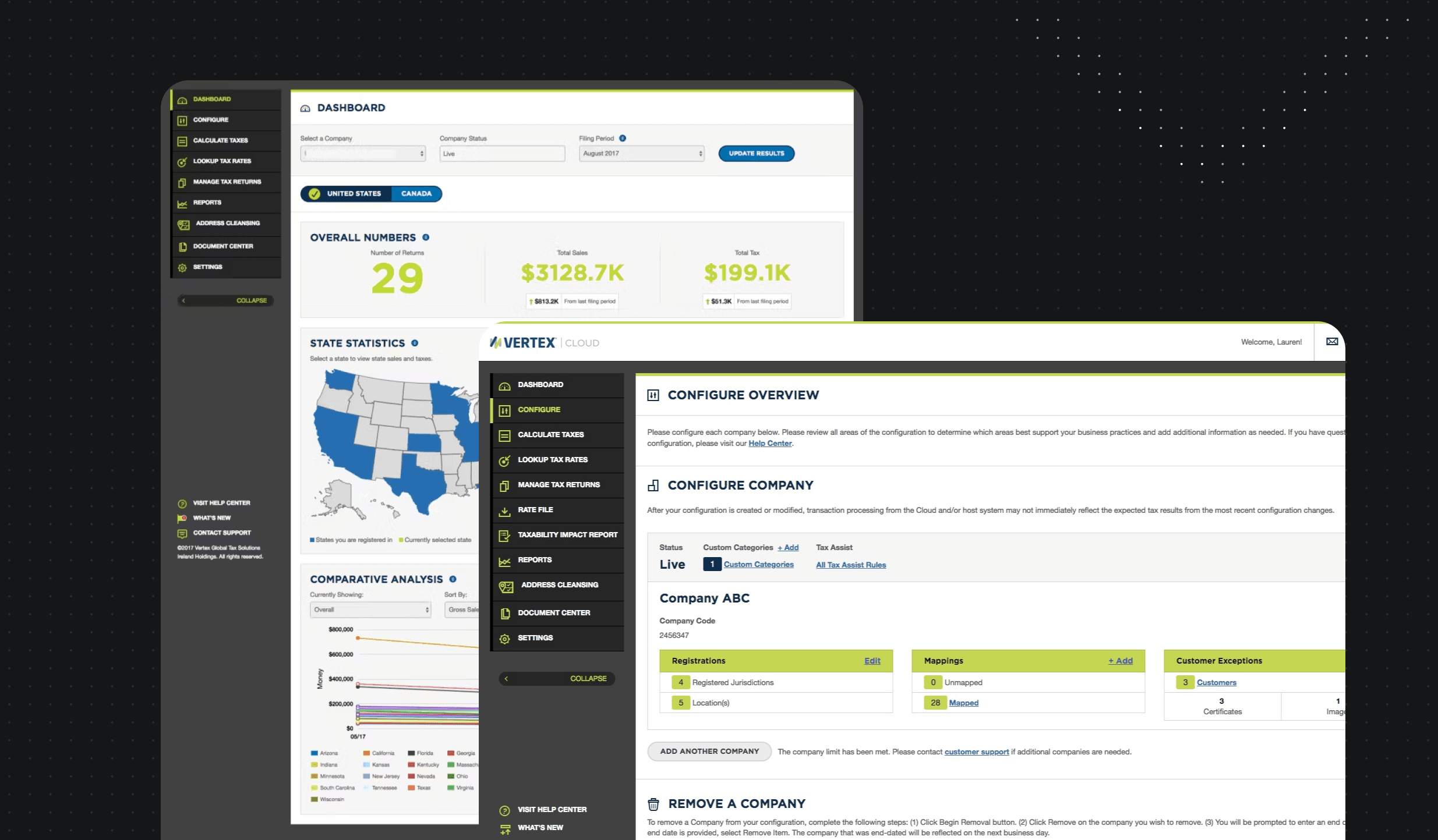
Vertex serves large enterprises with complex international operations. The platform offers robust functionality but requires significant implementation resources and comes with steep enterprise-level pricing.
Sovos
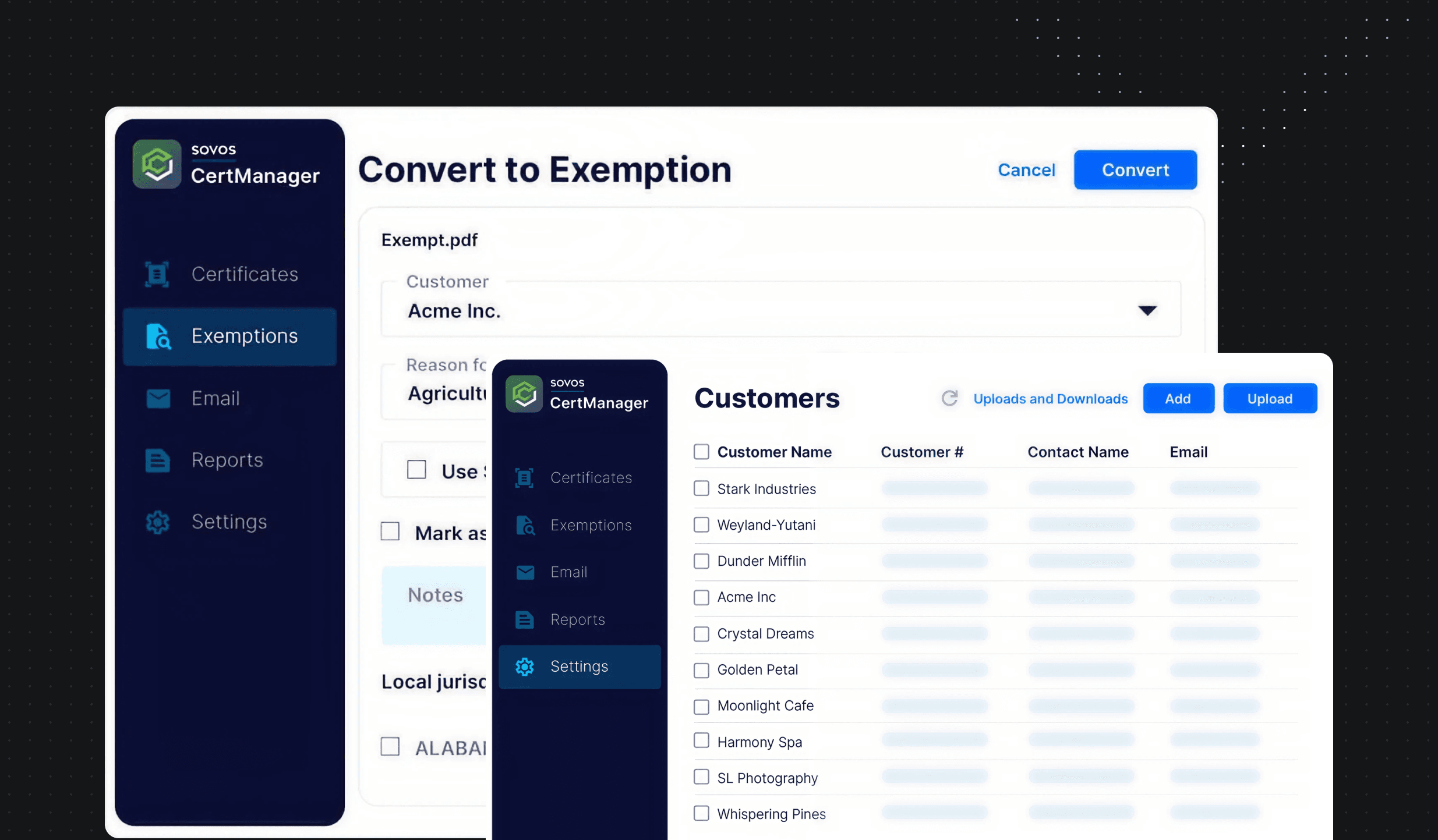
Sovos focuses on regulatory compliance beyond just tax, offering solutions for tax, e-invoicing, and other compliance requirements. This makes Sovos a good choice for companies dealing with multiple regulatory challenges beyond indirect tax.
Quaderno
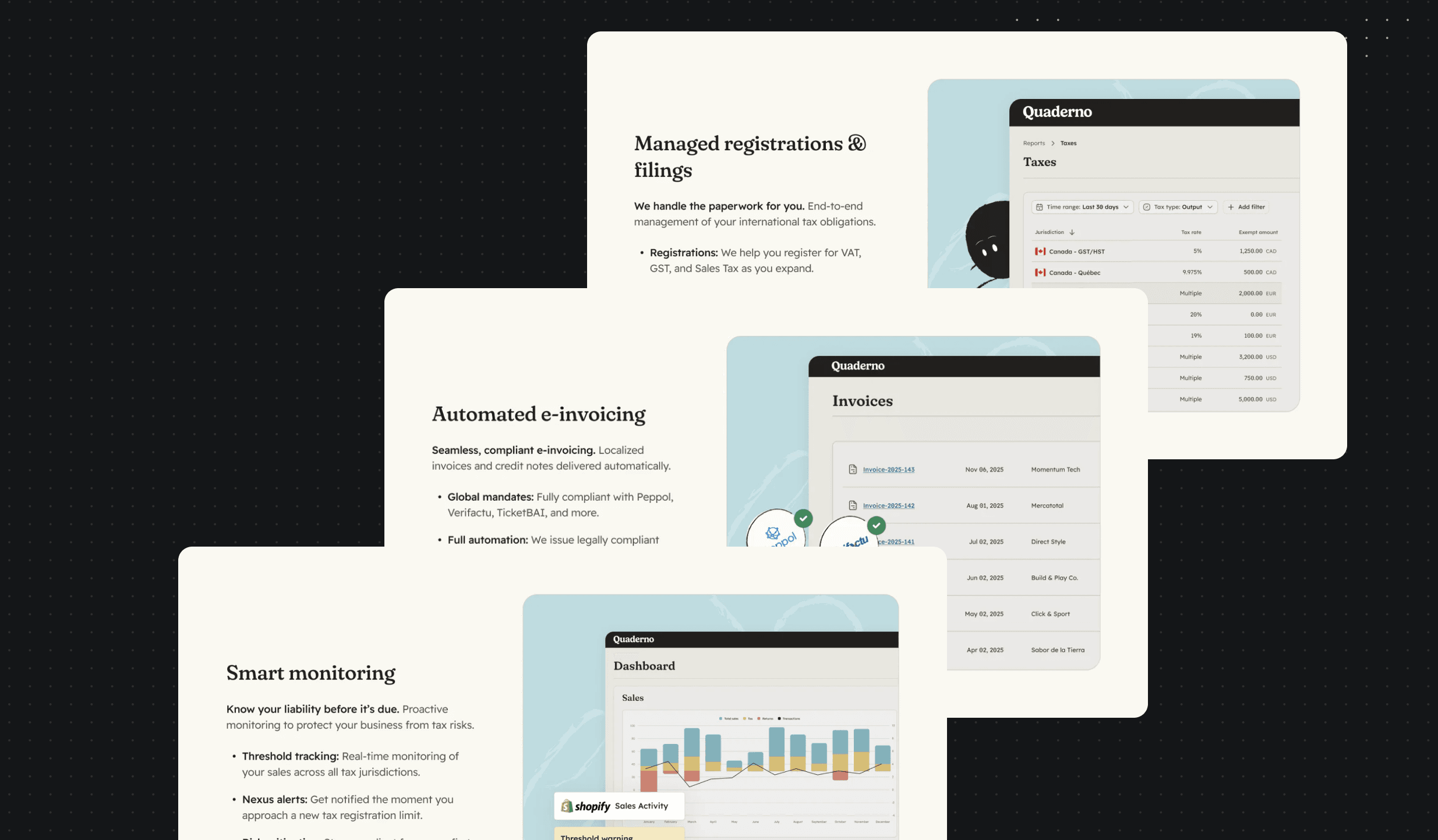
Quaderno targets freelancers, creators, and small digital businesses. The platform handles sales tax, VAT, and GST for companies with simpler needs and lower transaction volumes.
Each of these solutions fits specific business sizes and use cases. The key is matching the platform's complexity and cost to your actual compliance requirements.
How to choose the right sales tax compliance software
Not all tax software is created equal. Here’s how to vet the right software for your business’s use case.
Match software to your tax obligations
Start by evaluating your nexus exposure. In how many states or countries are you currently required to collect tax? Where do you project you’ll have obligations in 12-14 months?
Factor US sales tax versus global tax needs into your decision. If you only sell in the US, a US-focused platform may suffice. But if you have international customers or plan to expand globally, choose a platform with native global support from the start. You won’t want to completely switch platforms mid-stream in the middle of a global expansion.
Consider how your products are taxed. Companies selling standard physical products have simpler needs than those selling SaaS, digital products, or services with varying taxability rules across jurisdictions.
Evaluate integrations and workflows
For ease of onboarding, your chosen platform should connect natively to the systems you already use. Avoid solutions that require manual data exports or custom API development unless you have engineering resources to support it.
Review API flexibility if you've built custom systems. Some platforms offer robust APIs that enable deep integration, while others provide limited access.
Test the actual workflow before committing. Sign up for demos and trials to see how tax calculations happen in your specific billing flow. Make sure the integration feels seamless, not bolted on. Evaluate how much, if any, manual work the solution requires your teams to perform.
Compare pricing and support
Check pricing transparency carefully. Look for clear, predictable pricing models without usage caps, overage fees, or hidden add-on costs. Factor in what you'll actually pay as your transaction volume grows.
Review access to tax professionals and customer support. Check average response times, support hours, and whether you can speak to someone who understands tax law, not just the software.
Calculate total cost of ownership including implementation time and ongoing maintenance. A platform with a higher sticker price but quick setup may cost less than a cheaper solution that requires months of implementation work or ongoing manual work.
Why Deel and sales tax compliance software are complementary
Scaling internationally doesn’t just create one type of compliance risk — it creates two. You need to manage both your workforce obligations and your transaction tax obligations at the same time.
Deel is the global people platform that handles everything related to your workforce. With Deel, you can hire contractors and employees in new markets quickly and compliantly — without setting up entities unless you choose to. As you grow, Deel helps you:
- Hire globally with built-in compliance safeguards
- Run payroll and contractor payments in one place
- Manage the entire employee lifecycle, from onboarding to offboarding
- Sponsor visas and relocate talent across borders
- Establish and operate legal entities in new countries
- Equip teams with devices and IT support worldwide
- Stay ahead of worker classification and local labor law requirements
In short, Deel ensures your people operations scale smoothly and compliantly wherever you expand.
Sales tax compliance software manages everything related to selling into those same markets. As you add customers in new states and countries, indirect tax obligations follow. Sales tax and VAT platforms handle:
- Real-time tax calculation on transactions
- Tracking economic nexus and VAT/GST thresholds
- Registration alerts when you trigger new obligations
- Automated filing and remittance
- Ongoing reporting and audit readiness
Together, these systems form a complete finance and compliance infrastructure.
When you expand internationally, hiring employees and entering new markets often trigger VAT, GST, and sales tax obligations at the same time. You might use Deel to set up operations and hire locally — only to realize your new revenue streams create indirect tax exposure in those jurisdictions.
Companies often discover this the hard way: workforce expansion and customer expansion go hand in hand. Having both Deel and sales tax compliance software in place ensures you’re covered on all fronts — employment compliance and transaction tax compliance — so growth doesn’t create unexpected risk.
Deel powers your global team. Sales tax compliance software protects your global revenue. Together, they give you the infrastructure to scale with confidence.
Sales tax compliance at scale starts with the right software
Modern businesses require automation and accuracy. Manual tax management doesn’t scale once you grow beyond a handful of jurisdictions, and mistakes create compliance risks that can threaten your business's bottom line.
The right sales tax compliance software handles calculations, nexus tracking, filing, and remittance automatically across every jurisdiction where you operate. This frees your finance team to focus on strategic work instead of drowning in tax returns.
For businesses managing both US sales tax and international VAT/GST, these platforms offer the most practical solution. True global coverage in a single system eliminates the complexity of managing separate US and international tools while giving you real-time accuracy powered by AI.
Choose a platform that matches your current needs while scaling with your growth. The tax compliance decisions you make today will impact your business for years to come.
Jemima is a nomadic writer, journalist, and digital marketer with a decade of experience crafting compelling B2B content for a global audience. She is a strong advocate for equal opportunities and is dedicated to shaping the future of work. At Deel, she specializes in thought-leadership content covering global mobility, cross-border compliance, and workplace culture topics.