
Guide
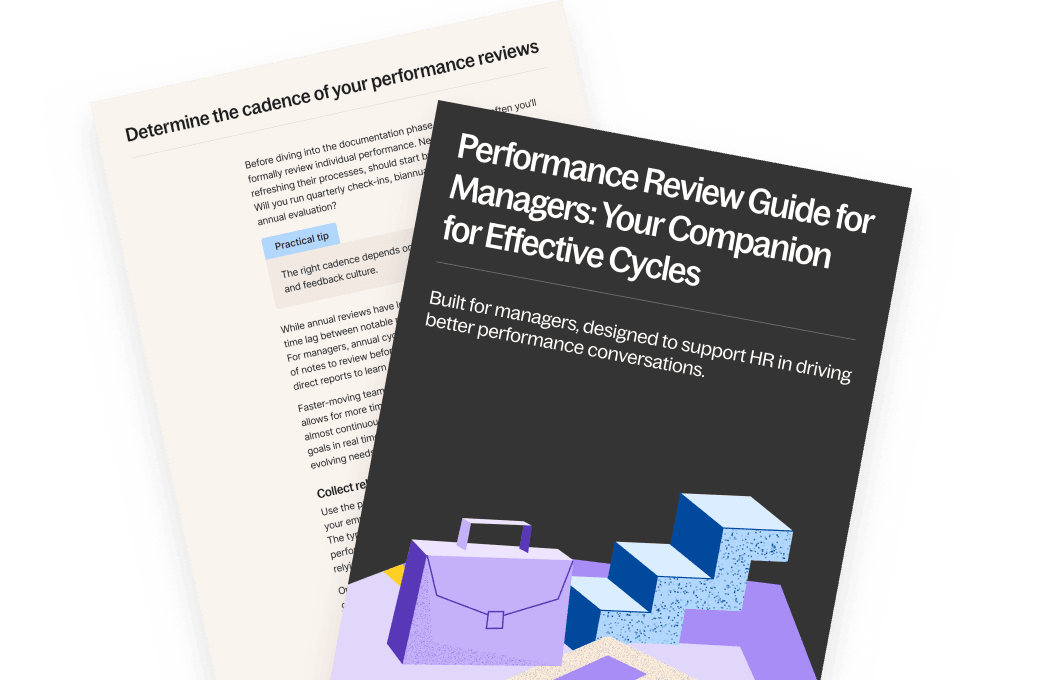
Performance Review Guide for Managers: Your Companion for Effective Cycles
Global HR
Get the resource for free
Performance reviews can make or break an employee’s engagement. When done right, they fuel motivation, growth, and trust. When mishandled, they can leave people confused, disengaged, or even looking elsewhere for carrer opportunities.
For many managers, the challenge isn’t wanting to give great feedback. It’s knowing how to deliver it in a way that’s structured, fair, and motivating. Add in time pressure, tough conversations, and calibration expectations, and even experienced managers can feel uncertain.
This guide was designed to take the pressure off. It helps managers and HR leaders navigate the full review cycle—from preparation to follow-up—with clear frameworks, examples, and ready-to-use tips.
Whether you’re conducting your first review cycle or leading performance programs across teams, this resource will help you make every review count.
Performance review guide overview: What you’ll learn
Inside, you’ll find practical tools and insights to help you deliver performance reviews that are fair, consistent, and impactful. Learn how to:
- Prepare effectively for review cycles with the correct data, context, and mindset.
- Evaluate performance objectively, ensuring fairness and consistency across teams.
- Write clear, constructive feedback that encourages growth without sugarcoating or discouraging.
- Lead productive review conversations, even when addressing complex topics.
- Build action-oriented growth plans that turn feedback into progress.
- Avoid common pitfalls that erode trust or create bias in the review process.
- Empower your managers with structured enablement tools through Deel Engage.
Key challenges this guide helps solve
- Unclear or inconsistent feedback across teams
- Biased or subjective evaluations that affect fairness and trust
- Difficult feedback conversations that demotivate rather than develop
- Managers who feel unprepared or unsupported in review cycles
- Disconnected processes between HR, managers, and employees
Who is this guide for
This guide is built for anyone responsible for shaping performance and development conversations:
- Managers, who want to strengthen their feedback and coaching skills.
- HR and People teams, looking to equip managers with consistent frameworks and language.
- Leaders and department heads, who need to drive alignment and performance across multiple teams.
Whether you’re in a growing startup or a mature global organization, you’ll gain the confidence to run review cycles that inspire progress and strengthen engagement.
Download the guide to structure reviews that inspire development, improve consistency, and drive team success. Build a stronger, fairer performance review process, from preparation to growth.
FAQs
How can the performance review process impact team performance?
When done well, the performance review process:
- Boosts morale by recognizing contributions.
- Aligns focus by connecting work to company priorities.
- Identifies blockers and resource gaps.
- Encourages development that leads to stronger execution.
- Drives retention by showing commitment to individual growth.
When done poorly, it can lead to disengagement, mistrust, and turnover—so structure and delivery matter.
What makes an effective performance evaluation for team members?
The core features of an effective performance evaluation for team members are:
- Consistency: Same criteria, cadence, and process for everyone.
- Fairness: Free of bias, and backed by diverse inputs (self, peer, manager).
- Clarity: Expectations (linked to seniority levels), goals, and rating systems are transparent.
- Actionability: Yields insights and plans employees can act on (going beyond performance results and touching on employees’ growth).
- Motivation: Helps employees feel seen, supported, and clear on what’s next.
What is HR’s role in performance reviews?
HR sets the structure, ensures fairness and compliance, equips managers with training and tools, and turns review data into actionable insights. They help create consistency, reduce bias, and support talent development at scale.
What is a good performance remark?
A good performance remark is:
- Specific: Highlights concrete actions or outcomes (“Consistently met Q2 deadlines and improved team workflow by introducing a new handoff process”).
- Balanced: Acknowledges both strengths and areas to grow
- Aligned: Tied to company goals, competencies, or role expectations.
- Forward-looking: Offers direction for continued success (“Great job leading the Q3 campaign. Next step is owning the full cross-functional rollout”).
What should you not say in an appraisal comment?
Reviewers need to avoid:
- Vague feedback (“You did great” lacks direction).
- Overly personal comments (“You’re just not a people person” can feel like a character critique).
- Comparisons to others (“Unlike Sarah, you struggle with X” can damage morale).
- Absolute terms (“You always… / You never…” are rarely accurate or constructive).
- Surprise criticisms that haven’t been raised in earlier check-ins.
How do you write a summary of an employee’s overall performance?
A strong performance summary should:
- Recap achievements against role expectations and goals.
- Comment on key strengths: skills, behaviors, or contributions.
- Note progress since the last review cycle (especially if growth was a focus).
- Include areas for growth tied to development or future responsibilities.
- End on a motivational note or next steps.
Example: “Over the past 6 months, Alex has exceeded expectations in project delivery and client satisfaction. Her ability to lead cross-functional initiatives stood out, particularly in the XYZ campaign. With further development in stakeholder communication, she’s well-positioned for a senior leadership track.”
How do you structure a performance review meeting?
A common and effective structure:
- Warm up: Set tone, purpose, and confirm the agenda.
- Employee reflection: Invite them to share wins, challenges, and aspirations.
- Manager feedback: Share your observations and data-backed insights.
- Discussion: Talk through alignment, professional development areas, and any disagreements.
- Future focus: Define development goals and support strategies.
- Wrap up: Summarize key takeaways and next steps.
What are the 5 most meaningful questions to ask in a performance review as a leader?
The 5 most meaningful questions to ask in a performance review as a leader are:
- What part of your work has felt most energizing or rewarding lately?
- Where have you felt most challenged, and what support could help?
- How do you feel your contributions have impacted the team’s goals?
- What skills or experiences are you eager to build next?
- What can I do differently to better support your success?
These questions open up reflection, goal alignment, and manager feedback.
More resources
- 7 Performance Evaluation Methods Compared: Find the Best for Your Organization
- The Best 11 Performance Review Templates: Evaluate and Grow Your People
- How to Conduct an Annual Performance Review Meeting: A Manager’s Guide
- 11 Companies with Best Performance Management Practices Building Exceptional Teams
- Performance Feedback Examples for Varying Levels of Performance
- Annual Performance Review Form for Word and Google Docs