Article
9 min read
What Is a PEO in Texas? Outsource Payroll, Benefits, and Compliance
PEO

Author
Shannon Ongaro
Last Update
October 14, 2025

Table of Contents
What does a professional employer organization do in Texas?
How do I get a PEO license in Texas?
What services do Texas PEOs provide?
Benefits of Texas PEO services
Payroll, labor, and employment laws in Texas
How to choose the right PEO in Texas
Manage your Texas, US, and global workers with Deel
Key takeaways
- Professional employer organizations (PEOs) in Texas let businesses outsource payroll, benefits, and HR compliance while sharing legal responsibilities.
- Providers must hold a Texas PEO license and follow TDLR regulations.
- With PEO, you can streamline HR, reduce compliance risks, and enhance employee benefits offerings.
Correctly hiring, paying, and managing a workforce in Texas demands an in-depth understanding of both state and federal laws. By partnering with a professional employment organization (PEO), companies can delegate compliance and HR tasks to a trusted provider, and as a result, hire with more confidence, compliance, and speed.
A PEO in Texas is a partnership with a licensed provider that lets businesses outsource payroll, benefits, and HR compliance while sharing legal responsibilities, streamlining operations, reducing risk, and providing expert support for state‑specific employment regulations.
Read on to explore the benefits and process of using a PEO in the state of Texas.
What does a professional employer organization do in Texas?
PEOs allow Texas businesses to outsource a number of employee and HR management functions including payroll and benefits administration. When you partner with a PEO provider, they can also help you maintain continuous compliance with all relevant state and federal laws.
How do I get a PEO license in Texas?
Texas regulates all professional employer organizations that operate within its jurisdiction. According to state law, providers must obtain a license and meet the strict requirements of the Texas Department of Licensing and Regulation (TDLR).
What services do Texas PEOs provide?
Many employee benefits are not required under state or federal law. However, if the PEO does offer benefits such as health insurance, retirement plans, or workers’ compensation, they must comply with applicable regulations.
Mandatory compliance documents
- Form W‑4: An IRS tax form for employee withholding status
- Form I‑9: Verifies identity and work eligibility
- PEO Arbitration Agreement: Employees resolve disputes via arbitration; opt‑out available
- Employee Communications Consent Agreement: Defines official company communication methods
- WSE Notice of PEO Relationship: Notifies workers of co‑employment and their rights
- Texas Workers’ Compensation Notice: Acknowledges compensation coverage

Benefits of Texas PEO services
Working with a PEO helps Texas companies simplify their HR operations, offer comprehensive benefits to employees, and stay updated with state‑specific employment laws.
Increased efficiency
HR outsourcing can lead to more streamlined operations by reducing the amount of time and resources dedicated to tasks. This approach frees up CFOs and finance teams to focus on strategic initiatives with the knowledge that the company’s core operations are in good hands.
Access to expertise
PEOs grant access to a bank of expertise and regulatory knowledge that’s often beyond the scope of startups or small businesses. The service tends to be more cost‑effective than hiring in‑house specialists as it has lower, more predictable costs.
Cost-effective employee benefit plans
A significant advantage of partnering with a PEO is the opportunity to offer a more attractive and affordable benefits package to employees.
| Feature | PEO Advantage |
|---|---|
| Group purchasing power | Access to lower rates on health, dental, vision, and retirement |
| Compliance management | Up‑to‑date with Texas and federal regulations |
| HR software and analytics | Real‑time dashboards for payroll and benefits tracking |
| Risk mitigation | Shared legal responsibility reduces fines and penalties |
Enhanced compliance
Non‑compliance has high stakes as violating state laws can lead to fines, legal cases, and reputational harm. PEOs help companies navigate and stay updated with state and federal laws to prevent issues.

Payroll, labor, and employment laws in Texas
The regulations in Texas are comprehensive and known for being employer‑friendly. Here are the most important state‑specific laws to be aware of:
Payroll and benefits laws in Texas
| Law / Topic | Details |
|---|---|
| Minimum wage | Texas aligns its minimum wage with the federal $7.25/hr; state adjusts if Congress raises the rate. |
| Wages | Must pay in US dollars (e.g., mail or direct deposit); alternative methods allowed with written employee agreement. |
| Pay frequency | Exempt employees: ≥ monthly; non‑exempt: ≥ semi‑monthly (defaults: 1st and 15th). |
| Final paychecks | Terminated employees: within six calendar days; resignations: on next regular payday. |
| Paid sick leave | Not required unless a disability or pregnancy accommodation; individual policies permitted. |
| Paid vacation | Not mandated; employers must honor any written vacation policies. |
| Unused benefits | Must include unused vacation or parental leave in final paycheck if policy specifies. |
| Deductions | Require written authorization from employee, government entity, or court. |
| Pay transparency laws | Cannot penalize candidates for asking about pay; no current requirement to post salary bands. |
Learn more: Your Ultimate Guide to Texas Payroll
Labor laws in Texas
| Law / Topic | Details |
|---|---|
| Meal and rest breaks | No paid break requirement under Texas Payday Law unless break ≤ 20 minutes. |
| Paid time | Must pay for any time worked, including mandatory training or meetings. |
| Overtime | > 40 hours/week → 1.5× pay or compensatory time (max 240 hours accrual). |
| Whistleblower protections | Protected under the Texas Whistleblower Act when reporting law violations in good faith. |
Employment laws in Texas
| Law / Topic | Details |
|---|---|
| Worker classification | Misclassification (employee vs. contractor) can lead to penalties, interest, and fines. |
| Right to work | Cannot discriminate based on union membership or similar affiliations. |
| Discrimination | Prohibited by federal law and enforced by the Texas Workforce Commission (race, color, national origin, religion, sex, age, disability). |
| Terminations | “At‑will” state: employees may be terminated at any time for any lawful reason, barring contractual or statutory restrictions. |
| Workers’ compensation | Not required for private employers under Texas state law. |
Additional requirements and enforcement
Companies must also comply with federal laws like FMLA and COBRA. Texas employers register for unemployment tax (0.25%–6.25% on $9,000 wage base for 2025).
Explore PEO

How to choose the right PEO in Texas
The state of Texas has unique laws and requirements that require a thoughtful approach to selecting a PEO. Consider the following strategy to help you find a provider that matches your organization’s HR needs and goals.
1. Define your business needs
Review your current HR operations to see where you might be facing inefficiencies or overspending. Go beyond your immediate needs to consider long-term goals.
Key areas of focus include your payroll processing, benefits administration, and risk management. Consider your organization’s growth projections as you’ll need your PEO to scale alongside your operations.
2. Research PEOs with Texas expertise
Narrow down your options by focusing on PEOs with a significant presence in Texas and a proven track record. The best providers will have case studies, high ratings, and reviews that demonstrate their expertise.
3. Evaluate the range of services and quality of benefits
Consider the range of services provided by potential PEOs to see whether they cover your business needs in Texas. Do they have robust administrative support, tax filing, HR services, and employee onboarding?
Balance the range and quality of the PEO’s benefits packages against the pricing. Their plans should accommodate your workforce’s shifting needs while fitting into your budget.
4. Assess compliance and risk management capabilities
Learn more about the PEO’s specific approach to maintaining compliance with Texas laws and regulations. Understanding what proactive measures they take will show you how they can reduce errors and mitigate risks.
Also, explore how they notify companies about upcoming regulatory changes. For example, Deel has a Compliance Hub with all the latest updates about any state, federal, or international policies that could impact your business.
5. Check customer service and support
Since you’re partnering with the provider, effective customer support is essential for seamless collaboration and communication. Research the PEO’s support in terms of response rate, availability, and contact options. Also, consider the quality of the tools they can access to resolve issues. For example, data security and protection are often a top concern.
6. Review and negotiate the contract
Ensure you understand every detail of the PEO contract including terms, fees, and the termination process, seeking legal counsel if necessary. Aim to negotiate conditions that align with your business objectives and interests, ensuring the responsibilities of both parties are clear.
7. Plan for implementation and transition
Inform your team about the upcoming changes. Start by explaining all the benefits and different stages of the transition to a PEO. Develop a step-by-step process for the PEO transition with the provider and key stakeholders. Assign responsibilities to specific team members and schedule regular update sessions to stay on track.
See also: How to Choose a PEO or US Payroll Provider: 9 Questions to Answer
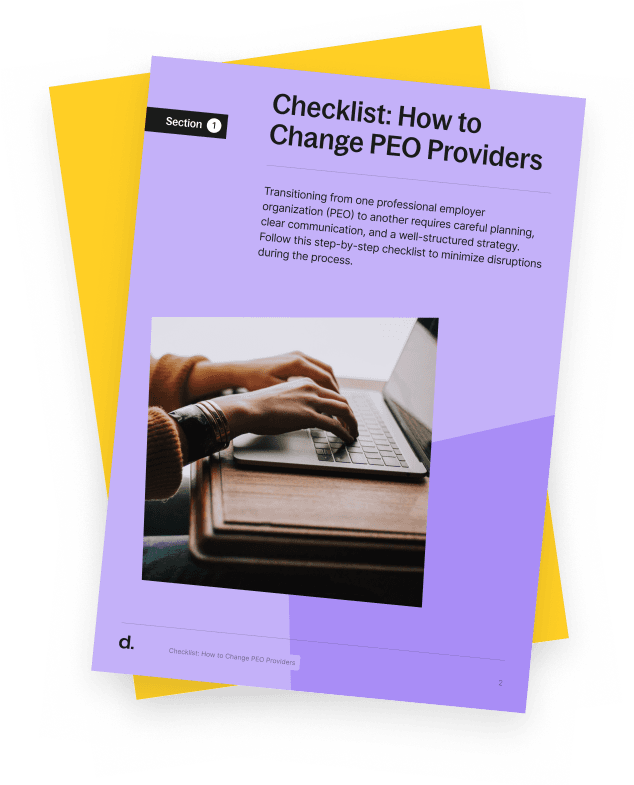
Manage your Texas, US, and global workers with Deel
Deel’s in-house PEO is built to support fast-growing teams with the tools, coverage, and service they need, all in one platform.
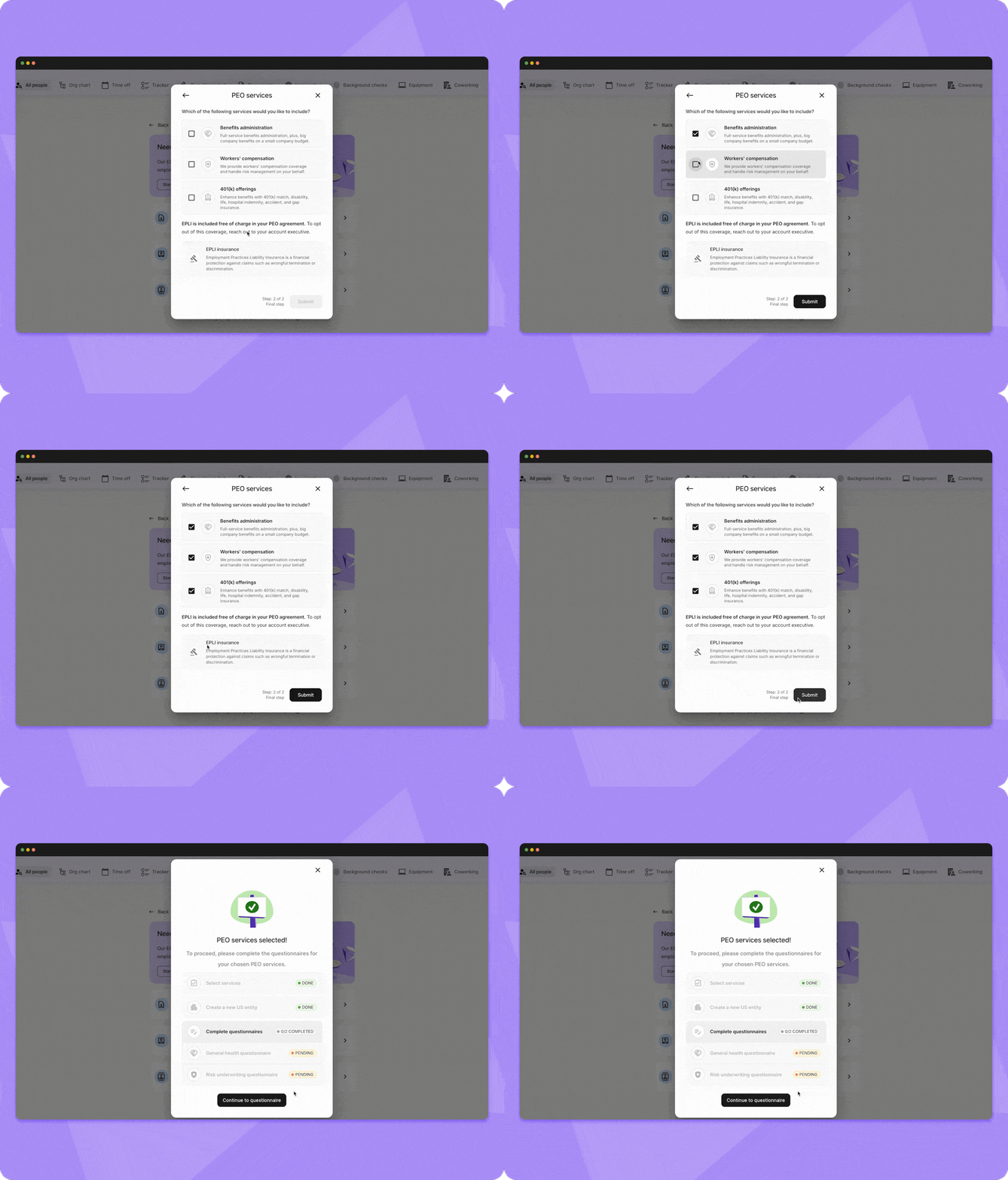
Fully in-house support
PEO is run entirely by internal specialists, including certified professionals, licensed advisors, and dedicated HRBPs. Clients get direct access to expert guidance across payroll, benefits, and compliance, with no third-party handoffs or delays.
Benefits admin made easy
Admins can choose, enroll, and manage health benefits for US employees directly in the Deel platform. They can view costs, track coverage, and handle renewals—all in one place, without chasing brokers or juggling paperwork.
Exclusive access to Aetna International plans
For teams with globally mobile employees, Deel is the only PEO to offer Aetna International health plans, ensuring continuous coverage across borders without needing to manage separate providers.
All-in-one platform
Admins can manage hiring, onboarding, payroll, and benefits in one place. Deel simplifies every step, from enrollment to renewals, reducing HR admin time.
Compliance coverage at every level
Deel helps businesses meet federal, state, and local employment laws, taking the guesswork out of US HR compliance.
Book a demo to learn more about using PEO in Texas.
Disclaimer: This article is intended for informational purposes and should not be considered legal advice. Consult a qualified licensed attorney for help on legal issues. Content is accurate at the time of publishing.
Deel on G2

Shannon Ongaro is a content marketing manager and trained journalist with over a decade of experience producing content that supports franchisees, small businesses, and global enterprises. Over the years, she’s covered topics such as payroll, HR tech, workplace culture, and more. At Deel, Shannon specializes in thought leadership and global payroll content.