Article
14 min read
AI ATS: What They Are, Benefits, and How to Choose One
AI

Author
Ellie Merryweather
Last Update
April 06, 2026

Table of Contents
What is an AI-powered applicant tracking system?
Benefits of AI in applicant tracking
Why an AI-powered ATS is a competitive advantage
Key concerns of using AI in hiring and how to overcome them
How to choose the right AI applicant tracking system
How Deel ATS uses AI to help teams hire smarter
Key takeaways
1. AI ATS automates recruitment tasks such as scheduling interviews, screening resumes, and assessing skills. 98% of hiring managers using AI have already seen improvements in hiring efficiency.
2. Using an AI-powered ATS reduces administrative costs, shortens hiring cycles, and supports better hiring decisions.
3. Recruiters have concerns with AI ATS, like algorithmic bias and data privacy. But choosing the right platform that addresses these concerns head-on makes all the difference.
Applicants are not landing roles, and employers are not finding the right applicants.
LinkedIn saw a 45% surge in applications per minute in 2025 compared to last year. Magdalena Robinson, a talent acquisition professional, had to apply to 300 openings to land a role. For every candidate grinding through hundreds of rejections, there's also a recruiter on the other side buried under thousands of applications.
It has become a vicious cycle of high application volume per job posting and slow or no responses.
The problem isn't effort. It's the tools.
Traditional ATS systems with stringent keyword-matching often filter out strong applications if they miss a few important keywords in the resume.
AI-powered ATS is the right solution to break this vicious cycle, moving beyond traditional keyword matching and interpreting resumes more like a human recruiter would. It helps companies screen resumes more accurately, respond faster, and improve the candidate experience.
In this guide, you'll learn:
-
How AI ATS actually works and how it’s different from old-school keyword matching
-
What are the key features, and how does it make a difference
-
What are the common fears of using AI in hiring, and how does AI ATS tackle them
-
How to choose the right AI ATS for your company
What is an AI-powered applicant tracking system?
An AI-powered applicant tracking system is recruiting software that uses artificial intelligence to screen resumes, rank candidates, and automate tasks like interview scheduling and reminders. Unlike traditional ATS tools that rely on rigid keyword matching, AI ATS screens resumes based on context. It speeds up hiring while reducing manual reviewing effort.
Deel HR
Traditional ATS vs. AI-Driven ATS
Traditional ATS was designed to centralize the hiring process and data. It screens resumes, but the outdated keyword-matching process it follows still requires manual review. On the other hand, AI-powered ATS reads the entire resume and gives it a score rather than scrambling for keywords.
AI ATS is also more proactive than reactive in hiring. Here’s how: it searches your existing talent pool for relevant past applicants, screens and scores them to close roles faster, and also provides insights into the hiring pipeline to improve the process.
| Traditional ATS | AI-powered ATS | |
|---|---|---|
| Candidate sourcing | Reactive (inbound applications only) | Proactive (searches existing talent pools and databases) |
| Resume screening | Keyword matching | Contextual interpretation |
| Interview scheduling | Manual | Automated |
| Reporting | Limited | Advanced, predictive alerts |
| Bias risk | Possible with keyword matching | Reduced with contextual interpretation |
| Recruiter workload | High | Low |
Benefits of AI in applicant tracking
Recruiting is full of repetitive, time-intensive tasks, exactly where AI thrives. That's why 73% of talent acquisition professionals believe AI will reshape how companies hire, and its benefits are already proving it:
1. AI writes better job descriptions in minutes
Getting a job description approved is the first stage where hiring gets delayed.
Take Jess, a recruiter at a large healthcare organization. She was working on a job description for a senior nursing leadership role. The draft went through the hiring manager, legal, and finance, with each requesting different changes. It took her 17 days to get the job posting live.
AI speeds up this process. It creates role-ready descriptions instantly, which are already checked for structure, completeness, and bias-free language.
There is a common worry that AI will create generic descriptions that may not be fit for your business. But advanced AI ATS like Deel takes care of it. Your hiring team can set templates in advance, and AI will use them as a base and add details on top of them. So, the final job description is tailored to your business.
By taking advantage of AI, you can get job descriptions approved faster and reduce the time between role approval and posting.
2. AI speeds up candidate sourcing
AI lets you take the driving seat in candidate sourcing instead of advertising a job opening and waiting solely for inbound applications.
It pulls relevant profiles from your past job applications received, internal candidate databases, or external databases you’ve integrated. It also ranks candidates based on requirements in job descriptions. As a result, you can source relevant talent faster and speed candidate selection using AI.
3. AI automates resume screening and candidate scoring
Application overload is real, and AI helps you deal with it. AI generates knock-out questions during the application stage to filter out candidates who do not meet the minimum requirements for the role. Here are some knock-out questions to give you an idea:
-
Are you legally authorized to work in the United States?
-
Do you now, or will you in the future, require sponsorship for employment visa status (e.g., an H-1B visa) to work legally for us in the United States?
-
Do you have a non-compete in place with your previous or current employer that prevents you from working for us?
With these questions in place, you can filter unqualified applicants automatically, mainly those who don't meet the basic criteria.
After this first layer of filtering is done, AI then handles resume screening much like a recruiter would, but at scale.
AI interprets the resume using natural language processing and ranks the best-fit profiles higher. Given AI handles this initial resume screening, recruiters can spend more time on higher-value tasks like interviewing, relationship-building, and strategic hiring decisions.
Complementary reading:
Hear from Deel's Senior Director of Talent Acquisition, Alan Price, on how an AI-powered ATS can help solve recruitment bias.
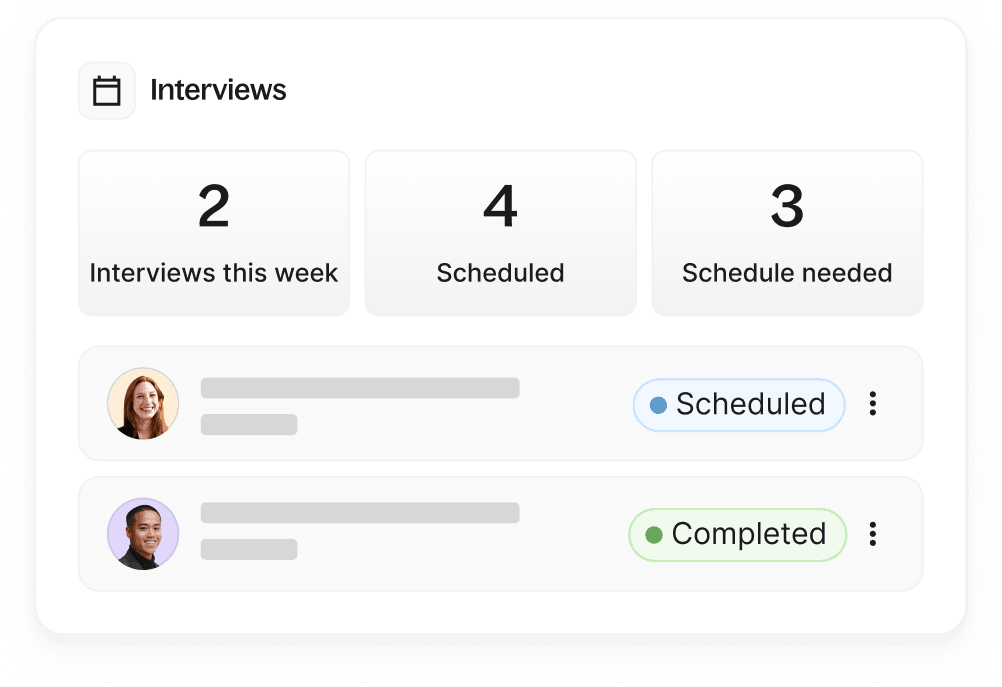
4. AI improves interviewing and scheduling
93% of hiring managers say hiring is taking longer than it did two years ago. One of their most time-consuming tasks remains scheduling interviews and gathering feedback.
AI simplifies interviewing by:
-
Smart scheduling: Syncs interviewer and candidate calendars, letting candidates self-schedule from available slots.
-
Structured interview scorecards: Generates standardized scorecards that encourage interviewers to evaluate all candidates based on role requirements and not let unconscious bias creep in.
-
Automated interview summaries: Creates summaries of each interview and stores them in a centralized platform, so the interviewer can focus on interviews rather than scribbling notes.
With these capabilities, AI improves interview scheduling efficiency, limits unconscious bias in interviews, and supports more objective decision-making.
5. AI turns recruiting data into a strategic superpower
AI doesn't just track, it predicts. It uses your past data to predict future hiring outcomes. One in two talent acquisition professionals believe that AI will improve the quality of hires in the long run.
It can forecast things like:
-
Predicted quality of hire
-
Predicted cost-per-hire
-
Cultural alignment score
-
Internal mobility readiness
-
Candidate drop-off forecast
-
Predicted time-to-fill
-
Offer acceptance probability
-
Source ROI prediction
-
Talent pipeline health score
With these insights, you can refine your recruitment strategies and prioritize top talent through predictive scoring.
Deel AI
6. AI enhances fairness and reduces bias
“Unconscious bias in hiring is the unseen force that can shape and influence recruitment decisions,” says Jessica Bilston-Gourley, Director and founder of consulting agency Positive HR. It’s tough to limit bias at all checkpoints, especially unconscious bias of recruiters and interviewers. AI provides a way to handle bias systematically.
AI prevents unconscious bias during shortlisting with structured evaluation, standardized scoring, and predictive insights.
It provides structured interview scorecards so all candidates are evaluated on the same parameters. It scores candidates based on job description requirements and not on name, gender, ethnicity, etc.
AI also helps hiring teams make more objective decisions with scoring and insights like predictive quality of hire.
7. AI improves the candidate experience
AI has already dramatically improved the candidate experience. About half of the talent pool has already interacted with AI as part of their job search, and 77% of them had a positive experience. In fact, 93% of those who had a positive AI interview experience would continue to approach their recruiters, compared to 67% of those who haven’t interacted with an AI agent.
AI-powered recruiting software improves candidate experience by:
-
Faster screening and interviews: Automates initial screening and interview scheduling, reducing back-and-forth and getting candidates into the process faster.
-
Smoother communication: Sends personalized communication to candidates at every step so they are always informed.
-
Consistent experience: Standardizes interview evaluation (with scorecards) and candidate communication (with automated updates), ensuring a consistent experience for every candidate.
A better candidate experience reduces friction and accelerates time-to-hire. More importantly, it increases the offer acceptance rate as candidates who feel respected throughout the process are more likely to say yes.
Complementary reading
Understand how ATS ranks talent in the age of AI-bots, for AI-powered but human-centric hiring.
Why an AI-powered ATS is a competitive advantage
Companies are shifting toward AI-powered applicant tracking systems to improve their hiring process. This move isn't for marginal gains, but for fundamental improvements to how they hire. Here's what sets these systems apart:
Lower administrative costs
AI is automating administrative tasks at every hiring stage. 98% of hiring managers saw significant improvements in hiring efficiency via AI in things like scheduling interviews, screening resumes, and assessing skills. That means you can accomplish more with a smaller team and lower your administrative costs.
Better hiring decisions
AI-powered ATS standardizes the interviewing process via scorecards and also provides predictive hints on the quality of hire. These features support recruiters in making better hiring decisions.
Fabien Desmangles, Talent Acquisition Manager at Dassault Systèmes, says AI will transform the way we think about quality of hire by enabling more data-driven, predictive, and unbiased decision-making.
It’s not just Fabien. 74% of hiring managers also say AI will be able to assist human interviewers or hiring managers during the hiring process to better assess the compatibility of applicants' skills with the position they’ve applied for. AI is fast becoming an essential tool for recruiters, helping them assess candidates more accurately and make higher-confidence hiring decisions.
More consistent processes
George Oehlert, Head of Transformation at Adams & Remers, explains the need for consistency in hiring. He says, “Consistency is not just to make better decisions, but also to ensure hiring is fair and unbiased. Inconsistency in delivery can also make scoring candidates difficult and leaves hiring managers not knowing who is right for the role or who to hire. This costs companies both time and money, with some estimates putting roughly 30% of an employee’s annual salary if the wrong person for the role is hired.”
Consistency at scale is harder than it looks, and that's where AI earns its place. It standardizes screening and interviews, keeps candidate communication on track, and gives hiring teams a clearer, fairer basis for every decision.
Shorter hiring cycles
Hiring looks different today than it did a few years ago. Ruchee Anand, Vice President - LinkedIn Talent Solutions, APAC, says that companies now want to assess candidates on actual skills, not just their pedigree (past job titles or where they went to school).
“This shift is hard to execute at scale without AI. Used responsibly, AI helps recruiters detect the right skills earlier, reduce screening friction, and create a more consistent and fair evaluation process,” she adds.
AI is speeding up the hiring process from resume screening to candidate evaluation and scheduling. Time saved on each application adds up to shorter hiring cycles overall.
Stronger employer brand
Your hiring process says a lot about your company culture and employer brand. Candidates are quick to share negative experiences with their network. Bad candidate experiences quietly shape who's willing to apply at your company.
An AI ATS improves candidate experience by creating structure and providing more personalized communication. It’s already making a difference. 37% of talent acquisition professionals say AI will enhance the candidate experience and, by extension, the employer brand.
Key concerns of using AI in hiring and how to overcome them
AI is showing real promise in streamlining hiring, but is HR ready to trust it with peoples’ decisions? The hesitation is real. Only 2% of HR professionals say they completely trust generative AI to make people-related decisions. 40% express limited confidence, and 26% don't trust it at all.
We get it. Hiring decisions carry real stakes. The good news? Today's AI tools have come a long way in addressing exactly these concerns. So let's dig into the most common ones and what you can actually do about them.
Free guide
Interview Guide and Checklist for Hiring Managers
Algorithmic bias
HR teams worry that AI will drop relevant candidates due to algorithmic bias. It's a valid concern, but the root cause is often misunderstood. AI doesn't generate bias on its own. It learns from the data it's trained on. If your past hiring data used for training models contains bias, AI will replicate it to make future decisions. Either this data needs to be audited, or you need more refined data to train the model.
Rather than constantly refining your hiring data, a better solution is to use a model that doesn’t reference past data to make future decisions. For example, Deel ATS checks your current job description, application responses, resume, and interview feedback to score candidates neutrally. Also, Deel ATS also doesn’t filter any candidates. It just scores the stronger matches higher, so no applicant gets overlooked.
Data privacy
When using AI in hiring, candidate data privacy is a real compliance concern. A 2026 lawsuit also highlighted the issue where the candidate accused an AI recruiting software of misusing their personal data.
To stay compliant, look for a platform compliant with global security standards, such as GDPR and CCPA. It should explicitly mention what data it will collect and how they plan to use it. Apart from that, it should also encrypt data and allow custom delete schedules if candidates want their data deleted.
Poor candidate experience
AI is good at streamlining candidate evaluation and automating communication. But too much automation without any human in the loop makes the experience impersonal.
Andrew Weiss, HR professional, says “Hiring is getting tiring for both recruiters and applicants. Recruiters are overwhelmed with volume, and for applicants, it feels like a black hole. Even rejection emails feel automated and impersonal. There is no human experience. No meaningful feedback. No real engagement. No sense of connection”.
Hiring needs human-AI collaboration. While AI will handle the repetitive tasks, a recruiter in the loop will keep the experience human. You can design a custom workflow in your AI-recruiting software to identify where you can lean in on AI and where a recruiter would take a lead.
How to choose the right AI applicant tracking system
Follow this comprehensive checklist to find the right AI ATS:
-
Does it automate candidate sourcing?
-
Does it generate complete, bias-free, and personalized job descriptions?
-
Does it screen and score applicants?
-
Does it provide predictive hiring insights?
-
Does it help with interview scheduling?
-
Does it provide structured interview scorecards to reduce bias ?
-
Can it screen and flag fake candidates?
-
Can it be integrated with your existing job boards?
-
Does the pricing fit your budget?
-
Does it have a dedicated support team for implementation and post-implementation support?
Useful resource:
How Deel ATS uses AI to help teams hire smarter
Deel ATS is built to improve hiring workflows while keeping users’ concerns with AI in mind. It is a GDPR and CCPA-compliant platform using AI to:
- Generate ready-to-post and bias-free job descriptions for quick approvals.
- Source candidates automatically from over 1000+ job boards to find talent faster.
- Screen and score applicants to help you prioritize top talent.
- Generate AI-powered interview summaries to centralize feedback.
- Provide actionable recruiting analytics to streamline the entire hiring lifecycle.
- Screen for fake candidates with AI-powered authenticity checking and candidate scoring to prevent fraud.
Deel ATS is also part of the complete Deel ecosystem, which supports onboarding, employee data management, training, payroll, performance management, and asset management. You can run all your HR functions from one place.
Book a quick demo of Deel ATS and all other modules to speed up your hiring and onboarding.
Live Demo
Get a live walkthrough of the Deel platform

Further reading:
- Level-Up Hiring with AI: 7 Playbook Moves to Trial Today
- AI in Recruiting: What It’s Actually Doing Today and What It Could Unlock Tomorrow
- AI in Talent Acquisition: A Guide for Global Teams
- Generative AI in HR: How to Use It for Enhanced People Processes
- How to Implement AI in HR: An Actionable Guide for HR Managers
- Beginner’s Guide to AI in HR: Smarter, Faster Processes
- AI in Talent Management: 6 Ways for HR Pros to Harness the Power of Machine Learning
Ellie Merryweather is a content marketing manager with a decade of experience in tech, leadership, startups, and the creative industries. A long-time remote worker, she's passionate about WFH productivity hacks and fostering company culture across globally distributed teams. She also writes and speaks on the ethical implementation of AI, advocating for transparency, fairness, and human oversight in emerging technologies to ensure innovation benefits both businesses and society.