
Article
8 min read
Best IT Service Management Software: Top 11 ITSM Tools Compared
IT & device management

Author
Michał Kowalewski
Last Update
January 30, 2026

Table of Contents
What is IT service management (ITSM) software?
How we evaluated ITSM platforms
ITSM tools: Quick overview
The 11 best ITSM tools in 2025
1. Deel IT
2. ServiceNow
3. Atlassian Jira Service Management
4. Freshservice (Freshworks)
5. Zendesk
6. Ivanti Neurons for ITSM
7. BMC Helix ITSM
8. ManageEngine ServiceDesk Plus
9. Rippling
10. TOPdesk
11. SysAid
Cost considerations for ITSM software
How Deel IT redefines IT service management

Explore this topic with AI
Key takeaways
- ITSM software standardizes how incidents, requests, changes, and assets are managed, helping IT and HR align on employee lifecycle workflows.
- The best ITSM tools vary by company size: SMBs need ease of use and affordability, while enterprises demand deep ITIL coverage and extensibility.
- Deel IT goes beyond ticketing by automating devices, access, and global support, preventing issues before they generate ITSM workload.
If you run IT at a growing company, you already know the pain: tickets piling up in inboxes, lost track of who has which device, and endless access requests. But in smaller organizations, it’s often not just IT handling this load. HR teams are responsible for ordering laptops for new hires, chasing down returns during offboarding, or resetting accounts when someone changes roles.
IT service management (ITSM) software exists to bring order to this chaos. These tools standardize how incidents, requests, changes, and problems are handled, often following ITIL best practices. Modern ITSM platforms also integrate with HR systems, automate routine tasks, and give managers visibility into devices and apps across the workforce.
In this guide, we cover 11 of the best ITSM tools in 2025. The list includes enterprise mainstays, SaaS-first platforms, and newer solutions designed for distributed and fast-growing teams.
What is IT service management (ITSM) software?
IT service management (ITSM) software is a category of tools that helps organizations deliver and support IT as a service. Instead of relying on scattered emails, spreadsheets, and ad hoc fixes, ITSM platforms provide a structured way to handle incidents, service requests, changes, and problems.
Most ITSM tools are based on ITIL (Information Technology Infrastructure Library) best practices, which offer standardized processes for managing IT services. A typical ITSM platform includes:
- Incident management: Resolving outages and service disruptions
- Service request management: Handling routine requests such as access or software installs
- Change and problem management: Introducing updates safely and identifying root causes of recurring issues
- Asset and configuration management (CMDB): Keeping track of hardware, software, and their relationships
- Self-service and knowledge management: Enabling employees to find solutions without filing a ticket
The result is more predictable service delivery, better visibility into IT operations, and less time wasted on repetitive tasks. Modern ITSM tools also integrate with HR, identity, and device management systems so that IT and People Ops can collaborate on onboarding, offboarding, and day-to-day support.
See also: Top 3 automation wins for HR and IT in 2025
How we evaluated ITSM platforms
We used practical criteria focused on what matters for IT and HR handling global teams.
- Core ITSM coverage: Incident management, service request management, change and problem management, service catalog, knowledge base, service level agreements (SLAs), configuration management database (CMDB), and IT asset management
- Automation and AI: Workflow automation, ticket deflection, virtual agents, and rule-based triggers that prioritize and escalate requests
- Integrations: Single sign-on (SSO) and identity platforms, human resources information systems (HRIS), mobile device management (MDM) and endpoint tools, monitoring and application performance management (APM), as well as finance and procurement systems
- Operations at global scale: Data residency options, multi-region support, localization, 24/7 support, and hardware logistics alignment for distributed teams
- Security and compliance: Role-based access control (RBAC), auditing and reporting, data retention policies, least-privilege workflows, and alignment with zero trust models
- Administration effort: Configuration versus customization, template quality, no-code builders, and ease of upgrades
- Analytics and reporting: Dashboards, SLA trends, request volumes, change success rates, and insights into asset costs
- User experience: Usability of the agent workspace, clarity of the requester portal, and mobile experience quality
- Pricing and total cost of ownership (TCO): Licensing model, required add-ons, implementation complexity, and time to value
- Ecosystem and extensibility: APIs (application programming interfaces), webhook support, marketplace apps, and depth of the partner ecosystem
See also: Best IT Asset Management Software of 2025: Top 15 Picks
ITSM tools: Quick overview
| Tool | Best for | Standout features | Limitation to note |
|---|---|---|---|
| Deel IT | Distributed and global-first teams | ITSM tied to HR events, global device lifecycle, MDM enrollment, app provisioning, certified offboarding | Not a classic heavy ITIL suite |
| ServiceNow | Large enterprises with complex processes | Deep ITIL coverage, mature workflows, AI and analytics, strong ecosystem | High cost and implementation effort |
| Atlassian Jira Service Management | Engineering-led orgs in Jira | DevOps change workflows, incident swarming, reasonable pricing | Advanced CMDB and ITAM may need add-ons |
| Freshservice | SMB and mid-market | Fast deployment, clean UI, AI assistants, solid automation | Very complex CMDB or regulated needs may outgrow |
| Zendesk | Teams prioritizing portal UX and self-service | Intuitive request portal, knowledge base, quick time to value | ITIL depth lighter than enterprise suites |
| Ivanti Neurons for ITSM | Security-conscious enterprises | ITSM + ITAM, discovery, endpoint and security integrations | Setup and tuning can be complex |
| BMC Helix ITSM | Standardized enterprise service management | Service modeling, AIOps tie-ins, robust change management | Cost and admin overhead |
| ManageEngine ServiceDesk Plus | Value-focused IT with broad needs | Full ITIL modules at accessible pricing, on-prem or cloud | UI and extensibility can require tuning |
| Rippling | Mid-market with tight HR–IT alignment | ITSM-lite ticketing plus HR and device management tie-ins | Not a full enterprise ITIL suite; advanced ITSM may require other tools |
| TOPdesk | Mid-market seeking straightforward rollout | Knowledge management, self-service, fast onboarding | Heavy customization more limited |
| SysAid | SMB and mid-market wanting all-in-one desk | Ticketing, asset, automation, decent value | UI and reporting can feel dated |
The 11 best ITSM tools in 2025
The ITSM market is full of choices, from heavyweight enterprise platforms to lighter tools built for SMBs. Each has its strengths depending on how your team operates and how global your workforce is.
1. Deel IT
Most ITSM platforms were built for traditional offices and on-premises infrastructure. Deel IT was built for something else entirely: a world where teams are global, onboarding happens remotely, and IT and HR often share responsibility for keeping employees productive.
Instead of just providing a ticketing system, Deel IT connects IT service management with the entire employee lifecycle.
Key capabilities include:
- Global device lifecycle: Buy, ship, configure, repair, and recover laptops in 130+ countries
- Pre-enrolled compliance: Devices arrive enrolled in mobile device management (MDM) with security policies applied from day one
- App access automation: Provision and revoke software access directly from onboarding and offboarding workflows
- 24/7 support: Global coverage for incidents, repairs, and loaner devices
- Certified data erasure: Secure recovery and disposal processes at offboarding to reduce compliance risk
This approach reduces tickets by automating the work that usually clogs IT queues: onboarding, access changes, and offboarding. It also strengthens security by linking access not just to identity, but to device compliance. For HR and People Ops, it means IT processes finally align with hiring and exit workflows rather than running in parallel silos.
Deel IT is not a traditional ITIL-heavy suite, but for organizations scaling across borders it offers something unique: ITSM that actually reflects how global teams operate today.
Deel IT

2. ServiceNow
Best for: Large enterprises with complex processes and high compliance requirements.
ServiceNow is often considered the benchmark in enterprise ITSM. It offers full ITIL coverage, from incident and request management to problem, change, and configuration management. Its workflow engine and AI-driven virtual agents help reduce ticket volume, and its analytics provide detailed reporting on service level agreements (SLAs) and process performance.
The platform also extends beyond IT, supporting enterprise service management (ESM) for HR, facilities, and finance. With a large marketplace of integrations, ServiceNow is highly customizable.
The trade-off is cost and complexity. Implementation requires significant time and resources, making it better suited for enterprises than for SMBs.
3. Atlassian Jira Service Management
Best for: Engineering-driven organizations already using Jira for development.
Jira Service Management brings ITSM into the same ecosystem as software and DevOps teams. It supports incident, request, change, and problem management with workflows that align naturally to agile practices. Teams can link service issues directly to development tickets, making it easier to coordinate between IT and engineering during incidents and releases.
The platform is approachable for mid-sized organizations and offers a large marketplace of extensions to add CMDB, asset management, and monitoring integrations. Pricing is tiered to scale with team size, which makes it more accessible than heavyweight enterprise suites.
The trade-off is depth: advanced IT asset management, configuration management database (CMDB) features, and discovery often require third-party add-ons. For organizations that want full ITIL coverage out of the box, Jira Service Management may need to be paired with additional tools.
4. Freshservice (Freshworks)
Best for: SMBs and mid-market teams seeking fast deployment and ease of use.
Freshservice delivers core ITSM capabilities with a strong emphasis on simplicity and automation. Its interface is clean and intuitive, lowering the barrier for teams without large IT departments. The platform includes incident, request, change, and problem management, as well as a service catalog and knowledge base. AI-powered assistants help deflect tickets and guide employees through self-service.
Freshservice is designed for quick time to value, with out-of-the-box workflows and cloud delivery that minimize setup. It integrates with popular identity platforms, collaboration tools, and asset management systems.
The trade-off is scalability in very complex environments. Organizations with extensive CMDB requirements, strict regulatory needs, or highly customized processes may outgrow Freshservice or need to upgrade into higher-tier plans. For many growing companies, however, it strikes a strong balance of capability and usability.
5. Zendesk
Best for: Teams that prioritize user experience and want ITSM with a consumer-grade feel.
Zendesk is best known as a customer support platform, but its ITSM capabilities make it an attractive choice for internal service desks as well. It covers incident and request management, provides a robust knowledge base, and emphasizes self-service portals that employees actually enjoy using. For organizations where adoption and usability are critical, Zendesk shines.
The platform integrates easily with collaboration tools like Slack and Microsoft Teams, and its reporting gives IT managers clear visibility into service levels and response times. Automation rules and workflows help deflect tickets and ensure requests are routed correctly.
The trade-off is depth. While Zendesk handles core ITSM functions well, it lacks the full ITIL coverage and advanced change, problem, and configuration management features of enterprise-first suites. For many growing companies, however, its speed of deployment and ease of use outweigh those limitations.
6. Ivanti Neurons for ITSM
Best for: Enterprises that want ITSM, IT asset management, and security tightly integrated.
Ivanti Neurons brings ITSM together with asset discovery and endpoint management, creating a single system for managing both services and devices. It includes modules for incident, change, and problem management, while adding strength in IT asset management (ITAM) and discovery. This makes it a strong choice for organizations that want ITSM processes aligned with security and compliance requirements.
Ivanti’s automation features can proactively detect issues, enforce patch compliance, and resolve common incidents without manual intervention. For regulated industries, its audit and reporting features are a significant advantage.
The platform’s complexity can be a drawback. Implementation often requires careful planning and dedicated resources, which may be a challenge for smaller teams. For large enterprises, though, Ivanti’s breadth makes it a compelling option.
7. BMC Helix ITSM
Best for: Enterprises standardizing on a service management platform with mature ITIL coverage.
BMC Helix ITSM is a long-standing enterprise player with deep ITIL alignment. It supports the full range of service management processes, from incident and change management to configuration and problem management, all backed by a robust CMDB. Its service modeling and AIOps capabilities allow IT teams to map dependencies and predict the impact of changes before they happen.
The platform includes strong reporting and analytics, helping IT leaders measure SLA compliance and process maturity at scale. It also extends into enterprise service management, supporting non-IT departments with similar workflows.
The trade-off is cost and complexity. BMC Helix requires significant resources for configuration and ongoing management, which puts it out of reach for many SMBs. For large enterprises with process-heavy IT policies, however, it remains one of the most comprehensive ITSM suites available.
8. ManageEngine ServiceDesk Plus
Best for: Value-focused IT teams that want broad ITIL coverage without enterprise-level cost.
ManageEngine ServiceDesk Plus offers a strong balance of price and functionality. It supports incident, request, change, problem, and asset management, along with a configuration management database (CMDB). Available in both cloud and on-premises versions, it appeals to organizations that need flexibility in deployment.
The platform includes a self-service portal, SLA tracking, and reporting dashboards. Automation rules can streamline common requests and reduce the burden on IT staff. Integration with other ManageEngine products adds depth in monitoring and security, while APIs allow for connections with third-party tools.
The trade-off is in user experience and customization. While functional, the interface is less polished than some SaaS-first ITSM tools, and teams may need extra effort to tailor it to their needs. For SMBs and mid-market companies, however, ServiceDesk Plus delivers reliable ITSM coverage at an accessible price.
9. Rippling
Best for: Mid-market companies that want HR, IT, and lightweight ITSM in a single platform.
Rippling combines HR and IT functions under one roof, making it appealing for companies where People Ops and IT share responsibilities. Its ITSM capabilities include ticketing, device management, and software access provisioning, tied directly to HR events like onboarding and offboarding. This integration reduces handoffs and helps ensure employees have the tools they need from day one.
The platform also offers payroll, benefits, and workforce management features, making it more of an all-in-one business platform than a traditional ITSM suite. For organizations that want a single vendor to manage employees and devices, this can be a major advantage.
The limitation is depth. Rippling does not provide full ITIL process coverage, advanced change management, or a robust CMDB. Larger or more regulated organizations may need to pair it with a dedicated ITSM solution. For fast-growing mid-market firms, though, Rippling’s breadth and simplicity are compelling.
10. TOPdesk
Best for: Mid-market organizations seeking a straightforward ITSM platform with strong knowledge sharing.
TOPdesk focuses on usability and quick deployment. It covers core ITSM functions such as incident, request, change, and problem management, and provides a clear self-service portal that encourages employees to find answers before submitting tickets. Its knowledge management features are particularly strong, helping IT teams reduce repeat requests.
The platform is well-suited for organizations that want to standardize processes without the heavy complexity of enterprise systems. Integrations and automation options are available, but TOPdesk is not as customizable as some competitors.
For companies that want a reliable ITSM system with a fast learning curve and strong adoption among end users, TOPdesk offers an appealing balance.
11. SysAid
Best for: SMB and mid-market teams that want an all-in-one ITSM platform with automation.
SysAid has been around for years as a dependable service desk solution. It covers incident, request, change, and problem management, along with asset tracking and SLA monitoring. The platform includes workflow automation that can handle common tasks such as password resets and software installations, helping IT teams save time.
SysAid is valued for its affordability and its ability to combine multiple ITSM capabilities in one package. It integrates with directory services, monitoring tools, and collaboration platforms, making it flexible for smaller IT policies.
The limitations are mostly around interface and reporting. Compared to modern SaaS-first competitors, the UI feels dated, and analytics are less sophisticated. For mid-market organizations that want solid ITSM coverage without enterprise-level cost or complexity, SysAid remains a practical choice.
Device Lifecycle Management
Cost considerations for ITSM software
ITSM platforms follow different pricing models, and the differences can add up quickly as your team scales.
- Per agent licensing: The most common model, where each support agent requires a license. This is predictable but can get expensive as your service desk grows.
- Per user or employee licensing: Less common, but sometimes used for ITSM tools that extend into enterprise service management. Pricing is tied to the number of employees supported, not just the IT team.
Flat subscription: Some vendors offer tiered plans with a fixed cost for a bundle of features, regardless of the number of agents. This can work well for SMBs with small IT teams.
Beyond base pricing, hidden costs can affect total spend:
- Modules and add-ons: Advanced ITIL processes, AI features, or asset management may require extra licenses.
- Integrations: Connecting ITSM to identity providers, HRIS, or monitoring tools can add costs or require professional services.
- Implementation and customization: Enterprise suites like ServiceNow or BMC Helix often require long deployments and dedicated admin staff.
For SMBs, affordability and speed of deployment matter most. Tools like Freshservice, ManageEngine, or SysAid keep costs accessible while covering core ITSM needs. For enterprises, IT budget is higher but so are demands: ServiceNow, Ivanti, and BMC deliver deep functionality but require significant ongoing investment.
See also: IT Services For Small Business: What You Actually Need in 2025

How Deel IT redefines IT service management
Traditional ITSM platforms are designed to track tickets. Deel IT is designed to reduce them, by running device, access, and support workflows end to end—eliminating the manual handoffs that create friction between IT, HR, and employees across 130+ countries.
Here’s how Deel IT makes ITSM more effective:
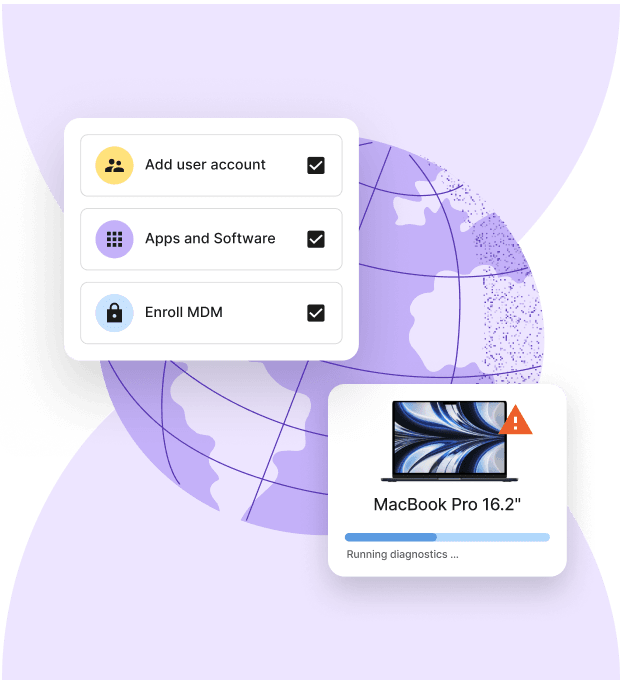
- Lifecycle-driven device management: Procure, ship, track, and manage laptops globally, preconfigured and enrolled in MDM, and secured from day one
- Built-in access management: Provision and revoke application access automatically during onboarding, role changes, and offboarding, based on HR and identity data
- 24/7 global IT support with native ticketing: Handle device issues, repairs, replacements, and loaners with round-the-clock coverage for distributed teams
- Secure, structured offboarding: Revoke access, recover devices, and perform compliance-aligned data erasure to reduce data and asset risk
- Connected HR + IT workflows: Hiring, transfers, and exits trigger IT actions automatically, reducing manual tickets and missed steps
While most ITSM tools focus on logging and routing problems, Deel IT focuses on preventing them by standardizing onboarding, device management, and offboarding in one global platform. The result is fewer tickets, stronger operational consistency, and better employee experiences.
Book a demo to see how Deel IT integrates ITSM with HR and global operations to simplify IT at scale.
Case study
By switching to Deel IT’s global-first solution, Directional Pizza, the largest Pizza Hut franchise in the UK, can now hire across borders and seamlessly equip employees with the tech they need, wherever they are. IT assets are now procured, deployed, and managed across all countries from a single platform.
FAQs
What are ITSM tools?
IT service management (ITSM) tools are software platforms that help organizations deliver IT as a service. They standardize processes such as incident, request, change, and problem management, often following ITIL best practices.
What is an ITSM ticketing system?
An ITSM ticketing system is the workflow engine that captures, routes, and resolves IT requests. It assigns priorities, enforces SLAs, and ensures visibility across the lifecycle of an issue.
What is the best ITSM software for SMBs?
For smaller teams, tools like Freshservice, ManageEngine ServiceDesk Plus, and SysAid provide strong ITSM coverage at accessible prices and with faster time to value.
Which ITSM tools are best for enterprises?
Enterprises typically choose platforms such as ServiceNow, BMC Helix, or Ivanti Neurons, which offer full ITIL coverage, robust CMDBs, and advanced automation.
Are there free ITSM tools?
Yes. Open source options such as GLPI or OTRS provide basic service management. They are customizable but require more effort to deploy and maintain.
How does ITSM connect with HR and People Ops?
Modern ITSM tools integrate with HRIS to automate onboarding and offboarding. Tasks such as device provisioning, access setup, and account revocation can be triggered directly from HR events.
Michał Kowalewski a writer and content manager with 7+ years of experience in digital marketing. He spent most of his professional career working in startups and tech industry. He's a big proponent of remote work considering it not just a professional preference but a lifestyle that enhances productivity and fosters a flexible work environment. He enjoys tackling topics of venture capital, equity, and startup finance.


