Article
9 min read
Buyer's Guide to Applicant Tracking Systems
Global hiring

Author
Ellie Merryweather
Last Update
April 06, 2026

Key takeaways
1. Not all Applicant Tracking Systems (ATS) are equal — capabilities like AI, automation, and data analytics decide whether a solution will support or slow your growth.
2. The effectiveness of your hiring process also depends on how well connected your ATS is to your HRIS.
3. Ultimately, the ideal solution should simplify workflows, maintain consistency, and scale workforce planning.
Hiring workflows often look fine on the surface but fail to deliver the expected results. Instead of moving through clear stages, you end up juggling multiple platforms and struggling to evaluate applicant pipelines effectively.
Candidates inevitably fall through the cracks, leading to delays, inconsistencies, and rushed decisions.
Strong contenders are unlikely to stick around after a poor first impression. If you manage to secure the hire, other issues are sure to follow: delayed start dates, disjointed onboarding experiences, rising hiring costs, and compliance gaps to name a few.
These issues may seem like process failures at first glance but they’re usually the result of disconnected systems. Even the best hiring workflows won’t be effective if your tools don’t work well together.
Our guide will show you how to find an Application Tracking System (ATS) that really supports your hiring workflow. We cover everything you need to know about buying recruiting software, whether you’re a startup, midsize business, or enterprise organization.
What is an ATS — and why does it matter?
An ATS is a system for managing the entire hiring process from job posting and candidate sourcing through to the eventual offer.
Think of it as a central place to handle recruitment. The system acts as a shared workplace where your team can keep track of open positions, applicants, and timelines, and collaborate to improve interview coordination. It also uses automation to perform many tasks such as screening candidates, scheduling interviews, and sending emails — basically taking all this work off your hands.
Although you can use an ATS at any growth stage, you’ll find its role changes as your business evolves:
- Startup: replaces informal, ad-hoc hiring with a repeatable process that a small team can manage
- Small to mid-size: supports coordination across multiple roles and departments and enables you to scale workforce planning
- Enterprise: keeps processes consistent and helps you maintain oversight and control, even when hiring at large volumes
ATS may have these factors in common but their capabilities can vary widely depending on the platform. That difference means some systems will support your hiring process as it grows and becomes more complex whereas others will begin to hold you back.
Deel HR
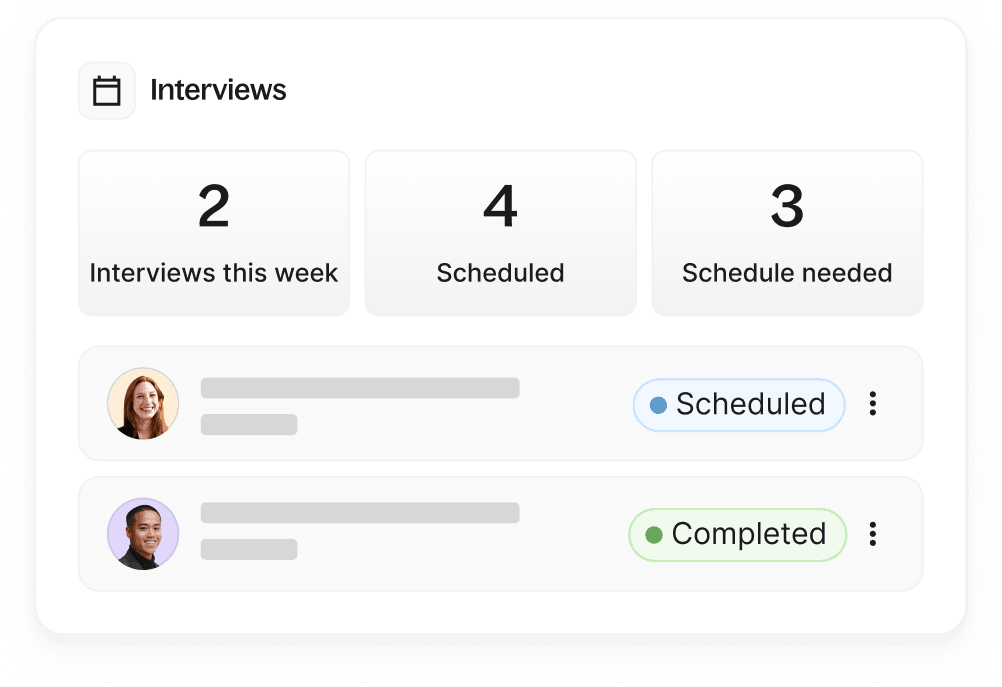
Complementary reading
Read the Ultimate Guide to ATS Recruiting for a closer look at how the system works in practice.
6 capabilities to look for in a modern ATS
The key challenge is understanding when an ATS will help you meet business objectives now and in the future. Here’s what your system must have at an absolute minimum:
1. AI that removes manual work, not just automates it
Many leading ATS have now embedded AI in hiring tools. They’ve moved beyond simple automation, such as categorizing applicants or sending interview reminders, to actually handling tasks. For example, Deel’s ATS can automate sourcing workflows, job description creation, and candidate screening and scoring.
This capability matters because hiring involves a significant amount of time-consuming administrative work. When you can trust this to your ATS, you free up more time to focus on decision making and the candidate experience.
While ATS may have AI automation, not all have advanced capabilities. Check that the system can take ownership of tasks rather than just providing suggestions or generating text. Your ATS should give you clear results — tailored job descriptions, candidate shortlists, structured evaluations — with minimal setup.
2. A connected candidate-to-employee experience
Hiring doesn’t stop at the job offer stage and neither should your ATS. Leading solutions like Deel automatically sync data with your HRIS and create a worker record in your system. This means onboarding can start instantly with no manual handoffs or unnecessary steps.
More importantly, this connected experience ensures new hires have a smooth start to their role. They don’t have to wait for you to add them to the system or repeat themselves to different departments — they’re ready with the right setup from day one.
Only a native connection between an ATS and a HR supports this kind of experience. Choose talent platforms with a direct integration and an immediate data transfer, not a third-party workaround, to guarantee a smooth flow of information.
Complementary reading
Don’t have a HRIS? Read our buyer’s guide to help you find the right solution.
3: A single dashboard for the full pipeline
A single dashboard brings all your hiring activity into one place, centralizing feedback collection and giving your team a shared view of the pipeline with one place to make updates. Everyone works from the same source of truth rather than disconnected silos.
Consolidating hiring processes is essential when you have multiple stakeholders. For example, even small businesses may involve a hiring manager, HR, department head, and current team members in the process. When you centralize your system, everyone can stay aligned and collaborate on decisions more easily.
When looking at the options, ensure your ATS doesn’t just display candidate status. Look for a system like Deel where all the following are visible:
- Open positions
- Candidates
- Interview feedback
- Pipeline status
- Job offers
4. Built-in compliance and data privacy
Hiring involves meeting legal requirements across various regions and industries. Your ATS should build this into the tools so you don’t have to track compliance records or secure data privacy yourself. For instance, Deel offers:
-
Compliant job posts: All hiring materials the system generates are tailored for both the specific role and aligned with local labor laws
-
Structured applications: The system standardizes how you collect applicants’ information, ensuring consistency and compliance
-
Custom permissions: Administrators can give access and control based on role, so only the right people can view sensitive candidate data
-
Data retention controls: Information is stored, managed, and deleted in line with international legislation like the General Data Protection Regulation (GDPR) and e-Privacy law
-
Local expert support: Where needed, support teams can provide guidance with unique challenges
-
Regulatory updates: Deel continuously reviews laws, adjusts processes, and provides regulatory updates via our Compliance Hub to prevent gaps
5. Integrations that actually save time
Integrations connect your ATS with the tools your team already uses. They enable you to perform key operations like posting roles, scheduling interviews, and communicating with candidates within a single system.
The goal of a well-connected ATS is to reduce the need to switch between platforms to complete everyday tasks and constantly fix integration failures. When your system links properly with popular tools like Google Workspace and Microsoft 365, you can keep workflows moving with minimal coordination.
Don’t just check your ATS has the tools you use now. Ensure it has a large integration marketplace so you have a choice of popular solutions to meet your future hiring needs and goals.
Free guide
Interview Guide and Checklist for Hiring Managers
6. Data that helps you hire better, not just track activity
Great analytics tools don’t just provide raw data. They give you powerful insights into hiring outcomes, like which sources deliver the best candidates and why offers fell through. Ideally, they should include a range of metrics, including:
- Candidate-to-offer ratios
- Time-to-fill
- Cost-to-hire
- Average time to hire
- Source quality comparisons
- Global salary benchmarks
Insights like these give you a clearer view of how your hiring works and performs, even at a large scale. They help you identify which approaches consistently lead to better outcomes, forecast personnel needs, and validate candidate assessments.
For example, Deel’s ATS enables you to analyze data to find past candidates or close runners-up who’d be great for an open position. That means if the top contender for a role rejects your offer, you can quickly find the next best person.
ATS checklist for different business phases
Not every company needs the same things from their ATS from day one. The system you choose should fit your current stage and help you meet your hiring goals.
Here’s what to prioritize based on where you are:
Startup (1-50 employees)
As a new company with a small team, your main focus will be speed and simplicity, so you don’t overwhelm your people. You’re also likely to have a small budget, making low overhead a major priority.
Questions to ask yourself:
- Could one or two people realistically handle the hiring pipeline?
- Is the pricing transparent and affordable? Are you sure there are no hidden fees as you add headcount?
- Does it automate key tasks like job descriptions and candidate screening?
- Can you post a job and start receiving applications in under an hour?
- Does it integrate with the calendar and email tools you already use? OR, if you’re still in the process of setting up your system, does it connect with popular solutions?
- When you approve a hire, does the ATS trigger onboarding?
Questions to ask in the demo:
- What’s the bare minimum we need to set up before we start hiring?
- Can you walk me through the process of posting a live job post?
- What happens after I send a job offer? Can you show me what the onboarding process will look like?
- What does the AI sourcing tool do? What do I still have to take care of manually?
- If we double headcount in six months, what changes about our pricing and setup?
Mid-size (51–200 employees)
Medium companies usually have enough team members to manage an ATS, regardless of the complexity, and can easily absorb the cost. You’re more concerned with ensuring processes remain consistent as you continue to scale and that your growing team can easily collaborate on workflows.
Questions to ask yourself:
- Does it support compliant hiring across multiple countries and industries?
- Can it benchmark salaries to help us build competitive offers?
- How easy is it for a large team to work from the same pipeline view?
- Can we set custom approvals before roles go live or offers get sent?
- Does it automatically send hiring data to your HRIS?
- What insights can it provide into our hiring performance?
Questions to ask in the demo:
- What countries do you support and how does compliance work for each location?
- Can we look at the salary benchmarking feature?
- Show me how a hiring manager and a recruiter collaborate on the same role. What does each person see?
- How do approval flows work? How do users give sign-off?
- Are there any manual steps in the handoff between the ATS and HRIS?
- How do we track which sources are delivering the best candidates and outcomes?
Enterprise (200+ employees)
Large companies have a wealth of resources at their disposal. Your biggest interest is maintaining control and oversight over a sprawling workforce as you continue to hire new employees, and ensuring no costly gaps appear in compliance.
Questions to ask yourself:
- Can it handle multiple hiring workflows simultaneously?
- Does it meet GDPR and local data retention requirements out of the box?
- Can it handle workforce planning at scale?
- Does it let you set role-based permissions so the right people access the right information?
- Is there an audit trail for approvals, offers, and candidate communication?
- Can you report on hiring activity by region, team, and worker type?
Questions to ask in the demo:
- How does the system handle multiple hires at the same time?
- What’s automated in your data protection compliance setup and what do we have to configure ourselves?
- If headcount gets approved, what happens next in the ATS?
- Show me what people with different permissions see when they view the system.
- How do we filter reporting by location or department?
- Can you show me an example of an audit trail for approvals?
The hidden cost of a disconnected ATS
A standalone ATS may seem sufficient at first, but the disconnection with your HRIS will create friction at key points in your hiring process. Over time, these issues will compound and spread throughout your organization.
-
Missing documents: The ATS doesn’t automatically share files with your HRIS, meaning teams have to re-upload them or request them from the candidate again
-
Inconsistent data: Candidate information doesn’t transfer cleanly into your system, so there are likely to be errors and inconsistencies. Teams have to dedicate time to checking and fixing these after every hire
-
Slow onboarding: Onboarding doesn’t get automatically triggered when a candidate accepts your offer. You must wait for team members to be available to transfer the data and kick off the process
-
Compliance gaps: Data handling becomes inconsistent across two systems, so employees may miss vital steps like collecting consent for data processing or deleting files after a retention period has expired
-
Poor employer brand: Candidates experience delays and have to chase up your team. They develop a negative impression of your business — and recent data shows that 72% will talk about this online and with their network
Why Deel ATS is the way to go
The capabilities you choose in an ATS decide how your hiring process runs. That’s why it’s essential to select an acquisition solution that meets all your needs and supports your long-term goals from the start.
Deel brings all the capabilities you need together into a single system, combining AI, automation, and data analytics. As a global solution, our platform supports hiring across different locations, industries, and workforce types. We’re just as effective for a small distributed team operating out of a single region as for a large enterprise with a mix of remote and hybrid teams in nearly every country worldwide.
Rather than operating as a standalone system, Deel’s ATS connects directly to our HRIS, payroll, and compliance modules. That means hiring doesn’t stop at the offer stage. Data flows straight from the ATS into the employee records, so onboarding can begin immediately without any manual handoffs.
AI is built in our workflows. Our ATS can handle time-consuming tasks like candidate sourcing, job descriptions, and screening, so you no longer have to handle them manually. This gives you more time to focus on evaluating high potential candidates and making the best decision for your organization.
Because everything sits within the same platform, Deel can keep hiring, workforce, and compliance data connected. That’s especially vital for growing teams, where consistency is key as your company becomes ever more complex.
Finally, Deel is a flexible solution. We let you start with our ATS and HRIS, then expand into areas like Engage, Compensation, and Workforce Planning if that’s what suits you. Our system can grow with your business, supporting new requirements without adding complexity or requiring you to rebuild your processes.
A more connected way to manage global hiring with Deel
Choosing an ATS shouldn’t be a matter of comparing feature lists or pricing tiers. It’s a strategic decision that determines whether your hiring workflow runs as a series of disconnected steps or a system your team can rely on over time.
When you choose a unified ATS like Deel, every stage supports the next and keeps hiring moving. That consistency makes it easier to scale as your workforce grows. Over time, your hiring process then becomes a competitive advantage rather than something your team works around.
Looking for a more connected system? Book a demo with the Deel team to see our ATS in action and see how it can support your unique hiring workflow.
Live Demo
Get a live walkthrough of the Deel platform

Ellie Merryweather is a content marketing manager with a decade of experience in tech, leadership, startups, and the creative industries. A long-time remote worker, she's passionate about WFH productivity hacks and fostering company culture across globally distributed teams. She also writes and speaks on the ethical implementation of AI, advocating for transparency, fairness, and human oversight in emerging technologies to ensure innovation benefits both businesses and society.