
Guide
First HR Software Implementation: A Go-To Guide
Global HR
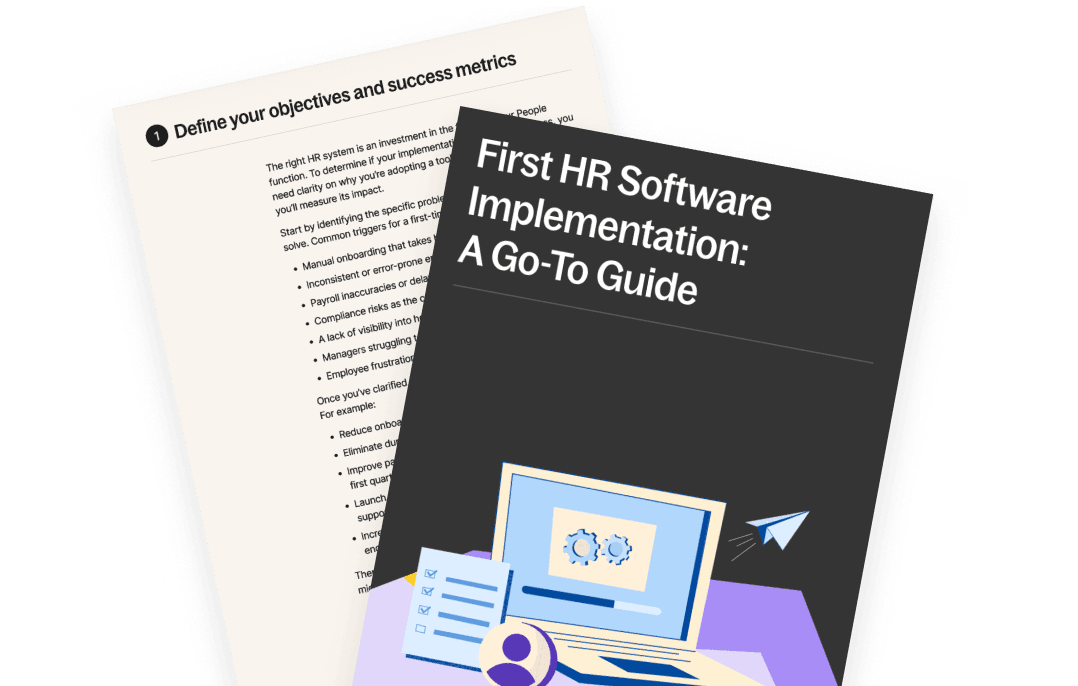
Get the resource for free
Implementing your first HR tool is a milestone, but also a high-stakes project. The data you migrate, the workflows you define, and the habits you set in this rollout will become the backbone of how your company hires, pays, develops, and supports people for years to come.
The problem? Most early-stage teams have to figure this out with limited time, limited resources, and zero margin for error.
This guide to HR software implementation was designed to remove the guesswork. Whether you’re a founder juggling HR off the side of your desk or a People leader preparing your team for scale, this is the practical, step-by-step companion that helps you implement your first HR platform with clarity, speed, and confidence.
HR software implementation guide overview
Your first HR system will shape your entire people operations, so getting it right matters. For growing teams, there’s always a moment when spreadsheets, scattered files, and manual processes break. Hiring accelerates. Onboarding becomes inconsistent. Data lives everywhere. Suddenly, what used to “work for now” becomes a blocker.
Whether you’re rolling out an HRIS, onboarding software, or a full people platform, this guide is your practical companion from planning to go-live and beyond. Inside, we cover:
- Why your first HR system sets the foundation for everything that comes next: Understand how your implementation impacts scale, compliance, and operational efficiency, and how to avoid painful rework later.
- A step-by-step implementation plan you can follow immediately: Follow eight practical stages covering goal-setting, workflow mapping, data prep, training, migration, testing, and post-launch optimization.
- Common pitfalls (and how to avoid them): Discover the real-world patterns we see in early-stage companies, from data chaos to misaligned workflows to underprepared managers.
- Guidance specifically for lean or first-time HR teams: If you’re doing this solo or in between 10 other responsibilities, you’ll find shortcuts, priorities, and realistic “good enough” approaches that won’t compromise quality.
- Templates, checklists, and communication resources: Including launch comms, manager training checklists, implementation task lists, and planning tools, all ready to use.
- How Deel supports fast, smooth, and scalable HR implementations: Learn how Deel’s platform and implementation team guide every step, from migration to onboarding workflows to global readiness.
Who is this guide for
This guide is built for teams implementing their first HR system, whether you’re formalizing People Ops for the first time or preparing the business for scale.
It’s especially useful for:
- First-time HR professionals or solo People Ops leads: Receive structured, step-by-step direction you can rely on, without needing years of implementation experience.
- HR managers preparing the company for its first system of record: Streamline workflows, improve data hygiene, and set up your processes for long-term scalability.
- Fast-growing teams hiring across functions or regions: Learn how to create consistency as hiring accelerates and people operations become more complex.
- Founders or CEOs managing HR responsibilities themselves: Get clarity on what to do, when to do it, and how to avoid costly early mistakes.
Download the guide and implement your first HR system with confidence.
FAQs
When is the right time to implement my first HR software?
Common triggers to implementing the first HR software include accelerated hiring, inconsistent onboarding, scattered data, manual payroll, or compliance risk. If people operations are slowing the business down, it’s time for software automation.
What does HR software implementation involve?
HR software implementation is the process of setting up a new HR platform that matches your workflows, data, policies, and team’s needs. It typically includes defining goals, mapping current processes, selecting an implementation partner, preparing and migrating data, configuring the system, training users, launching the tool, and optimizing after go-live.
A successful implementation ensures clean data, smooth adoption, and a strong technical foundation your team can grow on.
How long does it take to implement an HR tool?
Implementation timelines vary based on the size of your team, the complexity of your processes, and the system you choose. Lean HR tools can often be implemented in 2–6 weeks, while more complex or fully customized systems may take several months. The most significant timeline variable is usually employee data prep, not the software itself.
Who should be involved in HR tool implementation?
Your HR tool implementation team should stay small but intentional. Most companies include:
- An internal project owner, typically from the HR department (People lead, HR manager, or founder)
- One operations or systems partner, if available
- A representative from the vendor’s implementation team
Optionally, you might involve finance, IT, or legal, depending on integrations, security requirements, or budget approval. Clear ownership and accountability are more important than team size.
What HR processes should I map before tool implementation?
Before HR tool implementation, you should, at a minimum, map: onboarding, offboarding, time-off, payroll inputs, document storage, approvals, reporting structures, and any workflows tied to compliance.
What’s the biggest risk in first-time HR implementations?
Poor data hygiene is the biggest risk in first-time HR implementations. Bad data leads to adoption issues, workflow failures, and rework that slows teams down for months. Cleaning data early prevents this.
How do we know we picked the right HR platform?
The right tool should simplify, never complicate, your workflows. Look for:
- Strong implementation support
- Transparent pricing
- Intuitive UX
- Configurability without heavy development
- A clear roadmap and customer success partnership
- Scalability for your next 12–36 months
If the platform reduces manual work and increases clarity quickly, you likely made the right choice.
How can HR ensure employee and manager adoption of a new HR system?
To get employees and managers to adopt the new HR tool, focus on: clear communication, role-specific training, sharing early wins, and ongoing support during the first 2–4 weeks. Our guide includes templates for these actions.
What are common HR software implementation pitfalls?
Some common HR software implementation pitfalls include:
- Rushing data migration
- Skipping workflow mapping
- Not testing the system before launch
- Under-communicating with managers
All are covered in the “common pitfalls” section of the guide.
How can small teams implement HR software efficiently?
Small or first-time HR teams can implement successfully by prioritizing what matters most:
- Clean, accurate data
- A simple, realistic rollout plan aligning key stakeholders
- Focused communication and training
- Avoiding overconfiguration early on
With limited time and resources, the goal is not perfection, but rather establishing a usable and scalable foundation. Lean teams benefit especially from choosing a platform with strong onboarding support, prebuilt workflows, and a guided implementation model.
How can Deel support our first HR software implementation?
Deel provides guided onboarding, workflow configuration, data migration support, and global compliance expertise, helping you set up a system that scales as your organization grows.