Article
22 min read
7 Deel HR's Engage LMS Use Cases That Go Beyond Compliance Training
Global HR

Author
Lorelei Trisca
Last Update
April 16, 2026
Table of Contents
1. Knowledge sharing and internal expertise hubs
2. Career progression and skills-based learning
3. Leadership and manager enablement programs
4. Global compliance and cultural alignment
5. Change management and new process rollouts
6. Continuous feedback and development integration
7. Tool and process training
Why rethinking LMS use is critical for global organizations
Turn your LMS into a growth engine with Engage
Key takeaways
Learning management systems (LMS) were built for compliance, but their potential extends far beyond it. Modern learning platforms can serve as the foundation for knowledge sharing, skill development, leadership development, and global consistency.
HR and L&D leaders should view the LMS as a strategic enabler of growth and connection. Instead of serving as a mere course repository, an LMS can link learning to performance, progression, and change readiness, turning training into a driver of engagement and retention.
Engage unites learning, performance, and career development in a single, integrated system, enabling you to build capabilities across your global workforce.
Most learning management systems start strong, then stall, usually because companies only use them for the limited scope of mandatory training. A Training Magazine report highlights that the biggest portions of training budgets go to onboarding and compliance. Zooming in on compliance alone, nearly half of companies deliver their training entirely through their LMS.
The problem is: after using an LMS to check off these essential training requirements, it can quickly become a graveyard of forgotten courses and expired certificates. Workers have no motivation to dive back in and use the system as a vehicle for their own growth. Leaders know this has to change. The same report names “increasing learner usage” as a top priority for 2025 and “learner engagement” as a top challenge.
But now, forward-thinking HR and learning and development (L&D) teams are reimagining what an LMS can be. Instead of treating it as a compliance archive, they’re turning it into connective tissue that links learning with culture, capability, and career progression.
In this guide, we explore the most effective LMS use cases for building engagement and enabling continuous development, including how Engage brings each to life.
1. Knowledge sharing and internal expertise hubs
One of the most valuable LMS use cases is also one of the most overlooked. Beyond compliance or one-off training sessions, a modern learning management system can become your company’s central source of truth, a living hub for the knowledge your teams rely on every day.
For large, distributed organizations, this use case is a game changer. When teams work in siloes, valuable insights stay trapped within departments, and knowledge gaps widen fast. Turning your LMS into a shared knowledge hub helps capture and scale internal expertise, so every employee, from new hires to senior leaders, has access to the same playbooks, best practices, and process guides.
With Engage, companies can:
Upload or record internal demos, walkthroughs, and process documentation
Organize this content into structured learning programs that are accessible across regions and functions
Keep information current by adding or editing training courses or steps at any time.
Example: A global customer success team can document their top client retention strategies in Engage, creating a searchable, on-demand library that helps new team members ramp faster while maintaining consistent quality across markets.
2. Career progression and skills-based learning
It’s common for companies to struggle with the “what next?” of training. They budget for development programs, send their employees on relevant courses, but then fail to understand how to link that training with individual or organizational development goals.
Only 40% of organizations surveyed in LinkedIn’s Workplace Learning report have mature career development initiatives in place. Of those, 49% go the extra step to create individual career plans.
Why? To begin with, charting career progression and mapping out skills-based learning paths for every worker can be a daunting administrative task. If you’re trying to track development using scattered spreadsheets or loosely connected tools, you’ll quickly realize this approach isn’t scalable.
Instead, Engage offers LMS functionality that:
Aligns learning content with job architecture and skill frameworks, so every course supports defined career paths and organizational goals
Creates personalized learning journeys tailored to each role, location, or seniority level, equipping workers with the skills they need to grow
Integrates with performance reviews and promotion criteria, so development becomes part of everyday talent decisions, not a disconnected initiative
Links learning to individual development plans to give managers visibility into progression and keep workers accountable for growth.
Example: A global tech company can use Engage to align every engineering role with a defined skill framework. As employees complete targeted learning paths, their progress automatically updates in training dashboards and can inform promotion reviews. HR can now identify internal candidates for leadership roles faster, while workers have a transparent roadmap for growth.
3. Leadership and manager enablement programs
The quality of an organization’s leadership has an overwhelming impact on the people working there. Of all the drivers of engagement, Gallup finds that 70% of the variance in team-level engagement comes down to the manager.
Unsurprisingly, then, leadership development is one of the most popular investment areas for companies. According to LinkedIn Learning’s Workplace Learning Report, leadership development programs topped the list of L&D deployments for mature companies.
And yet, many organizations still struggle to turn their leadership programs into sustainable growth engines. They deliver one-off “manager training” sessions, but struggle to connect them to performance.
A modern LMS embedded within a broader talent platform like Engage can move the needle, enabling you to:
Deploy modular, role-based manager programs automatically triggered by events like a promotion or a lateral leadership role
Link manager training directly to performance and feedback systems so you can tie “leadership development” to measurable outcomes
Provide micro-learning bursts, peer-led content, or mentorship-oriented tracks that fit into manager workflows
Capture analytics on manager training uptake, competency growth, and team engagement outcomes.
Example: A global services firm uses Engage to launch a “first-time manager” program. When associates transition into management roles, they’re automatically assigned micro-modules on essential topics, such as coaching and remote team leadership.
Leaders drive our organization. With Engage, we’ve introduced innovative learning tools to enhance their effectiveness and success.
—Daniel Sobhani,
CEO, Freeletics
4. Global compliance and cultural alignment
Most organizations first adopt an LMS for compliance, and for good reason. Regulatory training, policy acknowledgments, and security certifications are all business-critical. However, for global companies, maintaining these consistent standards across multiple regions is increasingly complex: laws differ, languages vary, and culture influences how messages are perceived.
In many cases, HR and L&D teams rely on email reminders or spreadsheets to track completions across entities. This makes it almost impossible to achieve global compliance without eating up hours of manual follow-up.
That’s where Engage helps. Sitting within Deel’s unified HR platform, Engage centralizes compliance training and tracking while allowing local customization, so you can deliver consistent global messaging without losing any cultural nuance.
With Engage, you can:
Build and launch effective courses in minutes using AI-assisted, drag-and-drop creation tools
Localize training content to meet regional regulations, languages, and cultural norms
Automate course assignments and reminders based on start date, department, or location
Track completions and progress in real time, with dashboards that provide global oversight and local drill-downs
Monitor participation and certification renewals without chasing teams manually
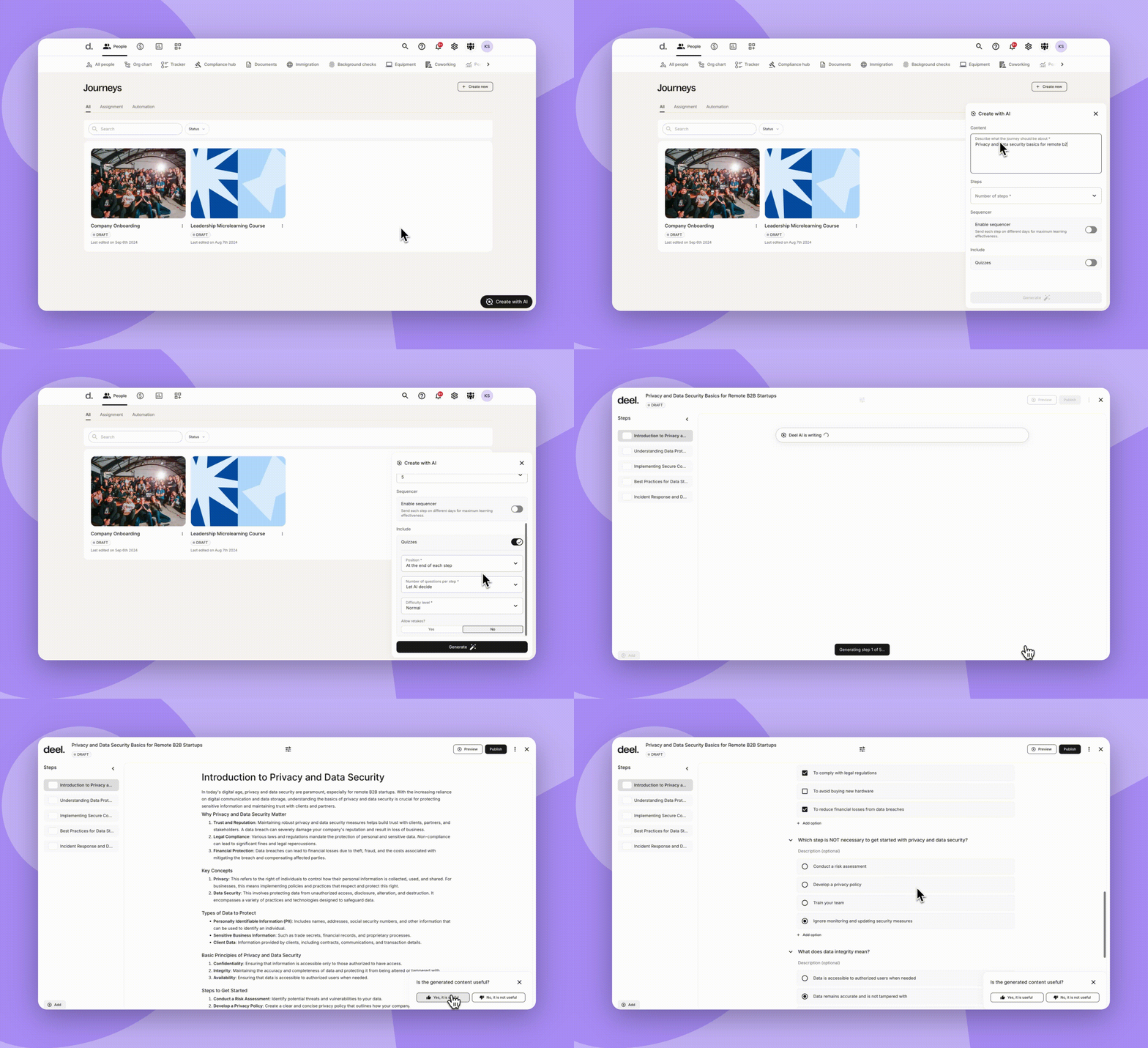
Example: A multinational software company can use Engage to deliver mandatory data privacy and DEI courses across 25 countries. The core content stays consistent, while local versions reflect each region’s compliance laws and cultural context. Completion data flows directly into HR dashboards, giving leadership instant visibility into global readiness.
Through the AI incorporated in the learning development module, I am able to build fantastic courses in half an hour.
—Lucía Rodriguez,
Head of HR, Ladonware
5. Change management and new process rollouts
If there’s one universal truth in HR tech, it’s that change is hard, not because teams resist improvement, but because rolling out new tools, processes, and workflows at scale can be chaotic without a shared system for learning.
According to the Monday.com World of Work report, the majority of employees have experienced some form of change in the past year. The tech sector has seen the greatest impact:
77% of employees report changes to the tools they use
68% say their job duties have shifted
67% have experienced changes to their team structures
Interestingly, employees at the largest enterprises are the least likely to have gone through major change. Monday.com’s Chief Operations Officer, Adi Dar, explains:
“In smaller companies, change is vital for growth and survival, and therefore becomes part of the culture. In the largest enterprise companies, change involves a vast workforce, where existing processes and systems are much more ingrained in the DNA.”
For HR and L&D teams, this dynamic creates a paradox. Smaller organizations tend to embrace change instinctively, while larger ones require structured systems to make it stick.
Engage can play a pivotal role here, allowing you to use your LMS as a change management engine, so every employee across every region understands your new systems, processes, or policies before they go live.
With Engage, you can:
Roll out training globally and instantly when new tools or workflows launch
Create targeted learning paths for specific departments or roles affected by a change
Track adoption and readiness through built-in analytics, so no team is left behind
Embed microlearning and quick-reference content that keeps new processes top of mind long after launch
Example: When introducing a new anonymous feedback tool, a global HR team uses Engage to roll out step-by-step training and short videos tailored to each user group. Employees receive automatic learning journeys based on their role and region, and completion data gives HR a clear picture of adoption rates, all before the system goes live.
6. Continuous feedback and development integration
Feedback is most powerful when it leads to action. Yet, in many organizations, feedback, performance, and learning still occur through a hodgepodge of separate systems and conversations.
All of these cycles connect in Engage. The platform brings together performance reviews, goal setting, and learning recommendations, helping teams close the loop between what’s discussed and what’s developed.
Through integrated LMS functionality, you can:
Add courses directly to individual development plans following reviews or check-ins
Align OKRs and goals with the learning activities that drive measurable improvement
Deliver bias-free performance appraisals with consistent criteria across teams
Promote role clarity and motivation by giving employees transparent, competency-based growth paths
Example: After a performance review, an employee receives targeted course recommendations in Engage based on their development goals. Their manager can track completion, note progress in the following review cycle, and update objectives accordingly, creating a genuine feedback-to-growth rhythm across the organization.
7. Tool and process training
You only have to consider the number of tools you use in your daily work to guess how long you’ve spent exploring each platform, learning the unique way your organization uses it, and for what purpose.
A third of small businesses use at least five digital tools per day, but this increases exponentially for larger organizations. One study by IBM and Palo Alto Networks found that the average organization now manages 83 security tools across a whopping 29 vendors. This figure doesn’t even include the CRMs, project management platforms, and internal communication systems that sit at the core of most corporate workflows.
With so many moving parts, training people on internal systems is an ongoing necessity. Engage can support organizations in delivering tool and process training that keeps pace with change, enabling you to:
Host short, role-specific tutorials for new or updated tools in one central location
Deliver microlearning bursts that fit naturally into daily work
Provide searchable, always-on reference materials for quick answers and troubleshooting
Assign refresher courses automatically when systems or processes change
Example: When a company introduces a new project management platform, HR and department leads collaborate to roll out short, on-demand tutorials tailored to each role via Engage. Instead of relying on endless message chains or ad-hoc demos, employees access structured, repeatable training in one place and get up to speed quickly.
Why rethinking LMS use is critical for global organizations
Learning doesn’t always travel well across international borders. Here’s why global companies should embrace LMS functionality to power growth and development.
Dispersed teams need unified development opportunities
Learning can often look different across teams or departments, leading to disappointment and frustration. A unified learning platform helps global teams share the same foundation for growth, so every employee has equal access to the same skills, knowledge, and opportunities, wherever they are.
Centralized LMS provides consistent messages across localities
Unified learning establishes a single standard for training quality and alignment, while allowing local teams to tailor content to reflect cultural nuance, language, and regulatory requirements. The result is a development ecosystem that feels both globally coherent and locally relevant.
Upskilled workers are a strategic level for agility and retention
As organizations evolve, skills become the currency of agility. Connecting learning with workforce data enables HR leaders to identify emerging capability gaps and redeploy talent more effectively to enhance internal mobility. Employees see the same investment in their growth, and are far more likely to stay and contribute to that evolution.
Turn your LMS into a growth engine with Engage
Engage transforms traditional learning management into a connected, data-driven experience. It provides HR and L&D teams with the tools to design, deliver, and track learning that develops real skills, rather than merely ticking compliance boxes. With Engage, you can:
Craft complete learning journeys made up of customizable steps, including content, quizzes, tasks, surveys, or group activities to guide employees through structured development paths
Support your LMS with AI that generates draft journeys automatically from a description or existing materials. You can then refine first drafts using Engage’s editor
Automate delivery and reminders so onboarding, upskilling, or compliance programs trigger on key events like a start date or role change
Upload or import Shareable Content Object Reference Model (SCORM) content at any stage, as part of a journey or a standalone course, so you can reuse and expand your existing learning library
Embed feedback loops to test understanding, track proficiency, and reinforce learning with immediate, automated feedback
Track progress and results in real time, with analytics showing completions, quiz performance, and development milestones across teams.
Engage connects learning with every part of the employee lifecycle. Ready to see our platform in action? Request a free Engage demo today.
FAQs
What do you use an LMS for?
A learning management system, or LMS, is a platform used to design, organize, deliver, and monitor online learning and training programs for employees or learners. It serves as a single hub for managing educational content such as e-learning courses, compliance modules, and professional development pathways.
What are the two main functions of LMS?
The two main functions of an LMS are content delivery and performance tracking. The right system provides employees with access to learning materials, such as videos, quizzes, and courses, while allowing HR and L&D teams to monitor progress, completion rates, and learning outcomes in real-time.
What are the different types of LMS?
There are several types of LMS platforms, including cloud-based, on-premise, open-source, and enterprise-integrated systems. Cloud-based LMS tools like Deel Engage scale easily, support remote access, and integrate with existing HR and performance management software.
How can an LMS support career development?
An LMS supports career development by linking learning directly to job roles, skills, and progression frameworks. With Deel Engage, HR teams can create personalized career growth paths and individual development plans that align training with promotion criteria and long-term career growth objectives.
Can an LMS help with performance management?
Yes, an LMS can enhance performance management by linking feedback with skill gaps and learning programs. Deel Engage integrates reviews, goals, and learning recommendations, helping managers assign targeted courses that address skill gaps and support continuous improvement.
What are examples of creative LMS use cases?
Creative LMS use cases include peer-led learning libraries, leadership enablement programs, change management rollouts, and internal tool training. Many organizations also use their LMS to capture institutional knowledge, run global culture initiatives, or support career progression and cross-functional upskilling.
How do you measure LMS effectiveness?
You measure LMS effectiveness through key learning metrics such as completion rates, quiz scores, engagement time, and post-training performance improvements. Advanced systems like Deel Engage also connect learning data with employee development and retention metrics, giving HR leaders a clear picture of ROI and impact.
Lorelei Trisca is a Product Marketing Manager at Deel passionate about the future of work and global talent. She drives go-to-market strategy, product launches, and global campaigns, while championing client enablement and product adoption to help teams get more value from the tools they use every day.