
Article
50 min read
All-In-One HR Platform: 9 Must-Have Features Explained
Global HR

Author
Lorelei Trisca
Last Update
December 09, 2025
Table of Contents
What does “all-in-one HR platform” really mean?
Nine must-have features of an all-in-one HR platform
6 key benefits of all-in-one HR platforms
How to evaluate all-in-one HR platforms
Get started with Deel, your forever people platform
Key takeaways
- An all-in-one HR platform supports every stage of the employee lifecycle, from hiring and onboarding to payroll, performance, compliance, and offboarding, eliminating the need for disconnected tools or duplicated data.
- The right platform gives HR and leaders real-time visibility into their people data while reducing workloads. It also scales as your business grows, without requiring costly add-ons or replacement systems later.
- Deel is a global, all-in-one people platform that helps companies hire, pay, and manage talent in 150+ countries. Customers report measurable gains, such as 70% faster payroll, $180,000 annual HR cost savings, and hundreds of hours reclaimed every month by consolidating their tools into Deel.
Modern people teams have inherited a cacophony of HR tools that were never designed to function together. Many systems don’t sync correctly, so essential employee data becomes inconsistent from system to system, making it difficult to trust. Others have overlapping features, causing companies to waste money maintaining multiple tools that all do the same job in different ways.
All this to say, HR stacks are both bloated and desperately inefficient, a problem familiar to too many businesses. According to SHRM, organizations use more than twice the number of HR technology modules they did five years ago. Yet, only 43% rate their HR software as effective.
No surprise, then, that more companies adopt all-in-one HR software to streamline their operations and eliminate unnecessary spend. The challenge is that “all-in-one” can mean wildly different things depending on which vendor you’re speaking to, and not every platform is equipped to handle modern, global workforce needs.
This guide explains what an all-in-one HR platform is, the benefits it unlocks at different growth stages, and how Deel’s all-in-one suite helps organizations run global operations with less complexity and more control.
What does “all-in-one HR platform” really mean?
An all-in-one HR platform is a single, unified system that manages the entire employee lifecycle from talent acquisition through to offboarding and everything in between. Instead of stitching a patchwork of unrelated tools together, the all-in-one approach acts as a single source of truth for every people initiative you run. It replaces dedicated tools for individual HR tasks, such as learning and development, onboarding, or performance management.
Crucially, there’s a difference between integrated tools and a truly unified platform:
- Integrated tools are separate systems connected by APIs. They still store data independently, which can lead to sync issues, duplicate records, and inconsistent reporting.
- A unified platform, by contrast, runs on one shared data core, where every workflow—onboarding, payroll, performance, time off, development, and compliance—draws from the same source of truth.
Customer success story
Tech company Petvisor realized the benefits of switching to an all-in-one HR tool when it moved to Deel. Previously, its team managed payroll and workforce operations across five different systems, each handling a distinct piece of the process. After consolidating everything into Deel’s all-in-one platform, including Global Payroll, EOR, Contractor Management, and Immigration, Petvisor now operates from one shared data core instead of fragmented tools.
We looked at other HR and payroll platforms, but Deel is the only truly all-in-one solution for global teams.
—Sophie Karagianes,
Chief People Officer, Petvisor
Nine must-have features of an all-in-one HR platform
A platform claiming to be “all-in-one” should offer the following features:
1. Global employee management and compliance
Global workforce management requires you to navigate different labor laws, tax requirements, contract standards, and employment models across every country you operate in.
This need can sometimes arise suddenly, for example, when entering a new market or hiring contractors overseas. To accommodate, your all-in-one tool’s global management and compliance layer should include:
- Centralized worker records and contracts across countries and worker types
- Built-in alignment with local labor laws, tax rules, and statutory benefits
- Audit-ready documentation and secure data handling
- Guardrails against misclassification, payroll errors, and non-compliant contracts
- Country-specific guidance for onboarding, terminations, time off, and ongoing employment requirements
Customer success story
Turing, a global talent marketplace, faced complexity in managing its workers across multiple jurisdictions. When seeking a consolidated HR tool, Deel’s emphasis on compliance was a major differentiator.
When we came to understand the importance that Deel places on individual country laws and making sure that contracts are structured in the right way, Deel really stood out.
—Sudarshan Sivaram,
Head of Customer Success & Sales, Turing
2. Recruiting and onboarding
Recruiting and onboarding are two of the most critical moments in the employee lifecycle, and often the most fragmented. In a typical organization, hiring teams might use one system for sourcing and interviewing, while HR uses another for contracts and new-hire data. Similarly, IT manages equipment provisioning and setup, while managers track onboarding tasks in spreadsheets or messaging apps.
An effective recruiting and onboarding system brings all these moving parts together:
- Applicant tracking system functionality or seamless ATS integrations to manage sourcing, interviewing, and hiring
- Automated and compliant offer letters and contracts, tailored to local laws
- Digitized document collection and e-signing
- Structured onboarding workflows that trigger tasks for HR, IT, and managers
- Provisioning support, including device ordering, setup, and delivery
- Localized onboarding steps based on country-specific requirements
Customer success story
Lloyd’s List Intelligence, a global maritime data and analytics company, used Deel to simplify onboarding across regions. With Deel IT, the team could order, deploy, and ship equipment directly from the platform, solving complex logistics challenges like getting devices to new hires in China.
Not having to worry about ordering monitors from one vendor, a laptop from another, and a phone and contract from yet another makes everything much simpler. It’s the whole package.
—Hetty Townsend,
APAC People and Culture Business Partner, Lloyd’s List Intelligence
3. Payroll and payments
Global payroll and payments are where complexity often explodes, and where an all-in-one HR platform can deliver real leverage. When you’re paying employees and contractors across countries, the overhead of multiple currencies and tax regimes can spiral.
The payroll and payments functionality of your all-in-one HR platform should include:
- Multi-country payroll support across all worker types (employees, contractors, EOR hires)
- Payments in local currencies, with support for conversion, local banking, and global rails
- Automated tax deductions, benefits contributions, and statutory filings for every jurisdiction
- A single dashboard for global payroll reporting, analytics, cost visibility, and audit-ready compliance
Customer success story
Ladonware, a software company operating internationally, faced a highly manual payroll process. Adopting Deel’s global payroll engine enabled Ladonware to simplify payroll across jurisdictions, using one central view of its global payroll spend.
Before Deel, we were doing fifty transfers and three deductions per person — every single cycle, all manually, with different banks, different countries, and different laws. It was a lot of work.
—Lucía Rodriguez,
Head of HR, Ladonware
4. Time off, attendance, and scheduling
Time off and attendance management multiply as your teams grow or operate across borders. You should also factor in different statutory leave rules and regional holidays, as well as approval structures. The right all-in-one solution supports this important HR task by automating workflows and centralizing policies. In particular, a complete time off and attendance layer includes:
- Global PTO tracking across all leave types (vacation, sick leave, parental leave, local holiday entitlements)
- Localized, country-specific leave policies are applied automatically based on location or worker type
- Self-service requests and manager approvals, all managed directly within the platform
- Automatic updating of balances, accruals, and carryovers
- Attendance or scheduling tools that flex to different working patterns, regions, and contract types
- Real-time visibility for HR and managers into who’s out, when, and why
Customer success story
Before switching to Deel, Otamiser tracked PTO and holidays manually using spreadsheets, but it was difficult to keep balances accurate or manage approvals across regions. After graduating from spreadsheets to Deel’s global HRIS, the team now handles time-off requests, approvals, and updates directly in one system.
I’m in Deel several times a week—payments, time-off approvals, you name it. It’s basically my HR command center.
—Phebe Vandamme,
HR Manager, Otamiser
5. Performance management
Modern performance reviews don’t follow the traditional format of being hosted annually by a manager, which is too infrequent and subjective. Instead, high-performing companies like Netflix use multi-source feedback as part of a 360-degree evaluation system to support their employees, while Adobe opts for frequent check-ins to develop talent.
Performance management touches every part of the employee lifecycle. So, for your evaluations to be meaningful and drive results, your performance tools must connect with your HRIS data, compensation structures, onboarding, development plans, manager workflows, and more.
A full set of performance features includes:
- Goal setting and OKRs cascading from company to team to individual
- Structured feedback cycles, including 360-degree input when needed
- Performance reviews designed for different roles and seniority levels
- Integration with compensation, promotions, and career frameworks
- Real-time check-ins and recognition tools
- Dashboards that keep managers and employees connected throughout the cycle
Customer success story
Beatgrid, a media measurement company, used to manage performance reviews in spreadsheets, making it difficult to translate company-wide OKRs into meaningful, individual goals. After adopting Engage, Beatgrid replaced manual reviews with a structured, repeatable system directly connected to their broader HR workflows.
Engage transformed how we approach performance. We could finally translate high-level company OKRs into clear, individual goals, giving our teams the clarity they needed to succeed.
—Shawnda Kohr,
HRBP, Beatgrid Media
6. Learning and development
Growth goes hand in hand with performance management, connecting employee strengths and development areas with actionable next steps to drive improvement. If a performance evaluation highlights that an employee needs to improve a specific skill, that insight should immediately translate into relevant learning opportunities.
When performance and L&D sit in the same system, managers and direct reports have instant access to actionable next steps, including development paths and recommended courses, without losing momentum or switching tools.
In more advanced platforms like Engage, teams can create tailored learning content in just a few clicks using AI, making development both scalable and personalized. Lucía Rodriguez, Head of HR at Ladonware, describes the impact of the AI functionalities on content creation at her org:
Through the AI incorporated in the learning development module, I am able to build fantastic courses in half an hour.
—Lucía Rodriguez ,
Head of HR, Ladonware
For maximum efficiency, your tool’s learning and development capabilities need to include:
- A centralized learning library with structured, accessible content
- Manager enablement and growth tracking to ensure follow-through
- Upskilling and internal mobility alignment, so learning supports long-term career paths
- Integrated development plans that tie directly into performance outcomes
Customer success story
Ladonware moved from fragmented, stand-alone processes to a combined system that supports performance, learning, and employee engagement in one place.
Engage has everything. We went from cobbling forms together to running reviews, learning, and surveys in one click.
—Lucía Rodriguez,
Head of HR, Ladonware
7. Compensation and benefits management
Compensation and benefits are among the most complex aspects of HR to get right, and one of the easiest to overlook when selecting an all-in-one platform. Pay structures, tax rules, and statutory benefits vary not only from country to country, but also within individual countries. In locations such as the United States, they can vary dramatically from state to state and even city to city.
That means HR teams are constantly juggling:
- Different minimum wage rules
- Varying paid sick leave requirements
- State-specific family leave programs
- Local tax withholdings
- Different overtime rules
- Region-specific benefits expectations
Trying to manage all this manually almost guarantees inconsistencies that result in compliance gaps. And if your all-in-one platform doesn’t include compensation and benefits management, you’ll end up buying extra tools, creating the exact fragmentation you’re trying to escape.
An all-in-one HR platform should centralize and automate the full compensation lifecycle, by including:
- Automated salary review cycles, including manager input, calibration, and approvals
- Tracking for bonuses, commissions, equity, and incentives across regions and roles
- Localized benefits administration tailored to each country, state, or region
- Benchmarking tools to compare pay ranges across markets and support equitable compensation
- Pay transparency support, including clear compensation bands and structured review processes
- Audit-ready reporting for compliance and finance teams
8. Analytics and reporting
One of the hardest parts of working in HR today is trying to get a straight answer from your systems. Leaders want numbers on headcount, spend, performance, or turnover right now, leaving you flicking across an array of dashboards and half-synced tools trying to piece together a story that should already be clear.
When your data lives everywhere, insight lives nowhere. But an all-in-one platform fixes this by pulling everything into one place—intel on your people, payroll, performance, hiring—so you don’t have to waste hours chasing information or cross-checking exports. You can invest the time saved back into more valuable initiatives instead.
With Deel, I finally have visibility across every country. We’re compliant, reporting is centralized, and I can focus on people instead of chasing payroll across seven spreadsheets.
—Akésia Doubrere,
HR Manager, Cohabs
Your HR system’s analytics and reporting system should include:
- Unified dashboards across HR, payroll, and performance
- AI-powered insights that spot trends before they become problems
- Workforce planning and cost forecasting
- Centralized, audit-ready reporting whenever you need it
Customer success story
As a fast-growing creative startup, Palm NFT Studio needed a simple way to track everything from headcount and contractor costs to performance and leave across different geographies. Its team now uses Deel’s reporting dashboard to view workforce data in one place, broken out by employee type, location, and project.
I can really appreciate how the data is presented, making it easier for me to explore and extract relevant information to make more informed decisions.
—Anita Smith,
Head of People, Palm NFT Studio
9. Employee self-service experience
Few things drain HR’s time more than repetitive questions. On the other side, employees must wait for answers to basic questions because HR is juggling too many manual tasks.
An all-in-one HR platform delivers a unified employee experience so workers can resolve their own queries. Make sure your self-service component includes:
- A unified portal where employees can access payslips, contracts, benefits, time off, expenses, feedback, and learning
- A consistent, intuitive UX across countries, devices, and worker types
- Mobile access so distributed teams can update information and submit requests on the go
- Automatic syncing of changes across HR, payroll, and performance
Customer success story
As AI startup company Gomboc scaled, it wanted to support employees to find fast answers to their questions without relying on HR every time. This is made possible with Deel.
Our employees love having everything accessible in one place—their docs, reviews, time off, and expenses. It’s all in Deel now.
—Dario Valiant Casilli,
Operations Manager, Gomboc AI
Deel HR
6 key benefits of all-in-one HR platforms
When all the essential elements of HR live in one connected system, the benefits are a natural outcome of how the platform works. Here’s what you can expect from a quality all-in-one HR solution.
Significant cost savings
The best HR solutions allow you to win back your software investment in the hours you stop losing to manual admin. These savings play a major role when you’re making a business case for HR software, especially when you can show how consolidation eliminates work that would otherwise consume your team’s week.
Customer success story
Beatgrid has achieved some incredible cost savings through consolidation. Its single HR lead uses Deel to manage the company’s people function across six countries. The software effectively performs the work of multiple specialists, resulting in $180,000 in annual savings in HR costs.
Without Deel, I’d need to hire three full-time specialists: one for payroll, one for compliance, and one for HR support. Deel saves us their salaries.
— Shawnda Kohr,
HRBP, Beatgrid Media
Increased speed and productivity
The financial savings of using an HR tool come in part from the pure speed at which it handles your workload. When your system automates the heavy lifting, routine HR processes suddenly move effortlessly.
This speed becomes a competitive advantage that your customers feel immediately. Gecko Robotics, for example, saw a dramatic shift after switching to Deel Payroll. Marion Passalinqua, Mobility and Legal Operations Specialist, describes:
Deel Global Payroll is exponentially faster than our previous international payroll provider. It’s made us 70% more efficient and more confident that our team is getting paid accurately and on time.
—Marion Passalinqua,
Mobility and Legal Operations Specialist, Gecko Robotics
Tangible hours saved
Organizations that go all in on the right tool win back significant time they can spend on other value-adding people initiatives. We’re not talking about the odd hour here and there, but rather days or even weeks regained every month.
Deel customers have reported the following results after switching to our all-encompassing HR solution:
- Cohabs saves 960+ hours per month on admin tasks
- Beatgrid saves 500+ hours per month on HR admin
- LiquidX has reduced its salary processing time from one week to one day
- Ladonware saved two full months on performance reviews in its first year
Single source of truth for global workforces
For global HR teams, the biggest barrier to smooth operations is fragmentation. When data lives in different systems and contracts are stored in different folders, HR is trapped in a cycle of rechecking details across tools.
As part of our “From Patchwork to Platform” event, Pete Tiliakos, HR tech analyst and strategic advisor at Payroll Influences, describes it this way:
It’s become fragmented in terms of a lot of shiny things out there to layer into the stack and fill gaps. But I think a lot of global organizations, particularly those that are moving very fast, wake up one day and realize ‘we’ve acquired a lot of things, or used systems to solve things in locations that no longer necessarily lend itself to where we are right now’.
—Pete Tiliakos,
HR tech analyst and strategic advisor
A true all-in-one platform alleviates this timesuck by acting as a single source of truth for every worker, in every country, under every contract type. According to Christian Burri, co-founder and CTO of coffee marketplace Algrano, this is just one reason why switching to Deel has been a win:
Our business reality is global complexity, different countries, different contracts. We chose Deel to be the single source of truth that could finally manage all of it.
—Christian Burri,
Co-founder and CTO, Algrano
Likewise, Amilon, a gift card technology company, noticed a transformation in how work gets done after adopting our all-in-one solution.
Before Deel, we were drowning in complexity — separate providers for every country, endless emails, different languages, and paying €1,000 just to get basic legal advice. Now I just search Deel’s Compliance Hub and get instant answers.
—Izacco Scattolin Neto,
Senior HR Recruiter, Amilton
Centralized compliance
According to PwC, 47% of companies struggle with rising regulatory complexity, and another 28% say they simply don’t have the internal capacity to keep up. When compliance work is scattered across tools, teams spend hours researching rules and reacting to the latest changes.
A centralized system removes that workload entirely, which is particularly significant when hiring workers across borders. This is exactly why PartnerOne leans on Deel for global compliance. As Diane Pezzuto, Global Head of HR, explains:
Whether it’s one hire or a whole team through M&A, Deel gives us the speed and compliance we need to onboard talent anywhere in the world, without the heavy lifting. I don’t waste time on benefits or compliance research anymore.
—Diane Pezzuto,
Global Head of HR, PartnerOne
Enhanced employee and manager experience
When HR processes are simple, intuitive, and consolidated, the entire experience feels more modern and seamless for every employee and manager in your org chart.
Lucía Rodriguez, Head of HR at Ladonware, is just one example of a Deel customer delighted by this experience transformation:
Having everything in one system makes us look and feel like a tech‑forward employer.
—Lucía Rodriguez,
Head of HR, Ladonware
How to evaluate all-in-one HR platforms
If the end goal of investing in an all-in-one HR platform is to avoid layering on different tools later, this places extra emphasis on the vendor and product evaluation process.
A strong all-in-one HR platform should offer:
Unified data core
Payroll, HRIS, performance, onboarding, compliance, and any other HR processes need to sit on the same database so that information updates everywhere instantly. If the platform relies heavily on APIs to connect separate modules, you’ll inherit the same sync issues you’re trying to solve.
Genuine scalability
Check that your HR system is capable of growing with your organization. Whether you’re planning to expand into new countries or add headcount, your platform of choice must be able to keep up. Look for localization expertise as a strong indicator, including compliant contracts, multi-country payroll support, and in-country expertise as a minimum.
Reliable, human support through implementation and beyond
Adopting an all-in-one system affects your entire company, so you need a partner with responsive support, from onboarding onwards. Look for a partner with a proven track record of working with global teams. For example, here’s what Charles Cook, VP of Operations and Marketing at PostHog has to say:
Deel’s customer support is very good…the responsiveness is super fast. There is always someone who can help me get answers quickly.
—Charles Cook,
VP of Operations and Marketing, PostHog
Certified data security and privacy protections
Global payroll and HR data is highly sensitive. Your platform should meet top industry standards like GDPR, SOC 2, and regional data residency requirements. Leigh Attwood-Smith of The Landbanking Group called this out directly:
We needed a GDPR-compliant HR system to centralize employee data. After evaluating several options, Deel stood out for its strong security, customizable features, and dedicated support.
—Leigh Attwood-Smith,
Platforms and Processes, The Landbanking Group
Purpose-built global design
You want a provider that has intentionally built a space for multinational teams to excel at their work, rather than retrofitting a collection of tools together.
That means looking for a global-ready platform that accelerates expansion and removes the operational drag that usually slows hiring, onboarding, and payroll across new markets.
Directional Pizza ’s CPO Emily Curtis has found this in Deel, which she describes as “the only truly complete solution for scaling a global team.”
The moment I saw everything Deel could do in one platform, I knew they understood our challenges and had built exactly what we needed.
—Emily Curtis,
CPO, Directional Pizza
Get started with Deel, your forever people platform
Deel helps businesses hire, manage, and pay global teams with unparalleled scalability, compliance, and efficiency. Instead of managing a series of disconnected tools, Deel unifies every part of your people operations, giving you a single platform that grows with you, no matter your size, industry, or global footprint.
Because different-sized organizations don’t face the same challenges, your all-in-one HR platform should adapt to your structure, headcount, and growth ambitions. Here’s how Deel supports teams at every stage:
| Company size | Core challenges | How Deel solves them | Customer proof |
|---|---|---|---|
| SMB (1-100 employees) | Heavy admin on small teams, fragmented tools, high cost + risk of global hiring | Replaces spreadsheets and multiple vendors; enables compliant hiring in any country without setting up entities; acts as an instant HR department | - Otamiser replaced four tools with Deel. - Beatgrid scaled globally with 1 HR lead. - Sparksense saved $150K+ in entity setup. |
| Mid-market (200-2,000 employees) | Vendor sprawl, messy multi-country payroll, M&A complexity, limited visibility | Consolidates global payroll + HR into one dashboard; offers EOR, Contractor, Global Payroll, Immigration, and integrations into existing HRIS | - Miinto replaced seven payroll providers. - Keyrock streamlined hiring + visas. - Mynewsdesk automated payroll via Deel’s API. |
| Enterprise (1,000+ employees) | High compliance risk, inconsistent global data, fast-moving expansion, Workday/SAP integration | Provides a unified global infrastructure (EOR, CoR, Global Payroll); deep HRIS integrations; high-SLA global support | - Outreach consolidated four vendors. - FEMSA hired 40+ people across 9 countries compliantly. |
As Deel is a modular platform, you only pay for the functionality you need, with the freedom to add more as you scale. We offer fair and transparent pricing that grows with your business. And to make sure you always get a great “deal,” we also offer exclusive savings when you bundle select HR solutions.
Deel offers solutions for:
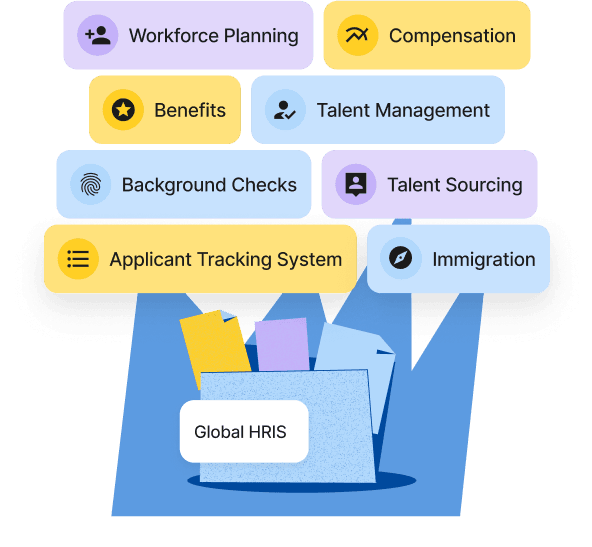
- Workforce planning
- International hiring (employees & contractors)
- Talent sourcing
- Background checks
- Visa and immigration
- Localized perks and benefits
- HR information management
- Onboarding and offboarding
- Time off and attendance
- Worker data and documentation
- HR workflow automation
- Global payroll
- Talent and performance management
- Compensation management
- Employee equipment and access provisioning
- Global compliance
Doron Bashan, VP of People at Mixtiles, shares what it feels like to combine all of this functionality into a single platform:
To date, with Deel, we have hired over 125 team members across 11 different countries, including the United States, Australia, Canada, the UK, and more. When we first saw all of the information that we used to have in other formats, all in the Deel platform, all clean and in one place, it really was pretty, pretty powerful.
—Doron Bashan,
VP of People, Mixtiles
Ready to build a modern, end-to-end people platform? Book a free Deel demo today.
FAQs
What is the meaning of all-in-one HR tools?
An all-in-one HR tool is a single platform that manages the entire employee lifecycle, from hiring and onboarding to payroll, performance, and compliance. Instead of relying on multiple disconnected systems, organizations use a unified environment where data updates are automatic, and every workflow connects seamlessly.
How do all-in-one HR solutions improve efficiency for organizations?
All-in-one HR solutions eliminate the constant back-and-forth that slows down HR. When your core people information lives in one place, teams spend less time fixing discrepancies or switching between tools. This frees HR to focus on long-term people initiatives and cuts down on repetitive manual tasks that usually drain capacity.
How do all-in-one platforms streamline payroll and HR tasks?
All-in-one platforms tie payroll directly to the HR data that drives it, so updates flow automatically from one layer of the software to another, rather than one disconnected system to the next. This removes the need to re-enter information in separate tools or deal with the fallout of miskeyed data or failed synchronization. Overall, payroll cycles become faster and far more reliable.
Lorelei Trisca is a content marketing manager passionate about everything AI and the future of work. She is always on the hunt for the latest HR trends, fresh statistics, and academic and real-life best practices. She aims to spread the word about creating better employee experiences and helping others grow in their careers.


