Instant feedback
Feedback that doesn't wait for annual reviews
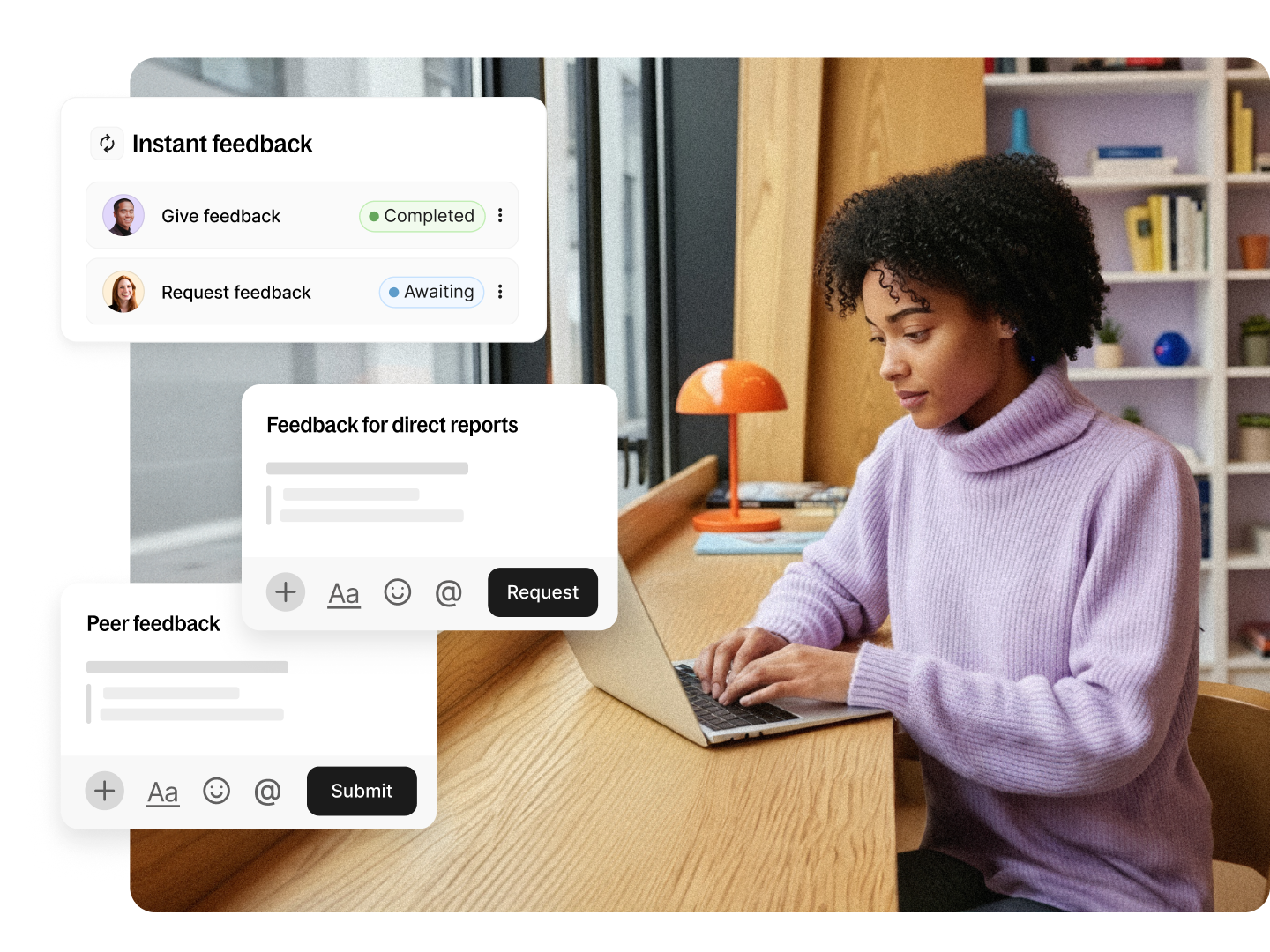
Meaningful feedback shouldn't wait for a formal review cycle. Instant feedback lets anyone give, request, and document input, peer-to-peer, upward, or cross-team, while context is still fresh.
Trusted by 40,000+ companies from startups to enterprise


























Continuous feedback
Give or request feedback any time, in any direction
Meaningful feedback shouldn't wait for a formal cycle. Anyone in your org can send specific, actionable input, to a peer, a manager, or a cross-team collaborator, right when context is fresh and the observation is still useful. No cycle, no approval, no waiting.


FROM INSTANT FEEDBACK TO FORMAL REVIEW
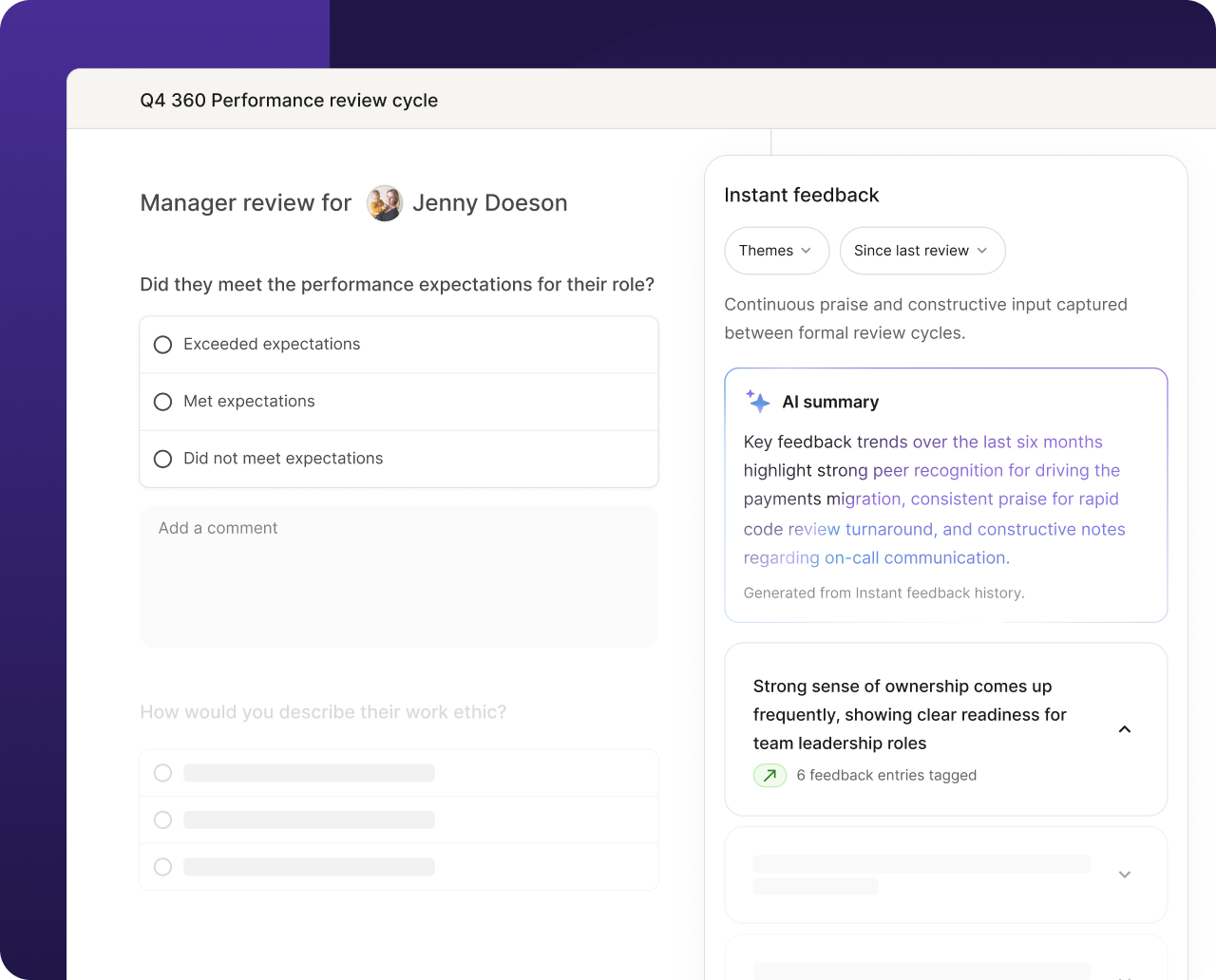
Observations ready when your review opens
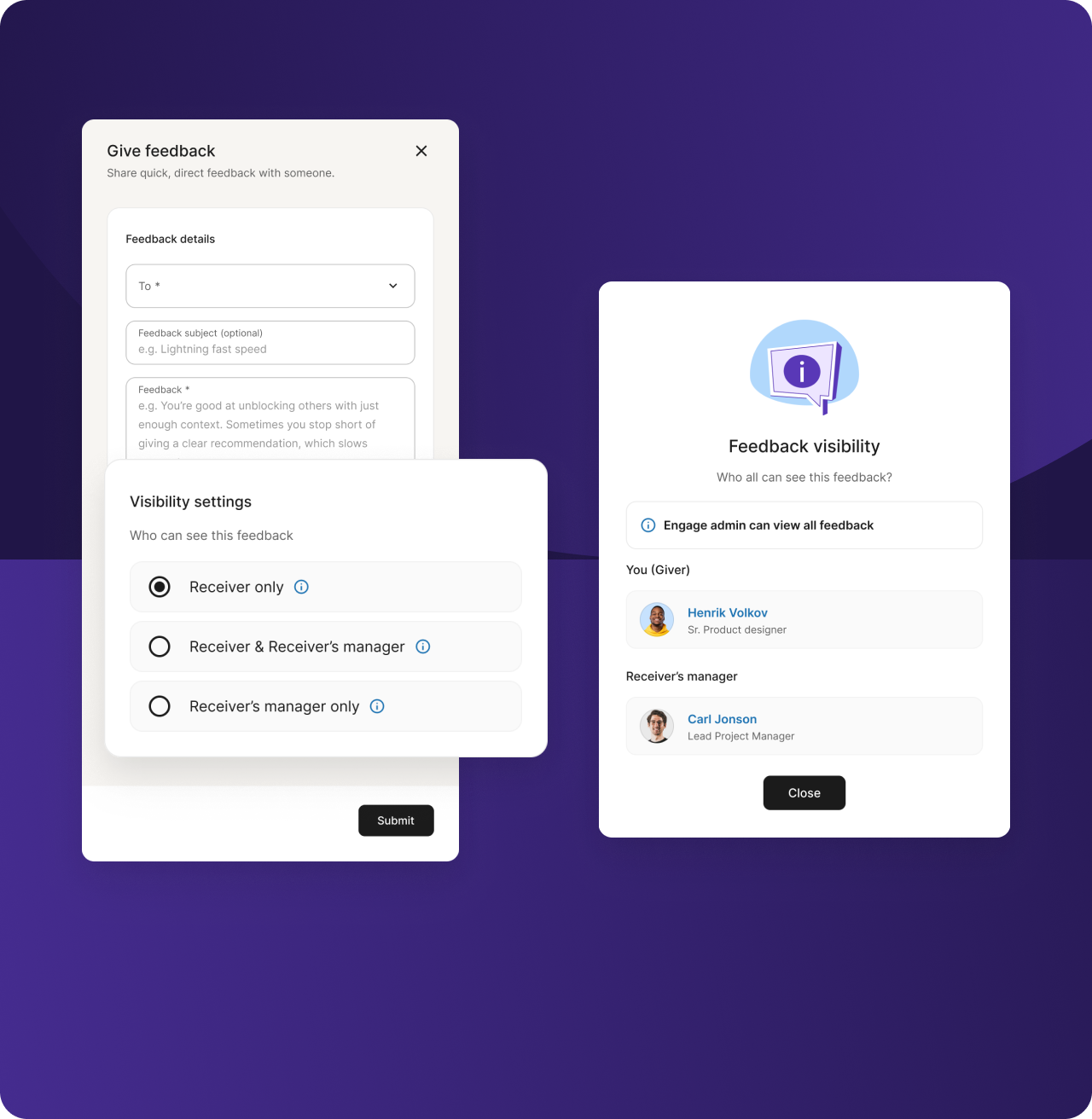
Reviews become more accurate when the evidence doesn't rely on memory. When a formal cycle opens, all instant feedback the reviewee received surfaces automatically in the context panel, organized and ready to use. No recency bias, no reconstructing what happened six months ago.
FEEDBACK IN THE FLOW OF WORK
Higher adoption, zero behaviour change
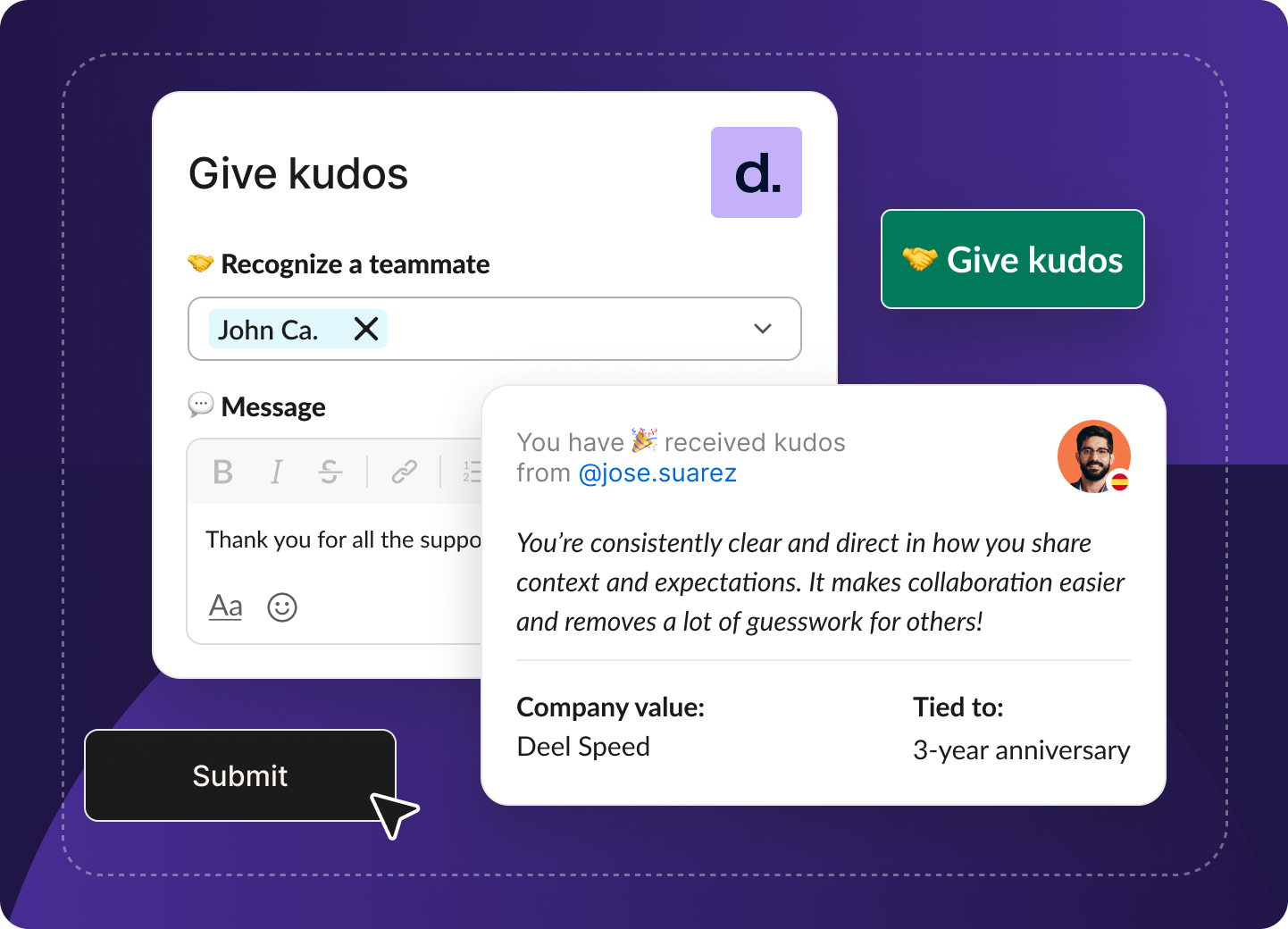
The best feedback tool is the one people actually use. Instant feedback is natively built into the Deel Plugin for Slack, so your team gives, requests, and responds to feedback without opening another tab. Every response syncs to Deel automatically. The record builds itself.
SEE IT IN ACTION
See how effortless building a feedback culture can be
INTEGRATED TALENT MANAGEMENT
All your talent management tools, connected in Engage
FAQs
What are the key features of Instant feedback?
Instant feedback includes the following key features:
Give feedback: Send direct, specific feedback to any colleague, peer, manager, or cross-team, at any time. No formal review cycle, no approval required.
Request feedback: Ask anyone for input on your work. Set an optional due date, add context for what you're looking for, and define visibility before sending.
Managers request on behalf of reports: Managers can initiate a feedback request directed at someone on their team, gathering input from collaborators the employee might not have thought to ask.
Team feedback dashboard: A dedicated view for managers showing all feedback across their direct reports, with filters by report and time period.
Visibility controls: Public (visible to the recipient, their manager, reviewers, and admins) or private (feedback requester and giver only, or, for manager-requested feedback, the feedback giver and manager only).
Feedback feed: A searchable, filterable history of all feedback given, received, and team feedback, with author, date, visibility label, and full text.
Native Slack integration: Give feedback, request feedback, and receive real-time notifications directly from the Deel Plugin for Slack. Every input syncs back to Deel automatically.
Surfaced in review cycles: When writing a formal review, all instant feedback the reviewee received during the review period appears automatically in the context panel, ready to use, no copy-paste needed.
How does Instant feedback connect to the rest of Deel HR?
Instant feedback is built into Deel HR. That means feedback accumulates on the same platform where reviews are run, development plans are managed, and career progression is tracked. Specifically:
Feedback surfaces automatically in the review context panel when a formal cycle opens
It will also appear in the AI-generated review summary
The same worker profile carries feedback history, goals, and performance data in one place (which can be further linked to compensation review cycles) The more of Deel HR your team uses, the more useful the feedback record becomes, it's one connected picture of each person's development, not a snapshot from a separate tool.
How does Instant feedback help managers?
Managers typically go into review cycles with thin notes and a strong recency bias, they remember what happened last month, not last quarter. Instant feedback changes that in three specific ways:
A running record of documented observations accumulates throughout the year, automatically surfacing inside the review when it's needed
The “Team feedback” dashboard shows who has received feedback recently and who hasn't, before review season, so managers can address gaps proactively
Managers can request feedback on behalf of their direct reports from project collaborators, gathering input that the workers might never have asked for themselves The result: review conversations become a summary of what already happened, not a high-stakes reconstruction.
How does Instant feedback help HR build a culture of feedback across the organization?
A culture of feedback doesn't come from mandating a review cycle. It comes from making feedback easy, frequent, and consequential. Instant feedback addresses all three, and becomes more powerful when used alongside the rest of Engage:
Easy: Feedback flows in any direction, from Deel or Slack, with no cycle to open and no admin to approve it. Lower friction means higher frequency.
Frequent: Because feedback isn't locked to a review window, it accumulates naturally throughout the year. Managers can see who's receiving input regularly and proactively build the record for people who aren't.
Consequential: This is where the Engage ecosystem makes the difference. Instant feedback doesn't disappear after it's submitted; it surfaces in the review context panel when a formal cycle opens, informs development plan conversations, and connects to the performance data managers use to make compensation and promotion decisions. The result is a feedback loop that's genuinely closed: give input, document it, surface it at the right moment, and act on it. That's what makes feedback a cultural habit rather than an annual event.
What's the difference between Instant feedback and Reviews, and how do they work together?
The two modules are built for different moments, and they're more useful together than either is alone.
Reviews is a structured, scheduled process. It runs on a defined cycle—quarterly, bi-annually, or annually—with configurable feedback types, anonymity settings, rating scales, calibration steps, and formal analytics (9-box, skills matrices, radar charts). It's designed for a thorough, bias-aware evaluation of performance against goals and competencies. It requires coordination, preparation, and time.
Instant feedback is none of those things by design. It's asynchronous, unscheduled, and frictionless. Anyone can give or request specific input at any point, after a project wraps, when something goes well, when a collaborator's perspective matters, without opening a cycle or involving HR.
**How they work together: **The distinction matters most at review time. When a manager sits down to write a formal review in Engage, all the instant feedback the reviewee received during that review period surfaces automatically in the context panel. The informal observations, coaching moments, and peer input that accumulated throughout the months are already there, organized, searchable, and ready to inform the evaluation.
That means: Reviews become more accurate, because they reflect what actually happened across the year, not just what the manager remembers from the last few weeks Managers spend less time reconstructing context and more time having a meaningful conversation Workers experience review outcomes as fair, because the evidence behind them was built continuously, not assembled under pressure.
Will Instant feedback work for our team size and structure?
Yes. Instant feedback works for any team structure, flat, hierarchical, or distributed across multiple countries. Feedback can flow peer-to-peer, upward, downward, or cross-team, in any direction, without a reporting relationship required. Managers at any level can use the team dashboard and request feedback on behalf of their reports. The Slack integration also means adoption doesn't depend on getting everyone to change their habits, feedback happens inside the communications tool your team already lives in.
Why companies around the world use Deel for talent management

“On Engage, within each goal you see who’s responsible, what needs to be done, and you can upload progress evidence.”

Lucía Rodriguez
Head of HR

“Our employees love having everything accessible in one place—their docs, reviews, time off, expenses. It’s all in Deel now.”

Dario Valiant Casilli
Operations Manager

“We were drowning in spreadsheet reviews—a big mess that was a drain on time and morale. Engage is how we turn that painful process into a strategic, joyful one.”

Christian Burri
Cofounder & Chief Product Officer
Deel makes growing remote and international teams effortless
150+
countries
+40,000
customers
$20B+
compliantly processed global payroll
90+
NPS for enterprise customers