Article
8 min read
The 7 Best Applicant Tracking Systems for SMB Recruiters in 2026
Global hiring

Author
Ellie Merryweather
Last Update
March 31, 2026

Key takeaways
- The standalone ATS trap is costing SMBs time and talent. Most applicant tracking systems create a dead end at the offer stage — candidate data doesn't flow into onboarding, payroll, or HR systems, forcing manual re-entry that causes compliance gaps, delayed onboarding, and lost momentum for new hires.
- Not all ATS platforms are built for the realities of modern SMB hiring. The best systems in 2026 go beyond basic applicant tracking to offer AI-powered sourcing, dual-track management of both full-time employees and contractors, and seamless integrations with the tools teams already use — all at pricing that doesn't require an enterprise budget.
- Deel's ATS eliminates the fragmentation by connecting recruiting directly to HR and payroll. Candidate data automatically flows into onboarding, compliance, and payroll at the point of offer acceptance — with global compliance across 150+ countries and transparent per-worker pricing. No manual re-entry, no disconnected systems.
The best Applicant Tracking System (ATS) for most SMBs in 2026 is one that connects hiring directly to onboarding, payroll, and HR — without manual data re-entry between disconnected systems. As headcount grows and hiring spans multiple countries and worker types, a standalone applicant tracking system creates bottlenecks: missed candidates, compliance gaps, and slow onboarding handoffs that cost your team time and new hires' momentum.
In this guide, we've evaluated the seven strongest ATS platforms for SMBs in 2026 across eight criteria that determine real-world value. Whether you're scaling from 20 to 200 employees or managing a globally distributed team across multiple worker types, this shortlist covers the options that actually deliver.
How we selected these platforms: 8 criteria that matter for SMBs
Most ATS platforms are either enterprise tools stripped down for smaller teams or entry-level products that can't scale beyond basic applicant tracking. Every platform in this guide was evaluated against criteria specifically relevant to SMBs hiring globally in 2026:
- Dual-Track Talent Management: Native workflows for both Full-Time Employees (FTEs) and Contractors/Contingent Workers in a single pipeline — no separate data silos or workarounds required.
- Automated Global Compliance: Built-in legal safeguards including automatic GDPR Article 17 data retention, localized tax form collection, and Right-to-Work verification across jurisdictions.
- Agentic AI Sourcing: Systems that proactively find and rank passive candidates from external talent pools — not just filter inbound applications.
- Predictable SMB Pricing: Transparent, tiered, or usage-based pricing with no hidden implementation fees or mandatory multi-year enterprise contracts.
- Low-Friction Manager UX: An interface non-HR hiring managers can use effectively with little formal training.
- Ecosystem Connectivity: Native, one-click integrations with Slack, Microsoft 365, Google Workspace, and localized payroll providers.
- Self-Service Onboarding Portals: Candidate-facing portals allowing new hires to e-sign contracts and upload required documents via mobile before their first day.
Quick snapshot: How do the top ATS platforms compare in 2026?
Use this table for a rapid side-by-side comparison before reading the full tool reviews below.
| Tool | Best For | Pricing | Global Coverage | AI Sourcing |
|---|---|---|---|---|
| Deel’s ATS | Global compliance + unified HR suite | Transparent per-user/worker | 150+ countries | Yes |
| Ashby | Speed & stack consolidation | Mid-range | Moderate | Yes |
| Workable | AI sourcing & out-of-box ease | Starter plan available | Moderate | Yes — strong |
| Zoho Recruit | Budget & deep customization | From ~$30/user/mo; free tier | 25+ languages | Partial |
| Pinpoint | IR35/US contractor classification | Mid-range | Europe + US (GDPR) | Partial |
| Recruitee | Collaborative, manager-led hiring | SMB-friendly tiered plans | Moderate | Partial |
| Manatal | Budget AI sourcing | From $15–$30/user/mo | Multi-language | Yes |
Quick picks by priority:
- Best for global compliance across 150+ countries: ATS
- Best for IR35 and US contractor classification: Pinpoint
- Best for lowest price with AI sourcing: Manatal
- Best for consolidating ATS, CRM, and scheduling in one tool: Ashby
- Best for teams already using Zoho CRM or Zoho Books: Zoho Recruit
- Best for collaborative hiring with non-HR managers: Recruitee
Which ATS is right for your business?
1. Deel's ATS: Best for global SMBs that need recruiting connected to HR and payroll
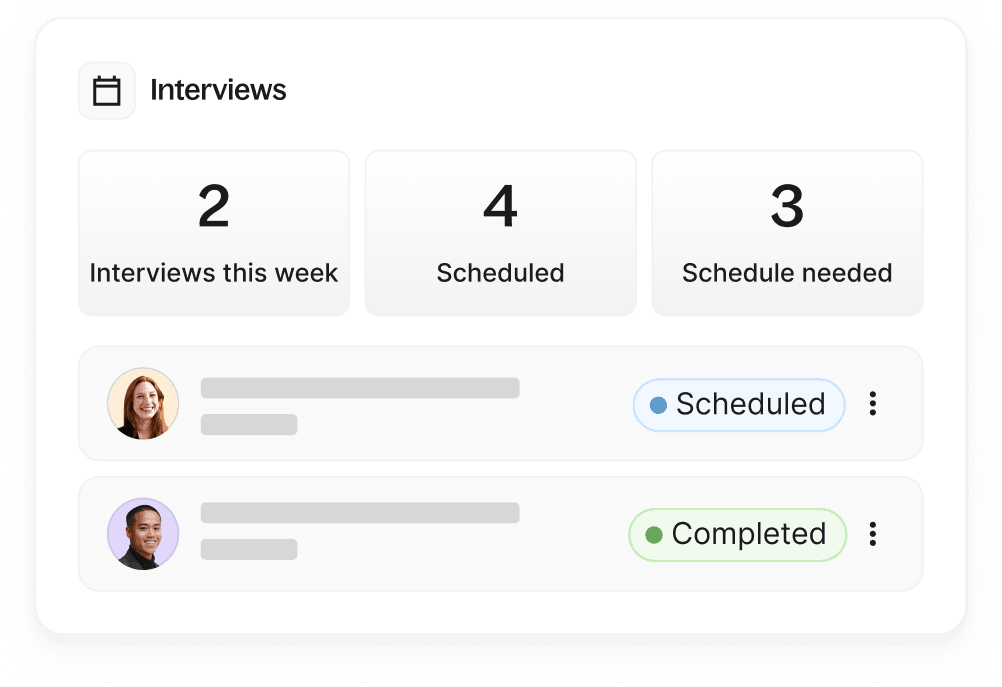
Deel's ATS is the strongest choice for SMBs hiring globally because candidate data flows automatically into onboarding, payroll, and HRIS — with no manual re-entry. Unlike standalone applicant tracking systems that create a dead end at the offer stage, Deel's ATS is built as a native module within Deel HR, meaning the entire candidate-to-employee lifecycle lives in one platform. When a headcount request is approved in Workforce Planning, it flows directly into a job requisition. When a candidate accepts an offer, their record automatically populates Deel's HRIS for immediate onboarding, payroll, and benefits setup.
The platform uses AI-powered sourcing to pull candidates from internal talent pools and external networks, generates compliant job descriptions in seconds, and screens and scores applicants automatically based on role requirements. Hiring insights across 150+ countries — including global salary benchmarks for competitive offer-building and GDPR Article 17 compliance — make it particularly suited to distributed teams managing both FTEs and contractors across multiple jurisdictions. Native integrations with LinkedIn, Google Workspace, and Microsoft 365 mean no additional middleware is needed for core workflows.
Pros: Entire candidate-to-employee journey in one platform; automatic data flow into HRIS, onboarding, and payroll; built-in compliance across 150+ countries; AI sourcing and screening; global salary benchmarks; transparent per-worker pricing; native LinkedIn, Google Workspace, and Microsoft 365 integrations.
Cons: Requires Deel's HRIS as the foundation module. However, this integration makes it an ideal choice for those already running payroll or people operations through Deel.
Best suited for: SMBs with 1–200 employees managing global or distributed teams across multiple worker types — especially those who want to eliminate fragmented tooling and manage every stage of the employee lifecycle, from open requisition to offboarding, in a single platform.
Deel HR
2. Ashby: Best for high-growth SMBs consolidating a fragmented recruiting stack
Ashby is the best choice for SMBs that want to replace a fragmented combination of ATS, CRM, and scheduling tools with a single, consolidated platform that doesn't require ongoing integration maintenance. It combines applicant tracking, candidate relationship management, and automated interview scheduling into one interface — which means hiring managers, recruiters, and HR only ever need to learn one system. Headcount Management tracks FTEs and contingent workers in real time, and full implementation, including integrations, typically takes under three weeks.
Pros: Consolidates ATS, CRM, and scheduling in one interface; fast implementation under 3 weeks; native FTE and contractor tracking via Headcount Management; strong analytics and reporting.
Cons: Mid-range pricing may exceed lean startup budgets; global compliance coverage is less comprehensive than dedicated global platforms; no native HRIS connection for automatic onboarding handoff.
Best suited for: High-growth SMBs replacing a fragmented recruiting stack of 3–4 separate tools that want a single consolidated platform with minimal integration overhead.
3. Workable: Best for the fastest time-to-value
Workable is the fastest ATS to launch in 2026 — SMBs can have their first job live and AI sourcing active in under one hour, with no implementation project required. Its 2026 updates significantly strengthen Agentic AI capabilities for candidate screening and automatic ranking, making it a strong choice for lean teams without a dedicated recruiter. With 400+ pre-built native integrations spanning Slack, Gmail, Google Workspace, and multiple global payroll providers, Workable fits easily into most existing SMB tech stacks. Its Starter plan is one of the most accessible price points for businesses with occasional or seasonal hiring needs.
Pros: Fastest launch time on this list (under 1 hour); strong Agentic AI candidate sourcing and ranking; 400+ native integrations, including Slack and global payroll; flexible pricing with a Starter tier; intuitive interface requiring no HR training.
Cons: No native HRIS integration for automatic onboarding handoff; global compliance features are less robust in highly regulated jurisdictions; contractor management workflows are limited.
Best suited for: Lean startups and SMBs without a dedicated HR or recruiting team that need to be live and sourcing candidates within hours, not weeks.
4. Zoho Recruit: Best ATS value for budget-conscious SMBs already using Zoho
Zoho Recruit delivers the lowest cost-per-seat of any full-featured ATS on this list, starting around $30 per user per month with a robust free tier for solo recruiters — making enterprise-grade customization accessible to budget-constrained SMBs. Its deepest competitive advantage is ecosystem integration: for businesses already using Zoho CRM, Zoho Books, or Zoho Mail, candidate and employee data flows automatically across the entire business stack without additional middleware. Supporting 25+ languages and multiple currencies, it also serves small international staffing agencies managing multi-region operations.
Pros: Lowest per-seat price on this list; robust free tier for single-user teams; deep native integration with Zoho CRM, Zoho Books, and Zoho Mail; 25+ language support and multi-currency; highly customizable workflow automation.
Cons: AI sourcing capabilities are less advanced than dedicated AI-first platforms; interface complexity increases for users without prior Zoho experience; global compliance automation is limited compared to Deel or Pinpoint.
Best suited for: Cost-sensitive SMBs and solo recruiters — particularly those already invested in the Zoho ecosystem — who need strong workflow customization on a tight budget.
Free guide
Interview Guide and Checklist for Hiring Managers
5. Pinpoint: Best ATS for IR35 compliance and in-house contractor hiring
Pinpoint is the strongest choice for SMBs that need dedicated workflows for IR35 (UK) and US contractor classification — two of the highest-risk compliance areas for businesses mixing full-time and contingent workers. It is one of the few ATS platforms with purpose-built modules for worker misclassification risk management, which protects businesses from the significant financial penalties associated with incorrectly classifying contractors as employees or vice versa. Its automated New Hire Experience portal generates localized contracts and collects required compliance documents in minutes, and region-specific GDPR data retention rules are enforced automatically.
Pros: Dedicated IR35 (UK) and US contractor classification workflows; automated localized contract generation; GDPR-compliant data retention by region; multilingual candidate experience; purpose-built for scaling in-house recruiting to replace agency spend.
Cons: Lower brand recognition than larger platforms; AI sourcing capabilities are less advanced; global coverage is strongest in Europe and the US, with limited depth elsewhere.
Best suited for: UK and US-based SMBs managing a mixed workforce of FTEs and contractors who need to stay compliant with IR35 or US worker classification rules and want to reduce external agency dependency.
6. Recruitee (by Tellent): Best ATS for collaborative, manager-led hiring
Recruitee is the best option for SMBs where hiring managers — not just HR — drive the recruiting process, because its interface requires virtually no training and makes it nearly impossible for a non-HR user to lose track of a candidate. Its visual pipeline gives every stakeholder a real-time "bird's eye view" of all open roles and candidate stages simultaneously, which eliminates the back-and-forth coordination that slows down collaborative hiring. Tiered pricing scales with team size without gating essential features behind enterprise plans, and its open ecosystem includes 100+ native one-click integrations for payroll, background checks, and Slack.
Pros: Zero-training interface for non-HR hiring managers; visual bird's-eye pipeline management; 100+ native one-click integrations (payroll, background checks, Slack); SMB-friendly tiered pricing with no essential feature-gating.
Cons: Limited global compliance automation; AI sourcing is in development; no native HRIS integration means the offer-to-onboarding handoff requires manual steps.
Best suited for: SMBs with cross-functional hiring processes where department heads and hiring managers review candidates and make decisions independently, without relying on HR to manage the pipeline.
7. Manatal: Most affordable AI-powered ATS
Manatal is the most cost-effective AI-powered ATS available in 2026, starting at $15–$30 per user per month — roughly half the price of most mid-tier competitors — while still delivering genuine AI candidate matching and social media enrichment. Its AI Recommendation engine scores candidates from your existing internal database, including past contractors, against new job descriptions automatically — making it particularly valuable for teams that build talent pools over time and want to redeploy past candidates without manual re-sourcing. The Social Media Enrichment tool aggregates candidate profiles across LinkedIn, GitHub, and other professional networks with a single click.
Pros: Most affordable AI-powered ATS on this list (from $15/user/mo); AI candidate scoring against internal talent pools including past contractors; one-click social media enrichment across LinkedIn and GitHub; multilingual and multi-currency support.
Cons: Limited global compliance automation and contractor management workflows; no native HRIS integration for automatic onboarding handoff; analytics are less robust than premium platforms; smaller brand presence.
Best suited for: Very lean SMBs and early-stage startups that want AI-powered candidate matching and talent pool management without the cost of a premium ATS platform.
What questions should you ask during an ATS product demo?
Walking into a demo without a structured question list is how SMBs end up with tools that looked compelling in a presentation, but fail in practice. Use these questions to pressure-test every vendor against the criteria that actually determine day-to-day value:
| Category | Question to Ask |
|---|---|
| Dual-Track Hiring | Can your platform manage both FTEs and contingent workers in a single pipeline, without creating separate data silos? |
| Implementation Speed | What does a typical time-to-value look like for an SMB? Can we be fully live and hiring within 30 days? |
| Global Compliance | How do you handle GDPR Article 17 data retention, Right-to-Work verification, and localized tax form collection automatically across different countries? |
| AI Sourcing | Does your AI proactively source passive candidates from external networks, or does it only screen inbound applicants? Can you show me the AI candidate ranking in a live environment? |
| Pricing Transparency | What fees are not included in the advertised price — implementation, support tiers, integration costs, or per-seat overages? |
| Integrations | Which payroll, HRIS, Slack, and Microsoft 365 integrations are native vs. via Zapier? What is the typical setup time per integration? |
| Analytics | What hiring metrics are tracked out of the box — time-to-hire, candidate-to-offer ratio, source quality — and how customizable are the reporting dashboards? |
| Onboarding Handoff | When a candidate accepts an offer, how does their data transfer into onboarding, payroll, and HRIS? Is it automatic or does it require manual re-entry? |
See how ATS connects recruiting to the rest of your HR stack
If your team is managing global hiring across a mix of full-time employees and contractors — and you're losing time to manual data re-entry between a standalone ATS and your HRIS — Deel's ATS was built to solve exactly that problem.
Deel's ATS gives recruiting teams, HR managers, and founders a single source of truth: from the moment a headcount request is approved to the day a new hire's contract is signed, and their first paycheck is processed.
Live Demo
Get a live walkthrough of the Deel platform

FAQs
What is the best ATS for startups and SMEs in 2026?
The best ATS for small businesses depends on your top priority. For global hiring with full HR integration: Deel ATS. For fastest setup: Workable. For the lowest cost with AI: Manatal. For IR35 and contractor compliance: Pinpoint. Most SMBs benefit most from a platform that connects directly to their HRIS and payroll system to avoid manual data re-entry between tools. With IT, Employer of Record, Contractor of Record, talent sourcing, PEO, immigration support, and global payroll covering more than 150 countries, Deel is the best choice for consolidating a full HR tech stack.
What does ATS stand for, and what does it do?
ATS stands for Applicant Tracking System. It is software that manages the end-to-end recruiting process — from job posting and candidate sourcing to interview scheduling, offer management, and onboarding handoff. Modern ATS platforms in 2026 also include AI-powered candidate sourcing, automated screening, compliance automation, and analytics dashboards.
How long does ATS implementation take for an SMB?
Implementation time varies significantly by platform. Workable is the fastest, with SMBs live in under one hour. Ashby typically takes under three weeks for full implementation including integrations. Most other platforms on this list can be operational within 30 days. Enterprise ATS tools not covered in this guide often require 3–6 months.
What is the difference between an ATS and an HRIS?
An ATS (Applicant Tracking System) manages the pre-hire recruiting process — sourcing, screening, interviewing, and offer management. An HRIS (Human Resources Information System) manages the post-hire employee lifecycle — onboarding, payroll, benefits, performance, and offboarding. Most SMBs need both, and the best setup connects them so candidate data flows automatically into HRIS at the point of offer acceptance, eliminating manual re-entry.
Can an ATS manage both full-time employees and contractors?
Yes, but not all ATS platforms do this well. Deel ATS and Pinpoint offer dedicated dual-track workflows for managing both FTEs and contingent workers in a single pipeline. Ashby's Headcount Management feature also supports both worker types. Platforms like Workable and Manatal are primarily optimized for FTE hiring and have limited contractor management functionality.
How does global compliance work in an ATS?
Global compliance in an ATS refers to built-in safeguards that ensure hiring practices meet local legal requirements across jurisdictions. This includes automatic GDPR Article 17 data retention and deletion rules, Right-to-Work verification workflows, localized tax form collection (such as W-9 in the US or P45 in the UK), and region-specific employment contract generation. Deel ATS covers compliance across 150+ countries. Pinpoint specializes in IR35 (UK) and US contractor classification compliance.
What hiring metrics should an ATS track?
The most important hiring metrics for SMBs are: time-to-hire (days from job opening to accepted offer), candidate-to-offer ratio (how many applicants it takes to make one offer), offer acceptance rate, source quality (which channels produce the best hires), and cost-per-hire. Advanced platforms like Deel ATS also provide candidate-to-hire ratio by role, team, and geography, plus funnel drop-off analysis to identify where strong candidates are being lost.
Ellie Merryweather is a content marketing manager with a decade of experience in tech, leadership, startups, and the creative industries. A long-time remote worker, she's passionate about WFH productivity hacks and fostering company culture across globally distributed teams. She also writes and speaks on the ethical implementation of AI, advocating for transparency, fairness, and human oversight in emerging technologies to ensure innovation benefits both businesses and society.