Article
19 min read
The Complete ATS Guide: Building Better Hiring Systems
Global hiring

Author
Ellie Merryweather
Last Update
March 31, 2026

Table of Contents
What is an applicant tracking system?
Why every modern recruitment team needs an ATS
How an ATS improves a recruiter’s daily workflow
Types of applicant tracking systems
Key features recruiters should look for in an ATS
Why modern recruiters are choosing AI-powered ATS software
Common myths about ATS software
5 Popular ATS software to consider
Questions recruiters should ask before implementing an ATS
How to choose the right ATS for your recruiting team
The future of applicant tracking systems
Looking for future-focused recruitment software? Meet Deel’s ATS
Key takeaways
-
ATS is necessary for companies to tackle growing recruitment challenges, mainly the rising application volumes.
-
Companies are shifting towards AI-powered ATS as it prevents one of the key limitations of traditional ATS: filtering out good candidates due to strict keyword matching.
-
AI-powered ATS will soon be supporting crucial recruitment decisions for companies with its predictive analytics capabilities to scan past interview records and find a better fit.
Hiring isn’t getting any easier.
Recruiters are facing new challenges day by day:
-
Massive talent shortages
-
Generic AI-generated applications
-
Overwhelming AI-fueled surge in application volumes.
Jamie Kohn, Senior Research Director at Gartner, says, “It’s getting harder for employers to evaluate candidates’ true abilities, and in some cases, their identities.” In fact, they predict one in four candidate profiles worldwide will be fake by 2028.
As a result, competition for the best talent is getting fierce. For example, 78% of top sales candidates received at least two offers in Q1 2025.
Now is not the time to compromise on building a system that optimizes the hiring process to filter low-quality applications and improve candidate experience for top applicants.
That system is an Applicant Tracking System (ATS). It prevents your hiring team from being stuck in a loop of spreadsheets and emails to just close a single role.
In this guide, we’ll explain:
-
What ATS is and how it works
-
Why is it necessary for recruiters
-
Key features that make an ATS effective
-
How to choose the right ATS.
What is an applicant tracking system?
An Applicant Tracking System (ATS) is a recruiting software that centralizes hiring data and automates the process. Hiring teams work from this single hub to post job listings, track applications, schedule interviews, and send offer letters. ATS also provides reporting features to analyze which stage of recruiting is taking more time/cost, and where candidates are dropping off.
With its automation and reporting features, ATS helps to handle growing recruitment challenges, including increasing application volumes, rising time-to-hire and cost-per-hire, and declining candidate experience.
Deel HR
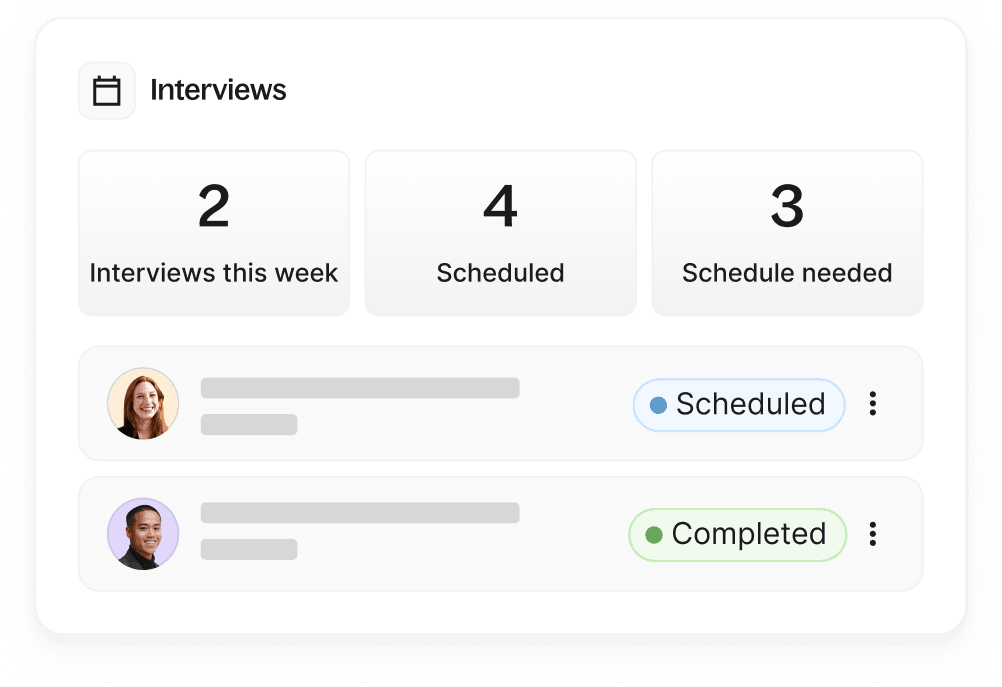
How an ATS works
An ATS works by automating each of these steps of the hiring process:
-
Creating job requisitions: Getting approvals internally for any new job posting.
-
Publishing job posts: Posting the job requirements on all the required job boards in a single click.
-
Collecting and parsing applications: Gathering and storing all candidate applications in one place.
-
Screening and ranking candidates: Filtering and ranking candidates based on how well they fit the requirements.
-
Managing interviews: Scheduling interviews and sending automated reminders to candidates and hiring teams.
-
Extending offers: Generating and sending offer letters to selected candidates to close the requirement.
Who uses an ATS?
HR professionals responsible for managing hiring typically use ATS. These include corporate recruiters, agency recruiters, third-party staffing firms, and internal recruiters and hiring managers across companies of all sizes, from small businesses to enterprises.
Why every modern recruitment team needs an ATS
An ATS is specifically designed to handle the rising challenges of hiring and improve recruitment workflows. Here are some of the top issues that ATS can handle:
Increasing application volumes
The New York Times conducted a deep dive into one job-hiring board: LinkedIn. They found that the number of applications submitted on LinkedIn has surged more than 45% in 2025. The platform is clocking close to 11,000 applications per minute. The increasing use of AI to generate applications was driving this rise.
Katie Tanner, an HR Consultant, describes how hiring gets crazy in this age of AI. One just gets inundated.
Like Katie, many HR professionals are stuck in a sea of irrelevant applications. Manually screening them is no longer an efficient approach. That’s where an ATS helps to automatically screen resumes for required skills, filter out unqualified job applicants, and drop AI-generated submissions.
Rising time-to-hire
93% of hiring managers say hiring is taking longer than it did two years ago. Their most time-consuming tasks are evaluating candidate applications, conducting background checks, and scheduling interviews.
An ATS tackles all three: parsing and ranking applications, integrating background checks into the workflow, and scheduling interviews automatically when a candidate is shortlisted. It helps close a role faster and saves the hiring team time.
Declining candidate experience
90% of job seekers have been ghosted after an interview. Such radio silence from employers leaves a poor impression and degrades candidate experience. But it’s also tough for recruiters to reply to every candidate, considering the number of applications per role continues to rise.
An ATS helps bridge the gap by allowing you to set up automated communication for interview reminders, feedback, and status updates. It ensures candidates stay informed and engaged throughout the hiring process while keeping manual administrative work for recruiters to a bare minimum.
Growing cost-per-hire
The cost-per-hire is increasing, making the entire recruitment process expensive for organizations. Companies need to tweak recruitment strategies to keep this cost under control. But without adequate data tracking, the hiring process becomes a black box, leaving them unsure what to optimize.
An ATS gives a clear picture of the current recruitment situation by providing metrics such as candidate pass-through rates by source type, time spent at each interview stage, top reasons for offer declines, and more. This data then sets a base for optimizing future recruitment methods.
How an ATS improves a recruiter’s daily workflow
An ATS improves a recruiter’s daily workflow by centralizing candidate data, automating repetitive tasks, and providing a complete picture of the entire hiring pipeline.
Here’s a clear before-and-after picture of recruiting with and without an ATS:
| Recruiting without an ATS | Recruiting with an ATS |
|---|---|
| Multiple spreadsheet tracking | Centralized dashboard |
| Time-taking email-based coordination | One-click scheduling |
| Manual resume review | Automated resume screening |
| High candidate ghosting | Proper follow-ups and feedback |
| Missing metrics | Clear pipeline visibility |
Types of applicant tracking systems
Not all ATS platforms are built the same. Choosing the wrong type can mean costly rework and wasted budget. Here are the three main categories to know before making a decision:
Standalone ATS software
Standalone ATS is specialized HR software designed to manage recruitment workflows. You get hiring-focused features such as better resume parsing, automated interview scheduling, and collaborative hiring. It is more affordable than the other types of ATS, but you must keep the admin cost in mind. You’re going to have a fragmented software system that handles only one HR function and needs to be integrated with the rest of the HR tools.
ATS built into HR platforms
An integrated ATS is part of a larger full-stack HR solution that handles all key HR functions, including recruitment. It provides you with the advantage of having all data in one place and the ability to do centralized reporting. But it’s a big suite for all HR functions, and it’s tough to find a solution that provides all the necessary features. For example, some full-stack solutions may lack advanced AI features.
Complementary reading:
Dive deeper into how an integrated HRIS and ATS cuts down on double work and ensures data accuracy, and what it looks like with Deel.

Case Study
We couldn't find a global HRIS. So we built our own.
AI-powered ATS platforms
An AI-powered ATS uses natural language processing and machine learning to improve hiring processes. For example, instead of traditional error-prone keyword matching, an AI ATS can understand context in resumes and suggest the right matches. One important caution while choosing AI-powered ATS is to finalize a solution compliant with GDPR and CCPA data standards.
Key features recruiters should look for in an ATS
Apart from understanding the type, here are the key features you must look for before selecting an applicant tracking system.
Job posting creation and management
The ATS simplifies job posting creation and management through the following capabilities:
-
AI-generated job descriptions: Create personalized and complete job descriptions based on the inputs from the recruiter.
-
Multi-channel job distribution: Allow publishing the job posting to multiple job boards and company’s careers page in one click.
-
Careers page management: Manage the company’s careers page to display, categorize, and track job openings directly via ATS.
Candidate sourcing tools
An ATS with a good candidate sourcing reach reduces the extra work to promote the job posting to find applicants. It can help recruiters find applicants through:
-
Talent pool search: Searching through its internal database of all candidates who have shown interest in working with the company.
-
External sourcing integrations: Browsing through third-party job boards and resume databases to find eligible profiles for candidate sourcing.
-
LinkedIn connectivity: Displaying relevant LinkedIn profile recommendations, or enabling saving LinkedIn profiles to the ATS for outreach.
AI-powered resume screening
Advanced ATS systems go beyond exact keyword matching and interpret the resume's context through AI-powered resume screening. With this value-added information, it can perform:
-
Knockout question creation: Suggest early-stage screening questions to filter out unqualified candidates in the application stage itself.
-
Automated resume filtering: Scan and filter out irrelevant resumes based on the job description.
-
Candidate scoring: Rank applicants based on how well their profiles match the job requirements.
Complementary reading:
Confused about how ATS keywords really work? Cut through the noise with our guide: ATS Keywords: How They Actually Work, and What Recruiters Need to Know
Interview scheduling automation
The ATS simplifies scheduling interviews with the shortlisted candidates through:
-
Calendar integrations: Displaying interviewers' and interviewees’ available slots in the calendar to schedule an interview directly via ATS.
-
Automated interview notification: Sending automated interview invites and reminders to reduce manual follow-ups.
Collaboration and structured feedback
After the interview, the ATS makes it easy to gather notes and feedback and to select/reject candidates. These happen through features like:
-
Interview scorecards: Provide a structured interview scorecard for the interviewer to evaluate the applicant against predefined criteria and questions.
-
Notes and comments: Allow interviewers and recruiters to drop feedback and notes directly on candidate profiles in ATS.
-
Approval workflows: Trigger approval workflows for next-level managerial, finance, or HR whenever an applicant is selected.
-
Offer letter generation: Create and send an offer letter for signature once a candidate is approved for the role.
Recruiting analytics and reporting
The ATS helps you track these necessary metrics and optimize your recruitment strategy accordingly:
-
Time-to-hire: How many days it took to hire for a role, basically from the posting to the offer acceptance timeline.
-
Cost-per-hire: How much does it cost to hire each worker?
-
Candidate-to-offer ratio: How many candidates had to be evaluated to release an offer?
-
Source effectiveness: Which candidate sources are bringing the most selected candidates?
-
Funnel drop-off tracking: In which hiring stage are candidates getting dropped or rejected the most?
Complementary reading:
Dive deeper into The Metrics That Matter in Applicant Tracking
Compliance and data security
ATS systems are bound to follow the data protection standards of the local region. But as a company, you must verify if these safeguards are in place for you to stay compliant:
-
GDPR and CCPA compliance: Protect candidates’ personal data and trigger auto-delete as per the retention policy.
-
Data retention controls: Allow setting retention rules for candidate data and inform them about it.
-
Structured hiring workflows: Create structured hiring workflows that prevent individual biases from creeping in and let all candidates pass through the same funnel.
-
Equal opportunity safeguards: Mask candidates’ identification data at all necessary stages to prevent bias.
Free guide
Interview Guide and Checklist for Hiring Managers
Why modern recruiters are choosing AI-powered ATS software
Almost 43% of recruiters are shifting to AI tools for hiring tasks. Here's why:
Faster shortlists
98% of hiring managers who have used AI in their recruitment process saw significant process improvement in hiring efficiency for tasks like scheduling interviews, screening resumes, and assessing skills. This time-saving in admin tasks leads to faster hiring shortlists.
Better hiring decisions
74% of hiring managers say AI can assist human interviewers during the hiring process to assess the compatibility of applicant skills with the position they’ve applied to. This additional context helps recruiters make better hiring decisions.
Stronger candidate experience
37% of talent acquisition professionals say AI enhances the candidate experience. An AI ATS improves candidate experience by providing personalized, faster, and consistent communication, ensuring they are always aware of the next step. Candidates can get instant status updates and query responses.
Greater recruiting visibility
Traditional ATS often limits metrics till candidate selection. But an AI ATS provides real-time dashboards with an end-to-end view of the hiring funnel. For example, it gives you metrics on how the candidate performed after getting selected. Over time, the model can also provide predictive insights, such as identifying candidates who are more likely to succeed in a role. As a result, 61% of talent acquisition professionals say AI will help them better assess the quality of hire.
Common myths about ATS software
There are some common myths about ATS that prevent companies from making the best use of it. We want to address a few below:
Myth 1: ATS systems filter out great candidates
Reality: Traditional ATS relies on rigid keyword filters, which can lead to incorrect filtering. But modern AI-powered ATS solutions interpret the context of resumes and score them based on how well they fit the criteria. This AI scoring doesn’t filter candidates but brings the more relevant profiles up.
AI’s greatest strength is its ability to reduce noise. It doesn’t replace judgment, but it sharpens it. By handling the initial sorting, it allows leaders to spend less time sifting and more time thinking deliberately about who they are bringing into the business and why.
—Emma Davison,
CEO of Virtual Headquarters
Myth 2: ATS software is only for large enterprises
Reality: Hiring is becoming overwhelming across all company sizes, considering the huge rise in applications. Be it an enterprise, mid-scale, or a small business. In fact, small or mid-sized companies operate with even smaller HR teams, where a tool like ATS can help them by automating manual tasks.
Take Beatgrid Media, an ad-tech company, for instance. They were expanding into five new locations, dramatically increasing HR workload. But they did all this with a single HR lead. The company brought in Deel to manage all global hiring and day-to-day operations.
Without Deel, I'd need to hire three full-time specialists. Deel saves us their salaries and over 500 hours of manual work every single month.
—Shawnda Kohr,
HRBP, Beatgrid Media
Read more about how Beatgrid Media scaled global HR with one HR lead and Deel.
Myth 3: An ATS makes recruiting impersonal
Reality: Instead of making recruiting impersonal, an ATS automates communication, ensuring candidates are aware of each step. Now, AI ATS also allows personalizing candidate communication, assignments, and onboarding. As Anand Kabra, Chief People and Transformation Officer, Apexon explains:
“AI-enabled assessment platforms now offer adaptive evaluations that deliver objective, fair skills mapping. AI bots also provide continuous engagement, share real-time company updates, and resolve candidate queries instantly.
Employee onboarding is also increasingly personalized through AI-driven buddy assignments and sentiment tracking. New hires are matched with mentors, and learning content is dynamically tailored to their skills and interests, ensuring an engaged and confident start.”
Further reading:
Cut through the noise and discover more common myths in our guide: Common ATS Myths (What Recruiters and Candidates Get Wrong)
5 Popular ATS software to consider
We’ve compiled five ATS options for you, each with a different strength:
-
Deel: Deel AI-powered ATS comes with a complete HR suite where you get not only recruiting capabilities but also onboarding, worker management, training, performance management, admin, and features to support the entire employee lifecycle.
-
Ashby: Ashby is a standalone and specialized ATS known for its reporting and forecasting features.
-
Workable: Workable is an ATS solution with additional HR features like employee data management, time-tracking, and payroll reporting.
-
Zoho Recruit: Zoho Recruit positions itself as a recruitment CRM more than ATS, as it focuses on candidate relationship management.
-
Recruitee: Recruitee ATS is known for its collaboration features, enabling a team of recruiters to work together on a hiring project.
The 7 Best Applicant Tracking Systems for SMB Recruiters in 2026
Looking for your new ATS? We’ve compiled a complete list for SMBs and Startups, vetted against the criteria that really matter.
Questions recruiters should ask before implementing an ATS
Before looking for an ATS, you must have answers to these questions:
-
What are our current hiring needs, and how much will they grow over the coming years?
-
Which job boards are we currently using or plan to use in the future?
-
Which manual processes are slowing down our hiring?
-
At which stage are our current candidates dropping off the most?
-
Which recruitment metrics do we want to track?
-
Which repetitive tasks are taking up the most recruiter time that an ATS should handle?
-
At what points in our hiring process do candidates feel uninformed or disengaged?
-
What is our budget, and how large is the team that will use this tool?
How to choose the right ATS for your recruiting team
You can follow this checklist to evaluate whether an ATS meets your team's key requirements:
- Does it support all stages of a hiring workflow?
- Does it offer advanced AI features for creating job postings, sourcing candidates, and screening candidates?
- Can it be integrated with the job boards you use?
- Can it be integrated with your company's careers page?
- Can it be integrated with your company’s HRIS and background screening platforms?
- Does it provide recruiting analytics with pipeline visibility and reporting?
- Is it intuitive and easy to use for both recruiters and applicants?
- Does the pricing fit your budget?
- Does it support compliance and data privacy requirements?
- Can it scale as your hiring needs grow?
- Does it provide adequate customer support?
The future of applicant tracking systems
Is your ATS decision futuristic, or will you be back in the market soon looking for another tool? Understand the trends to stay secure.
The future of the ATS is increasingly defined by AI capabilities. You'll see advanced AI features that will make the global hiring process more efficient:
Predictive recruiting analytics
An AI ATS will provide real-time dashboards with an end-to-end view of the hiring funnel and predictive insights like which candidates are more likely to succeed in the role.
Case in point: 61% of talent acquisition professionals say AI will help them better assess the quality of hire.
These predictive insights help you revisit your hiring strategy more proactively than reactively.
Automated interview summaries
AI is leveling up the hiring game by turning interview notes into talent intelligence. Firstly, it summarizes calls so you can focus on the interview rather than scribbling notes. That also makes it faster to provide feedback and close the loop on every interview. Then, these interview summaries set a base for analytics. You can take months of interview summaries and use them to identify trends by skill, location, or compensation expectations.
Bias reduction through structured evaluation
66% of hiring managers say AI will be able to remove or mitigate cultural biases from the interview process. AI-powered ATS will help in bias reduction through these two main features:
-
It screens resumes objectively based on skills and requirements, keeping individual biases aside.
-
It can provide interview scorecards to assess candidates in a structured way rather than letting interviewer bias creep in.
Looking for future-focused recruitment software? Meet Deel’s ATS
Deel’s AI-powered ATS is built keeping the future expectations of ATS in mind. It helps you hire global talent faster with these advanced capabilities:
-
AI generation of bias-free job descriptions that attract the best talent
-
AI scoring that doesn’t filter out qualified candidates
-
Integrated calendar allowing candidates to self-schedule interviews and reduce follow-ups
-
AI verification of candidates to flag scams
-
Reporting of the entire hiring funnel to optimize hiring strategy
Deel’s ATS is part of a comprehensive HR suite that includes HRIS, Payroll, Benefits, Learning/Training, Performance management, Employee Mobility, and IT support modules. You get features to support the hiring as well as the entire employee lifecycle.
Book a demo to see how Deel ATS can help you keep up with the hiring demands and future trends.
Live Demo
Get a live walkthrough of the Deel platform

FAQs
What does an ATS do for recruiters?
ATS systems streamline the hiring process by providing a centralized portal to post job listings, track candidates, schedule interviews, and send offer letters.
How does an ATS screen resumes?
Traditional ATS screens resumes by scanning for keywords such as job titles, skills, or experience as specified in the job posting. On the other hand, modern ATS uses AI to interpret context in resumes and prioritize the one matching the job requirements.
Is AI in ATS accurate?
Yes, AI in ATS is mostly accurate, but no model is perfect. As a result, it should be used as a supporting tool for hiring, not as a replacement for human judgment.
What recruiting metrics should be tracked in an ATS?
Key recruiting metrics that should be tracked in ATS are time-to-hire, cost-per-hire, candidate-to-offer ratio, source effectiveness, and funnel drop-off tracking.
Can small recruiting teams benefit from ATS software?
Yes, small recruiting teams can benefit from ATS by automating the repetitive hiring tasks. In fact, it is beneficial for them to reduce their administrative workload through automation, given that they are already operating on limited resources.
Ellie Merryweather is a content marketing manager with a decade of experience in tech, leadership, startups, and the creative industries. A long-time remote worker, she's passionate about WFH productivity hacks and fostering company culture across globally distributed teams. She also writes and speaks on the ethical implementation of AI, advocating for transparency, fairness, and human oversight in emerging technologies to ensure innovation benefits both businesses and society.