Article
11 min read
Debunking the Top 5 Myths About PEOs for International Businesses
PEO

Author
Shannon Ongaro
Last Update
September 16, 2025

Key takeaways
- Professional employer organizations scale with your business, adapting to your growth and helping you stay compliant across states.
- Cost is only part of the equation. The real value of a PEO lies in transparency, reduced risk, and long-term stability.
- A PEO is much more than payroll. From benefits access and HR manuals to compliance training and workers’ comp, the right PEO acts as your operational partner for US expansion, not just a payment processor.
Expanding into the United States is exciting, but it’s also one of the most complex moves an international business can make. Between navigating compliance, payroll, healthcare, benefits, HR rules, and state-specific regulations, many founders and HR leaders quickly realize the US is unlike any other market.
Despite the help a Professional Employer Organization (PEO) can provide, international founders often hesitate to use one. That hesitation usually stems from persistent myths, misconceptions about who PEOs are for, what they cost, and how much control you retain over your operations.
This article explores five of the most common myths, drawing directly from Deel’s recent fireside chat with leaders who have lived this experience.
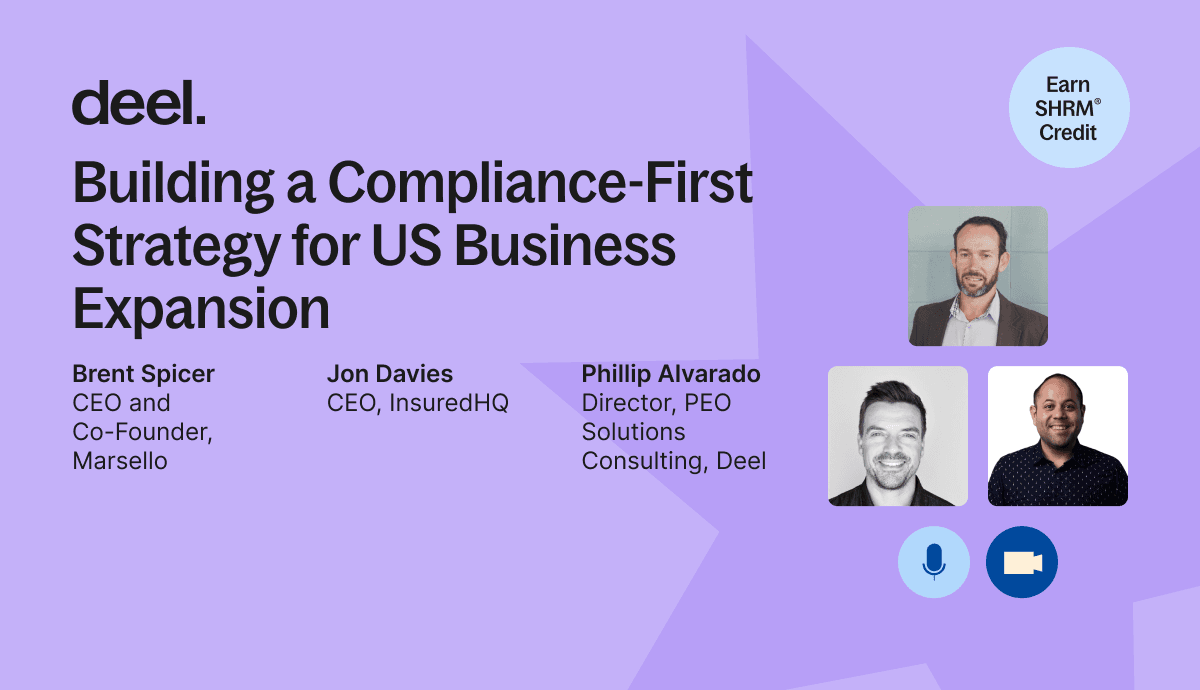
The conversation brought together three unique perspectives:
- Brent Spicer, CEO of Marsello – who moved his young family to the US and experienced the challenges of setting up a US team firsthand.
- Jon Davies, CEO of InsuredHQ – who has helped multiple international startups expand into the US and understands the compliance maze across 50 states.
- Phillip Alvarado, Director of PEO Solutions Consulting at Deel – who has spent over a decade helping global companies navigate US expansion through PEOs.
Watch the webinar replay here.
With these insights, global founders and HR leaders can make informed decisions about using PEOs for US expansion, with a clear view of both the benefits and the risks.
Myth #1: “PEOs are only for companies of a certain size”
Many international founders assume PEOs are designed for Fortune 500 giants, not small startups. Others think they’ve already outgrown the model. In reality, both assumptions miss the mark.
Phillip Alvarado summed it up:
“Some of them go, ‘I’m too small for a PEO,’ and some of them go, ‘I’m too big for a PEO.’ It’s always like... everybody thinks the opposite.”
The truth is that PEOs scale with you. Deel, for instance, works with companies hiring their very first US employee as well as those with thousands of W-2 employees. Jon Davies reinforced how the model has changed:
“It used to be that you couldn't enroll in a PEO until you had at least five staff. But now that’s very different. You can start at one. Absolutely.”
This flexibility is why startups like Tough Leaf and Superfiliate have used PEOs to scale. They didn’t wait until they were “big enough.” Instead, they leaned on a PEO from day one to keep hiring fast and compliant across states.
For global companies entering the US, the lesson is simple: you don’t need to wait until you hit a certain size. A PEO can support you from your first hire and grow alongside your business.

Myth #2: “Using a PEO is too expensive”
Another sticking point for many international businesses is the perception that PEOs are a luxury, something only companies with deep pockets can afford.
Brent Spicer, who expanded his New Zealand–based company Marsello into the US, admitted he was surprised by how affordable it actually was:
“Using a PEO doesn't necessarily need to cost a lot to get all this compliance and stuff done for you. I was quite shocked at how affordable it was.”
By pooling employees across many client companies, PEOs can negotiate healthcare plans and benefits at a scale most startups could never achieve on their own. That translates to lower per-employee costs and access to benefits packages competitive enough to attract top US talent.
Still, Phillip cautioned that not every PEO is transparent in how it prices its services. This risk becomes clear when it’s time to renew employee benefits. Many clients are lured in with attractive initial rates, only to face massive spikes later.
“I can’t tell you how many times I speak with PEO clients that just received their renewal, and they had beautiful rates in the beginning, and then they get a 50% renewal or a 100% renewal at renewal time. No company can sustain a 100% renewal increase for benefits.”
Beyond renewals, hidden fees can creep into contracts. Some PEOs charge a percentage of payroll, which scales unpredictably as salaries increase. Others bury administrative costs in tax line items or add steep termination fees that make switching providers costly.
So, is a PEO expensive? It depends on the provider. The more useful framing is value:
- What compliance risks are you avoiding?
- What benefits of access are you gaining?
- How transparent is the pricing structure?
- How much founder and HR time are you freeing up?
For Brent, the decision was clear. Compared to the costs of setting up payroll, managing compliance, and negotiating benefits independently, a PEO was not only simpler but also cost-effective.
The lesson is that cost alone should never be the deciding factor. Transparency, long-term affordability, and reduced risk are where the real value lies.
Myth #3: “I can do everything in-house instead”
Founders who already have a US entity often assume they don’t need a PEO. After all, if you can hire directly through your own corporation, why outsource HR and compliance?
Brent Spicer wrestled with this exact question:
“We had a US entity... so we could have employed people directly through that and set up payroll and worry about compliance and stuff. But the last thing I wanted to do was learn all about US employment law.”
He also considered using an Employer of Record (EOR). EORs are a great fit for companies that want to expand quickly without establishing a local entity, but for Brent—who already had one in place—the model wasn’t the best cultural fit.
For Brent, the PEO experience was transformative:
“We went down the full PEO route, and it just simplified the process so much... all those numbers and acronyms and stuff—I don’t know any of that. Never had to.”
Jon Davies added another perspective:
“You’re never going to be able to get access to the deals and benefits on your own that you can get through a massive organization like Deel PEO.”
This highlights a second limitation of going in-house. Even if you manage payroll and compliance internally, you’ll likely struggle to negotiate competitive benefits as a small company. Without strong benefits, recruiting top US talent becomes harder, as does retaining them.
Ultimately, trying to do everything in-house can distract from your company’s real mission, resulting in a long tail of operational tasks that eat up founder and leadership bandwidth without contributing to growth. A professional employer organization removes that long tail, letting you focus on what you came to the US to do: build your business.
Learn more: PEO vs EOR: The Difference (And Why It Matters)

Myth #4: “A PEO is just payroll”
Another myth is that a PEO is nothing more than a payroll provider. While payroll is part of the package, it’s only the beginning.
Phillip outlined just how many compliance requirements a PEO helps companies meet:
“PEOs are not just about payroll. We’re talking health insurance, workers’ comp, some states mandating 401(k) offerings, anti-harassment training, state-mandated insurances like New York Paid Family Leave, NY disability insurance. There’s so much insurance. You need an HR partner with your PEO that can inform you on what you need to do or what you don’t know.”
Jon’s story reinforced this breadth of support:
“Navigating how to onboard someone, get them access to benefits, figure out how to get workers’ comp, even how to create an HR manual—that’s the first thing the PEO did for us.”
Employee handbooks are a good example. As Phillip explained, they’re not strictly required by federal law, but they can provide critical legal protection if disputes arise. A good PEO supplies a compliant handbook template covering policies, procedures, and employee expectations that can be adapted to all 50 states, so international founders don’t have to piece one together themselves.
In practice, this means a PEO acts more like a full HR and compliance partner than just a payroll processor. It supports:
- Payroll and tax filings
- Benefits access and administration
- HR compliance training
- Workers’ compensation
- State and municipal insurance mandates
- Risk mitigation and audit preparedness
For companies new to the US, having this all managed in one place is a game-changer. Instead of stitching together payroll software, benefits brokers, compliance consultants, and HR advisors, you get a single accountable partner.
Explore PEO

Myth #5: “We can compare PEOs easily on price alone”
It’s tempting to treat PEOs the way you’d shop for any other business software: line up three providers, compare their prices, and pick the cheapest one. But PEOs don’t work like SaaS tools, where the features are clear and the costs are predictable.
Phillip Alvarado explained why this approach is risky:
“Not every PEO was created equally... There are PEOs that charge a percentage of payroll, and that can get very expensive. There are PEOs that have so many different hidden costs that you never realize you’re paying because they hide them in taxes. There are PEOs that lock you into contracts with crazy termination fees...”
On paper, two PEOs might look identical, but the headline price often hides what really matters. One might tie its fees to payroll percentages, which balloon as your salaries increase. Another might offer attractive rates up front, only to hit you with steep benefit renewals down the line. Others bury admin fees in tax line items or include lock-in clauses that make it expensive to switch providers later.
From a founder’s perspective, this complexity makes comparison nearly impossible. Brent Spicer captured that frustration well:
“When you’re brand new, it’s hard to work out what’s expensive and what’s not.”
That’s why focusing solely on cost is a mistake. A cheaper monthly fee means little if it leaves you exposed to compliance risks, limits your ability to carry over existing benefits, or locks you into a long contract you can’t exit.
Instead, international founders should evaluate PEOs on factors that influence long-term stability:
- Transparency: Is the pricing model clear and upfront, including renewals?
- Flexibility: Can you bring your own benefits or carve out plans if needed?
- Contracts: Are there hidden termination fees or lock-in clauses?
- Support: Will you have access to HR experts who can guide you through compliance?
- Infrastructure: Does the PEO own its systems and expertise, or do they rely on third parties?
Choosing a PEO based only on price is like hiring an employee solely for their salary expectations. It may save you money today, but it could cost you far more tomorrow. The smarter move is to weigh transparency, service quality, and long-term value—the factors that will keep your expansion stable as your US team grows.
Get a closer look at PEO services
Whether you’re hiring US employees for the first time or expanding to more US states, Deel’s PEO solution takes care of the employment work for you. We’re your expert partner for HR, compliance, payroll, and benefits, so your internal team can focus on company growth and strategy.
Most PEOs can’t support international companies with US employees. Deel’s different—we support your workforce globally, all in one platform.
Backed by Deel’s global platform and expert support, we take on the heavy administrative burden across all areas of workforce management:
- Compliance support and answers at the federal, state, and local levels
- Market-leading employee benefits, including exclusive access to Aetna international plans for globally mobile employees
- Payroll and tax administration done for you
- Global HRIS and payroll platform for one consistent and easy user experience
- Risk mitigation and coverage for employment liability insurance, workers’ comp, and employee termination support
- 24/7 employee and admin support, plus a dedicated HR Business Partner as your go-to strategic guide
Explore how Deel’s in-house PEO can help you offer better benefits and stay compliant from day one, or book a demo to see the platform in action.
FAQs
Does a PEO handle Affordable Care Act (ACA) compliance?
Yes. Deel PEO manages ACA reporting and compliance for companies that qualify as an Applicable Large Employer (ALE). For smaller organizations, ACA rules may not apply, but Deel guides you through the requirements so you don’t get caught off guard as you grow.
How does Deel PEO support Family and Medical Leave Act (FMLA) compliance?
FMLA applies only once your US workforce reaches a certain size. Deel PEO tracks those thresholds and ensures your policies align with federal and state laws so you don’t risk penalties or employee disputes when the rules kick in.
Can I join a PEO without offering benefits right away?
Yes. Deel PEO lets you onboard employees without benefits if you’re not ready to implement them. Later, you can add benefits plans as your hiring needs and budget evolve. This flexibility is especially helpful for international startups testing the US market.
What if my company already has benefits in place?
You don’t need to abandon them. Deel can either administer your current plans or let your existing broker continue managing them. That means you can transition smoothly without disrupting employees’ healthcare coverage.
Isn’t a PEO just payroll with some add-ons?
Not at all. A PEO covers payroll, but also compliance, workers’ comp, state-mandated benefits, HR handbooks, harassment training, and more. Think of it as an all-in-one partner that reduces your legal and operational risk, not just a paycheck processor.
Shannon Ongaro is a content marketing manager and trained journalist with over a decade of experience producing content that supports franchisees, small businesses, and global enterprises. Over the years, she’s covered topics such as payroll, HR tech, workplace culture, and more. At Deel, Shannon specializes in thought leadership and global payroll content.