
Global Work Glossary
- Results for ""
Table of Contents
How deepfake detection works
Deepfake detection risks for employers
Key facts
Detect deepfakes and protect your organization with Deel Security
FAQ
What is deepfake detection / video deepfake detection?
Deepfake detection, also called video deepfake detection when specifically applied to video content, is the process of identifying AI-generated or manipulated video, audio, and images that may be used to impersonate real people or create false identities. Security teams and identity verification providers use deepfake detection to identify fraudulent content during hiring and onboarding.
Employers may use deepfake detection during remote interviews to identify potential impersonation attempts, during onboarding to check submitted identity verification videos, or later in employment when re-verifying workers for sensitive system access. Some tools can analyze video and audio in real time, helping security and HR teams identify suspicious activity while a verification session is taking place.
To better detect identity fraud during remote interviews and onboarding, organizations may choose to combine deepfake detection with face matching and liveness detection.
How deepfake detection works
Detection systems analyze video, audio, and images for signs that content has been generated or manipulated using AI. The process might include assessing unusual facial movements, mismatches between lip movements and speech, inconsistencies in lighting or facial features, and patterns in audio that suggest a voice has been artificially generated.
Deepfake detection risks for employers
Fraudsters may use AI-generated video or audio to impersonate job candidates during remote interviews or identity verification checks. If the manipulation goes undetected, an employer could hire someone under a false identity (candidate impersonation fraud) or fail to recognize that the person completing the interview is different from the person who starts work.
Employers may then face risks such as unauthorized access to company systems, fraudulent payroll payments, and potential compliance issues if worker identities have not been properly verified.
Key facts
Here are some key facts about deepfake detection, the risks it poses to employers, and how organizations can respond.
A deepfake is AI-generated video, audio, or image content designed to simulate a real person's appearance or voice. Detection systems look for the technical traces that generative models leave in the media.
Deepfake attacks in hiring can involve AI-assisted video interviews, cloned voices on a phone screen, or manipulated identity documents. Voice cloning and video spoofing are two techniques that deepfake detection tools are built to catch.
Organizations may get better results by layering controls: automated media analysis, liveness checks, and human review together might reduce the chance that synthetic content passes undetected.
Attackers might use deepfakes to bypass access controls, impersonate employees on video calls, or defeat re-verification steps during employment.
HR teams may benefit from a clear escalation path. When a detection system flags potentially synthetic media, HR should follow a documented review process and record every decision.
Detect deepfakes and protect your organization with Deel Security
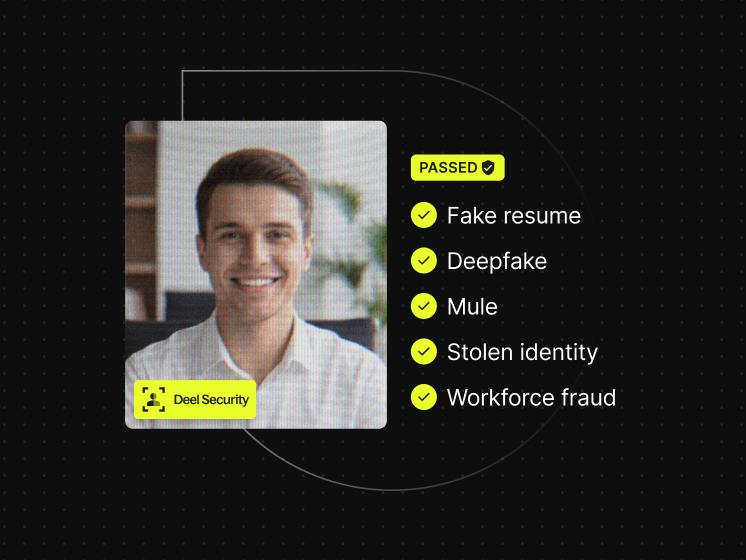
Deel Security helps businesses detect deepfakes, fake candidates, and impersonation attempts throughout hiring, onboarding, and ongoing employment.
Deel Security works with your existing applicant tracking system (ATS), bringing identity fraud alerts into hiring workflows for human review. This helps HR and security teams investigate potential impersonation attempts and reduce the risk of fraudulent hires.
Book a demo to see how Deel Security helps protect your business from deepfakes and identity fraud.
Deel Security
Hire real people, keep fraud out from hiring to offboarding
FAQ
Can deepfake detection catch all synthetic media?
No detection system catches every deepfake. Generative technology evolves quickly, and teams may get more reliable coverage by layering detection with liveness checks, biometric verification, and human review.
Is deepfake detection only relevant during job interviews?
Deepfake detection applies to any identity-related interaction where synthetic media could be substituted for authentic content, including voice calls, identity document submission, and live video checks during onboarding or access reviews.
Who owns deepfake detection in a hiring process?
Responsibility often sits with the team that owns the identity verification and background screening workflow. In practice, that's HR working alongside security or Information Technology (IT), supported by an identity verification provider that runs the technical detection.
What should HR do when a deepfake detection check returns a flag?
A flag is a signal to review, not an automatic disqualification. HR should follow a documented escalation process, involve a security or compliance reviewer, and record the decision before proceeding or withdrawing the offer.
How does deepfake detection differ from liveness detection?
Liveness detection confirms that the person completing a check is physically present, not a photo, video replay, or mask. Deepfake detection is broader: it identifies AI-generated synthetic media across video, audio, and images, not only during a live biometric check. The two controls complement each other.
This entry is provided for informational purposes only and does not substitute for legal, security, or compliance advice from qualified advisers.