
Global Work Glossary
- Results for ""
Table of Contents
How identity fraud works
Key facts
Identity fraud vs. synthetic identity fraud
Protect your business from identity fraud with Deel Security
FAQ
What is identity fraud?
Identity fraud is the unauthorized use of another person's identity to obtain employment, financial benefits, or access to systems and services. It differs from identity theft: identity theft is the act of obtaining personal information without consent, while fraud is the act of using that information to deceive others. Employers, financial institutions, and government agencies all face identity fraud risks across hiring, payroll, and access management.
How identity fraud works
Identity fraudsters use stolen, forged, or fabricated credentials to impersonate real people or create fake identities to secure jobs, receive payments, or gain unauthorized access to company systems. Common methods include presenting altered identity documents, using data stolen in a breach, and generating convincing fake personas or deepfake content with AI tools. These tactics often target onboarding and application workflows, where organizations verify high volumes of documents and often rely on automated screening.
Once a fraudulent identity passes initial checks, it can persist in payroll systems or access directories until a manual audit or anomaly triggers a review. The consequences for employers include unauthorized payroll access, misrepresented qualifications, and exposure to regulatory liability if workforce records do not reflect the actual identities of the people employed. That's why checking identities throughout the worker lifecycle, not just during hiring, is important for detecting fraud.
Key facts
Here are some key things to know about identity fraud, how it affects employers, and how organizations can protect themselves:
Identity fraud involves using someone else's personal information without permission to deceive others, while identity theft involves obtaining that information.
Employers face identity fraud risks during hiring, onboarding, and after hiring, particularly when managing remote and global workforces.
Common threats include forged identity documents, synthetic identities, account takeover, and AI-generated deepfakes.
Identity verification, liveness detection, and face matching help employers check that someone is who they claim to be.
Fraudsters may attempt to impersonate employees after hiring to access sensitive information, company systems, or payroll payments.
Organizations using biometric data for identity verification must follow applicable privacy and data protection laws.
Identity fraud vs. synthetic identity fraud
Identity fraud can take different forms, depending on whether someone impersonates a real person, creates a fake identity, or takes over an existing account.
Synthetic identity fraud is a subset of identity fraud that combines real and fabricated data to create a persona that does not correspond to any single existing person. Classic identity fraud impersonates a real individual, while synthetic fraud constructs a new one. Both types evade simple document checks, but synthetic identities are harder to detect because no single victim exists to report the fraud.
Account takeover is a related but distinct pattern, where an attacker seizes control of a legitimate existing account rather than creating a new fraudulent identity. All three patterns can intersect in workforce and payroll systems. Teams that combine document checks, biometric controls, and ongoing monitoring reduce exposure to all three.
Protect your business from identity fraud with Deel Security
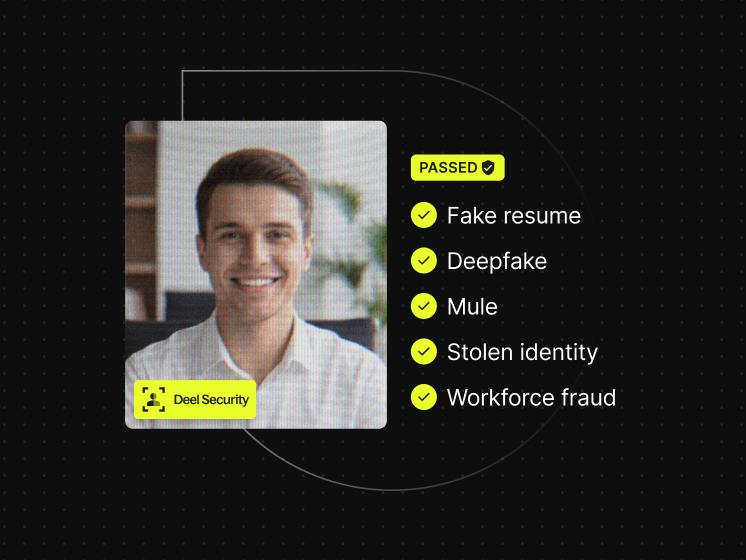
Identity fraud can happen at any stage, from job applications and interviews to onboarding and beyond. Deel Security helps you detect fake identities, forged documents, and impersonation attempts with AI-powered fraud detection and identity verification throughout the worker lifecycle.
From screening candidates before hiring to verifying identities after onboarding, Deel Security helps keep fraudulent workers out and your business protected.
Ready to prevent identity fraud across your workforce? Book a demo to learn more.
Deel Security
Hire real people, keep fraud out from hiring to offboarding
FAQ
What is the difference between identity fraud and identity theft?
Identity theft is the act of obtaining personal information without consent, through methods such as phishing, data breaches, or document theft. The two acts carry separate legal consequences in most jurisdictions, even when a single actor commits both.
What types of identity fraud do employers commonly face?
Employers encounter document fraud, where a candidate presents forged or stolen identity papers. They also face synthetic identity fraud, where real and fabricated details combine to create a persona, and account takeover, where an attacker gains control of an existing employee account. AI-generated deepfake content has also emerged as a tactic for deceiving video-based identity checks.
How can organizations reduce their exposure to identity fraud?
Thorough background checks, automated identity verification at onboarding, and biometric controls such as liveness detection all help reduce exposure. Periodic re-verification and access-management reviews catch fraudulent identities that slipped through initial checks. Teams that apply these controls consistently across all geographies lower the risk that cross-border hiring creates.
Which laws govern identity fraud?
The applicable law varies by jurisdiction. In the United States, the FTC provides guidance for businesses on preventing and responding to identity fraud, and federal criminal law treats the unauthorized use of another person's identity as a punishable offense. The United Kingdom applies fraud and identity-document legislation, with the Information Commissioner's Office (ICO) overseeing data-protection obligations connected to identity processing.
The applicable authority depends on each jurisdiction where the organization operates.
This entry provides general information about identity fraud and is not a substitute for advice from qualified legal advisers.