
Guide
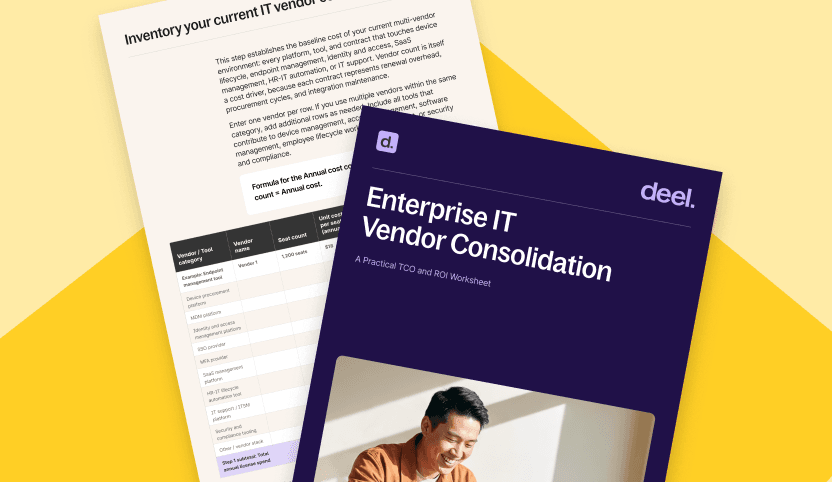
Enterprise IT Vendor Consolidation: A Practical TCO and ROI Worksheet
IT & device management
Get the resource for free
Most enterprise IT teams know they're paying for too many tools. What they don't know is the full cost of maintaining them.
Vendor sprawl creates more than duplicate software spend. It increases IT workload, slows employee lifecycle processes, fragments security and compliance, and makes audits harder to manage. Those costs rarely appear in a software budget, making it difficult to build a compelling business case for consolidation.
This worksheet guides you on how to calculate the Total Cost of Ownership (TCO) of your current IT environment and estimate the potential ROI of moving to a consolidated platform. Using your own data, you'll quantify both the visible and hidden costs of your current vendor stack and produce financial metrics you can use to support investment decisions.
How this worksheet helps
Use this worksheet to:
Calculate the true cost of your current IT environment, including software, labor, operational failures, and SaaS waste
Quantify the financial impact of consolidating multiple IT vendors into a single platform
Build a data-backed business case with TCO, ROI, payback period, and projected annual savings
Create finance-ready calculations using your organization's own operational and cost data
What's inside
This practical worksheet walks you through every component of an enterprise IT cost analysis, with formulas, editable tables, and guidance throughout.
Inside, you'll find:
A five-step framework for calculating the total cost of your current IT environment
Worksheets covering software licensing, IT labor, operational failures, SaaS waste, and consolidation costs
Built-in formulas to calculate TCO, annual savings, ROI, payback period, and percentage cost reduction
Guidance on validating your assumptions before presenting your business case to finance or executive leadership
An editable spreadsheet template to complete the calculations using your own data
Who this worksheet is for
This worksheet is designed for enterprise IT leaders, procurement teams, finance stakeholders, and operations leaders evaluating vendor consolidation initiatives.
It's especially useful if you're:
Managing multiple vendors across devices, identity, SaaS management, IT support, and employee lifecycle operations
Preparing a business case to justify platform consolidation or IT transformation initiatives
Looking to reduce software costs, administrative overhead, and duplicated technology investments
Trying to quantify operational inefficiencies that aren't reflected in software licensing costs alone
Comparing the financial impact of maintaining multiple point solutions versus adopting a unified platform
Whether you're planning a consolidation project, preparing for a budget cycle, or evaluating new IT platforms, this worksheet gives you a structured way to measure the financial impact before making a decision.
Reduce IT costs with Deel IT
This worksheet helps you understand the financial impact of vendor sprawl. Deel IT helps you eliminate it.
Deel IT replaces disconnected point solutions with one platform for devices, access, applications, lifecycle management, and IT support, reducing administrative overhead while improving visibility, security, and operational efficiency.
With Deel IT, you can:
Consolidate device management, application management, access, lifecycle workflows, and IT support into a single platform
Automate onboarding, offboarding, and role changes through HRIS and identity provider integrations
Reduce manual administration with built-in endpoint management, compliance controls, and automated policy enforcement
Optimize software licensing with centralized application visibility and access management
Simplify global device procurement, repairs, recovery, and lifecycle management through one provider
Support employees worldwide with 24/7 global IT support and standardized operational workflows
Book a demo to see how Deel IT helps organizations reduce costs by consolidating fragmented IT operations into one connected platform.