
Report
EOR vs Entity Decision Tree: A Framework for Smarter Global Expansion Choices
Employer of record
Global expansion
Global hiring
Get the resource for free
Key takeaways
- Deciding how to expand and hire globally can be complex. Choosing between an Employer of Record (EOR), setting up an entity, or using a hybrid approach isn’t always straightforward—especially when teams have different priorities.
- The best route depends on your goals, timelines, and compliance needs. This decision tree helps you evaluate factors like speed, cost, risk, market strategy, and long-term presence so you can identify the model that fits your situation.
- Deel is uniquely positioned to guide your global growth. With support in 150+ countries, Deel enables you to hire, pay, and manage teams through both EOR and entity models—and transition seamlessly as your business evolves.
Overview
Expanding into new countries is exciting, but deciding how to hire compliantly can be complex. Should you partner with an Employer of Record (EOR) to launch quickly, or invest in establishing an entity for long-term operations?
This framework walks you through every factor that matters—from time to hire and payroll taxes to compliance requirements and administrative overhead—so you can make an informed choice.
Built on Deel’s experience helping thousands of companies scale globally, the EOR vs Entity Decision Tree helps you evaluate both models side by side and choose the structure that best supports your global hiring goals.
Who will benefit from this framework?
- HR and People leaders evaluating the best global hiring structure
- Finance and Operations teams managing budgets, payroll, and compliance
- Founders, Legal, and Expansion leads planning long-term international presence
Whether you’re hiring one employee abroad or building a distributed global workforce, this framework helps you balance speed, compliance, and control—and understand when each model makes sense.
What’s included
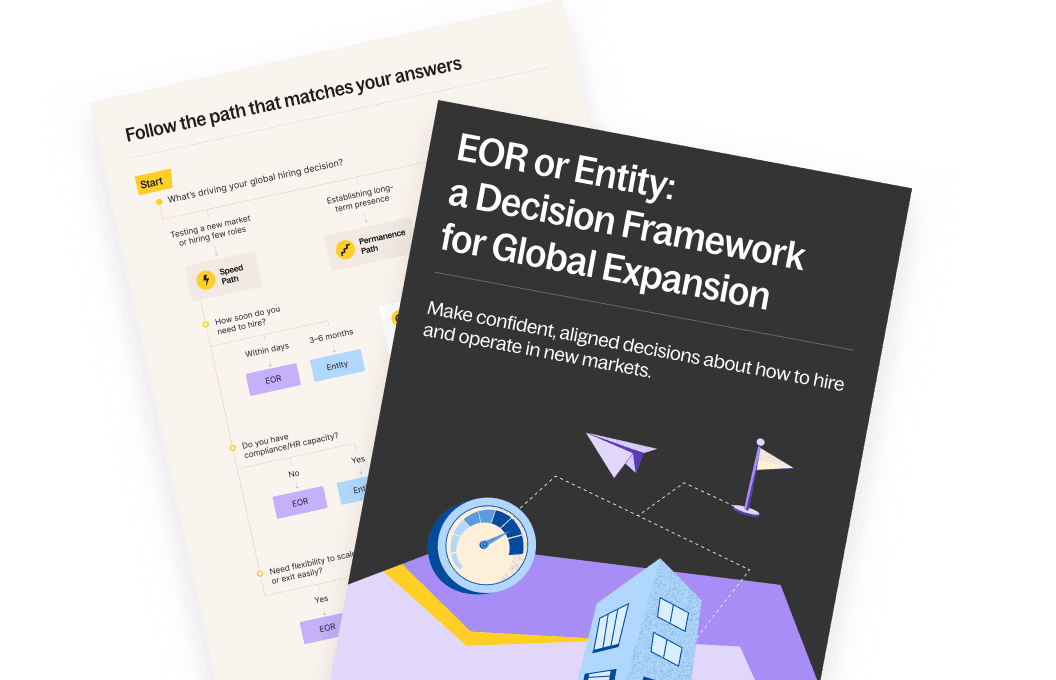
- A decision tree that guides you step by step through key expansion questions
- Educational notes explaining EOR vs Entity tradeoffs by market
- Comparison tables covering time to hire, setup costs, payroll benefits, compliance requirements, and administrative overhead
- Expert insights on when to use a hybrid approach—combining EOR services in some markets with entity setup in others
More resources
FAQs
What’s the difference between an Employer of Record (EOR) and setting up an entity?
An Employer of Record (EOR) is a third-party legal employer that allows you to hire talent abroad without setting up a local entity. The EOR handles employment contracts, payroll benefits, and compliance requirements, often charging a monthly fee per employee.
By contrast, when you set up an entity, you assume full responsibility for employment, payroll taxes, and compliance — but entities require more time, cost, and ongoing management.
When should I use an EOR versus establishing a local entity?
Use an EOR when you need to hire globally fast, test new markets, or avoid a long-term commitment. It’s ideal for small teams or short-term market entry.
Choose to establish a local entity when you have a long-term presence, plan to hire many employees, or want full responsibility over operations. Some countries may also require an entity if you plan to obtain local licensing, introduce local branding, or set up local offices or facilities, as well as if you intend to invoice locally or maintain a fixed business presence.
Can I combine both EOR and Entity models?
Yes — many companies use a hybrid approach. You might hire through EOR services in emerging or complex markets while setting up a local entity in larger, strategic countries. Deel helps you manage both models on one platform, ensuring consistent payroll benefits, employment contracts, and compliance across all countries.
What are the costs associated with each option?
EOR models charge a predictable monthly fee per employee, covering payroll, benefits, and compliance management.
Entity setup costs vary depending on the country, involving registration, legal filings, and ongoing payroll taxes. With Deel, you can compare both costs before committing and even transition from EOR to Entity as your footprint grows.
How does Deel help with global hiring and compliance?
Deel simplifies global employment by combining EOR and Entity Setup under one platform. Whether you’re setting up a local entity, hiring employees directly, or using EOR and entity models together, Deel helps you stay compliant with employment contracts, payroll taxes, and local labor laws—no matter the country.